
BuddhistCatholicContemplativeEvangelicalGeneral ChristianHinduJewishLatter-day SaintMuslimNew VisionsProgressive Christian
Beliefs
- Buddhist
- Catholic
- Contemplative
- Evangelical
- General Christian
- Hindu
- Jewish
- Latter-day Saint
- More Voices
- Muslim
- New Visions
- Pagan
- Progressive Christian
Topics
- Religion News
- Food and Religion
- Sports and Religion
- Religious Art
- Religious Music and Entertainment
- Religious Events
- History and Religion
- Style and Religion
- Politics and Religion
- Women in Religion
- Recreation Outdoors and Religion
- Business Finance and Religion
- Careers Workplace and Religion
- Education and Religion
- Family Parenting and Religion
- Health Fitness and Religion
- Home and Religion
- Relationships and Religion
- Technology and Religion
- Travel and Religion
Columnists
- Buddhist Columnists
- Business Finance and Religion Columnists
- Careers Workplace and Religion Columnists
- Catholic Columnists
- Contemplative Columnists
- Education and Religion Columnists
- Evangelists Columnists
- Family Parenting and Religion Columnists
- General Christian Columnists
- Health Fitness and Religion Columnists
- Hindu Columnists
- History and Religion Columnists
- Home and Religion Columnists
- Jewish Columnists
- More Voices Columnists
- Latter Day Columnists
- Muslim Columnists
- New Visions Columnists
- Nonreligious Columnists
- Pagan Columnists
- Politics and Religion Columnists
- Progressive Columnists
- Recreation Outdoors and Religion Columnists
- Relationships and Religion Columnists
- Religion News Columnists
- Religious Art Columnists
- Religious Events Columnists
- Religious Music and Entertainment Columnists
- Sports and Religion Columnists
- Style and Religion Columnists
- Technology and Religion Columnists
- Travel and Religion Columnists
- Women in Religion Columnists
Resource Library
- 2026 Calendar
- Library of World Religions
- The 100 Most Holy Places on Earth
- Patheos Answers
- Podcasts
- Videos
- Faith Leaders Database
- Anglican Episcopalian
- Bahai
- Baptist
- Buddhism
- Christianity
- Confucianism
- Eastern Orthodoxy
- Hinduism
- Holiness and Pentecostal
- ISKCON
- Islam
- Judaism
- Lutheran
- Methodist
- The Church of Jesus Christ of Latter-day Saints
- New Age
- Paganism
- Presbytarian and Reformed
- Protestantism
- Religion Behind the Scenes
- Roman Catholic
- Scientology
- Shia Islam
- Sikhism
- Sufism
- Sunni Islam
- Taoism
- Zen
- See all religions
Research Tools
 Ad-Free & Subscriber Log-In Subscription Support
Ad-Free & Subscriber Log-In Subscription Support
Follow Patheos 

- Trending:
- Forgiveness
- |
- Marriage
- |
- Consciousness
- |
- Death Penalty
- |
- Election
- |
- Halloween
 Mercy Not Sacrifice
-
More
- Home
- Progressive Christian
- Detoxify Christian lingo #1: Salvation
Detoxify Christian lingo #1: Salvation
Last updated on: June 22, 2016 at 11:12 am by Morgan Guyton
Detoxify Christian lingo #1: Salvation 2016-06-22T11:12:05-05:00 Morgan Guyton
Patheos Explore the world's faith through different perspectives on religion and spirituality! Patheos has the views of the prevalent religions and spiritualities of the world.
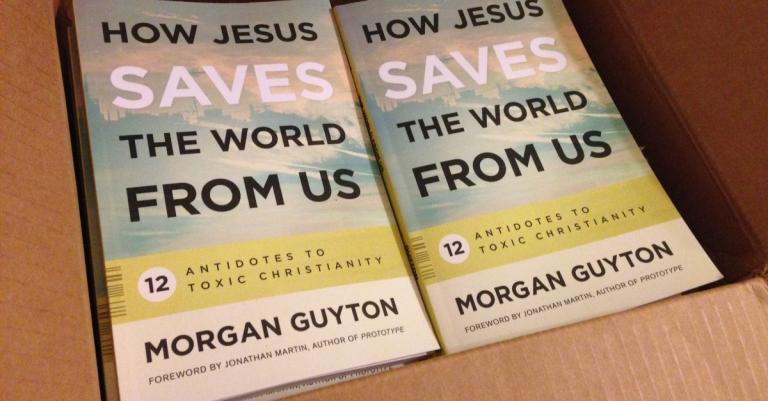
I’ve decided to write a series of blog posts focusing on some of the Christian lingo that has become loaded and toxic in our age of culture war. The basic premise of my book How Jesus Saves the World From Us is that Christians fundamentally need to reorient the way we talk about salvation. As I recently blogged, I don’t dispute the existence of hell. But to package salvation as afterlife insurance means tailoring Christian theology to fit the sensibilities of white middle class anxiety. The salvation we read about in the Bible is actually far richer than the tacky door-to-door sales product that toxic Christianity has developed.
My primary text for understanding what Christian salvation looks like is the story of Peter’s first sermon in Acts 2. 3000 people were converted to Christianity upon hearing Peter preach. I don’t think even Billy Graham was able to pull off numbers like that. So what did Peter say that was so compelling? And is there a way to replicate that in our context today? What’s noticeably absent from Peter’s sermon is any mention of hell. Peter’s sermon is utterly unconcerned with the afterlife. His focus is on the legitimacy of Jesus as Israel’s messiah.
The clincher of Peter’s sermon is when he confronts his fellow Israelites with the awful truth that they crucified their messiah: “Therefore let the entire house of Israel know with certainty that God has made him both Lord and Messiah, this Jesus whom you crucified” (Acts 2:36). The text says that the listeners were “cut to the heart” (v. 37) by Peter’s words, which was what motivated 3000 of them to be baptized. After the initial baptism, the text summarizes Peter’s continued exhortation for his listeners: “Save yourselves from this corrupt generation” (v. 40).
This phrase of course reveals how the Biblical text is messier than our Christian doctrine wants it to be. Every good Augustinian Christian knows that we cannot save ourselves because that would be works-righteousness. But the larger point is that what we are saved from is corruption. This needs to be the foundation of our understanding of salvation. Whatever we say about the afterlife is secondary to that. In other words, hell means persisting eternally in the corruption of sin which keeps us from experiencing the incredible belonging of God’s love. Heaven means being liberated from that corruption so that we are able to immerse ourselves fully in communion with God and humanity.
Our narrative of salvation becomes toxic when we act as if the problem is not the corruption of sin itself but God’s punishment for sin. When Romans 1:18 says that “the wrath of God is revealed from heaven against all ungodliness and wickedness of those who by their wickedness suppress the truth,” it then proceeds to talk about the corruption of sin. If wrath referred to a punishment other than the direct natural consequences of sin’s corruption, then we could expect Romans 1 to talk about natural disasters like tornadoes and collapsed bridges by which God punished people for sin. What God’s wrath looks like, according to Romans 1:29, is people who are “filled with every kind of wickedness, evil, covetousness, malice.” In other words, that’s the corruption we are saved from.
Of course, we shouldn’t define salvation purely in the negative. What do peoples’ lives look like after they’ve been saved? Acts 2 again gives us the purest possible answer.
Awe came upon everyone, because many wonders and signs were being done by the apostles. All who believed were together and had all things in common; they would sell their possessions and goods and distribute the proceeds to all, as any had need. Day by day, as they spent much time together in the temple, they broke bread at home and ate their food with glad and generous hearts, praising God and having the goodwill of all the people. And day by day the Lord added to their number those who were being saved. [Acts 2:43-47]
Christian salvation is authentic community built around the wonder and radical trust of pure worship. That’s what heaven looks like. People who are “being saved” are inspired, grateful, and generous to the radical degree of “having all things in common.” They treat everyone outside their community with such genuine kindness that they “have the goodwill of all the people.” Imagine if Acts 2 were what church looked like today. Indeed, there are pockets of nearly every church today that look like this, but too often, it happens in spite of our theology rather than as a natural outgrowth from it.
The grammar of Acts 2 is critical. Salvation is being saved. It’s present tense and it’s ongoing. It’s a process of being detoxified as the Holy Spirit inspires us through the synergy of awestruck, grateful community. In Wesleyan theology, we talk about salvation as the combination of justification (putting our trust in Jesus’ sacrifice for our sins) and sanctification (allowing the Holy Spirit to transform our character). Some people understand justification as an instantaneous transformation and sanctification as the transformative process that follows. My understanding is that our increasing trust in Christ and our increasing transformation by the Holy Spirit are dynamic, mutually reinforcing processes that never stop.
Acts 2 says nothing about how the initial Jerusalem church understood the relationship between Jesus’ cross and their sins. What’s clear is that they trusted God radically enough to sell their possessions and share all things in common. So I would say that Christian salvation isn’t contingent upon having a perfect articulation of what Jesus has done for me. Our grasp of orthodox Christian doctrine is relevant insofar as it increases the trust that allows for transformation.
My recent spiritual journey has exposed me to the 12 step recovery community where trust and transformation occur independent of orthodox Christian doctrine. I haven’t yet figured out what to make of it. But I do think something is lost in building a community around a formula rather than a story and building an identity around the disease I’m trying to avoid rather than a messiah I’m trying to emulate. And yet it works, often way more powerfully than discipleship in communities with pristine, orthodox Christian doctrine. A formula that works is better than a story that has been corrupted by anxious souls and market forces. Regardless, I will never abandon the story in which my savior has destroyed my corruption on his cross and triumphed over it in his resurrection.
I believe that the most potent metaphor for spiritual transformation is to be personally crucified and resurrected with the creator of the universe so that I can be part of the new heaven and new earth that is replacing the toxic world I helped to corrupt. Salvation is citizenship in the new world that is being born whatever that will eventually look like after our mortal bodies have returned to the dust of the earth.
Subscribe to our podcast Crackers and Grape Juice!
Like my author page on Facebook!
Previous Post

June 21, 2016
How to taste a waterfall
Next Post

June 23, 2016 My quarrel with N.T. Wright about sex
Browse Our Archives
Select a Category Advent Beauty Will Save the World Bible Big Picture: Ephesians Bloggers Book Christian salvation and the Beautitudes Culture Daily Office Danceable Homiletics Deadly Sins Deep Roots: Genesis Devotions Dominican Republic May 2011 El Principio Misericordia (The Mercy Principle) Five verses God tattooed on my heart Fundraising FutureGospel Good Biblical Words Henri Nouwen Interview Jennings' Christian Imagination Jesus inside the beltway Jesus Is My Candidate Jesus vs the Pharisees Jesus vs. Plato Journey to Eternity Looking Back on 2012 Love Actually Monday Merton Monday Merton Music Occupy the manger On Earth As It Is In Heaven Original Sin Podcast Poetry Politics Prayer Psalm 119 Radical Jesus 101 Reviews Sermon on the Mount Sermons Spanish Bible study Special Series Spiritual but not religious Synchroblog Theology Things that made me think Thomas a Kempis Ugliness Into Beauty Uncategorized Viaje Dominicano 2013 Walking in the Valley (Lent) Welcome: It's More than a Mat Wild Goose 2013 Wrestling
Select a Month March 2022 January 2022 December 2021 September 2021 April 2021 September 2020 August 2020 July 2020 June 2020 May 2020 April 2020 March 2020 February 2020 January 2020 December 2019 November 2019 October 2019 September 2019 August 2019 June 2019 May 2019 April 2019 March 2019 February 2019 January 2019 December 2018 November 2018 October 2018 September 2018 August 2018 July 2018 June 2018 May 2018 April 2018 March 2018 February 2018 January 2018 December 2017 November 2017 October 2017 September 2017 August 2017 July 2017 June 2017 May 2017 April 2017 March 2017 February 2017 January 2017 December 2016 November 2016 October 2016 September 2016 August 2016 July 2016 June 2016 May 2016 April 2016 March 2016 February 2016 January 2016 December 2015 November 2015 October 2015 September 2015 August 2015 July 2015 June 2015 May 2015 April 2015 February 2015 January 2015 December 2014 November 2014 October 2014 September 2014 August 2014 July 2014 June 2014 May 2014 April 2014 March 2014 February 2014 January 2014 December 2013 November 2013 October 2013 September 2013 August 2013 July 2013 June 2013 May 2013 April 2013 March 2013 February 2013 January 2013 December 2012 November 2012 October 2012 September 2012 August 2012 July 2012 June 2012 May 2012 April 2012 February 2012 January 2012 December 2011 November 2011 October 2011 September 2011 August 2011 July 2011 June 2011 May 2011
Follow Us!
TAKE THE
Religious Wisdom Quiz
Who became king after David and built the first Temple in Jerusalem?
Select your answer to see how you score.
Rehoboam Adonijah Solomon Absalom
Related posts from Mercy Not Sacrifice


Donald Trump And The Exorcism Of White America

When God's A Cop, Every Cop Is God

"All People Are Holy": The Theology Of Alexandria...
TRENDING AT PATHEOS Progressive Christian

What Being a Modern-Day Apostle Means to Me
In my last column, I discussed the ins and outs of modern-day...

Did Ancient China Once Worship the God of...
Across human history, a common thread weaves through the origins of the...

Love Your Neighbor – Including Earth-Kin: Lev. 19,...
God’s command to love your neighbor means acting in an ethical and...

Lead a Church Study of “Jesus and Lao...
Guest writer Jack Thomas (The Irreverent Reverend) reflects on leading his church...

Pastoral Wisdom for Responding to Sermon Pushback
Getting sermon pushback on your social justice sermon? Learn practical, Proverbs-based strategies...

Principles for Understanding the Apostolic Ministry Today
Whenever people discover that my formal ministry title is "apostle," as in...
view all Progressive Christian blogs
Ad-Free & Subscriber Log-In Subscription Support
- About Us
- 2026 Calendar
- Videos
- Podcasts
- Library of World Religions
- Faith In Media Tracker
- Advertise With Us
- Write for Us
- Privacy Policy
- Terms of Service
- Do Not Sell My Data
- Contact Us
- Radiant Digital
- Manage Newsletter Subscriptions
- Unsubscribe From Notifications
- Sitemap
Copyright 2008-2026, Patheos. All rights reserved.
Subscription Support Ad-Free & Subscriber Log-In
Follow Patheos