
BuddhistCatholicContemplativeEvangelicalGeneral ChristianHinduJewishLatter-day SaintMuslimNew VisionsProgressive Christian
Beliefs
- Buddhist
- Catholic
- Contemplative
- Evangelical
- General Christian
- Hindu
- Jewish
- Latter-day Saint
- More Voices
- Muslim
- New Visions
- Pagan
- Progressive Christian
Topics
- Religion News
- Food and Religion
- Sports and Religion
- Religious Art
- Religious Music and Entertainment
- Religious Events
- History and Religion
- Style and Religion
- Politics and Religion
- Women in Religion
- Recreation Outdoors and Religion
- Business Finance and Religion
- Careers Workplace and Religion
- Education and Religion
- Family Parenting and Religion
- Health Fitness and Religion
- Home and Religion
- Relationships and Religion
- Technology and Religion
- Travel and Religion
Columnists
- Buddhist Columnists
- Business Finance and Religion Columnists
- Careers Workplace and Religion Columnists
- Catholic Columnists
- Contemplative Columnists
- Education and Religion Columnists
- Evangelists Columnists
- Family Parenting and Religion Columnists
- General Christian Columnists
- Health Fitness and Religion Columnists
- Hindu Columnists
- History and Religion Columnists
- Home and Religion Columnists
- Jewish Columnists
- More Voices Columnists
- Latter Day Columnists
- Muslim Columnists
- New Visions Columnists
- Nonreligious Columnists
- Pagan Columnists
- Politics and Religion Columnists
- Progressive Columnists
- Recreation Outdoors and Religion Columnists
- Relationships and Religion Columnists
- Religion News Columnists
- Religious Art Columnists
- Religious Events Columnists
- Religious Music and Entertainment Columnists
- Sports and Religion Columnists
- Style and Religion Columnists
- Technology and Religion Columnists
- Travel and Religion Columnists
- Women in Religion Columnists
Resource Library
- 2026 Calendar
- Library of World Religions
- The 100 Most Holy Places on Earth
- Patheos Answers
- Podcasts
- Videos
- Faith Leaders Database
- Anglican Episcopalian
- Bahai
- Baptist
- Buddhism
- Christianity
- Confucianism
- Eastern Orthodoxy
- Hinduism
- Holiness and Pentecostal
- ISKCON
- Islam
- Judaism
- Lutheran
- Methodist
- The Church of Jesus Christ of Latter-day Saints
- New Age
- Paganism
- Presbytarian and Reformed
- Protestantism
- Religion Behind the Scenes
- Roman Catholic
- Scientology
- Shia Islam
- Sikhism
- Sufism
- Sunni Islam
- Taoism
- Zen
- See all religions
Research Tools
 Ad-Free & Subscriber Log-In Subscription Support
Follow Patheos 

- Trending:
- Advent
- |
- Forgiveness
- |
- Thanksgiving
- |
- Election
- |
- Seasonal Holidays
- |
- Marriage
 Mercy Not Sacrifice
-
More
- Home
- Progressive Christian
- What Romans 1 teaches about sin and why it ironically exonerates LGBT identity
What Romans 1 teaches about sin and why it ironically exonerates LGBT identity
Last updated on: May 6, 2016 at 7:04 am by Morgan Guyton
What Romans 1 teaches about sin and why it ironically exonerates LGBT identity 2016-05-06T07:04:33-05:00 Morgan Guyton
Patheos Explore the world's faith through different perspectives on religion and spirituality! Patheos has the views of the prevalent religions and spiritualities of the world.
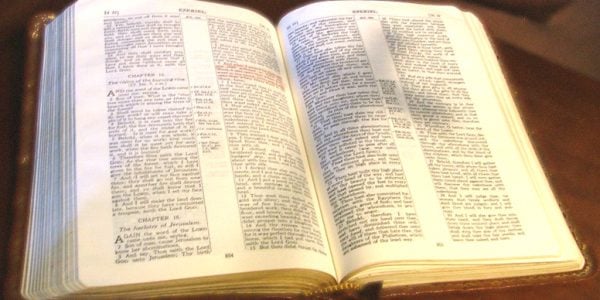
“Bible with Cross Shadow,” David Campbell, Flickr C.C.
Romans 1:18-32 is one of the most important passages in scripture, because it describes the nature of sin. Specifically, it shows how idolatry is the foundation for injustice, and moreover, how sin always cascades into deeper forms of corruption. This passage is one of the most prominent biblical proof-texts against homosexuality, but the mention of same-sex practices is incidental to Paul’s larger points in the passage. Ironically, if we recognize the larger points that Paul is making about sin, then this passage actually becomes the basis for exonerating LGBT identity.
Yesterday when I was contemplating this passage, I noticed the way that it completely dismantles two critical toxicities in mainstream pop evangelical theology.
1) Original sin is social, not biological
One of the most nihilistic, toxic teachings of pop Christianity is that people are born wicked. This teaching originated with Augustine after he read a Latin mistranslation of Romans 5:12. Augustine thought that Paul had written that all humanity had sinned with Adam as primordial seed within his semen. For years, the Catholic church taught that original sin was literally passed onto babies through the semen of the father. Thus, Mary had to receive an immaculate conception and have a virgin birth so that Jesus could be born without original sin.
When you teach that original sin is biological, then anything you don’t want to accept about human genetics can be attributed to “fallen creation.” Adam’s sin is made into the cause of people being born with same-sex attraction or gender dysphoria. God didn’t create them that way; sin did.
But that’s not the story that Romans 1 tells. Paul insists that humanity is “without excuse” (v. 20) since “what can be known about God is plain to them” (v. 19). He could not make this statement if he believed that we were born with a “fallen nature” that makes us unable to see and worship God. Rather, we are corrupted by being born into a world that has “exchanged the glory of the immortal God for images resembling a mortal human being or birds or four-footed animals or reptiles” (v. 23), i.e. a world awash in a sea of idolatry.
Idolatry means to “worship and serve creation rather than the Creator” (v. 25), whether our idols are actual physical statues or abstractions like money, success, patriotism, political correctness, etc. It is the idolatry of our world that prevents us from finding our joy in the beauty and comfort of God. Without the spiritual security of that divine foundation, we are handed over to “degrading passions” (v. 26).
Paul uses the visceral image of the orgy practices of Roman society to capture the degrading passions to which humanity resorts when trapped in a world of idolatry. These orgy practices include, but are not limited to, same-gendered sex. The key question is whether the same-gendered aspect of the orgy practices is itself the problem or if it’s the whole thing which includes adultery, promiscuity, etc.
The basic truth captured by Romans 1 is the way that our desires occur in a skewed frame of reference because of the omnipresence of idolatry. This is particularly true in a world where capitalism has manipulated us from birth to want what we don’t naturally want so that somebody can make money off of us. We’ve been socialized to think of identity in consumerist terms. If I buy this music, this fashion, this brand of beer, that defines who I am as a person.
This skewed frame of reference for desire is also true about our sexual socialization. Social factors like the widespread use of sex in marketing over the past several decades and the rise of the internet porn industry has left people in our culture with a very confused and unnatural sense of sexuality. When sex becomes just another consumable object like food, then it loses its power as a means of establishing spiritual intimacy between two people.
Now, sexual traditionalists would argue at this point that LGBT identity is just a fad created by the market, an unnatural desire formed by our skewed frame of reference. Plenty of scientific research suggests this is not the case. Ultimately, I take the stance that I cannot ever know and should not speculate whether someone else’s sexual identity is authentically intrinsic or an imposed socialization. I choose to respect what people say about themselves rather than rejecting any professed identity that makes my world too complicated.
So is LGBT sexuality “against nature”? Thankfully Paul provides us with a litmus test to discern what are degrading passions like those described in Romans 1:26-27, which brings me to the second major point.
2) Sin is evil because of corruption not inconformity
What’s wrong with “unnatural” desires? Is it simply that God has an arbitrary way he likes to see things done, and it’s a test of our loyalty whether we’re willing to submit? Many evangelical Christians would say that sin is sin because it violates “God’s design.” But that’s not the argument we see in Romans 1.
What happens to the people who pursue degrading passions with their bodies is that they are “filled with every kind of wickedness, evil, covetousness, and malice” (v. 29). They are “full of envy, murder, strife, deceit, craftiness.” They are “gossips, slanderers, God-haters, insolent, haughty, boastful, inventers of evil, rebellious toward parents, foolish, faithless, heartless, ruthless” (v. 30).
These toxic character qualities bubble up quickly in a community built around unhealthy, addictive behaviors like promiscuous sex and drug use. I know this first hand. Fourteen years ago, I lived in a debaucherous artists’ colony in Toledo, Ohio. I became a toxic person because of all the ways that I was self-medicating my depression and anxiety. God chose to rescue me from this spiritually toxic lifestyle through a mostly LGBT United Methodist church a few blocks down the street from where I lived. Unlike me, they were not toxic, which is why I find it completely ironic to apply Romans 1:26-27 to their lifestyle instead of mine.
Paul gives us a very clear litmus test for whether someone’s sexuality is a degrading passion or not. If it’s a degrading passion, they will be filled with “every kind of wickedness, evil, covetousness, malice,” and every other toxic character quality in verses 29-31. That’s what happens to the community that Paul is talking about in Romans 1. The reason degrading passions are degrading is not because of their inconformity to an established norm, but because they corrupt our hearts and drag us into deeper levels of sin.
If you want to claim that Paul is talking about LGBT people in verses 26-27, then you have to be willing to say that all LGBT people exhibit the toxic character qualities in verses 29-31. Anti-gay Christian scholar Robert Gagnon is comfortable making this claim. In his reading of Romans 1, he insists that same-sex attraction itself is sinful, because it’s a result of the idolatry at the beginning of the cascade of sin. So Gagnon would say that you cannot be acceptable as a celibate LGBT Christian; you must renounce your LGBT identity altogether.
Indeed, Gagnon’s position is the one that must be taken if verses 26-27 are about LGBT identity itself rather than being about sex orgies. The idea that LGBT Christians are okay as long as they’re celibate is a biblically unjustifiable compromise made by evangelicals when it became untenable to tell LGBT people to “pray away the gay.” Gagnon emphatically rejects this compromise.
However, since I’ve met too many LGBT people who are plainly not filled with wickedness, evil, covetousness, and malice, I have concluded that Paul is not condemning LGBT identity itself in Romans 1. When I was filled with wickedness, evil, covetousness, and malice, it was an LGBT church that nurtured me back to health. Spiritual toxicity can arise in the LGBT community just like any other community. But I’ve met far too many holy LGBT people to conclude that being LGBT makes you toxic.
Previous Post
May 5, 2016
Seven easy ways you can help me promote my book

Browse Our Archives
Select a Category Advent Beauty Will Save the World Bible Big Picture: Ephesians Bloggers Book Christian salvation and the Beautitudes Culture Daily Office Danceable Homiletics Deadly Sins Deep Roots: Genesis Devotions Dominican Republic May 2011 El Principio Misericordia (The Mercy Principle) Five verses God tattooed on my heart Fundraising FutureGospel Good Biblical Words Henri Nouwen Interview Jennings' Christian Imagination Jesus inside the beltway Jesus Is My Candidate Jesus vs the Pharisees Jesus vs. Plato Journey to Eternity Looking Back on 2012 Love Actually Monday Merton Monday Merton Music Occupy the manger On Earth As It Is In Heaven Original Sin Podcast Poetry Politics Prayer Psalm 119 Radical Jesus 101 Reviews Sermon on the Mount Sermons Spanish Bible study Special Series Spiritual but not religious Synchroblog Theology Things that made me think Thomas a Kempis Ugliness Into Beauty Uncategorized Viaje Dominicano 2013 Walking in the Valley (Lent) Welcome: It's More than a Mat Wild Goose 2013 Wrestling
Select a Month March 2022 January 2022 December 2021 September 2021 April 2021 September 2020 August 2020 July 2020 June 2020 May 2020 April 2020 March 2020 February 2020 January 2020 December 2019 November 2019 October 2019 September 2019 August 2019 June 2019 May 2019 April 2019 March 2019 February 2019 January 2019 December 2018 November 2018 October 2018 September 2018 August 2018 July 2018 June 2018 May 2018 April 2018 March 2018 February 2018 January 2018 December 2017 November 2017 October 2017 September 2017 August 2017 July 2017 June 2017 May 2017 April 2017 March 2017 February 2017 January 2017 December 2016 November 2016 October 2016 September 2016 August 2016 July 2016 June 2016 May 2016 April 2016 March 2016 February 2016 January 2016 December 2015 November 2015 October 2015 September 2015 August 2015 July 2015 June 2015 May 2015 April 2015 February 2015 January 2015 December 2014 November 2014 October 2014 September 2014 August 2014 July 2014 June 2014 May 2014 April 2014 March 2014 February 2014 January 2014 December 2013 November 2013 October 2013 September 2013 August 2013 July 2013 June 2013 May 2013 April 2013 March 2013 February 2013 January 2013 December 2012 November 2012 October 2012 September 2012 August 2012 July 2012 June 2012 May 2012 April 2012 February 2012 January 2012 December 2011 November 2011 October 2011 September 2011 August 2011 July 2011 June 2011 May 2011
Follow Us!
TAKE THE
Religious Wisdom Quiz
What is the biblical view of work?
Select your answer to see how you score.
Work hard as for the Lord Work is a curse Only kings should work Avoid work
Related posts from Mercy Not Sacrifice

When God's A Cop, Every Cop Is God


"All People Are Holy": The Theology Of Alexandria...

Epimenides And The Plague Of Athens
TRENDING AT PATHEOS Progressive Christian

Can a Chatbot Touch Your Soul?
Can a chatbot offer genuine spiritual counsel? One conversation brought me to...

Religion and Politics: How Should We Then Live?
Two cultural axioms get repeated in polite company. Don't mix religion and...

7 Things We Get Wrong About Giving Thanks
It's a time of year when many of us turn to the...

Uncaging Truth: Spirituality Beyond Institutions
The Lost Connection: Why True Spirituality, Not Religion, Is the Key to...

Christ the King? Maybe We've Misunderstood the Crown
What do we mean when we say that Jesus is King? What...

Counter “Christ Is King” Nationalism with Christ THE...
Christ the King Sunday is an ideal time to address the heresy...
view all Progressive Christian blogs
Ad-Free & Subscriber Log-In Subscription Support
- About Us
- 2026 Calendar
- Videos
- Podcasts
- Library of World Religions
- Faith In Media Tracker
- Advertise With Us
- Write for Us
- Privacy Policy
- Terms of Service
- Do Not Sell My Data
- Contact Us
- Radiant Digital
- Manage Newsletter Subscriptions
- Unsubscribe From Notifications
- Sitemap
Copyright 2008-2026, Patheos, part of the Radiant Digital network of media brands. All rights reserved.
Subscription Support Ad-Free & Subscriber Log-In
Follow Patheos