
BuddhistCatholicContemplativeEvangelicalGeneral ChristianHinduJewishLatter-day SaintMuslimNew VisionsProgressive Christian
Beliefs
- Buddhist
- Catholic
- Contemplative
- Evangelical
- General Christian
- Hindu
- Jewish
- Latter-day Saint
- More Voices
- Muslim
- New Visions
- Pagan
- Progressive Christian
Topics
- Religion News
- Food and Religion
- Sports and Religion
- Religious Art
- Religious Music and Entertainment
- Religious Events
- History and Religion
- Style and Religion
- Politics and Religion
- Women in Religion
- Recreation Outdoors and Religion
- Business Finance and Religion
- Careers Workplace and Religion
- Education and Religion
- Family Parenting and Religion
- Health Fitness and Religion
- Home and Religion
- Relationships and Religion
- Technology and Religion
- Travel and Religion
Columnists
- Buddhist Columnists
- Business Finance and Religion Columnists
- Careers Workplace and Religion Columnists
- Catholic Columnists
- Contemplative Columnists
- Education and Religion Columnists
- Evangelists Columnists
- Family Parenting and Religion Columnists
- General Christian Columnists
- Health Fitness and Religion Columnists
- Hindu Columnists
- History and Religion Columnists
- Home and Religion Columnists
- Jewish Columnists
- More Voices Columnists
- Latter Day Columnists
- Muslim Columnists
- New Visions Columnists
- Nonreligious Columnists
- Pagan Columnists
- Politics and Religion Columnists
- Progressive Columnists
- Recreation Outdoors and Religion Columnists
- Relationships and Religion Columnists
- Religion News Columnists
- Religious Art Columnists
- Religious Events Columnists
- Religious Music and Entertainment Columnists
- Sports and Religion Columnists
- Style and Religion Columnists
- Technology and Religion Columnists
- Travel and Religion Columnists
- Women in Religion Columnists
Resource Library
- 2026 Calendar
- Library of World Religions
- The 100 Most Holy Places on Earth
- Patheos Answers
- Podcasts
- Videos
- Faith Leaders Database
- Anglican Episcopalian
- Bahai
- Baptist
- Buddhism
- Christianity
- Confucianism
- Eastern Orthodoxy
- Hinduism
- Holiness and Pentecostal
- ISKCON
- Islam
- Judaism
- Lutheran
- Methodist
- The Church of Jesus Christ of Latter-day Saints
- New Age
- Paganism
- Presbytarian and Reformed
- Protestantism
- Religion Behind the Scenes
- Roman Catholic
- Scientology
- Shia Islam
- Sikhism
- Sufism
- Sunni Islam
- Taoism
- Zen
- See all religions
Research Tools
 Ad-Free & Subscriber Log-In Subscription Support
Ad-Free & Subscriber Log-In Subscription Support
Follow Patheos 

- Trending:
- Forgiveness
- |
- Marriage
- |
- Consciousness
- |
- Death Penalty
- |
- Election
- |
- Halloween
 Mercy Not Sacrifice
-
More
- Home
- Progressive Christian
- Responses to a thoughtful book critic
Responses to a thoughtful book critic
Last updated on: April 22, 2016 at 10:10 am by Morgan Guyton
Responses to a thoughtful book critic 2016-04-22T10:10:51-05:00 Morgan Guyton
Patheos Explore the world's faith through different perspectives on religion and spirituality! Patheos has the views of the prevalent religions and spiritualities of the world.
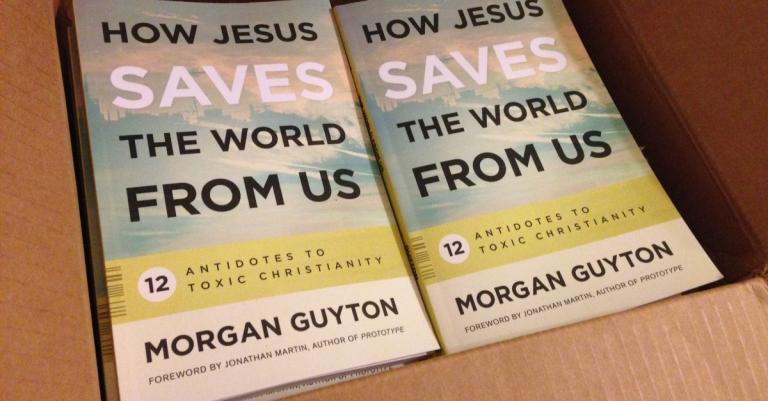
Edwin Tait is one of my most thoughtful internet conversation partners. We disagree on some things and agree on others, probably agreeing more than disagreeing. He really enjoyed my book How Jesus Saves the World From Us and he had some honest critiques that I wanted to engage and take seriously. You can check out Edwin’s two part review of the book here and here.
I. Sacrifice is only bad when it’s transactional
One of Edwin’s first critiques is that I’m not precise enough in how I talk about sacrifice in the second chapter “Mercy Not Sacrifice.” He’s absolutely right. Sacrifice is a word that can refer to a number of different things. In the Roman Catholic mass, the act of Eucharist is called a “sacrifice,” even though it doesn’t involve any pain or privation on the part of the priest or the congregants. The apostle Paul says to “present your bodies as a living sacrifice, holy and acceptable to God, which is your spiritual worship” (Romans 12:1). Again, in Paul’s meaning, sacrifice seems to connote a sanctification rather than pain or privation.
Sacrifice that refers merely to sacred ritual doesn’t have anything inherently toxic about. Nor does sacrifice in the sense of undergoing hardship in the service of a larger goal. What makes sacrifice toxic specifically is when we try to make it transactional. If I bring up the fact that I fast every Monday and Friday in a theological debate as a means of giving myself credibility, then my sacrifice has become toxic. As long as we’re very clear that sacrifice earns nothing, then it will not be toxic for us. The problem is when people use their imagined self-sacrifice as part of a narrative that justifies their wealth and selfish refusal to help others.
II. I still don’t understand how to talk about the fear of the Lord
Edwin points out that I file two different things under the fear of the Lord: 1) a respect for God’s wildness; 2) a sense of moral integrity. I see both of these forms of holy “fear” in the Bible, and I don’t necessarily know how to put them together under a single definition. Most uses of the fear of the Lord in the Old Testament basically refer to an honorable way of life in which you don’t do evil even if you can get away with it. But there seems to be something different going on in Acts 9:31 when it says, “Meanwhile the church throughout Judea, Galilee, and Samaria had peace and was built up. Living in the fear of the Lord and in the comfort of the Holy Spirit, it increased in numbers.”
Obviously this “fear of the Lord” is not being terrified by God. How is that compatible with saying that the church “had peace” and was living “in the comfort of the Holy Spirit”? The only way I can understand it is that the Acts church was bubbling over with amazement at the awesomeness of God’s power that they were experiencing. To fear the Lord in this sense means to be seduced by the wildness of God. When you’ve seen God move in powerful, supernatural ways, you cannot have a normal, abysmal life after that. I think my overall point is valid: when the “fear of the Lord” is commended by the Bible, it’s not commending being scared of God. It’s commending reverence, honor, and amazement.
One thing that was distracting to Edwin was my expression that I’m not afraid of God hurting me as much as I’m afraid of crucifying Jesus. He said that triggered in him the paranoia of a hyper-vigilant holiness morality. I can appreciate that. I just can’t conjure up an angry, omnipotent God in my head when I’ve sinned in secret. But I am haunted by the face of the crucified Christ. The helpless Jesus in the cross has more authority for me than the YHWH who zaps people for touching the ark of the covenant. It’s too easy for me to say I know God loves me and he understands my frailty so surely he won’t strike me with lightning. Yes, God loves me and understands my frailty but he also looks at me with betrayal in his eyes like Jesus did to Peter when the cock crowed. If he just threw lightning bolts at me, I could call him my oppressor and call my sin a revolution against him.
III. Should God’s music be a classical symphony or a blues jam?
In articulating his reservations about my chapter “Communion Not Correctness,” Edwin plays with the blues jam metaphor that I used to describe a method of doctrinal discernment. Edwin wonders if doctrine works better when you have a magisterium to conduct the orchestra. I definitely think the hierarchical Roman Catholic model is one way to avoid stupid, needless doctrinal arguments between lay people. However, I remain a Protestant. I’m more concerned that laypeople are grasping the gospel and assimilating it into their lives than that God’s song is always being played perfectly correctly. The problem that doctrine must address is the need for different people to grasp truth at a vast variety of cognitive abilities and spiritual maturity levels. If every Christian has to become theologically precise enough to be the first chair oboe in God’s orchestra, then we’re going to have a very small church. In a blues open jam, simple-minded half-heretics can jam sloppily together and find their way to the groove that God put into his song.
IV. Do sacred space and time require rules and boundaries to exist?
Edwin makes the point that if you want to have a temple, you have to have some sense of rules and boundaries in order to make it sacred. This is absolutely true. I definitely think that the purpose of the sacrificial purity laws in Leviticus are to establish set-aside holy space and time. If there are no rules and boundaries, then everything is secular.
V. What does it mean to have solidarity with sinners?
In my chapter “Solidarity Not Sanctimony,” I argue that Jesus shows in all of his interactions that he puts the humanity of people over abstract rules. To respond to sin with solidarity does not mean that we enable harm. It means that we respond to every circumstance of sin with the well-being of the person as our primary concern rather than the defense of an abstract rule, which would be sanctimony. Edwin points to my ambivalence about Jesus’ solidarity with Zacchaeus and the tax collectors who are oppressing their people to suggest that an ethic of universal moral principles provides the necessary clarity that an ethic of solidarity lacks. I am wary of universal moral principles, because they seem to inevitably privilege certain categories of identity.
For example, the sin of pride is definitely my greatest mortal enemy. I have a tremendously large ego. But for my wife to have more pride would be a good thing. Likewise, when you have power, there are certain social rules of “politeness” that are good and important to follow. But it’s wrong to criticize people who lack power for speaking “rudely” to people with power when “politeness” makes them easy to ignore.
I wouldn’t say that we have to throw out universal moral principles altogether and fly completely blind. But I would say that rules are always penultimate to the solidarity that can only be discerned in a situational context. Jesus says, “The Sabbath was made for humanity, not humanity for the Sabbath.” Sometimes in order to give Sabbath to a leper, you have to break the Sabbath. If all we need are rules, then there is no role for the Holy Spirit in our minute-by-minute discernment. As a virtue ethicist, I believe that my moral experience consists less in making hundreds of right or wrong choices every day and more in cultivating a virtuous character so that loving behavior comes naturally to me. I need to empty my heart of idols so that I will be moved by God to love rather than expecting my behavior to consist in strictly rationalistic ethical decisions.
VI. Who is the true outsider?
Edwin has some concerns about the “intrinsic relativism” in my chapter “Outsiders Not Insiders.” I had pointed to the example of Bartolome de las Casas as somebody who championed outsiders during the colonial “evangelism” (a.k.a. genocide) of the New World. Edwin points out that Las Casas wanted to import Africans to work in slavery instead of enslaving the natives of the New World. He wonders “if an absolute rule like ‘chattel slavery is always wrong’ may actually be more liberating than a relative principle of ‘find the most marginalized people and side with them.’ ”
I definitely agree that there’s a problem with what’s called the “oppression Olympics” where you basically try to invert the power of white, straight, cisgendered men by giving people a “point” for every marginalized category they embody so that black transgender lesbian trumps white straight woman, like you’re playing a game of spades. It’s definitely correct that universal principles need to inform our solidarity rather than simply saying if a black transgender lesbian is in an argument with a white straight man, she automatically wins the argument no matter what’s being said because she scores higher in the “oppression Olympics.”
But the concern for us as Christians should not be who gets to win the argument. My concern is whether I am truly taking up my cross to follow Jesus. Is my “cross” a set of transactional sacrifices (like no premarital sex, drugs, or cussing) that I use mentally to justify my worldly privilege as an insider or is it the journey of renouncing my worldly privilege to become an outsider? I believe that taking up my cross means the crucifixion of my self-justification so that I will not inherently enter into subconscious worldly power dynamics whenever I’m interacting with the world’s outsiders. Jesus’ cruciformity means that he can sit down with schizophrenics, sex workers, undocumented immigrants, transgender homeless youth, or any other outsider, and make them feel completely at home. That’s the kind of radical hospitality I want to have.
VII. Do leaders need to be shepherds?
Edwin didn’t push too hard on this, but I’m ambivalent about my chapter “Servanthood Not Leadership.” I figured it would get the most pushback, but so far it hasn’t. When I was in my twenties, I self-identified as an anarchist. I suppose I still do. I really believe in creating spaces without hierarchy. But I’m concerned that I’m too ideological and I’ve used my anarchist ideology to justify my own lack of responsibility. As I said at the beginning of the chapter, I hate being in charge but I love being influential. What haunts me is the thought that maybe my students really do need me to be their shepherd rather than just their adviser/companion.
It seems like churches with authoritarian pastors who “cast a clear vision” tend to grow the most explosively. Is it a legitimate human need to need to be told what to do by your charismatic leader or is it a worldly weakness we need to grow beyond? I’m not sure. I do continue to see it as a primary goal to teach my students how to listen directly to their shepherd king rather than spoon-feeding them the answers that I think I have from listening to him. I want for each of them to have a robust prayer life. It would give me so much joy to hear them start a sentence with “God put it on my heart…” Maybe that’s me still thinking that they need to sound evangelical to be truly Christian. All this is just to say that my understanding of leadership is continuing to evolve. Chapter 11 is probably the chapter I’m least certain about.
Thanks to Edwin for his thoughtful engagement! Please do offer your own critiques. Don’t feel like you have to say only nice things about my book. I really want it to be a conversation-starter.
How Jesus Saves the World from Us
Previous Post

April 21, 2016
The great spiritual battle of the 21st century
Next Post

April 23, 2016 Is transgender bathroom panic the gay marriage of the 2016 election season?
Browse Our Archives
Select a Category Advent Beauty Will Save the World Bible Big Picture: Ephesians Bloggers Book Christian salvation and the Beautitudes Culture Daily Office Danceable Homiletics Deadly Sins Deep Roots: Genesis Devotions Dominican Republic May 2011 El Principio Misericordia (The Mercy Principle) Five verses God tattooed on my heart Fundraising FutureGospel Good Biblical Words Henri Nouwen Interview Jennings' Christian Imagination Jesus inside the beltway Jesus Is My Candidate Jesus vs the Pharisees Jesus vs. Plato Journey to Eternity Looking Back on 2012 Love Actually Monday Merton Monday Merton Music Occupy the manger On Earth As It Is In Heaven Original Sin Podcast Poetry Politics Prayer Psalm 119 Radical Jesus 101 Reviews Sermon on the Mount Sermons Spanish Bible study Special Series Spiritual but not religious Synchroblog Theology Things that made me think Thomas a Kempis Ugliness Into Beauty Uncategorized Viaje Dominicano 2013 Walking in the Valley (Lent) Welcome: It's More than a Mat Wild Goose 2013 Wrestling
Select a Month March 2022 January 2022 December 2021 September 2021 April 2021 September 2020 August 2020 July 2020 June 2020 May 2020 April 2020 March 2020 February 2020 January 2020 December 2019 November 2019 October 2019 September 2019 August 2019 June 2019 May 2019 April 2019 March 2019 February 2019 January 2019 December 2018 November 2018 October 2018 September 2018 August 2018 July 2018 June 2018 May 2018 April 2018 March 2018 February 2018 January 2018 December 2017 November 2017 October 2017 September 2017 August 2017 July 2017 June 2017 May 2017 April 2017 March 2017 February 2017 January 2017 December 2016 November 2016 October 2016 September 2016 August 2016 July 2016 June 2016 May 2016 April 2016 March 2016 February 2016 January 2016 December 2015 November 2015 October 2015 September 2015 August 2015 July 2015 June 2015 May 2015 April 2015 February 2015 January 2015 December 2014 November 2014 October 2014 September 2014 August 2014 July 2014 June 2014 May 2014 April 2014 March 2014 February 2014 January 2014 December 2013 November 2013 October 2013 September 2013 August 2013 July 2013 June 2013 May 2013 April 2013 March 2013 February 2013 January 2013 December 2012 November 2012 October 2012 September 2012 August 2012 July 2012 June 2012 May 2012 April 2012 February 2012 January 2012 December 2011 November 2011 October 2011 September 2011 August 2011 July 2011 June 2011 May 2011
Follow Us!
TAKE THE
Religious Wisdom Quiz
True or False: All Scripture is God-breathed and is useful for teaching, rebuking, correcting and training in righteousness.
Select your answer to see how you score.
TRUE FALSE
Related posts from Mercy Not Sacrifice

When God's A Cop, Every Cop Is God


"All People Are Holy": The Theology Of Alexandria...

Epimenides And The Plague Of Athens
TRENDING AT PATHEOS Progressive Christian

What Being a Modern-Day Apostle Means to Me
In my last column, I discussed the ins and outs of modern-day...

Did Ancient China Once Worship the God of...
Across human history, a common thread weaves through the origins of the...

Love Your Neighbor – Including Earth-Kin: Lev. 19,...
God’s command to love your neighbor means acting in an ethical and...

Lead a Church Study of “Jesus and Lao...
Guest writer Jack Thomas (The Irreverent Reverend) reflects on leading his church...

Pastoral Wisdom for Responding to Sermon Pushback
Getting sermon pushback on your social justice sermon? Learn practical, Proverbs-based strategies...

Principles for Understanding the Apostolic Ministry Today
Whenever people discover that my formal ministry title is "apostle," as in...
view all Progressive Christian blogs
Ad-Free & Subscriber Log-In Subscription Support
- About Us
- 2026 Calendar
- Videos
- Podcasts
- Library of World Religions
- Faith In Media Tracker
- Advertise With Us
- Write for Us
- Privacy Policy
- Terms of Service
- Do Not Sell My Data
- Contact Us
- Radiant Digital
- Manage Newsletter Subscriptions
- Unsubscribe From Notifications
- Sitemap
Copyright 2008-2026, Patheos. All rights reserved.
Subscription Support Ad-Free & Subscriber Log-In
Follow Patheos