
BuddhistCatholicContemplativeEvangelicalGeneral ChristianHinduJewishLatter-day SaintMuslimNew VisionsProgressive Christian
Beliefs
- Buddhist
- Catholic
- Contemplative
- Evangelical
- General Christian
- Hindu
- Jewish
- Latter-day Saint
- More Voices
- Muslim
- New Visions
- Pagan
- Progressive Christian
Topics
- Religion News
- Food and Religion
- Sports and Religion
- Religious Art
- Religious Music and Entertainment
- Religious Events
- History and Religion
- Style and Religion
- Politics and Religion
- Women in Religion
- Recreation Outdoors and Religion
- Business Finance and Religion
- Careers Workplace and Religion
- Education and Religion
- Family Parenting and Religion
- Health Fitness and Religion
- Home and Religion
- Relationships and Religion
- Technology and Religion
- Travel and Religion
Columnists
- Buddhist Columnists
- Business Finance and Religion Columnists
- Careers Workplace and Religion Columnists
- Catholic Columnists
- Contemplative Columnists
- Education and Religion Columnists
- Evangelists Columnists
- Family Parenting and Religion Columnists
- General Christian Columnists
- Health Fitness and Religion Columnists
- Hindu Columnists
- History and Religion Columnists
- Home and Religion Columnists
- Jewish Columnists
- More Voices Columnists
- Latter Day Columnists
- Muslim Columnists
- New Visions Columnists
- Nonreligious Columnists
- Pagan Columnists
- Politics and Religion Columnists
- Progressive Columnists
- Recreation Outdoors and Religion Columnists
- Relationships and Religion Columnists
- Religion News Columnists
- Religious Art Columnists
- Religious Events Columnists
- Religious Music and Entertainment Columnists
- Sports and Religion Columnists
- Style and Religion Columnists
- Technology and Religion Columnists
- Travel and Religion Columnists
- Women in Religion Columnists
Resource Library
- 2026 Calendar
- Library of World Religions
- The 100 Most Holy Places on Earth
- Patheos Answers
- Podcasts
- Videos
- Faith Leaders Database
- Anglican Episcopalian
- Bahai
- Baptist
- Buddhism
- Christianity
- Confucianism
- Eastern Orthodoxy
- Hinduism
- Holiness and Pentecostal
- ISKCON
- Islam
- Judaism
- Lutheran
- Methodist
- The Church of Jesus Christ of Latter-day Saints
- New Age
- Paganism
- Presbytarian and Reformed
- Protestantism
- Religion Behind the Scenes
- Roman Catholic
- Scientology
- Shia Islam
- Sikhism
- Sufism
- Sunni Islam
- Taoism
- Zen
- See all religions
Research Tools
 Ad-Free & Subscriber Log-In Subscription Support
Ad-Free & Subscriber Log-In Subscription Support
Follow Patheos 

- Trending:
- Forgiveness
- |
- Marriage
- |
- Consciousness
- |
- Death Penalty
- |
- Election
- |
- Halloween
 Mercy Not Sacrifice
-
More
- Home
- Progressive Christian
- Three arguments for Biblical inerrancy that need to be retired
Three arguments for Biblical inerrancy that need to be retired
Last updated on: September 19, 2014 at 1:57 pm by Morgan Guyton
Three arguments for Biblical inerrancy that need to be retired 2014-09-19T13:57:17-05:00 Morgan Guyton
Patheos Explore the world's faith through different perspectives on religion and spirituality! Patheos has the views of the prevalent religions and spiritualities of the world.
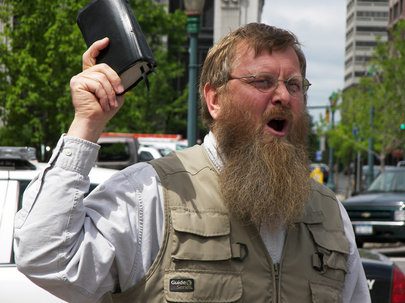 One of the most important books I read in seminary was evangelical Old Testament scholar Peter Enns’ Incarnation and Inspiration, which offers a way of understanding the Bible in which its authority can be respected even if some of the stories it tells are not historical events. Peter Enns just released another book called The Bible Tells Me So that has the Biblical inerrantists in a tizzy. For a long time, I’ve been wanting to name and repudiate three of the more frustrating arguments that inerrantists make for their position. So here goes.
1) Paul and Jesus believed in a historical Adam/Noah/etc.
This seems to be the biggest issue for many inerrantists. Jesus and Paul and other New Testament writers do make references to Old Testament stories in their discourse. Paul makes a contrast between Jesus and the first Adam. Peter talks about Noah’s flood as a metaphor for baptism. Jesus says that he will give the “sign of Jonah” by spending three days in the earth before being resurrected.
But the fact that Jesus, Paul, and Peter used Old Testament stories as illustrations in their writing and preaching tells us nothing about what they believed. All it means is that they used the resources of the common imaginative space of their audience to engage in teaching. If I used Mickey Mouse or Huck Finn or Quasimodo in a sermon illustration and someone two thousand years from now found the manuscript, there would be no way to tell whether I had been talking about fictional or historical figures.
Huck Finn is a real person because millions of American readers have journeyed with him down the Mississippi and then related their experiences for the rest of their lives to his story after having read it. Huck Finn is more real than the historical people from Samuel Clemens’ childhood that he amalgamated together to create Huck Finn, because Huck Finn continues to exist in the imagination of the American people.
So no, God did not need to design a fish whose acid-filled stomach was replaced by a pressurized oxygen-filled chamber in which Jonah could sit and pray for 72 hours in the depths of the ocean so that Jesus’ teaching isn’t invalidated by modern scientific considerations. Jonah can be a fictional story whose life was real enough in the imaginations of the Hebrew people that Jesus could use it as an illustration to explain his death and resurrection.
2) Are you saying that God lets people lie about him?
One of the analogies that Peter Enns uses to describe Old Testament accounts of God going into battle and decimating Israel’s enemies is to say that it’s like children bragging (not entirely truthfully) about their superhero fathers:
Children tell stories of their parents from their point of view as children, which is not the whole story. Think of boys bragging about their dads on the playground. I loved my father and I defended his honor. He was a mighty man who could lift heavy objects, was a sharpshooter, brilliantly smart, and as strong as any man anywhere. Not everything I said about my dad was fully and objectively true, but this is how I saw my father, a description born of love, from my youthful perspective, that followed the “rules of the playground.”
My friend Derek takes exception to this explanation because the Ten Commandments include a law against misrepresenting God with idols and if anything the Bible says about God isn’t perfectly truthful, then it’s a misrepresentation:
Now that would be odd wouldn’t it? For God to deliver commands to us about not falsely representing him and taking his name in vain, through narratives that falsely represent him and take his name in vain? What kind of confusing father is that? A little exaggeration here and there is one thing, but to fundamentally miss a key component like that is kind of a big deal. I mean, especially when God seems particularly picky about the “no false images” thing (Ex. 32-33).
I should cut Derek some slack because he’s not a parent yet so he’s never had to tell his child something that’s a little bit untrue because it’s impossible to explain the truth to them. Until you’ve had to deal with Santa Claus and the tooth fairy and “Where do babies come from?” you can be a Kantian rationalist about the meaning of truth. But once you’ve been a parent, you know that it’s necessary to tell your kids half-truths all the time. Sometimes we’re wrong to do this, but sometimes it’s legitimately the best way to accomplish a moral purpose. In parenting, the “truth” is never a purely objective category; it’s always pragmatic. You give your kids the “truth” they need to believe in order to do what they need to do. It would be horrible parenting to respond to your kids with robotic objectivity like Sheldon from “Big Bang Theory.”
I’m not going to dismiss out of hand the claim that God made miracles happen for the Israelites on the battlefield just because of science. But I think it’s also legitimate to say that God allowed the Israelites to believe and write down the things about him that they were capable of believing based on their historical context as well as what they needed to believe in order to evolve in the direction he wanted them to evolve. I would also contend that it’s not wrong to say that Israel got to know God better over time. The later chapters of Isaiah articulate a more refined account of God’s purpose for Israel in the world than the account of God in Judges. Jesus’ incarnation is the culmination of an evolutionary revelation process that is documented through scripture. If all that Jesus revealed about God were perfectly self-evident and entirely consistent with the understanding of God in the Old Testament, then the incarnation would be completely unnecessary.
Derek recognizes the legitimacy of saying that God “accommodated” his people in his revelation. Where I’m going to part ways with Derek is to say that whatever God was doing with the Israelites in the early years, the character of God extrapolated from those texts is a less reliable account of the character of God than the perfect revelation offered by Jesus. John 1:18 says, “No one has ever seen God. It is God the only Son, who is close to the Father’s heart, who has made him known.” That verse has no meaning if all parts of the Bible are equally reliable depictions of God.
Again, being a parent changes everything about how you think on these matters. There are many times in my interactions with my sons that I have affected a level of sternness and anger that I didn’t actually feel on the inside for the purpose of getting them to obey my commands. I don’t think that the ancient Israelites perfectly understood what God was saying, but I also recognize that God throughout his supervision of the editing process of his sacred texts over the centuries has left in there what’s in it today. So while I agree that the text as it exists is what God wants to be there, that doesn’t necessarily mean that we can take impressions of God from ancient stories out of context and put them all in a theological petri dish together in order to build an artificially constructed, systematic portrayal of God’s nature.
That’s why I think that R.C. Sproul is completely wrong in his landmark text The Holiness of God when he lets the God of Leviticus control his account of God’s holiness and set the parameters through which Jesus is supposed to be read. Jesus is the lens through which to interpret the rest of the Bible, not vice-versa. And this isn’t to say that Jesus is an uncomplicated gentle nice guy. He says plenty that’s crazy and disturbing and angry for us to wrestle with. But Jesus didn’t just offer a blanket endorsement of everything in the Old Testament as Derek claims. He took sides. When he quotes, “I desire mercy not sacrifice” to the Pharisees, he’s blatantly picking Hosea over Leviticus. When he says, “The Sabbath was made for man, not man for the Sabbath,” he’s contradicting the understanding of Sabbath established when God tells Moses to stone a man to death for gathering sticks on the Sabbath.
3) So you don’t think God is powerful enough to…?
This is the most annoying one. Don’t you believe that God had the power to make magic canoes for the kangaroos of Australia and the lemurs from South America to ride over thousands of miles of open ocean to the ancient Middle East so they could report to Noah’s Ark and get saved from the flood? Don’t you believe that God had the power to make strictly vegetarian dinosaurs as well as bacteria and fungus that subsisted on magic fairy dust to inhabit creation until Adam ate the apple and the curse of physical mortality was “created”?
Sure, God could have crammed all the millions of species of the world’s animals into an ark the size of a football field and created some magical means of nourishment so that lions whose digestive systems are only designed to process antelope and other meat would somehow be able to make nice for several months with all the other species in the food chain. Sure, God could have made it so that the animals would not only not need to ate the way they are biologically shaped to do but that they also wouldn’t pee or poop either and turn the ark into a massive disease pool. For a hilarious account of the logistical difficulties of Noah’s Ark, see this video that an atheist made about it.
I just don’t think that the most likely explanation for the ancient stories that the Bible borrowed from other more ancient cultures is that they historically occurred exactly as they are written. I imagine there was a devastating ancient flood somewhere in the ancient world that got reported in the epic of Gilgamesh and other ancient myths before it was reinterpreted theologically in the Hebrew Bible. There was also a point in ancient history when people stopped being monkeys and realized they were naked and vulnerable so that they lost their innocence and began to hurt one another deliberately out of fear for their mortality. The story of Adam and Eve in the Garden of Eden is a genius representation of the strange innate curse of our consciousness. I doubt the world ever had a single common language, but I do believe that God has always found ways to sabotage the hegemony of empire that the Tower of Babel story represents even when that hegemony is Christendom itself.
Bottom line is I absolutely agree that the scriptures are “God-breathed and useful for teaching, reproof, correction, and training in discipleship” (2 Timothy 3:16). None of them should be thrown out because the Holy Spirit has a purpose for all of them. I just don’t think that this also means that the scriptures are perfectly flat and equivalent in their historical accuracy or reliable portrayal of God’s nature.
Previous Post

September 17, 2014
Do you deserve to be crucified for your sin?
Next Post

September 23, 2014 Cock-blocking and rape culture
Browse Our Archives
Select a Category Advent Beauty Will Save the World Bible Big Picture: Ephesians Bloggers Book Christian salvation and the Beautitudes Culture Daily Office Danceable Homiletics Deadly Sins Deep Roots: Genesis Devotions Dominican Republic May 2011 El Principio Misericordia (The Mercy Principle) Five verses God tattooed on my heart Fundraising FutureGospel Good Biblical Words Henri Nouwen Interview Jennings' Christian Imagination Jesus inside the beltway Jesus Is My Candidate Jesus vs the Pharisees Jesus vs. Plato Journey to Eternity Looking Back on 2012 Love Actually Monday Merton Monday Merton Music Occupy the manger On Earth As It Is In Heaven Original Sin Podcast Poetry Politics Prayer Psalm 119 Radical Jesus 101 Reviews Sermon on the Mount Sermons Spanish Bible study Special Series Spiritual but not religious Synchroblog Theology Things that made me think Thomas a Kempis Ugliness Into Beauty Uncategorized Viaje Dominicano 2013 Walking in the Valley (Lent) Welcome: It's More than a Mat Wild Goose 2013 Wrestling
Select a Month March 2022 January 2022 December 2021 September 2021 April 2021 September 2020 August 2020 July 2020 June 2020 May 2020 April 2020 March 2020 February 2020 January 2020 December 2019 November 2019 October 2019 September 2019 August 2019 June 2019 May 2019 April 2019 March 2019 February 2019 January 2019 December 2018 November 2018 October 2018 September 2018 August 2018 July 2018 June 2018 May 2018 April 2018 March 2018 February 2018 January 2018 December 2017 November 2017 October 2017 September 2017 August 2017 July 2017 June 2017 May 2017 April 2017 March 2017 February 2017 January 2017 December 2016 November 2016 October 2016 September 2016 August 2016 July 2016 June 2016 May 2016 April 2016 March 2016 February 2016 January 2016 December 2015 November 2015 October 2015 September 2015 August 2015 July 2015 June 2015 May 2015 April 2015 February 2015 January 2015 December 2014 November 2014 October 2014 September 2014 August 2014 July 2014 June 2014 May 2014 April 2014 March 2014 February 2014 January 2014 December 2013 November 2013 October 2013 September 2013 August 2013 July 2013 June 2013 May 2013 April 2013 March 2013 February 2013 January 2013 December 2012 November 2012 October 2012 September 2012 August 2012 July 2012 June 2012 May 2012 April 2012 February 2012 January 2012 December 2011 November 2011 October 2011 September 2011 August 2011 July 2011 June 2011 May 2011
Follow Us!
TAKE THE
Religious Wisdom Quiz
What is a "cubit's" approximate length according to the Bible?
Select your answer to see how you score.
24 inches 18 inches 12 inches 36 inches
Related posts from Mercy Not Sacrifice


When God's A Cop, Every Cop Is God


"All People Are Holy": The Theology Of Alexandria...
TRENDING AT PATHEOS Progressive Christian

What Being a Modern-Day Apostle Means to Me
In my last column, I discussed the ins and outs of modern-day...

Did Ancient China Once Worship the God of...
Across human history, a common thread weaves through the origins of the...

Love Your Neighbor – Including Earth-Kin: Lev. 19,...
God’s command to love your neighbor means acting in an ethical and...

Lead a Church Study of “Jesus and Lao...
Guest writer Jack Thomas (The Irreverent Reverend) reflects on leading his church...

Pastoral Wisdom for Responding to Sermon Pushback
Getting sermon pushback on your social justice sermon? Learn practical, Proverbs-based strategies...

Principles for Understanding the Apostolic Ministry Today
Whenever people discover that my formal ministry title is "apostle," as in...
view all Progressive Christian blogs
Ad-Free & Subscriber Log-In Subscription Support
- About Us
- 2026 Calendar
- Videos
- Podcasts
- Library of World Religions
- Faith In Media Tracker
- Advertise With Us
- Write for Us
- Privacy Policy
- Terms of Service
- Do Not Sell My Data
- Contact Us
- Radiant Digital
- Manage Newsletter Subscriptions
- Unsubscribe From Notifications
- Sitemap
Copyright 2008-2026, Patheos. All rights reserved.
Subscription Support Ad-Free & Subscriber Log-In
Follow Patheos