
BuddhistCatholicContemplativeEvangelicalGeneral ChristianHinduJewishLatter-day SaintMuslimNew VisionsProgressive Christian
Beliefs
- Buddhist
- Catholic
- Contemplative
- Evangelical
- General Christian
- Hindu
- Jewish
- Latter-day Saint
- More Voices
- Muslim
- New Visions
- Pagan
- Progressive Christian
Topics
- Religion News
- Food and Religion
- Sports and Religion
- Religious Art
- Religious Music and Entertainment
- Religious Events
- History and Religion
- Style and Religion
- Politics and Religion
- Women in Religion
- Recreation Outdoors and Religion
- Business Finance and Religion
- Careers Workplace and Religion
- Education and Religion
- Family Parenting and Religion
- Health Fitness and Religion
- Home and Religion
- Relationships and Religion
- Technology and Religion
- Travel and Religion
Columnists
- Buddhist Columnists
- Business Finance and Religion Columnists
- Careers Workplace and Religion Columnists
- Catholic Columnists
- Contemplative Columnists
- Education and Religion Columnists
- Evangelists Columnists
- Family Parenting and Religion Columnists
- General Christian Columnists
- Health Fitness and Religion Columnists
- Hindu Columnists
- History and Religion Columnists
- Home and Religion Columnists
- Jewish Columnists
- More Voices Columnists
- Latter Day Columnists
- Muslim Columnists
- New Visions Columnists
- Nonreligious Columnists
- Pagan Columnists
- Politics and Religion Columnists
- Progressive Columnists
- Recreation Outdoors and Religion Columnists
- Relationships and Religion Columnists
- Religion News Columnists
- Religious Art Columnists
- Religious Events Columnists
- Religious Music and Entertainment Columnists
- Sports and Religion Columnists
- Style and Religion Columnists
- Technology and Religion Columnists
- Travel and Religion Columnists
- Women in Religion Columnists
Resource Library
- 2026 Calendar
- Library of World Religions
- The 100 Most Holy Places on Earth
- Patheos Answers
- Podcasts
- Videos
- Faith Leaders Database
- Anglican Episcopalian
- Bahai
- Baptist
- Buddhism
- Christianity
- Confucianism
- Eastern Orthodoxy
- Hinduism
- Holiness and Pentecostal
- ISKCON
- Islam
- Judaism
- Lutheran
- Methodist
- The Church of Jesus Christ of Latter-day Saints
- New Age
- Paganism
- Presbytarian and Reformed
- Protestantism
- Religion Behind the Scenes
- Roman Catholic
- Scientology
- Shia Islam
- Sikhism
- Sufism
- Sunni Islam
- Taoism
- Zen
- See all religions
Research Tools
 Ad-Free & Subscriber Log-In Subscription Support
Ad-Free & Subscriber Log-In Subscription Support
Follow Patheos 

- Trending:
- Forgiveness
- |
- Marriage
- |
- Consciousness
- |
- Death Penalty
- |
- Election
- |
- Halloween
 Mercy Not Sacrifice
-
More
- Home
- Progressive Christian
- 2013: The Year of the Post-Evangelical Memoir (Erika Rae, Chris Haw, Tony Kriz, Addie Zierman)
2013: The Year of the Post-Evangelical Memoir (Erika Rae, Chris Haw, Tony Kriz, Addie Zierman)
Last updated on: July 17, 2014 at 1:59 pm by Morgan Guyton
2013: The Year of the Post-Evangelical Memoir (Erika Rae, Chris Haw, Tony Kriz, Addie Zierman) 2014-07-17T13:59:29-05:00 Morgan Guyton
Patheos Explore the world's faith through different perspectives on religion and spirituality! Patheos has the views of the prevalent religions and spiritualities of the world.
The post-evangelical memoir has exploded as a genre in the wake of Rachel Held Evans’ 2010 Evolving in Monkey Town: How A Girl Who Knew All The Answers Learned to Ask The Questions. Since that time, an industry of thirty-something post-evangelical memoirists has blossomed. And it seems like 2013 was the year that they all got published (or at least read by me). I read four post-evangelical memoirs this year that were each very different: Erika Rae’s Devangelical, Chris Haw’s From Willow Creek to Sacred Heart, Tony Kriz’s Neighbors and Wise Men, and Addie Zierman’s When We Were On Fire.
1) Erika Rae’s Devangelical

Erika Rae’s memoir is probably the cheekiest. At least I found myself laughing out loud frequently as I read it.
She starts off talking about the matter-of-fact expectation of the end of the world in evangelical circles: “While the average person may occasionally enjoy getting goose bumps about the extinction of humankind, evangelicals thrive on it. As in, they expect it. Pray for it. Indeed, the average Evangelical craves it. Why? Because it means that this temporary life will end and a real one will begin” (19).
She relates attending a slumber party at a non-church friend’s house where all the stereotypical things happened that fundamentalist parents are paranoid about: “Had the dancing opened the possibility for Light as a Feather, which in turn, had led to the Ouija board? Or had it been the presence of the Ouija board that had influenced the dancing? Or was the Ouija board and Light as a Feather in a class of their own and the dancing… was just fun? (40).
Her youth group went on a field trip to a new age convention to fight spiritual warfare: “It was worse than I thought. The entire floor of the arena was filled with sin. For as far as the eye could see, there was booth after booth selling the Devil’s wares: meditation books, crystals, dragon sculptures, smoking devices–it was endless” (54).
And finally when the sexual temptation that evangelical youth culture is obsessed with and built around got too intense, there was only one thing for her and her boyfriend Scott to do: “We knew two things at the ripe age of 19. One: we wanted to have sex. Two: premarital sex was wrong. Thinking about it was wrong. Planning for it was wrong. And doing it was definitely wrong. We were supposed to be hot for God, not each other. There was only one way around it: Marriage” (130-131).
Erika and Scott managed to stay together. They are still Christian, though not evangelical. They still attend church regularly, though the church is too “liberal” for her parents’ tastes. After the bemused, mischievous tone of most of the book, the end really cut into my heart as Erika describes the death of her father and the unresolved conflict between them. It was an unusual ending for a mostly lighthearted memoir, but it reflected a real truth. Post-evangelicals joke around about our upbringing to a point, but we still deeply love the people who made us who we are even if we disagree with them.
2) Chris Haw’s From Willow Creek to Sacred Heart
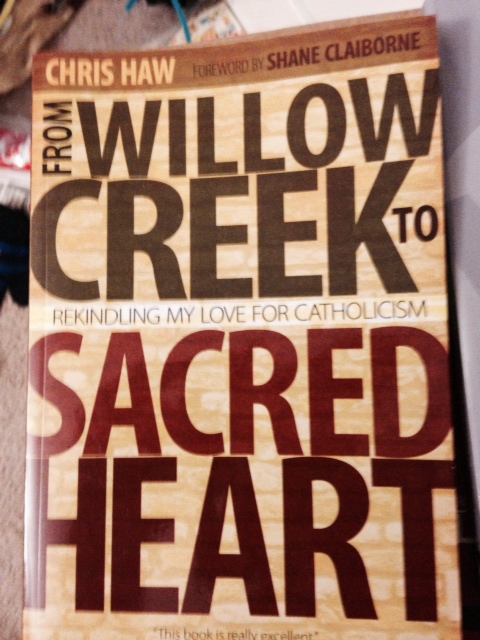
Chris Haw takes a unique approach to describing his conversion from nominal Catholicism to evangelicalism back to Catholicism. He spends the first half of his book sharing his personal story discovering and getting involved with the Willow Creek megachurch, going away to college at Eastern University where he discovered a social justice-oriented evangelicalism, and then starting an intentional community in Camden, New Jersey where he found his way back to Catholicism in the neighborhood parish. The second half of the book provides a theological reflection on Haw’s newly discovered Catholicism framed according to evangelical sensibilities.
Throughout the book, Haw maintains a thoughtful, charitable tone, refusing to denigrate his evangelical past or whitewash his Catholic present. He does share that his immersion in a non-denominational environment did give him a bit of a condescending attitude toward Christians devoted to specific denominations: “Why couldn’t they give up their silly rituals, dogmas, and traditions for the sake of simply following Jesus–without reference to the past?” (15).
Haw shares how he got involved in social justice activism at Eastern University after befriending both Shane Claiborne and Jonathan and Leah Wilson-Hartgrove who both attended there also. He went on an immersion study program in the jungle of Belize. He went with Jonathan and Leah to Iraq with the Christian Peacemaker Team in 2003 at the start of the war. Then a guest presentation on environmental racism at Eastern by Father Michael Doyle laid the groundwork for Haw to start an intentional community with some friends in a tough neighborhood in Camden, New Jersey.
The part that I most enjoyed in the book was the second part where Haw examines the theological implications of his conversion. Catholic converts can sometimes be insufferable in their zeal, but Haw’s humility and openness about his lingering disagreements with the Church makes him a very compelling apologist.
Haw makes a powerful case for the Catholic crucifix over the Protestant empty cross: “Even if Jesus is resurrected, the wounds and scars still remain, just as our violence still remains to this day. The one who truly sees Christ crucified is, however joyful in his experience of forgiveness, always tempered and humbled as one who has witnessed the torturing and execution of another human, killed from our own betrayal or indifference. Far too often, instead our theologies of atonement and pious patriotism can dress up or obscure the painful lament at the sight of the Cross. It didn’t seem coincidental, then, that many people from the evangelical community in which I heard this disdain for the crucifix’s imagery, who had removed the Cross but kept the flag, were also often overlooking or rationalizing the deaths of civilians in our current wars” (92).
He goes through an excellent engagement with Rene Girard to talk about the experience of the cross’s atonement in Catholic liturgy. For someone who’s been wanting to tap into Girard, Haw presents a very accessible and creative reading that is worth the price of the book in itself. It was hard to find a short, representative quote, but here’s a creative application that he concludes with: “There is a desperate necessity for exalting martyrs in the wake of the Gospel’s myth-dissolving force: without being accompanied by a community of compassionate suffering and virtue, the Gospel will only cut and not mend. Simply, the Word of Christ needs to be accompanied by the Body of Christ–that community of positive mimesis, of a culture bound together by a different kind of ‘sacrifice,’ the ‘anti-sacrifice’ of Christ. And so one of the Christian’s tasks is not only to proclaim ‘Christ crucified,’ that we blindly murdered the Lamb of God, but also that we must remain like lambs in a world of wolves” (117).
In addition, Haw provides a helpful defense of the Catholic use of saints: “If Christ interpreted God, we have to keep identifying the best interpretations of his interpretation. Naming saints, people who have interpreted the life of Christ by living in their own unique way, is like being able to sight down the barrel of a long rifle–the longer the rifle is, the more accurate it is; the shorter the barrel, the more dangerous and haphazard” (136).
He also deals with the church pedophilia scandal and the question of church corruption in general very thoughtfully and openly: “I have gotten some mileage out of that provocative claim, ‘The Church is a whore, but she is our mother.’ While she–in both her leaders and her common members–often dirties the bathwater, she is also the one who championed water sanitation and told us how to wash up… We’ve all heard the old and easily misused proverb to hate the sin, love the sinner. In applying this to the Church, I’m not only suggesting to love it but to hate its sins. I’m coming to see a more profound reality: that the Church’s tradition is the very thing that told us what sins are. This has helped me forgive the Church for her evils–for the Church taught me forgiveness and how to identify evil” (157).
Just be careful. Reading this book might make you turn into a Catholic. I was half-ready to do that when I put it down.
3) Tony Kriz’s Neighbors and Wise Men
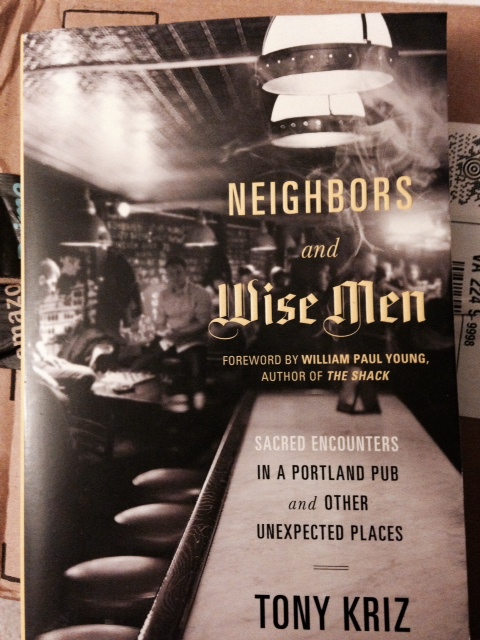
Tony Kriz may be the most “post” of the four post-evangelicals I read. He’s gotten kicked around a lot. He shares his wounds bravely and with a lot of grace for those who created them by yanking him first from the mission field in eastern Europe and then from campus ministry at Reed College. The book culminates in a beautiful vision for what parish ministry could look like when your parish really is the people in your neighborhood and not just the people who come to your church. If you think of yourself as a “missional” type of Christian, you should definitely check out this book.
During his time as a missionary in Albania, Tony lived with a Muslim family that stayed Muslim the whole time he was there and for which he gained a lot of respect over time. He shares his ambivalence after witnessing the conversion of one Muslim to Christianity: “My team had won again. We had added another name to our role and taken a name from theirs. But in time, I had to repent of seeing my friend as some sort of Christian conquest. I was blinded by my belief that my team was ‘better,’ so much that I could not see the cost. In time I realized what it took for a young, proud man to do what I had never, ever considered doing… following the path of faith wherever it might lead… even if it meant immersing himself in an opposing religion… Eventually, Luli became my teacher” (46).
When Tony ends up in a confrontation with two Muslim evangelists who came to the town where he was living, they have a very polite and amicable conversation in which the Muslim guys seem to “win” the debate. Tony writes, “Later, I thought more about those Muslim scholars in their woolen hats, beards, and long robes. I realized that they looked like the Magi (wise men) in my childhood Nativity set. Who were the Magi anyway? They were spiritual scholars from the East who honored Jesus… Did the Magi hold to all the theological intricacies that we Christians believe today? I somehow doubt that they did” (56).
Some of Tony’s most interesting adventures come about in a Portland bar called the Horse Brass. He relates several conversations with bar regulars during a time when he was feeling spiritually ungrounded. They end up being his spiritual guides in a time when he was wanting to give up his faith. Like Pope, a spiritual not religious guy studying the Kabbalah. Or Katarina, a sixty-something year old liberal Jew who despite her age is pursuing a doctorate in religious studies. Eventually, Tony winds up being a campus minister at Reed College where he acquires a new set of conversation partners, many of whom are “de-Christians” who were disillusioned from the faith at some point in the past. Throughout his book, Tony honors the people with whom he walks in ministry as his teachers.
I really appreciated a metaphor that Tony uses to talk about his approach to evangelism: “What if ‘sharing the gospel’ was not so much like sharing a chocolate cake, where one person has privileged access and the other has not? What if sharing the gospel was instead like sharing a sunset? Sharing a sunset is quite different from sharing cake… As you share a sunset, you must stand shoulder to shoulder, not face-to-face. When you share a sunset, both observers are caught up in the glory and beauty and mystery. When you share a sunset, everyone present has equal opportunity to contribute” (172).
I have really found myself resonating with Tony’s philosophy of evangelism. I think it’s about admiring God’s beauty in the company of another person. While I don’t think “all paths lead to heaven” or that every perspective is just as good as any other, I don’t see a lot of value in making sure that it’s clear that I’m the one in the know and the person I’m talking to is not. I have learned the most from teachers who were interested in learning from me. Tony seems like a real teacher.
4) Addie Zierman’s When We Were on Fire
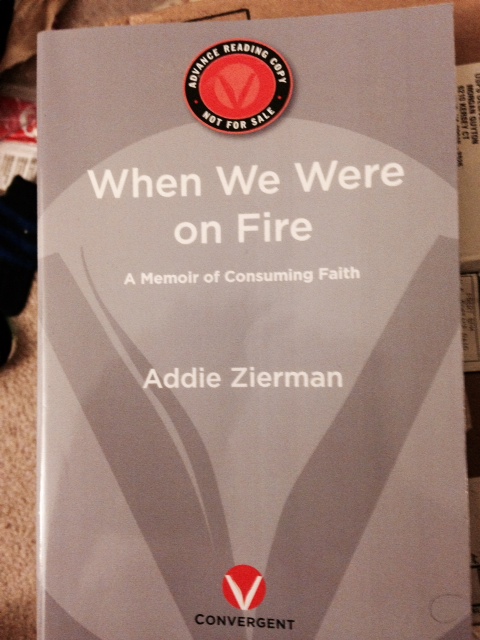
Addie opens her memoir with a poignant scene: standing at the school flagpole in the rain, thinking she was the only kid who had come out to pray at the annual See You at the Pole prayer event. “I wanted the empty courtyard,” she writes, “the chance to be a solitary figure at the pole. To be the only one bold enough, brave enough, passionate enough to stand in the rain for Jesus” (6). It turned out that all the other evangelicals had made a prayer circle inside the front hallway. Addie’s friend comes out to get her, and she realizes that she wasn’t the solitary prayer warrior hero, just a lonely, wet kid standing in the wrong place.
There’s something about that image that really captures something about my experience with evangelical culture. I don’t know how many other people felt like there was a secret password that they didn’t know or instincts and lingo that everyone else seemed to grasp intuitively except you. The other trope of evangelicalism that Addie captures is its genderedness. Boys are supposed to be missionaries; and girls are supposed to be missionary wives.
She spends a lot of her book talking about her first love, a guy named Chris she dated and broke up with throughout high school: “He led Bible studies and he led prayer groups and he led people int he Prayer of Salvation. The binding on his Bible was falling off from so much opening and closing, the words marked by his underlines, the margins heavy with his notes. When he talked about faith, he used words like revival, words like spiritual battle and prayer warrior and sacrifice. He signed his e-mails and letters with the phrase Consumed by the call” (35).
I smacked my head a lot remembering how I was as a teenager when I read about Chris’s uber-zealous piety in their relationship: “A few weeks after we started dating… he drew up a contract for our relationship and went through it for me point by point at a Barnes and Noble coffee shop… There were eleven or twelve points, most of which I cannot remember. The first involved putting God ahead of our relationship at all times. The second restricted our physical affection to handholding and hugs… Below he had created several lines for signatures: mine, his, each of our parents’, the youth pastor’s, and even the head pastor’s… When I brought the contract home to my parents, my dad laughed, as if it were a joke” (82).
Addie and her friends tried to emulate Chris’s uber-piety by breaking into the school cafeteria late at night to anoint the cafeteria tables with vegetable oil and pray for “revival” to come to their school: “The container held a couple of tablespoons of Aldi-brand vegetable oil, which we had because we were planning to ‘anoint’ the cafeteria table. We’d heard there was specific oil made for this task, but we didn’t have any. Anyway, plain oil cooking oil was what I had seen Christ use the week before. I’d never heard of this symbolic gesture before I saw him ‘anoint’ the door frame of the home of one of his friends before a prayer meeting” (40).
I wonder if there’s something about the message evangelicals receive in youth group that makes us think that we’re all supposed to be “leaders.” I feel like I’ve always been haunted by the need to be the biggest fish in whatever pond I find myself in. I’m not sure where that comes from, but I really related to Addie’s observations on arriving at her evangelical college: “I felt very aware that there were twenty-five hundred students at Northwestern, most of them Bible study leaders and prayer group leaders from high school youth groups around the country… I remember realizing that I would have to vie for what used to be my most defining characteristic: my faith. The spectrum would be defined differently now; there would be a new ‘top’ and a new ‘bottom.’ After all, we couldn’t all lead Bible studies here” (103).
In college, evangelicals get even more extreme than they were in high school. Addie relates the hyper-zeal of the RA for her freshman dorm: “‘One thing I do is I have this plasty baggy,’ she continued oblivious to my distractedness. ‘And I write Bible verses on note cards and I put them inside of it, and then I hang it in the shower.’ She smiled big, pleased with her creativity. ‘That way, I can dwell on God’s Word while I’m getting ready in the morning.’ She looked at me with wide, expectant eyes, so I said something like, ‘That’s a great idea’… ‘I have one for you if you want.’ ‘Sure,’ I said, gritting my teeth into a smile” (110).
Addie starts to break away from the zeal competition in college after meeting a boy named Andrew whom she ends up marrying: “If he cared what people thought of him or his faith, he never showed it. He did not vie for positions of spiritual leadership or talk about his life’s calling… He had a casual disregard for Northwestern’s many Rules. It’s not as if he set out to break them, he just didn’t factor them into his daily decisions… He laughed, and he made me laugh, and it was because his relationship to his faith was not a do-or-die mission but something life-giving and fluid” (114-115).
The adventures continue from there. Addie’s relationship with Andrew survives an English teaching experience in China with a community of fundamentalists from Michigan, an oppressive house church, a phase of Addie’s binge-drinking, and a narrow escape from infidelity with a hipster guy at Caribou Coffee. This book left me feeling the most hopeful, probably because Andrew and Addie were able to stick together after some heavy things happened that would have torn many relationships apart.
Previous Post

December 30, 2013
How the culture wars have bastardized the concept of holiness
Next Post
December 31, 2013 Some posts I wish more people had read in 2013
Browse Our Archives
Select a Category Advent Beauty Will Save the World Bible Big Picture: Ephesians Bloggers Book Christian salvation and the Beautitudes Culture Daily Office Danceable Homiletics Deadly Sins Deep Roots: Genesis Devotions Dominican Republic May 2011 El Principio Misericordia (The Mercy Principle) Five verses God tattooed on my heart Fundraising FutureGospel Good Biblical Words Henri Nouwen Interview Jennings' Christian Imagination Jesus inside the beltway Jesus Is My Candidate Jesus vs the Pharisees Jesus vs. Plato Journey to Eternity Looking Back on 2012 Love Actually Monday Merton Monday Merton Music Occupy the manger On Earth As It Is In Heaven Original Sin Podcast Poetry Politics Prayer Psalm 119 Radical Jesus 101 Reviews Sermon on the Mount Sermons Spanish Bible study Special Series Spiritual but not religious Synchroblog Theology Things that made me think Thomas a Kempis Ugliness Into Beauty Uncategorized Viaje Dominicano 2013 Walking in the Valley (Lent) Welcome: It's More than a Mat Wild Goose 2013 Wrestling
Select a Month March 2022 January 2022 December 2021 September 2021 April 2021 September 2020 August 2020 July 2020 June 2020 May 2020 April 2020 March 2020 February 2020 January 2020 December 2019 November 2019 October 2019 September 2019 August 2019 June 2019 May 2019 April 2019 March 2019 February 2019 January 2019 December 2018 November 2018 October 2018 September 2018 August 2018 July 2018 June 2018 May 2018 April 2018 March 2018 February 2018 January 2018 December 2017 November 2017 October 2017 September 2017 August 2017 July 2017 June 2017 May 2017 April 2017 March 2017 February 2017 January 2017 December 2016 November 2016 October 2016 September 2016 August 2016 July 2016 June 2016 May 2016 April 2016 March 2016 February 2016 January 2016 December 2015 November 2015 October 2015 September 2015 August 2015 July 2015 June 2015 May 2015 April 2015 February 2015 January 2015 December 2014 November 2014 October 2014 September 2014 August 2014 July 2014 June 2014 May 2014 April 2014 March 2014 February 2014 January 2014 December 2013 November 2013 October 2013 September 2013 August 2013 July 2013 June 2013 May 2013 April 2013 March 2013 February 2013 January 2013 December 2012 November 2012 October 2012 September 2012 August 2012 July 2012 June 2012 May 2012 April 2012 February 2012 January 2012 December 2011 November 2011 October 2011 September 2011 August 2011 July 2011 June 2011 May 2011
Follow Us!
TAKE THE
Religious Wisdom Quiz
Who interpreted the "writing on the wall" for King Belshazzar?
Select your answer to see how you score.
Isaiah Jeremiah Daniel Ezekiel
Related posts from Mercy Not Sacrifice


Intuition and the Garden of Eden

The Continuous Gaslighting Of An Autistic Mind

Why I Still Call Myself A Christian
TRENDING AT PATHEOS Progressive Christian

What Being a Modern-Day Apostle Means to Me
In my last column, I discussed the ins and outs of modern-day...

Did Ancient China Once Worship the God of...
Across human history, a common thread weaves through the origins of the...

Love Your Neighbor – Including Earth-Kin: Lev. 19,...
God’s command to love your neighbor means acting in an ethical and...

Lead a Church Study of “Jesus and Lao...
Guest writer Jack Thomas (The Irreverent Reverend) reflects on leading his church...

Pastoral Wisdom for Responding to Sermon Pushback
Getting sermon pushback on your social justice sermon? Learn practical, Proverbs-based strategies...

Principles for Understanding the Apostolic Ministry Today
Whenever people discover that my formal ministry title is "apostle," as in...
view all Progressive Christian blogs
Ad-Free & Subscriber Log-In Subscription Support
- About Us
- 2026 Calendar
- Videos
- Podcasts
- Library of World Religions
- Faith In Media Tracker
- Advertise With Us
- Write for Us
- Privacy Policy
- Terms of Service
- Do Not Sell My Data
- Contact Us
- Radiant Digital
- Manage Newsletter Subscriptions
- Unsubscribe From Notifications
- Sitemap
Copyright 2008-2026, Patheos. All rights reserved.
Subscription Support Ad-Free & Subscriber Log-In
Follow Patheos