
BuddhistCatholicContemplativeEvangelicalGeneral ChristianHinduJewishLatter-day SaintMuslimNew VisionsProgressive Christian
Beliefs
- Buddhist
- Catholic
- Contemplative
- Evangelical
- General Christian
- Hindu
- Jewish
- Latter-day Saint
- More Voices
- Muslim
- New Visions
- Pagan
- Progressive Christian
Topics
- Religion News
- Food and Religion
- Sports and Religion
- Religious Art
- Religious Music and Entertainment
- Religious Events
- History and Religion
- Style and Religion
- Politics and Religion
- Women in Religion
- Recreation Outdoors and Religion
- Business Finance and Religion
- Careers Workplace and Religion
- Education and Religion
- Family Parenting and Religion
- Health Fitness and Religion
- Home and Religion
- Relationships and Religion
- Technology and Religion
- Travel and Religion
Columnists
- Buddhist Columnists
- Business Finance and Religion Columnists
- Careers Workplace and Religion Columnists
- Catholic Columnists
- Contemplative Columnists
- Education and Religion Columnists
- Evangelists Columnists
- Family Parenting and Religion Columnists
- General Christian Columnists
- Health Fitness and Religion Columnists
- Hindu Columnists
- History and Religion Columnists
- Home and Religion Columnists
- Jewish Columnists
- More Voices Columnists
- Latter Day Columnists
- Muslim Columnists
- New Visions Columnists
- Nonreligious Columnists
- Pagan Columnists
- Politics and Religion Columnists
- Progressive Columnists
- Recreation Outdoors and Religion Columnists
- Relationships and Religion Columnists
- Religion News Columnists
- Religious Art Columnists
- Religious Events Columnists
- Religious Music and Entertainment Columnists
- Sports and Religion Columnists
- Style and Religion Columnists
- Technology and Religion Columnists
- Travel and Religion Columnists
- Women in Religion Columnists
Resource Library
- 2026 Calendar
- Library of World Religions
- The 100 Most Holy Places on Earth
- Patheos Answers
- Podcasts
- Videos
- Faith Leaders Database
- Anglican Episcopalian
- Bahai
- Baptist
- Buddhism
- Christianity
- Confucianism
- Eastern Orthodoxy
- Hinduism
- Holiness and Pentecostal
- ISKCON
- Islam
- Judaism
- Lutheran
- Methodist
- The Church of Jesus Christ of Latter-day Saints
- New Age
- Paganism
- Presbytarian and Reformed
- Protestantism
- Religion Behind the Scenes
- Roman Catholic
- Scientology
- Shia Islam
- Sikhism
- Sufism
- Sunni Islam
- Taoism
- Zen
- See all religions
Research Tools
 Ad-Free & Subscriber Log-In Subscription Support
Ad-Free & Subscriber Log-In Subscription Support
Follow Patheos 

- Trending:
- Forgiveness
- |
- Marriage
- |
- Consciousness
- |
- Death Penalty
- |
- Election
- |
- Halloween
 Mercy Not Sacrifice
-
More
- Home
- Progressive Christian
- Lord, I thank you that I’m not like those people who thank God they’re not like other people
Lord, I thank you that I’m not like those people who thank God they’re not like other people
Last updated on: July 17, 2014 at 2:00 pm by Morgan Guyton
Lord, I thank you that I’m not like those people who thank God they’re not like other people 2014-07-17T14:00:52-05:00 Morgan Guyton
Patheos Explore the world's faith through different perspectives on religion and spirituality! Patheos has the views of the prevalent religions and spiritualities of the world.
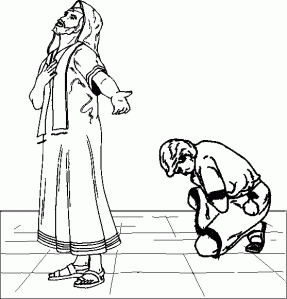 Our senior pastor Larry Buxton, who’s a baseball nut, says that parables are supposed to be stories that have a “late-breaking curveball.” He threw a curveball this past weekend with his sermon on the familiar parable of the Pharisee and tax collector in Luke 18:9-14. The Pharisee says, “I thank you God that I’m not like other people,” and the tax collector says, “Lord, have mercy on me, a sinner.” Pastor Larry shared that too often, we come away from this parable thinking that the moral of the story is to be more conspicuously self-deprecating in our prayer life. So we become people who say, “I thank you God that I’m a humble sinner, unlike those Pharisees who thank you that they’re not like other people.”
It’s very hard not to spend your spiritual life defining yourself against other people. Having grown up a moderate Southern Baptist in the midst of the fundamentalist takeover of our denomination, I have been thanking God that I’m not like those fundamentalists since before I knew how to read. To some degree, I haven’t rebelled against my upbringing so much as lived into the dissident that I was raised to be.
I don’t apologize for being zealous about sharing what God has shown me in my journey or for being anguished when people say and do things that make God look less beautiful than He is. But it has been a lifelong struggle to separate my zeal for God’s truth from my poisonous spiritual pride and tendency to make unfair presumptions about where other Christians are coming from when they appear to be engaged in Pharisaic pious posturing (which I of course do in my own slightly more ironicized way).
There’s a joke that a rabbi once shared with me about exhibitionist humility. One rabbi goes into his synagogue and throws himself down before God saying, “Lord, I am a worthless sinner. Have mercy on me.” Then another one comes in and does the same. But then the custodian who’s cleaning the church throws himself down and says he’s a worthless sinner too. And the first rabbi gets mad and says, “You’ve got some nerve trying to say you’re as worthless a sinner as I am.”
So what should be our takeaway from the parable of the Pharisee and the tax collector? Pastor Larry’s punchline was to say that it’s not about us, it’s about the merciful God that we share who forgives and restores the Pharisees and tax collectors alike. I definitely agree with that. I am also interested in why Jesus says about the tax collector, “This man went down to his home justified rather than the other” (Luke 18:14). What does justified mean in this case?
I think that the mistake that we make is to assume that we can justify ourselves before God by acting sufficiently humble and self-deprecating. The word “justify” that Jesus uses is the Greek word dikaio, which can really mean both to make a person just and to declare a person to be just. I don’t think we do justice to the justification that is central to Christian theology without letting the word live in the tension between the two meanings of dikaio.
It is true that Jesus’ sacrifice overwrites our guilty verdict for our sins and unilaterally pronounces us righteous. We desperately need to be justified by Christ as a starting point in order to have the safety to confess our sins openly and be liberated from our fearful defensiveness. But God’s arbitrary declaration of righteousness always has the purpose of making us just. And if there is no progress in that direction, it indicates that we didn’t really think the sins we confessed were all that sinful.
When Jesus says that the tax collector went home “justified” rather than the Pharisee, it means not only that he was declared just by the amnesty of God’s mercy, but that his posture of genuine brokenness in prayer meant that God would be able to make him just. In using that word dikaio, Jesus’ parable implies that God was changing the tax collector’s heart so that he wouldn’t jump back into the exact same sins that made him beat his breast before God.
If nothing about the tax collector’s life were to change after saying that prayer, that would show his exhibition of humility to be a mere performance, thanking God that he’s “humble” and not like that arrogant Pharisee. In that case, the Pharisee would actually be the “more righteous one” for justifying himself boldly and openly, rather than cloaking his self-satisfaction in pious self-deprecation.
The reason the Pharisee was not justified is because he didn’t think he needed God’s mercy for anything. People who don’t see anything wrong with themselves have plateaued in their standards of holiness. For too many of us, “sin” refers to the things we thank God that we don’t do like other people whether these things look more like “immorality” on the one hand or “bigotry” on the other. Sin is anything I’m doing that keeps me from being absolutely intimate with the God who is both perfectly loving and truthful.
Whenever we pray, Jesus is standing before us like he stood before the blind man in Mark 10:51, asking, “What do you want me to do for you?” When Jesus asks me what I want Him to do for me, too often my answer is something like: Oh nothing, I just wanted to say aloud all the bad things I’ve done this week so I could get them off my chest and feel better about myself. I’ll see you next week when I come to confess the exact same sins again.
Chad Holtz, a United Methodist pastor whom God delivered from addiction, makes a distinction between being “sorry” and being “broken” that I think is very important to consider:
An unbroken person will still try to justify themselves. They will offer what seems to them a good reason for being who they are and for doing what they do. They will blame their history, their culture, their parents, their church, their spouse, their kids, their job, and on and on. They will continue to insist that they have some rights. They will name certain conditions before they will act.
While doing all of this they may very well say they are sorry. But being sorry is not the same as being broken. And being sorry makes you just, well, sorry.
God can’t and won’t do anything with a sorry person. But He will do miracles with a broken one.
Again, the point here is not to wallow in self-deprecation. It is to long for integrity and intimacy with God, to hate everything I do that separates me from God, and to join God in battle against my sin recognizing that He is my chariot. Apart from Christ, pursuing integrity in my life would be an unbearably dissonant cycle of self-hatred from which I would understandably tire and settle into complacent self-satisfaction. But in Christ, I discover my true self, and I stop trying to defend the dumb things that I do, because they are not me, but betrayals of who I really am.
So the question to ask ourselves is this. Do we really desire God’s mercy for ourselves or are we just saying that we do as a way of saying that we’re not like those Christians who don’t like mercy? Let us ache to be rid of everything except for the mercy that is an even greater joy to give than to receive. Much remains within me that blocks the perfect flow of agape love that God would like to instill. Lord, have mercy on me, a sinner.
Previous Post

November 6, 2013
How I read the Bible differently than John MacArthur
Next Post
November 14, 2013 The United Methodist gay wedding crisis
Browse Our Archives
Select a Category Advent Beauty Will Save the World Bible Big Picture: Ephesians Bloggers Book Christian salvation and the Beautitudes Culture Daily Office Danceable Homiletics Deadly Sins Deep Roots: Genesis Devotions Dominican Republic May 2011 El Principio Misericordia (The Mercy Principle) Five verses God tattooed on my heart Fundraising FutureGospel Good Biblical Words Henri Nouwen Interview Jennings' Christian Imagination Jesus inside the beltway Jesus Is My Candidate Jesus vs the Pharisees Jesus vs. Plato Journey to Eternity Looking Back on 2012 Love Actually Monday Merton Monday Merton Music Occupy the manger On Earth As It Is In Heaven Original Sin Podcast Poetry Politics Prayer Psalm 119 Radical Jesus 101 Reviews Sermon on the Mount Sermons Spanish Bible study Special Series Spiritual but not religious Synchroblog Theology Things that made me think Thomas a Kempis Ugliness Into Beauty Uncategorized Viaje Dominicano 2013 Walking in the Valley (Lent) Welcome: It's More than a Mat Wild Goose 2013 Wrestling
Select a Month March 2022 January 2022 December 2021 September 2021 April 2021 September 2020 August 2020 July 2020 June 2020 May 2020 April 2020 March 2020 February 2020 January 2020 December 2019 November 2019 October 2019 September 2019 August 2019 June 2019 May 2019 April 2019 March 2019 February 2019 January 2019 December 2018 November 2018 October 2018 September 2018 August 2018 July 2018 June 2018 May 2018 April 2018 March 2018 February 2018 January 2018 December 2017 November 2017 October 2017 September 2017 August 2017 July 2017 June 2017 May 2017 April 2017 March 2017 February 2017 January 2017 December 2016 November 2016 October 2016 September 2016 August 2016 July 2016 June 2016 May 2016 April 2016 March 2016 February 2016 January 2016 December 2015 November 2015 October 2015 September 2015 August 2015 July 2015 June 2015 May 2015 April 2015 February 2015 January 2015 December 2014 November 2014 October 2014 September 2014 August 2014 July 2014 June 2014 May 2014 April 2014 March 2014 February 2014 January 2014 December 2013 November 2013 October 2013 September 2013 August 2013 July 2013 June 2013 May 2013 April 2013 March 2013 February 2013 January 2013 December 2012 November 2012 October 2012 September 2012 August 2012 July 2012 June 2012 May 2012 April 2012 February 2012 January 2012 December 2011 November 2011 October 2011 September 2011 August 2011 July 2011 June 2011 May 2011
Follow Us!
TAKE THE
Religious Wisdom Quiz
True or False: Solomon asked God for wisdom rather than wealth or long life.
Select your answer to see how you score.
TRUE FALSE
Related posts from Mercy Not Sacrifice

When God's A Cop, Every Cop Is God


"All People Are Holy": The Theology Of Alexandria...

Epimenides And The Plague Of Athens
TRENDING AT PATHEOS Progressive Christian

What Being a Modern-Day Apostle Means to Me
In my last column, I discussed the ins and outs of modern-day...

Did Ancient China Once Worship the God of...
Across human history, a common thread weaves through the origins of the...

Love Your Neighbor – Including Earth-Kin: Lev. 19,...
God’s command to love your neighbor means acting in an ethical and...

Lead a Church Study of “Jesus and Lao...
Guest writer Jack Thomas (The Irreverent Reverend) reflects on leading his church...

Pastoral Wisdom for Responding to Sermon Pushback
Getting sermon pushback on your social justice sermon? Learn practical, Proverbs-based strategies...

Principles for Understanding the Apostolic Ministry Today
Whenever people discover that my formal ministry title is "apostle," as in...
view all Progressive Christian blogs
Ad-Free & Subscriber Log-In Subscription Support
- About Us
- 2026 Calendar
- Videos
- Podcasts
- Library of World Religions
- Faith In Media Tracker
- Advertise With Us
- Write for Us
- Privacy Policy
- Terms of Service
- Do Not Sell My Data
- Contact Us
- Radiant Digital
- Manage Newsletter Subscriptions
- Unsubscribe From Notifications
- Sitemap
Copyright 2008-2026, Patheos. All rights reserved.
Subscription Support Ad-Free & Subscriber Log-In
Follow Patheos