
BuddhistCatholicContemplativeEvangelicalGeneral ChristianHinduJewishLatter-day SaintMuslimNew VisionsProgressive Christian
Beliefs
- Buddhist
- Catholic
- Contemplative
- Evangelical
- General Christian
- Hindu
- Jewish
- Latter-day Saint
- More Voices
- Muslim
- New Visions
- Pagan
- Progressive Christian
Topics
- Religion News
- Food and Religion
- Sports and Religion
- Religious Art
- Religious Music and Entertainment
- Religious Events
- History and Religion
- Style and Religion
- Politics and Religion
- Women in Religion
- Recreation Outdoors and Religion
- Business Finance and Religion
- Careers Workplace and Religion
- Education and Religion
- Family Parenting and Religion
- Health Fitness and Religion
- Home and Religion
- Relationships and Religion
- Technology and Religion
- Travel and Religion
Columnists
- Buddhist Columnists
- Business Finance and Religion Columnists
- Careers Workplace and Religion Columnists
- Catholic Columnists
- Contemplative Columnists
- Education and Religion Columnists
- Evangelists Columnists
- Family Parenting and Religion Columnists
- General Christian Columnists
- Health Fitness and Religion Columnists
- Hindu Columnists
- History and Religion Columnists
- Home and Religion Columnists
- Jewish Columnists
- More Voices Columnists
- Latter Day Columnists
- Muslim Columnists
- New Visions Columnists
- Nonreligious Columnists
- Pagan Columnists
- Politics and Religion Columnists
- Progressive Columnists
- Recreation Outdoors and Religion Columnists
- Relationships and Religion Columnists
- Religion News Columnists
- Religious Art Columnists
- Religious Events Columnists
- Religious Music and Entertainment Columnists
- Sports and Religion Columnists
- Style and Religion Columnists
- Technology and Religion Columnists
- Travel and Religion Columnists
- Women in Religion Columnists
Resource Library
- 2026 Calendar
- Library of World Religions
- The 100 Most Holy Places on Earth
- Patheos Answers
- Podcasts
- Videos
- Faith Leaders Database
- Anglican Episcopalian
- Bahai
- Baptist
- Buddhism
- Christianity
- Confucianism
- Eastern Orthodoxy
- Hinduism
- Holiness and Pentecostal
- ISKCON
- Islam
- Judaism
- Lutheran
- Methodist
- The Church of Jesus Christ of Latter-day Saints
- New Age
- Paganism
- Presbytarian and Reformed
- Protestantism
- Religion Behind the Scenes
- Roman Catholic
- Scientology
- Shia Islam
- Sikhism
- Sufism
- Sunni Islam
- Taoism
- Zen
- See all religions
Research Tools
 Ad-Free & Subscriber Log-In Subscription Support
Ad-Free & Subscriber Log-In Subscription Support
Follow Patheos 

- Trending:
- Forgiveness
- |
- Marriage
- |
- Consciousness
- |
- Death Penalty
- |
- Election
- |
- Halloween
 Mercy Not Sacrifice
-
More
- Home
- Progressive Christian
- How I read the Bible differently than John MacArthur
How I read the Bible differently than John MacArthur
Last updated on: July 17, 2014 at 2:00 pm by Morgan Guyton
How I read the Bible differently than John MacArthur 2014-07-17T14:00:52-05:00 Morgan Guyton
Patheos Explore the world's faith through different perspectives on religion and spirituality! Patheos has the views of the prevalent religions and spiritualities of the world.
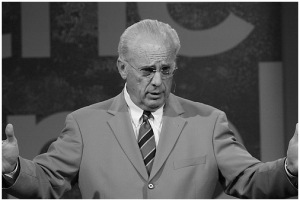 A friend pointed me to Tim Challies’ recent interview with John MacArthur in which MacArthur doubled down on the claims made in his Strange Fire conference condemning the charismatic movement in Christianity. While I don’t have time to consider MacArthur’s scriptural arguments exhaustively, one of the passages he used to support his cessationist view that the Holy Spirit has stopped revealing things to people in the way that happened in Biblical times is Ephesians 2:20. I find his use of this passage providentially ironic and a good opportunity to illustrate how differently we read the Bible.
Here is how MacArthur cites Ephesians 2:20 in his interview:
When did the gifts cease? One important passage that helps answer that question is Ephesians 2:20, which explains that apostles and New Testament prophets were the “foundation” upon which the church was being built. Before the canon of Scripture was complete, that foundation was still being laid through the apostles and prophets, and through the miraculous and revelatory gifts that accompanied and authenticated their ministries. But once the foundation was laid, those offices and gifts passed away. To follow Paul’s metaphor, the foundation is not something that is rebuilt at every phase of construction. It is laid only once.
It is true that Paul talks about a “foundation” of the prophets and apostles in Ephesians 2:20 (though he doesn’t mention spiritual gifts or give any commentary about their purpose). The question is what purpose does Paul’s metaphor serve. Is Paul making the argument that MacArthur is using him for? In the image Paul is creating, is the important thing about the “foundation” the fact that no impurities should be mixed with it? Is Paul concerned with setting boundaries for the canon? Or has this concern been anachronistically projected onto a metaphor with a very different purpose?
If we look at Ephesians 2:19-22, it gives us enough context to consider the image as a whole:
Consequently, you are no longer foreigners and strangers, but fellow citizens with God’s people and also members of his household, built on the foundation of the apostles and prophets, with Christ Jesus himself as the chief cornerstone. In him the whole building is joined together and rises to become a holy temple in the Lord. And in him you too are being built together to become a dwelling in which God lives by his Spirit.
This section of Paul’s letter is addressed to the Gentiles who had been excluded from the Jewish community prior to Christ’s coming. He is saying that they are now members of the same household and even part of the structure of the temple of God. The purpose of describing the foundation of the apostles and prophets is to say that the Gentiles are part of the same building as they are. So Paul is attributing to them an incredible honor: to become the Holy Spirit’s dwelling-place along with the apostles and prophets. It is amazingly ironic that John MacArthur chose this passage as a proof-text for cessationism because Paul is saying the exact opposite of what MacArthur is claiming!
If God’s temple were built according to John MacArthur’s specifications, it would be a concrete slab of foundation without anything on top of it. Can a foundation with no walls or roof become a dwelling-place for God’s Spirit? Paul seems to be saying pretty plainly here that the temple needs to include the Gentiles who had been foreigners and strangers in order to be a complete building. The most straightforward interpretation of Paul’s metaphor is that the church is a temple which continues to be built.
Sure, the foundation is set. I don’t dispute that. But the foundation is the starting point, not the entirety of everything the Holy Spirit has to say to God’s people. What I tell my congregation is that God teaches us His language in the Bible so that we can hear Him speak in the world around us today. He hasn’t stopped talking. While the vast library of beautiful Christian writing should not be confused with our foundation in the scriptures, we should not despise the riches that have been derived from but ultimately say more than scripture itself. Even writers and thinkers who ferociously disagree like Augustine and Jerome or Whitefield and Wesley each have a lot to teach us without one necessarily being right and the other being wrong.
One of the responses to MacArthur’s conference that I most strongly disagreed with was that of Trevin Wax. He says:
Unfortunately, much of the controversy surrounding this conference seemed to me less like continualists and cessationists making the case for their respective positions and more like postmodern aversion to saying someone could be right or wrong. In fact, some of the criticism launched at MacArthur seemed to imply that MacArthur is wrong simply for being so sure he is right. As if certainty or confidence is at odds with humility.
Wax is applying a very broad brush-stroke with the bogeyman label of “postmodernity” and appealing to a very simplistic conception of truth. Jesus didn’t have a lot of respect for the either/or questions that the Pharisees tried to use to entrap him (“Teacher, is it true or false that the Holy Spirit stopped giving charismatic gifts when the canon was closed?”). He always refused to answer those types of questions directly and usually answered them with questions of his own. That should tell us something about the nature of God’s truth.
Could it be that God isn’t scandalized if different Christians believe different things within a range of orthodoxy according to their giftings, the particularities of their spiritual journeys, and the mission fields to which they have been called? Don’t you give your five year old son a different oversimplification of the same answer that you give him when he’s 12 and when he’s 30? Do you describe concepts in the exact same way to your friend who’s a concert pianist and to your friend who’s an astrophysicist?
When I started out college in the engineering school, I discovered the world of reformed theology that I had never encountered before, because apparently engineering majors who are evangelical really love reformed theology. I spent the first two years of college completely immersed in their world. In engineering, there is one right way to wire a circuit, build a bridge, or design a building, and if you deviate from the one right way by an inch or two, then all of your work has been a complete failure and you have to start over.
When I transferred to the English department, the Trevin Waxes and John MacArthurs were nowhere to be found. I suspect this is because English majors hate anything that smells like reductionism in the interpretation of a work of art. It’s not because English majors are all “postmodern” nihilists making the claim that any literary interpretation is just as good as any other. It just seems disrespectful to truth to claim that I can explain everything about a book in a single page or even in several hundred pages and thus exhaust all of its interpretive possibility. What’s arrogant is not to be passionate about the truth, but to act like I’m the one who has given the final word.
The more truth is in a work of literature, the more impossible it should be to capture its interpretation conclusively (which would indicate there was no reason to read it ever again). If the Bible really is the truth that we believe that it is, it should produce endless conversation that doesn’t seek to cut itself off with conclusions or resolutions so much as to dive into greater depths of epiphany.
It seems that Christians like John MacArthur and Trevin Wax want to figure out the exact right size, shape, and color for the identical bricks that should be stacked up to build the temple of God on top of the foundation of scripture. The Bible never says that we’re all supposed to be the exact same bricks. Paul does say to be careful what we lay on top of the foundation in 1 Corinthians 3:12, and we certainly should. 1 Peter 2:5 uses the wonderfully strange image of “living stones” for what we are. But living stones are not necessarily all the exact same shape and size. 1 Corinthians 12 certainly suggests that every part of the body is supposed to be shaped differently.
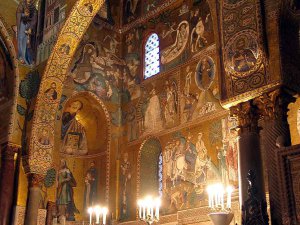 I happen to suspect that God doesn’t want a dull, Soviet-looking red brick box of a temple. One of the most beautiful churches I’ve ever entered was the Russian Orthodox Cathedral of St. John the Baptist in Washington, DC. The walls are covered in icons of saints. It was immensely more beautiful than the generic auditoriums of suburban megachurchianity.
Each of us is an icon of God, made to radiate His image through a unique filter that has been sullied but not destroyed by our sin. As we allow ourselves to be built into Christ, God polishes our icons so that we start to shine again the way we were always supposed to do. I suspect that if you ever have the opportunity to step inside an Orthodox church, you’ll agree with me that God is building His temple with icons, not bricks. And it’s okay with me if John MacArthur is an icon on that wall. I just don’t think he’s the template for the bricks that everyone else is supposed to be chiseled into.
Previous Post

November 5, 2013
A litmus test of Christian morality: the film North Country
Browse Our Archives
Select a Category Advent Beauty Will Save the World Bible Big Picture: Ephesians Bloggers Book Christian salvation and the Beautitudes Culture Daily Office Danceable Homiletics Deadly Sins Deep Roots: Genesis Devotions Dominican Republic May 2011 El Principio Misericordia (The Mercy Principle) Five verses God tattooed on my heart Fundraising FutureGospel Good Biblical Words Henri Nouwen Interview Jennings' Christian Imagination Jesus inside the beltway Jesus Is My Candidate Jesus vs the Pharisees Jesus vs. Plato Journey to Eternity Looking Back on 2012 Love Actually Monday Merton Monday Merton Music Occupy the manger On Earth As It Is In Heaven Original Sin Podcast Poetry Politics Prayer Psalm 119 Radical Jesus 101 Reviews Sermon on the Mount Sermons Spanish Bible study Special Series Spiritual but not religious Synchroblog Theology Things that made me think Thomas a Kempis Ugliness Into Beauty Uncategorized Viaje Dominicano 2013 Walking in the Valley (Lent) Welcome: It's More than a Mat Wild Goose 2013 Wrestling
Select a Month March 2022 January 2022 December 2021 September 2021 April 2021 September 2020 August 2020 July 2020 June 2020 May 2020 April 2020 March 2020 February 2020 January 2020 December 2019 November 2019 October 2019 September 2019 August 2019 June 2019 May 2019 April 2019 March 2019 February 2019 January 2019 December 2018 November 2018 October 2018 September 2018 August 2018 July 2018 June 2018 May 2018 April 2018 March 2018 February 2018 January 2018 December 2017 November 2017 October 2017 September 2017 August 2017 July 2017 June 2017 May 2017 April 2017 March 2017 February 2017 January 2017 December 2016 November 2016 October 2016 September 2016 August 2016 July 2016 June 2016 May 2016 April 2016 March 2016 February 2016 January 2016 December 2015 November 2015 October 2015 September 2015 August 2015 July 2015 June 2015 May 2015 April 2015 February 2015 January 2015 December 2014 November 2014 October 2014 September 2014 August 2014 July 2014 June 2014 May 2014 April 2014 March 2014 February 2014 January 2014 December 2013 November 2013 October 2013 September 2013 August 2013 July 2013 June 2013 May 2013 April 2013 March 2013 February 2013 January 2013 December 2012 November 2012 October 2012 September 2012 August 2012 July 2012 June 2012 May 2012 April 2012 February 2012 January 2012 December 2011 November 2011 October 2011 September 2011 August 2011 July 2011 June 2011 May 2011
Follow Us!
TAKE THE
Religious Wisdom Quiz
What currency did Judas receive for betraying Jesus?
Select your answer to see how you score.
Copper Silver Bronze Gold
Related posts from Mercy Not Sacrifice

When God's A Cop, Every Cop Is God


"All People Are Holy": The Theology Of Alexandria...

Epimenides And The Plague Of Athens
TRENDING AT PATHEOS Progressive Christian

Why Christians Have a Sacred Duty to Vote:...
The Bible offers strong support for the sacred duty to vote. Here...

What Being a Modern-Day Apostle Means to Me
In my last column, I discussed the ins and outs of modern-day...

Did Ancient China Once Worship the God of...
Across human history, a common thread weaves through the origins of the...

Love Your Neighbor – Including Earth-Kin: Lev. 19,...
God’s command to love your neighbor means acting in an ethical and...

Lead a Church Study of “Jesus and Lao...
Guest writer Jack Thomas (The Irreverent Reverend) reflects on leading his church...

Principles for Understanding the Apostolic Ministry Today
Whenever people discover that my formal ministry title is "apostle," as in...
view all Progressive Christian blogs
Ad-Free & Subscriber Log-In Subscription Support
- About Us
- 2026 Calendar
- Videos
- Podcasts
- Library of World Religions
- Faith In Media Tracker
- Advertise With Us
- Write for Us
- Privacy Policy
- Terms of Service
- Do Not Sell My Data
- Contact Us
- Radiant Digital
- Manage Newsletter Subscriptions
- Unsubscribe From Notifications
- Sitemap
Copyright 2008-2026, Patheos. All rights reserved.
Subscription Support Ad-Free & Subscriber Log-In
Follow Patheos