
BuddhistCatholicContemplativeEvangelicalGeneral ChristianHinduJewishLatter-day SaintMuslimNew VisionsProgressive Christian
Beliefs
- Buddhist
- Catholic
- Contemplative
- Evangelical
- General Christian
- Hindu
- Jewish
- Latter-day Saint
- More Voices
- Muslim
- New Visions
- Pagan
- Progressive Christian
Topics
- Religion News
- Food and Religion
- Sports and Religion
- Religious Art
- Religious Music and Entertainment
- Religious Events
- History and Religion
- Style and Religion
- Politics and Religion
- Women in Religion
- Recreation Outdoors and Religion
- Business Finance and Religion
- Careers Workplace and Religion
- Education and Religion
- Family Parenting and Religion
- Health Fitness and Religion
- Home and Religion
- Relationships and Religion
- Technology and Religion
- Travel and Religion
Columnists
- Buddhist Columnists
- Business Finance and Religion Columnists
- Careers Workplace and Religion Columnists
- Catholic Columnists
- Contemplative Columnists
- Education and Religion Columnists
- Evangelists Columnists
- Family Parenting and Religion Columnists
- General Christian Columnists
- Health Fitness and Religion Columnists
- Hindu Columnists
- History and Religion Columnists
- Home and Religion Columnists
- Jewish Columnists
- More Voices Columnists
- Latter Day Columnists
- Muslim Columnists
- New Visions Columnists
- Nonreligious Columnists
- Pagan Columnists
- Politics and Religion Columnists
- Progressive Columnists
- Recreation Outdoors and Religion Columnists
- Relationships and Religion Columnists
- Religion News Columnists
- Religious Art Columnists
- Religious Events Columnists
- Religious Music and Entertainment Columnists
- Sports and Religion Columnists
- Style and Religion Columnists
- Technology and Religion Columnists
- Travel and Religion Columnists
- Women in Religion Columnists
Resource Library
- 2026 Calendar
- Library of World Religions
- The 100 Most Holy Places on Earth
- Patheos Answers
- Podcasts
- Videos
- Faith Leaders Database
- Anglican Episcopalian
- Bahai
- Baptist
- Buddhism
- Christianity
- Confucianism
- Eastern Orthodoxy
- Hinduism
- Holiness and Pentecostal
- ISKCON
- Islam
- Judaism
- Lutheran
- Methodist
- The Church of Jesus Christ of Latter-day Saints
- New Age
- Paganism
- Presbytarian and Reformed
- Protestantism
- Religion Behind the Scenes
- Roman Catholic
- Scientology
- Shia Islam
- Sikhism
- Sufism
- Sunni Islam
- Taoism
- Zen
- See all religions
Research Tools
 Ad-Free & Subscriber Log-In Subscription Support
Ad-Free & Subscriber Log-In Subscription Support
Follow Patheos 

- Trending:
- Forgiveness
- |
- Marriage
- |
- Consciousness
- |
- Death Penalty
- |
- Election
- |
- Halloween
 Mercy Not Sacrifice
-
More
- Home
- Progressive Christian
- Singing songs of Zion in Babylon
Singing songs of Zion in Babylon
Last updated on: July 17, 2014 at 2:00 pm by Morgan Guyton
Singing songs of Zion in Babylon 2014-07-17T14:00:58-05:00 Morgan Guyton
Patheos Explore the world's faith through different perspectives on religion and spirituality! Patheos has the views of the prevalent religions and spiritualities of the world.
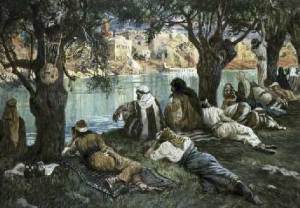 For the month of October, our LifeSign service at Burke United Methodist Church is journeying through a sermon series “By the rivers of Babylon: how to live as a people in exile.” My first sermon on October 6th looked at Psalm 137. Here is the audio podcast with some additional commentary below:
Psalm 137:4 asks the question, “How can we sing the Lord’s song in a foreign land?” To the Babylonians who captured the Israelites, their songs of Zion were a potential source of entertainment: “For there our captors asked us for songs, and our tormentors asked for mirth, saying, ‘Sing us one of the songs of Zion!'” The Israelites naturally resented their sacred songs being treated as objects of “mirth” for their tormentors. Many of these songs were geographically bound to the city of Jerusalem; they would sing them on the procession up the hill to Jerusalem on the great festival days.
This psalm reminds me of the Harlem Renaissance that was my favorite unit of literature to teach about as an English teacher. In the roaring twenties, rich white people would go to nightclubs in Harlem like the Cotton Club to be entertained by black performers like Duke Ellington and Josephine Baker. There were also black poets like Langston Hughes, Countee Cullen, Jean Toomer, or James Weldon Johnson who were often financially supported by rich white patrons.
Many of the rich white folks wanted the “mirth” of black culture without the reality of the Babylonian cruelty they had suffered. But the black intellectuals in the Harlem Renaissance revolted against the paternalism of the whites who were financing them. The rich whites wanted jazz and sexy, scantily clad cabaret singers, not words like these from Langston Hughes’s poem “Christ in Alabama”:
Christ is a n***er,
Beaten and black:
Oh, bare your back!Mary is His mother:
Mammy of the South,
Silence your mouth.God is His father:
White Master above
Grant Him your love.Most holy bastard
Of the bleeding mouth,
N***er Christ
On the cross
Of the South.
The paradox of the black Christian experience in America is that their songs of Zion came directly out of their experience of Babylonian oppression in the form of slavery, segregation, and racism. James Cones explains in his book The Spirituals and The Blues how black people came up with spirituals to praise God on the slave plantations not as an act of “mirth,” but as an act of survival, very much like the psalmist in 137 who makes a new song of Zion to stay together as a people in a foreign land: “If I forget you, O Jerusalem, let my right hand wither! Let my tongue cling to the roof of my mouth, if I do not remember you, if I do not set Jerusalem above my highest joy” (vv. 5-6).
I have had little first-hand experience of black Christianity, but in the white Christianity where I live, too often we presume that worship is supposed to be about “mirth.” In high school and college, you could always tell who the Christians were by the way they always smiled and had sunny dispositions. Singing songs about Jesus can get subsumed under a suffocating saccharine facade of “positive and encouraging.”
I don’t want to dis anyone who is bright and shiny because they have a genuinely hopeful attitude. I have a friend named Beth who constantly radiates joy in a way that I cannot be cynical about because I know how pure her heart is. But I do want to say something to people who feel like their churches are filled with Babylonians watching them and demanding that they put sufficient mirth into their praise songs. Worship is not about mirth; it’s about clinging to the hope of Jerusalem. In our case, Jerusalem is not a place we remember fondly, but a new Jerusalem where God will dry every tear and right every wrong.
So we sing to live in the reality of this new Jerusalem even as we walk the streets of Babylon. And as we sing our songs of Zion, God draws us into His joy even if the circumstances of our lives do not furnish any rational cause to be joyful. It is a joy that can coexist right in the midst of our real-life suffering and carry us through it.
I guess the last thing to say is that the closing of this psalm should be a comfort to us, as jarring as it is. “Happy shall they be who take your little ones and dash them against the rock!” (v. 9). What a horrible wish to have! It’s probably exactly what the Babylonians did to the babies of the Israelites who were too much of a burden to be marched into exile with their parents. But the fact that the psalm ends this way means that God doesn’t expect us to put a happy ending on our songs. It’s okay if we’re still hurt, still confused, still angry. God can handle our rage. He’s not going to obey it, but He can absorb it into Himself. That’s precisely what He did on the cross.
Previous Post

October 16, 2013
A second chance to love a stranger
Next Post
October 18, 2013 Isaiah 7 & 53: should prophecies be prooftexts?
Browse Our Archives
Select a Category Advent Beauty Will Save the World Bible Big Picture: Ephesians Bloggers Book Christian salvation and the Beautitudes Culture Daily Office Danceable Homiletics Deadly Sins Deep Roots: Genesis Devotions Dominican Republic May 2011 El Principio Misericordia (The Mercy Principle) Five verses God tattooed on my heart Fundraising FutureGospel Good Biblical Words Henri Nouwen Interview Jennings' Christian Imagination Jesus inside the beltway Jesus Is My Candidate Jesus vs the Pharisees Jesus vs. Plato Journey to Eternity Looking Back on 2012 Love Actually Monday Merton Monday Merton Music Occupy the manger On Earth As It Is In Heaven Original Sin Podcast Poetry Politics Prayer Psalm 119 Radical Jesus 101 Reviews Sermon on the Mount Sermons Spanish Bible study Special Series Spiritual but not religious Synchroblog Theology Things that made me think Thomas a Kempis Ugliness Into Beauty Uncategorized Viaje Dominicano 2013 Walking in the Valley (Lent) Welcome: It's More than a Mat Wild Goose 2013 Wrestling
Select a Month March 2022 January 2022 December 2021 September 2021 April 2021 September 2020 August 2020 July 2020 June 2020 May 2020 April 2020 March 2020 February 2020 January 2020 December 2019 November 2019 October 2019 September 2019 August 2019 June 2019 May 2019 April 2019 March 2019 February 2019 January 2019 December 2018 November 2018 October 2018 September 2018 August 2018 July 2018 June 2018 May 2018 April 2018 March 2018 February 2018 January 2018 December 2017 November 2017 October 2017 September 2017 August 2017 July 2017 June 2017 May 2017 April 2017 March 2017 February 2017 January 2017 December 2016 November 2016 October 2016 September 2016 August 2016 July 2016 June 2016 May 2016 April 2016 March 2016 February 2016 January 2016 December 2015 November 2015 October 2015 September 2015 August 2015 July 2015 June 2015 May 2015 April 2015 February 2015 January 2015 December 2014 November 2014 October 2014 September 2014 August 2014 July 2014 June 2014 May 2014 April 2014 March 2014 February 2014 January 2014 December 2013 November 2013 October 2013 September 2013 August 2013 July 2013 June 2013 May 2013 April 2013 March 2013 February 2013 January 2013 December 2012 November 2012 October 2012 September 2012 August 2012 July 2012 June 2012 May 2012 April 2012 February 2012 January 2012 December 2011 November 2011 October 2011 September 2011 August 2011 July 2011 June 2011 May 2011
Follow Us!
TAKE THE
Religious Wisdom Quiz
I hid two spies on my roof and tied a scarlet cord in my window to save my family. Who am I?
Select your answer to see how you score.
Ruth Tamar Rahab Deborah
Related posts from Mercy Not Sacrifice

When God's A Cop, Every Cop Is God


The Light That Will Not Be Seized
Home (A Poem About A Mother Who Waits)
TRENDING AT PATHEOS Progressive Christian

What Being a Modern-Day Apostle Means to Me
In my last column, I discussed the ins and outs of modern-day...

Did Ancient China Once Worship the God of...
Across human history, a common thread weaves through the origins of the...

Love Your Neighbor – Including Earth-Kin: Lev. 19,...
God’s command to love your neighbor means acting in an ethical and...

Lead a Church Study of “Jesus and Lao...
Guest writer Jack Thomas (The Irreverent Reverend) reflects on leading his church...

Pastoral Wisdom for Responding to Sermon Pushback
Getting sermon pushback on your social justice sermon? Learn practical, Proverbs-based strategies...

Principles for Understanding the Apostolic Ministry Today
Whenever people discover that my formal ministry title is "apostle," as in...
view all Progressive Christian blogs
Ad-Free & Subscriber Log-In Subscription Support
- About Us
- 2026 Calendar
- Videos
- Podcasts
- Library of World Religions
- Faith In Media Tracker
- Advertise With Us
- Write for Us
- Privacy Policy
- Terms of Service
- Do Not Sell My Data
- Contact Us
- Radiant Digital
- Manage Newsletter Subscriptions
- Unsubscribe From Notifications
- Sitemap
Copyright 2008-2026, Patheos. All rights reserved.
Subscription Support Ad-Free & Subscriber Log-In
Follow Patheos