
BuddhistCatholicContemplativeEvangelicalGeneral ChristianHinduJewishLatter-day SaintMuslimNew VisionsProgressive Christian
Beliefs
- Buddhist
- Catholic
- Contemplative
- Evangelical
- General Christian
- Hindu
- Jewish
- Latter-day Saint
- More Voices
- Muslim
- New Visions
- Pagan
- Progressive Christian
Topics
- Religion News
- Food and Religion
- Sports and Religion
- Religious Art
- Religious Music and Entertainment
- Religious Events
- History and Religion
- Style and Religion
- Politics and Religion
- Women in Religion
- Recreation Outdoors and Religion
- Business Finance and Religion
- Careers Workplace and Religion
- Education and Religion
- Family Parenting and Religion
- Health Fitness and Religion
- Home and Religion
- Relationships and Religion
- Technology and Religion
- Travel and Religion
Columnists
- Buddhist Columnists
- Business Finance and Religion Columnists
- Careers Workplace and Religion Columnists
- Catholic Columnists
- Contemplative Columnists
- Education and Religion Columnists
- Evangelists Columnists
- Family Parenting and Religion Columnists
- General Christian Columnists
- Health Fitness and Religion Columnists
- Hindu Columnists
- History and Religion Columnists
- Home and Religion Columnists
- Jewish Columnists
- More Voices Columnists
- Latter Day Columnists
- Muslim Columnists
- New Visions Columnists
- Nonreligious Columnists
- Pagan Columnists
- Politics and Religion Columnists
- Progressive Columnists
- Recreation Outdoors and Religion Columnists
- Relationships and Religion Columnists
- Religion News Columnists
- Religious Art Columnists
- Religious Events Columnists
- Religious Music and Entertainment Columnists
- Sports and Religion Columnists
- Style and Religion Columnists
- Technology and Religion Columnists
- Travel and Religion Columnists
- Women in Religion Columnists
Resource Library
- 2026 Calendar
- Library of World Religions
- The 100 Most Holy Places on Earth
- Patheos Answers
- Podcasts
- Videos
- Faith Leaders Database
- Anglican Episcopalian
- Bahai
- Baptist
- Buddhism
- Christianity
- Confucianism
- Eastern Orthodoxy
- Hinduism
- Holiness and Pentecostal
- ISKCON
- Islam
- Judaism
- Lutheran
- Methodist
- The Church of Jesus Christ of Latter-day Saints
- New Age
- Paganism
- Presbytarian and Reformed
- Protestantism
- Religion Behind the Scenes
- Roman Catholic
- Scientology
- Shia Islam
- Sikhism
- Sufism
- Sunni Islam
- Taoism
- Zen
- See all religions
Research Tools
 Ad-Free & Subscriber Log-In Subscription Support
Ad-Free & Subscriber Log-In Subscription Support
Follow Patheos 

- Trending:
- Forgiveness
- |
- Marriage
- |
- Consciousness
- |
- Death Penalty
- |
- Election
- |
- Halloween
 Mercy Not Sacrifice
-
More
- Home
- Progressive Christian
- Journey to Eternity: our next sermon series
Journey to Eternity: our next sermon series
Last updated on: July 17, 2014 at 2:13 pm by Morgan Guyton
Journey to Eternity: our next sermon series 2014-07-17T14:13:23-05:00 Morgan Guyton
Patheos Explore the world's faith through different perspectives on religion and spirituality! Patheos has the views of the prevalent religions and spiritualities of the world.
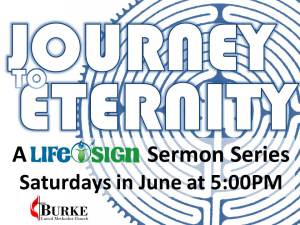
Tomorrow night I will be starting a new sermon series at LifeSign called the Journey to Eternity. My hope is to offer a fresh perspective on eternal life that is more faithful to what the Bible actually teaches than the depictions of eternal life in popular Christian discourse which have created so many stumbling blocks for people who are seeking God’s truth with sincerity.
In popular Christian discourse, eternal life is often assumed to be equivalent to the afterlife. It is understood as a reward or punishment for our life on Earth. When all of Christianity is reduced to the goal of acquiring an afterlife reward instead of a punishment, then getting saved in a decisive and official way isn’t really any different than the responsibility of talking with a financial planner in your mid-thirties to find the right investment portfolio so you can have the reward of a comfortable retirement. This is why the personal afterlife insurance gospel plays so well in suburbia and also why it disgusts many Christian young adults if they ever leave the protective subculture and have to think for themselves.
But this reductionist reward/punishment understanding of eternal life doesn’t have much to say about how Jesus actually talks about eternal life. He tells the woman at the well in John 4:14 that when people accept the living water he has to offer, it “will become in them a spring of water gushing up to eternal life.” I don’t think that we should wave away this passage and say oh, he’s just using fancy figurative language to talk about people going to heaven when they die. That would be a very clumsy, shallow way of reading the Bible.
There’s clearly a reality represented by this living water that satisfies the human spirit in such a powerful and complete way that it’s akin to drinking water that permanently satisfies someone’s thirst. If we stay within the metaphor, then eternal life is defined as the condition of finding the permanent spiritual nourishment of Jesus’ living water.
In John 17:3, Jesus says, “This is eternal life: that they may know you the only true God and Jesus Christ, whom you have sent.” Eternal life is not a reward that you get for knowing God; it is knowing God. The reward is the divine communion itself. It is experiencing the perfect intimacy for which we were created and without which we jump from one inadequate coping strategy to the next.
If eternal life is to know God, then the goal of life should be simply to know God as opposed to doing or saying whatever it takes to gain admission into Six Flags Heaven. When we understand the goal of life in these terms, it reframes how we think about the problem of the human condition. The main problem, as I preached in my sermon last weekend, is that our sin causes us to be “alienated from the life of God [i.e. eternal life] because of [the] ignorance and hardness of heart [that it causes]” (Ephesians 4:18).
Our alienation from God will become a darkness as thick and complete as hell if nothing happens to address it before we die. The problem is not that God is an inflexible bureaucrat who has some particular formulaic prayer or other “proof” that He’s waiting to observe in us before He puts our name on the special pass list for Six Flags Heaven. The problem is that we don’t trust God, and without that trust, we “will not see life” because “God’s wrath remains upon [us]” (John 3:36, my translation). Wrath is the word for how people receive God’s fiery passionate love when they don’t want anything to do with it.
God is perfectly hospitable, loving, and merciful, but we simply cannot enter into the eternal life that allows us to see God for who He really is without being given the ability to trust in Him. Our basic human problem is our lack of trust in God and the alienation this causes. To me, it’s important to explain that our problem doesn’t have anything to do with any deficit of beauty in God’s nature or the need for certain systematic theologians or megachurch pastors to retain their intellectual property rights over God’s nature and plug Him into the clumsy binaries of a theological system that goes adrift from its Biblical faithfulness insofar as it turns mercy and justice or holiness and love into opposites.
God is perfectly loving because He’s so holy. And His mercy is the most just response to the impossible mess of entangled culpabilities and mitigating circumstances that those of us who think we have clean noses would like to oversimplify so that we can justify ourselves. God’s grace is always absolutely unconditional, and its abundance is nothing less than infinite; there is nothing that needs to be “held in tension with it.”
But just because God is love doesn’t mean that He will lobotomize us into zombies who are programmed to desire eternity with Him. He has to win us over from our preference for cheap thrills, self-destruction, and isolation; honestly, it’s a very hard sell. Throughout the centuries, His people dissed Him for phantom gods who were more exotic and self-validating of like Baal and Asherah. But God decided to give it His best shot, so He sent us Jesus so that anyone’s trust that He gained through Him would not perish but have eternal life.
June 8th: The human problem with trusting God is where the sermon series will start, in the Garden of Eden, where the man whose Hebrew name is humanity (adam) and his wife (who didn’t get named Eve until after the story) decided not to trust God and as a result lost the wonder and delight in God that is supposed to be our existence. We will try to read the story with fresh eyes and put aside some of the interpretive legacy of Western Christianity that has tried to make the text fit its doctrine, instead taking our cue from the text’s natural emphases. Adam and Eve tell us what all of us as humans lose and need to regain.
June 15th: The next place we’ll go is to look at the gift of God’s Torah, which is way more than just a set of rules. It rather describes a way of life that seeks God’s heart and embraces the laws and principles that hold together His created order. This Torah has been a major source of eternal life for Jewish people throughout the centuries, but it is easily abused and turned into a means of self-exaltation and social hierarchy.
June 22th: Hence, we will next look at how God used His prophets to provide further insight into the eternal life He wanted His people to enjoy, to explain that the point of all the animal sacrifices and the rest of His elaborate system of ritual was not to appease a capricious bloodthirsty tyrant, but because God wanted His people to have concrete, physical means by which they could put their sin to death and experience the true repentance of a “contrite spirit” which would allow them to pursue “justice, mercy, and humility.”
June 29th: The week after that, we will look at a very special prophecy in Isaiah 53 about a suffering servant who would come and deliver His people from their sins. This prophecy can be understood to describe both the identity of God’s people, the God-wrestlers (Israel) in general as well as the identity of Jesus Christ. The way to eternal life is through the suffering servant both in what He does for us and what we do with Him.
July 6th: The weekend of July 6th and 7th will involve an overlap of two sermon series since I’m preaching both Saturday and Sunday. The topic for Sunday’s series is hospitality. And honestly, I cannot think of a better frame for describing what Jesus does for us. He is the one who welcomes us to God’s banquet and provides the means through His life, death, and resurrection for us to get there. In the words of John 14:3, He is the one who “goes to prepare a place for us,” the ultimate host. Eternal life is living in God’s hospitality both in the sense of receiving it graciously and being a vessel by which He shares it with others.
July 13th: The next week provides an opportunity for us to talk about the eternal life we experience through our incorporation into the living body of Christ and through the continuance of God’s Pentecostal outpouring of the Holy Spirit. This will provide an opportunity for us to talk about the sacraments and other means of God’s grace by which we experience eternal life in community with other disciples.
July 20th: In the final week of our series, we will explore what the Bible has to say about the ultimate consummation and glorification of God’s kingdom. Eternal life is both a present and a future reality. Though I’m seeking to transcend a tacky punishment/reward paradigm for describing the goal of intimacy with God, I do think that our hope in God’s ultimate victory is a very legitimate and important aspect of our faith.
Next Post

June 8, 2013 The Male Gaze: Attraction vs. Lust
Browse Our Archives
Select a Category Advent Beauty Will Save the World Bible Big Picture: Ephesians Bloggers Book Christian salvation and the Beautitudes Culture Daily Office Danceable Homiletics Deadly Sins Deep Roots: Genesis Devotions Dominican Republic May 2011 El Principio Misericordia (The Mercy Principle) Five verses God tattooed on my heart Fundraising FutureGospel Good Biblical Words Henri Nouwen Interview Jennings' Christian Imagination Jesus inside the beltway Jesus Is My Candidate Jesus vs the Pharisees Jesus vs. Plato Journey to Eternity Looking Back on 2012 Love Actually Monday Merton Monday Merton Music Occupy the manger On Earth As It Is In Heaven Original Sin Podcast Poetry Politics Prayer Psalm 119 Radical Jesus 101 Reviews Sermon on the Mount Sermons Spanish Bible study Special Series Spiritual but not religious Synchroblog Theology Things that made me think Thomas a Kempis Ugliness Into Beauty Uncategorized Viaje Dominicano 2013 Walking in the Valley (Lent) Welcome: It's More than a Mat Wild Goose 2013 Wrestling
Select a Month March 2022 January 2022 December 2021 September 2021 April 2021 September 2020 August 2020 July 2020 June 2020 May 2020 April 2020 March 2020 February 2020 January 2020 December 2019 November 2019 October 2019 September 2019 August 2019 June 2019 May 2019 April 2019 March 2019 February 2019 January 2019 December 2018 November 2018 October 2018 September 2018 August 2018 July 2018 June 2018 May 2018 April 2018 March 2018 February 2018 January 2018 December 2017 November 2017 October 2017 September 2017 August 2017 July 2017 June 2017 May 2017 April 2017 March 2017 February 2017 January 2017 December 2016 November 2016 October 2016 September 2016 August 2016 July 2016 June 2016 May 2016 April 2016 March 2016 February 2016 January 2016 December 2015 November 2015 October 2015 September 2015 August 2015 July 2015 June 2015 May 2015 April 2015 February 2015 January 2015 December 2014 November 2014 October 2014 September 2014 August 2014 July 2014 June 2014 May 2014 April 2014 March 2014 February 2014 January 2014 December 2013 November 2013 October 2013 September 2013 August 2013 July 2013 June 2013 May 2013 April 2013 March 2013 February 2013 January 2013 December 2012 November 2012 October 2012 September 2012 August 2012 July 2012 June 2012 May 2012 April 2012 February 2012 January 2012 December 2011 November 2011 October 2011 September 2011 August 2011 July 2011 June 2011 May 2011
Follow Us!
TAKE THE
Religious Wisdom Quiz
Who became king after David and built the first Temple in Jerusalem?
Select your answer to see how you score.
Rehoboam Adonijah Solomon Absalom
Related posts from Mercy Not Sacrifice


When God's A Cop, Every Cop Is God


Why Kevin DeYoung's "Culture War Strategy" Fails
TRENDING AT PATHEOS Progressive Christian

What Being a Modern-Day Apostle Means to Me
In my last column, I discussed the ins and outs of modern-day...

Did Ancient China Once Worship the God of...
Across human history, a common thread weaves through the origins of the...

Love Your Neighbor – Including Earth-Kin: Lev. 19,...
God’s command to love your neighbor means acting in an ethical and...

Lead a Church Study of “Jesus and Lao...
Guest writer Jack Thomas (The Irreverent Reverend) reflects on leading his church...

Pastoral Wisdom for Responding to Sermon Pushback
Getting sermon pushback on your social justice sermon? Learn practical, Proverbs-based strategies...

Principles for Understanding the Apostolic Ministry Today
Whenever people discover that my formal ministry title is "apostle," as in...
view all Progressive Christian blogs
Ad-Free & Subscriber Log-In Subscription Support
- About Us
- 2026 Calendar
- Videos
- Podcasts
- Library of World Religions
- Faith In Media Tracker
- Advertise With Us
- Write for Us
- Privacy Policy
- Terms of Service
- Do Not Sell My Data
- Contact Us
- Radiant Digital
- Manage Newsletter Subscriptions
- Unsubscribe From Notifications
- Sitemap
Copyright 2008-2026, Patheos. All rights reserved.
Subscription Support Ad-Free & Subscriber Log-In
Follow Patheos