
BuddhistCatholicContemplativeEvangelicalGeneral ChristianHinduJewishLatter-day SaintMuslimNew VisionsProgressive Christian
Beliefs
- Buddhist
- Catholic
- Contemplative
- Evangelical
- General Christian
- Hindu
- Jewish
- Latter-day Saint
- More Voices
- Muslim
- New Visions
- Pagan
- Progressive Christian
Topics
- Religion News
- Food and Religion
- Sports and Religion
- Religious Art
- Religious Music and Entertainment
- Religious Events
- History and Religion
- Style and Religion
- Politics and Religion
- Women in Religion
- Recreation Outdoors and Religion
- Business Finance and Religion
- Careers Workplace and Religion
- Education and Religion
- Family Parenting and Religion
- Health Fitness and Religion
- Home and Religion
- Relationships and Religion
- Technology and Religion
- Travel and Religion
Columnists
- Buddhist Columnists
- Business Finance and Religion Columnists
- Careers Workplace and Religion Columnists
- Catholic Columnists
- Contemplative Columnists
- Education and Religion Columnists
- Evangelists Columnists
- Family Parenting and Religion Columnists
- General Christian Columnists
- Health Fitness and Religion Columnists
- Hindu Columnists
- History and Religion Columnists
- Home and Religion Columnists
- Jewish Columnists
- More Voices Columnists
- Latter Day Columnists
- Muslim Columnists
- New Visions Columnists
- Nonreligious Columnists
- Pagan Columnists
- Politics and Religion Columnists
- Progressive Columnists
- Recreation Outdoors and Religion Columnists
- Relationships and Religion Columnists
- Religion News Columnists
- Religious Art Columnists
- Religious Events Columnists
- Religious Music and Entertainment Columnists
- Sports and Religion Columnists
- Style and Religion Columnists
- Technology and Religion Columnists
- Travel and Religion Columnists
- Women in Religion Columnists
Resource Library
- 2026 Calendar
- Library of World Religions
- The 100 Most Holy Places on Earth
- Patheos Answers
- Podcasts
- Videos
- Faith Leaders Database
- Anglican Episcopalian
- Bahai
- Baptist
- Buddhism
- Christianity
- Confucianism
- Eastern Orthodoxy
- Hinduism
- Holiness and Pentecostal
- ISKCON
- Islam
- Judaism
- Lutheran
- Methodist
- The Church of Jesus Christ of Latter-day Saints
- New Age
- Paganism
- Presbytarian and Reformed
- Protestantism
- Religion Behind the Scenes
- Roman Catholic
- Scientology
- Shia Islam
- Sikhism
- Sufism
- Sunni Islam
- Taoism
- Zen
- See all religions
Research Tools
 Ad-Free & Subscriber Log-In Subscription Support
Ad-Free & Subscriber Log-In Subscription Support
Follow Patheos 

- Trending:
- Forgiveness
- |
- Marriage
- |
- Consciousness
- |
- Death Penalty
- |
- Election
- |
- Halloween
 Mercy Not Sacrifice
-
More
- Home
- Progressive Christian
- How in charge is God when tragedy strikes?
How in charge is God when tragedy strikes?
Last updated on: July 17, 2014 at 2:14 pm by Morgan Guyton
How in charge is God when tragedy strikes? 2014-07-17T14:14:15-05:00 Morgan Guyton
Patheos Explore the world's faith through different perspectives on religion and spirituality! Patheos has the views of the prevalent religions and spiritualities of the world.
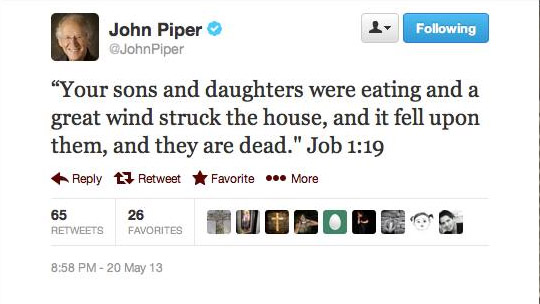
I knew it was coming: the Piper tweet, this time quoting Job in response to the Oklahoma tornado. As the dean of the neo-Calvinist movement, John Piper likes to push the envelope with his commentary on God’s role in natural disasters. He did it about a year ago when tornadoes hit the midwest. In 2007 after the Minneapolis bridge collapsed, he wrote that he and his daughter discussed how God must have done it so the people of Minneapolis would fear Him because our sin against God is “an outrage ten thousand times worse than the collapse of the 35W bridge.” Piper would say that he’s just being Biblical and that it shouldn’t be surprising that speaking Biblically would make people feel uncomfortable. So how do we talk about God’s role in tragedies?
Piper’s perspective on God’s role in disasters has two components: 1) Every event that happens is orchestrated by God for the purposes of His divine plan; 2) Violence within nature reflects God’s infinite anger over human sin, which is primarily understood in Anselmian terms as an abstract offense against His honor. In Piper’s post on the Minneapolis bridge collapse, he cites Luke 13:1-4 where Jesus uses tragedies in His day to issue a warning to his listeners to repent.
At that very time there were some present who told him about the Galileans whose blood Pilate had mingled with their sacrifices. He asked them, “Do you think that because these Galileans suffered in this way they were worse sinners than all other Galileans? No, I tell you; but unless you repent, you will all perish as they did. Or those eighteen who were killed when the tower of Siloam fell on them—do you think that they were worse offenders than all the others living in Jerusalem? No, I tell you; but unless you repent, you will all perish just as they did.”
It’s a pretty strange passage. When Jesus says “perish just as they did,” what is he saying? Is he saying you’ll die too in general or you’ll die in a similarly gruesome way? Piper eisegetes his Anselmian view of sin onto the text by making it about whether humans deserve to die as a punishment from God (“Jesus implies that those who brought him this news thought he would say that those who died, deserved to die, and that those who didn’t die did not deserve to die”). But taking the text at face value, there’s no reason to understand “perishing” as a divinely instituted punishment for sin rather than just a natural consequence of it (e.g. getting tangled up with bad people and dying a violent death as a result). Jesus wasn’t carrying the book of Romans around with him to make sure that his teaching was “Biblical.”
Regardless of what Jesus is saying in that particular passage, there are plenty of examples in the Old Testament of misfortune being proclaimed as the manifestation of God’s wrath and punishment for sin whether it’s a drought or an epidemic or the invasion of an enemy army. The ancient Israelites had no intellectual resources for thinking about disaster as anything other than a personal expression of anger from God. This puts us in an awkward place as Christians living in an age when scientific disciplines like meteorology exists.
Does the authority of scripture force us to say screw meteorology, tornadoes are a warning from God to bring the world into repentance? Or do we say God used to send tornadoes to punish Israel for its sin because the infallible Old Testament prophets say things like that, but now tornadoes happen because of atmospheric thermodynamics? Piper at least recognizes the inconsistency of trying to say that nature only began to behave according to predictable scientific principles after the Bible was written as a clumsy means of rescuing the Bible from being in error. In Piper’s perspective, if Jeremiah and Amos and all the rest were infallible, then the way we interpret disaster should emulate how they interpreted it. Thus he writes about the Minneapolis bridge collapse:
The meaning of the collapse of this bridge is that John Piper is a sinner and should repent or forfeit his life forever. That means I should turn from the silly preoccupations of my life and focus my mind’s attention and my heart’s affection on God and embrace Jesus Christ as my only hope for the forgiveness of my sins and for the hope of eternal life. That is God’s message in the collapse of this bridge. That is his most merciful message: there is still time to turn from sin and unbelief and destruction for those of us who live. If we could see the eternal calamity from which he is offering escape we would hear this as the most precious message in the world.
I imagine that this view is repugnant to most people. Is it because we have gone apostate and are no longer appropriately terrified by God? That’s what folks like John Piper would say. But there’s a subtlety to John Piper’s ideological stance here. God is not a terrifying mystery to Piper, because he knows the exact “meaning” of the collapse of the Minneapolis bridge. John Piper’s God may be a horrible Godzilla, but the prophetic authority Piper gives to himself means that he is sitting on Godzilla’s back holding the reins.
What’s far more terrifying than an angry, dangerous God with predictable motives who offers a canned salvation formula by which people can get right with Him is an unpredictable universe whose violence we do not try to explain even though we stubbornly cling to the belief that somehow a loving Creator is in charge of it. It is God’s unpredictability that makes Him truly sovereign.
The ancient Israelites grasped for prophetic explanations to natural disasters as a means of coping with the terror of an unpredictable universe. If Babylon sacked the city of Jerusalem just because they were the most powerful empire in the world at the time, then Israel’s God would lose all His authority and the Babylonian god Marduk would be the new God. Thus, Babylon had to be an agent in the hands of a God who was punishing his people for their apostasy.
Does it make the prophetic explanation of the Babylonian exile “false” to recognize that Babylon was going to conquer Israel regardless? No, but I believe the proper way to understand it is that God inspired His prophets to use natural disasters like war and drought to confront Israel about its sin. The events happened because of natural processes and human sociology, which are of course under God’s sovereignty and part of His creation, but the interpretation happened through God’s direct inspiration.
The question is whether in a scientific age, we should be using natural disasters to talk about sin. I don’t think that it represents a spiritual or moral regression for people in our day to find it unbecoming of God to crush elementary school kids in order to express His wrath against sin and instill repentance in His people. I believe that the reason God let the Israelite prophets talk about natural disasters the way they did is because He was meeting His Israelite people where they were. Even though God didn’t “make” the Babylonians conquer Israel, if the Israelites had not interpreted their Babylonian exile as God-ordained, they would have assimilated into Babylonian culture and ceased to exist as a people. So what if we understand the more “civilized” view of God’s relationship to natural disaster not as apostasy but as a greater fulfillment of the theology that understands God to be at His most persuasive and sovereign when He lets humanity crucify Him in the flesh?
I do think that as individuals, we can interpret our lives’ hardships in terms of our personal relationship with God. Psalm 119:71 says, “It was good for me to be afflicted so that I might learn your statutes.” I went through half a decade of severe depression in my twenties. Part of my meaning-making process has been to say that God blessed me with that affliction as part of the preparation for my pastoral vocation and in order to make me exouthenemenos, a “despised one,” a person without worth apart from the grace of God, inside of which I have infinite worth.
That story works for me; I could not cope with a story of my mental health history told entirely in biological terms. However, as a pastor, I do not give myself the authority to tell others how to interpret their tragedies. I can point them to the rich resources of God’s poetry in the Bible so that God can breathe into them the poem that fits. Raw experience is overwhelming to process; we need and we always will use some form of poetry to give our lives coherence.
The question is whether it’s good poetry or bad poetry. God’s poetry misapplied is bad poetry. The tragedy in Oklahoma is not a time to be making theological points about the sovereignty of God. I hope that the people of Oklahoma will find better poetry from God that breathes life and mercy and peace in a difficult time.
Previous Post

May 21, 2013
I want to sit in the clouds with Zach Sobiech
Next Post
May 23, 2013 Agenda-less fellowship and youth ministry
Browse Our Archives
Select a Category Advent Beauty Will Save the World Bible Big Picture: Ephesians Bloggers Book Christian salvation and the Beautitudes Culture Daily Office Danceable Homiletics Deadly Sins Deep Roots: Genesis Devotions Dominican Republic May 2011 El Principio Misericordia (The Mercy Principle) Five verses God tattooed on my heart Fundraising FutureGospel Good Biblical Words Henri Nouwen Interview Jennings' Christian Imagination Jesus inside the beltway Jesus Is My Candidate Jesus vs the Pharisees Jesus vs. Plato Journey to Eternity Looking Back on 2012 Love Actually Monday Merton Monday Merton Music Occupy the manger On Earth As It Is In Heaven Original Sin Podcast Poetry Politics Prayer Psalm 119 Radical Jesus 101 Reviews Sermon on the Mount Sermons Spanish Bible study Special Series Spiritual but not religious Synchroblog Theology Things that made me think Thomas a Kempis Ugliness Into Beauty Uncategorized Viaje Dominicano 2013 Walking in the Valley (Lent) Welcome: It's More than a Mat Wild Goose 2013 Wrestling
Select a Month March 2022 January 2022 December 2021 September 2021 April 2021 September 2020 August 2020 July 2020 June 2020 May 2020 April 2020 March 2020 February 2020 January 2020 December 2019 November 2019 October 2019 September 2019 August 2019 June 2019 May 2019 April 2019 March 2019 February 2019 January 2019 December 2018 November 2018 October 2018 September 2018 August 2018 July 2018 June 2018 May 2018 April 2018 March 2018 February 2018 January 2018 December 2017 November 2017 October 2017 September 2017 August 2017 July 2017 June 2017 May 2017 April 2017 March 2017 February 2017 January 2017 December 2016 November 2016 October 2016 September 2016 August 2016 July 2016 June 2016 May 2016 April 2016 March 2016 February 2016 January 2016 December 2015 November 2015 October 2015 September 2015 August 2015 July 2015 June 2015 May 2015 April 2015 February 2015 January 2015 December 2014 November 2014 October 2014 September 2014 August 2014 July 2014 June 2014 May 2014 April 2014 March 2014 February 2014 January 2014 December 2013 November 2013 October 2013 September 2013 August 2013 July 2013 June 2013 May 2013 April 2013 March 2013 February 2013 January 2013 December 2012 November 2012 October 2012 September 2012 August 2012 July 2012 June 2012 May 2012 April 2012 February 2012 January 2012 December 2011 November 2011 October 2011 September 2011 August 2011 July 2011 June 2011 May 2011
Follow Us!
TAKE THE
Religious Wisdom Quiz
Which Christian festival celebrates the coming of the Holy Spirit?
Select your answer to see how you score.
Lent Advent Pentecost Trinity Sunday
Related posts from Mercy Not Sacrifice

When God's A Cop, Every Cop Is God


"All People Are Holy": The Theology Of Alexandria...

Epimenides And The Plague Of Athens
TRENDING AT PATHEOS Progressive Christian

What Being a Modern-Day Apostle Means to Me
In my last column, I discussed the ins and outs of modern-day...

Did Ancient China Once Worship the God of...
Across human history, a common thread weaves through the origins of the...

Love Your Neighbor – Including Earth-Kin: Lev. 19,...
God’s command to love your neighbor means acting in an ethical and...

Lead a Church Study of “Jesus and Lao...
Guest writer Jack Thomas (The Irreverent Reverend) reflects on leading his church...

Pastoral Wisdom for Responding to Sermon Pushback
Getting sermon pushback on your social justice sermon? Learn practical, Proverbs-based strategies...

Principles for Understanding the Apostolic Ministry Today
Whenever people discover that my formal ministry title is "apostle," as in...
view all Progressive Christian blogs
Ad-Free & Subscriber Log-In Subscription Support
- About Us
- 2026 Calendar
- Videos
- Podcasts
- Library of World Religions
- Faith In Media Tracker
- Advertise With Us
- Write for Us
- Privacy Policy
- Terms of Service
- Do Not Sell My Data
- Contact Us
- Radiant Digital
- Manage Newsletter Subscriptions
- Unsubscribe From Notifications
- Sitemap
Copyright 2008-2026, Patheos. All rights reserved.
Subscription Support Ad-Free & Subscriber Log-In
Follow Patheos