
BuddhistCatholicContemplativeEvangelicalGeneral ChristianHinduJewishLatter-day SaintMuslimNew VisionsProgressive Christian
Beliefs
- Buddhist
- Catholic
- Contemplative
- Evangelical
- General Christian
- Hindu
- Jewish
- Latter-day Saint
- More Voices
- Muslim
- New Visions
- Pagan
- Progressive Christian
Topics
- Religion News
- Food and Religion
- Sports and Religion
- Religious Art
- Religious Music and Entertainment
- Religious Events
- History and Religion
- Style and Religion
- Politics and Religion
- Women in Religion
- Recreation Outdoors and Religion
- Business Finance and Religion
- Careers Workplace and Religion
- Education and Religion
- Family Parenting and Religion
- Health Fitness and Religion
- Home and Religion
- Relationships and Religion
- Technology and Religion
- Travel and Religion
Columnists
- Buddhist Columnists
- Business Finance and Religion Columnists
- Careers Workplace and Religion Columnists
- Catholic Columnists
- Contemplative Columnists
- Education and Religion Columnists
- Evangelists Columnists
- Family Parenting and Religion Columnists
- General Christian Columnists
- Health Fitness and Religion Columnists
- Hindu Columnists
- History and Religion Columnists
- Home and Religion Columnists
- Jewish Columnists
- More Voices Columnists
- Latter Day Columnists
- Muslim Columnists
- New Visions Columnists
- Nonreligious Columnists
- Pagan Columnists
- Politics and Religion Columnists
- Progressive Columnists
- Recreation Outdoors and Religion Columnists
- Relationships and Religion Columnists
- Religion News Columnists
- Religious Art Columnists
- Religious Events Columnists
- Religious Music and Entertainment Columnists
- Sports and Religion Columnists
- Style and Religion Columnists
- Technology and Religion Columnists
- Travel and Religion Columnists
- Women in Religion Columnists
Resource Library
- 2026 Calendar
- Library of World Religions
- The 100 Most Holy Places on Earth
- Patheos Answers
- Podcasts
- Videos
- Faith Leaders Database
- Anglican Episcopalian
- Bahai
- Baptist
- Buddhism
- Christianity
- Confucianism
- Eastern Orthodoxy
- Hinduism
- Holiness and Pentecostal
- ISKCON
- Islam
- Judaism
- Lutheran
- Methodist
- The Church of Jesus Christ of Latter-day Saints
- New Age
- Paganism
- Presbytarian and Reformed
- Protestantism
- Religion Behind the Scenes
- Roman Catholic
- Scientology
- Shia Islam
- Sikhism
- Sufism
- Sunni Islam
- Taoism
- Zen
- See all religions
Research Tools
 Ad-Free & Subscriber Log-In Subscription Support
Ad-Free & Subscriber Log-In Subscription Support
Follow Patheos 

- Trending:
- Forgiveness
- |
- Marriage
- |
- Consciousness
- |
- Death Penalty
- |
- Election
- |
- Halloween
 Mercy Not Sacrifice
-
More
- Home
- Progressive Christian
- The savior who made us relevant to His mission (Acts 1:6-11)
The savior who made us relevant to His mission (Acts 1:6-11)
Last updated on: July 17, 2014 at 2:14 pm by Morgan Guyton
The savior who made us relevant to His mission (Acts 1:6-11) 2014-07-17T14:14:22-05:00 Morgan Guyton
Patheos Explore the world's faith through different perspectives on religion and spirituality! Patheos has the views of the prevalent religions and spiritualities of the world.
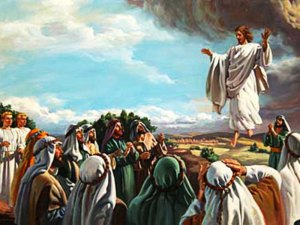
I preached this weekend about the ascension of Christ. As I shared in a blog post earlier in the week, I think it’s important to consider why Jesus ascended to heaven instead of sticking around in visible fleshly form in His immortal body. The dialogue between Jesus and His disciples in Acts 1:6-11 helps to shed light on why His ascension was part of God’s plan. Below I’m sharing the sermon audio along with a written summary:
I divided my sermon between four sentences in Jesus’ dialogue with His disciples. It starts when Jesus’ disciples ask Him a question.
1) “Lord, is this the time when you will restore the kingdom to Israel?” [Acts 1:6]
Israel had been under occupation by foreign powers for about 580 years when the disciples asked this question. First the Babylonians, then the Persians, then Alexander the Great, then his generals, and last Rome. If you think about it, it’s not an unreasonable thing to ask a messiah who has just proven He can’t be killed. Jesus could have marched on Rome and used His miraculous powers to achieve a battlefield victory.
In a much more abstract sense, there’s a way in which this is the question that our world is constantly asking. When will the kingdom be restored? When will we get back to the golden age? When will the world be what it was when we were innocent? As Paul puts it in Romans 8:19, “The creation waits with eager longing for the revealing of the children of God.”
I remember when I was a senior in college and the Y2K scare came up. Several fundamentalist Christians I knew were really hoping that was going to be the rapture moment. They stocked up on supplies and built wells in their backyard. And then… nothing. I don’t think they wanted the world to crash for malicious reasons. I see their yearning as a product of living under a suffocating technocracy that has smothered the possibility of doing anything heroic in the lives of most people at least in our country.
We have not experienced any decisive social upheaval for at least the past forty years. I think this makes a lot of Americans restless in their doldrum cubicle worlds, and that’s why they need to fantasize about secret plots by the Muslim Brotherhood to take over our government and so forth. So we ask like the disciples, “God, when will you flush all the corruption and inertia and hopelessness of our world down the toilet and replace it with your new Jerusalem?”
2) “It’s not for you to know the times or periods the Father has set by His own authority.” [Acts 1:7]
Jesus’ response to the disciples is one of the most obnoxious things to hear from God when you’re praying: “It’s not for you to know.” Ooh… I get so mad when He says that to me. I want to know why. I want to know when. I want to know how. But it doesn’t work that way. An important part of God’s sovereignty over us is His mystery. When we hate mystery in God’s word, what we’re hating is our lack of sovereignty over God. We want to be in the position of owning the truth so we can use it to our advantage.
One thing that Jesus’ ascension reveals about God is that He’s deliberately choosing to hide some things out of our reach. If Jesus were still walking around in Galilee, there would be no theological debate whatsoever because we would simply phone it in to Jesus and ask Him to give us the answer. Of course, this wouldn’t necessarily be true if we consider how Jesus responded whenever anyone approached Him with a question that was part of trying to win an argument. Jesus answered those kinds of questions with questions of His own. He refused to be pinned down. So His ascension is basically a radicalization of His coyness in responding to people who demanded answers from Him.
3) “But you will receive power when the Holy Spirit comes over you.” [Acts 1:8]
This is the heart of the answer to why Jesus ascended to heaven: so that we could be empowered. If Jesus had stuck around, there would be no opportunity for His disciples to grow as leaders. He wouldn’t need a rock like Simon Peter on which to build His church because He would remain the fully-fleshed head of the church instead of being a mystical body into which we can all be absorbed like branches miraculously grafted onto a tree.
Of course, the other thing we should say about heaven is that it’s not somewhere far away where Jesus flew on the back of a comet. Heaven is the eternal core of our reality. It is closer to us than we are to ourselves, because heaven is the reality being described when Paul writes about Jesus that “in him all things were created… and in him all things hold together” (Colossians 1:16-17). Jesus’ heavenly presence floods every corner of God’s creation. As the Word of God, He is the one who speaks every sunrise into existence and every piece of foam on the beach and every drop of every tidal wave and every cell of blood in our bodies.
Because Jesus fills the realm of heaven, Paul can write, “I have been crucified with Christ and I no longer live, but Christ lives in me” (Galatians 2:20). We can gain a greater intimacy with Jesus than is possible between two human beings in the flesh. We can abide in His body and have Him abide in our bodies (John 15:4) at the same time! It is in the mystery of this intertwined intimacy that we receive the power Jesus describes, which can at the same time be described as the Holy Spirit coming over us.
Now I want to go on a brief tangent to address a problematic misinterpretation that can occur with this verse. Some Christians interpret the Bible to describe three eras of history: the age of the Father (the Old Testament), the age of the Son (the life of Jesus), and the age of the Holy Spirit (Pentecost and afterward). They would say the reason Jesus had to go to heaven was because the Holy Spirit couldn’t be given to the disciples otherwise. This is a dangerously overconfident assertion to make.
When you split the Bible neatly into three dispensations, you’re basically creating a divinity of three Gods with completely different personalities instead of one God in three persons. This particularly comes out in the form of a bad cop / good cop duality between the Father of the Old Testament and the Son of the New Testament which expresses itself in a very bad theology of the cross where the Father Himself crucifies Jesus rather than sending His Son from heaven to redeem the world through the cross.
If God is Trinity, then God is Trinity at every moment in history. Whenever there is a word from God received by the Old Testament prophets, it comes by way of the Holy Spirit. When Jesus sends out the 70 disciples to drive out demons and heal people in Luke 10, they do what they do by the power of the Holy Spirit even though Jesus doesn’t use the phrase “Holy Spirit” to describe it.
All this is just to say that Jesus didn’t have to go to heaven for the Holy Spirit to come to Earth. Disabused of that way of looking at it, we can say that Jesus chose to go to heaven. Why did He make that choice? To give us power by stepping aside and making Himself a reality we could step into.
4) “And you will be my witnesses in Jerusalem, and in all Judea and Samaria, and to the ends of the earth.” [Acts 1:8]
Jesus doesn’t need other witnesses. As Revelation 1:5 says, He is the one “faithful witness.” He rebuked the Pharisees who had challenged Him in John 8:13, saying, “You are testifying on your own behalf; your testimony is not valid.” Since the testimony of two witnesses is valid, Jesus says, “I testify on my own behalf, and the Father who sent me testifies on my behalf” (v. 18). Jesus doesn’t need to use us; He could have been a faithful witness to His Father’s truth all by Himself, completely independent of us.
But that’s not what He chose to do. He ascended to heaven so that we could be His witnesses. To be His witnesses means that we are not just passive recipients of His story; we become part of His story. He’s the only protagonist in human history whose goal is to make every member of humanity co-protagonists with Him. Jesus doesn’t just save us from our sins; He makes us relevant to His mission. I would even say that part of our salvation is the relevance He gives us, because so many stupid things we do are out of our attempt to be relevant. So rejoice in your relevance; you are a witness for the kingdom whom Jesus values infinitely, and He is reaching out to you through the Holy Spirit every moment with heavenly power.
Previous Post

May 12, 2013
My mommy was my first pastor
Next Post
May 13, 2013 Monday Merton 5.13.2013
Browse Our Archives
Select a Category Advent Beauty Will Save the World Bible Big Picture: Ephesians Bloggers Book Christian salvation and the Beautitudes Culture Daily Office Danceable Homiletics Deadly Sins Deep Roots: Genesis Devotions Dominican Republic May 2011 El Principio Misericordia (The Mercy Principle) Five verses God tattooed on my heart Fundraising FutureGospel Good Biblical Words Henri Nouwen Interview Jennings' Christian Imagination Jesus inside the beltway Jesus Is My Candidate Jesus vs the Pharisees Jesus vs. Plato Journey to Eternity Looking Back on 2012 Love Actually Monday Merton Monday Merton Music Occupy the manger On Earth As It Is In Heaven Original Sin Podcast Poetry Politics Prayer Psalm 119 Radical Jesus 101 Reviews Sermon on the Mount Sermons Spanish Bible study Special Series Spiritual but not religious Synchroblog Theology Things that made me think Thomas a Kempis Ugliness Into Beauty Uncategorized Viaje Dominicano 2013 Walking in the Valley (Lent) Welcome: It's More than a Mat Wild Goose 2013 Wrestling
Select a Month March 2022 January 2022 December 2021 September 2021 April 2021 September 2020 August 2020 July 2020 June 2020 May 2020 April 2020 March 2020 February 2020 January 2020 December 2019 November 2019 October 2019 September 2019 August 2019 June 2019 May 2019 April 2019 March 2019 February 2019 January 2019 December 2018 November 2018 October 2018 September 2018 August 2018 July 2018 June 2018 May 2018 April 2018 March 2018 February 2018 January 2018 December 2017 November 2017 October 2017 September 2017 August 2017 July 2017 June 2017 May 2017 April 2017 March 2017 February 2017 January 2017 December 2016 November 2016 October 2016 September 2016 August 2016 July 2016 June 2016 May 2016 April 2016 March 2016 February 2016 January 2016 December 2015 November 2015 October 2015 September 2015 August 2015 July 2015 June 2015 May 2015 April 2015 February 2015 January 2015 December 2014 November 2014 October 2014 September 2014 August 2014 July 2014 June 2014 May 2014 April 2014 March 2014 February 2014 January 2014 December 2013 November 2013 October 2013 September 2013 August 2013 July 2013 June 2013 May 2013 April 2013 March 2013 February 2013 January 2013 December 2012 November 2012 October 2012 September 2012 August 2012 July 2012 June 2012 May 2012 April 2012 February 2012 January 2012 December 2011 November 2011 October 2011 September 2011 August 2011 July 2011 June 2011 May 2011
Follow Us!
TAKE THE
Religious Wisdom Quiz
What is the distinctive cup used in receiving communion in many traditions?
Select your answer to see how you score.
Plate Chalice Bowl Jug
Related posts from Mercy Not Sacrifice


When God's A Cop, Every Cop Is God


Why Kevin DeYoung's "Culture War Strategy" Fails
TRENDING AT PATHEOS Progressive Christian

What Being a Modern-Day Apostle Means to Me
In my last column, I discussed the ins and outs of modern-day...

Did Ancient China Once Worship the God of...
Across human history, a common thread weaves through the origins of the...

Love Your Neighbor – Including Earth-Kin: Lev. 19,...
God’s command to love your neighbor means acting in an ethical and...

Lead a Church Study of “Jesus and Lao...
Guest writer Jack Thomas (The Irreverent Reverend) reflects on leading his church...

Pastoral Wisdom for Responding to Sermon Pushback
Getting sermon pushback on your social justice sermon? Learn practical, Proverbs-based strategies...

Principles for Understanding the Apostolic Ministry Today
Whenever people discover that my formal ministry title is "apostle," as in...
view all Progressive Christian blogs
Ad-Free & Subscriber Log-In Subscription Support
- About Us
- 2026 Calendar
- Videos
- Podcasts
- Library of World Religions
- Faith In Media Tracker
- Advertise With Us
- Write for Us
- Privacy Policy
- Terms of Service
- Do Not Sell My Data
- Contact Us
- Radiant Digital
- Manage Newsletter Subscriptions
- Unsubscribe From Notifications
- Sitemap
Copyright 2008-2026, Patheos. All rights reserved.
Subscription Support Ad-Free & Subscriber Log-In
Follow Patheos