
BuddhistCatholicContemplativeEvangelicalGeneral ChristianHinduJewishLatter-day SaintMuslimNew VisionsProgressive Christian
Beliefs
- Buddhist
- Catholic
- Contemplative
- Evangelical
- General Christian
- Hindu
- Jewish
- Latter-day Saint
- More Voices
- Muslim
- New Visions
- Pagan
- Progressive Christian
Topics
- Religion News
- Food and Religion
- Sports and Religion
- Religious Art
- Religious Music and Entertainment
- Religious Events
- History and Religion
- Style and Religion
- Politics and Religion
- Women in Religion
- Recreation Outdoors and Religion
- Business Finance and Religion
- Careers Workplace and Religion
- Education and Religion
- Family Parenting and Religion
- Health Fitness and Religion
- Home and Religion
- Relationships and Religion
- Technology and Religion
- Travel and Religion
Columnists
- Buddhist Columnists
- Business Finance and Religion Columnists
- Careers Workplace and Religion Columnists
- Catholic Columnists
- Contemplative Columnists
- Education and Religion Columnists
- Evangelists Columnists
- Family Parenting and Religion Columnists
- General Christian Columnists
- Health Fitness and Religion Columnists
- Hindu Columnists
- History and Religion Columnists
- Home and Religion Columnists
- Jewish Columnists
- More Voices Columnists
- Latter Day Columnists
- Muslim Columnists
- New Visions Columnists
- Nonreligious Columnists
- Pagan Columnists
- Politics and Religion Columnists
- Progressive Columnists
- Recreation Outdoors and Religion Columnists
- Relationships and Religion Columnists
- Religion News Columnists
- Religious Art Columnists
- Religious Events Columnists
- Religious Music and Entertainment Columnists
- Sports and Religion Columnists
- Style and Religion Columnists
- Technology and Religion Columnists
- Travel and Religion Columnists
- Women in Religion Columnists
Resource Library
- 2026 Calendar
- Library of World Religions
- The 100 Most Holy Places on Earth
- Patheos Answers
- Podcasts
- Videos
- Faith Leaders Database
- Anglican Episcopalian
- Bahai
- Baptist
- Buddhism
- Christianity
- Confucianism
- Eastern Orthodoxy
- Hinduism
- Holiness and Pentecostal
- ISKCON
- Islam
- Judaism
- Lutheran
- Methodist
- The Church of Jesus Christ of Latter-day Saints
- New Age
- Paganism
- Presbytarian and Reformed
- Protestantism
- Religion Behind the Scenes
- Roman Catholic
- Scientology
- Shia Islam
- Sikhism
- Sufism
- Sunni Islam
- Taoism
- Zen
- See all religions
Research Tools
 Ad-Free & Subscriber Log-In Subscription Support
Ad-Free & Subscriber Log-In Subscription Support
Follow Patheos 

- Trending:
- Forgiveness
- |
- Marriage
- |
- Consciousness
- |
- Death Penalty
- |
- Election
- |
- Halloween
 Mercy Not Sacrifice
-
More
- Home
- Progressive Christian
- God’s grace in 4 stick figure drawings
God’s grace in 4 stick figure drawings
Last updated on: January 27, 2013 at 2:20 pm by Morgan Guyton
God’s grace in 4 stick figure drawings 2013-01-27T14:20:01-05:00 Morgan Guyton
Patheos Explore the world's faith through different perspectives on religion and spirituality! Patheos has the views of the prevalent religions and spiritualities of the world.
We had the first session of our new member class today. During the first class, we do introductions and give a primer on Methodist theology. We had the fortunate problem of having too many people in the class so our introductions took up all but 15 minutes. I didn’t want us to leave having only done introductions, so I tried to explain in 15 minutes and 4 stick figure drawings the three kinds of grace we talk about in Methodism: prevenient, sanctifying, and justification, along with the Christian perfection that God’s grace draws us toward. The way I’ve illustrated it is a bit individualistic (which of course I would have criticized if someone else had done it ;-)). I’m interested in hearing your feedback and suggestions for improvement.
I. Prevenient Grace
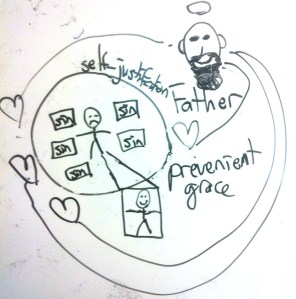
All of us are born with a condition that afflicts us before we’re self-aware enough to really make decisions for ourselves. Christianity has historically referred to this condition as “original sin.” Because of a lot of misunderstandings this term has generated, I prefer to label our originating condition “self-justification.” Simply put, we’re rational creatures who do irrational things. We want to make sense to ourselves and other people so we distort both our recollection of our mistakes and how we represent ourselves to others to put ourselves in the best light. By justifying ourselves in this way, we generate a bubble around us that isolates us from God and other people. This bubble is not something we have the power to break on our own. Unless it is broken, we cannot experience God’s love or live in complete integrity with other people.
Prevenient grace describes the patient love sent our way continuously by God the Father (who is called “Father” simply because He is the origin of everything and the member of the Trinity from whom the Son is begotten and the Holy Spirit proceeds). God is constantly using people and events in our lives to tap on our bubble and draw us closer to Him. What we believe as Methodists is that God has never not loved us and never stops loving us, even if we choose to stay inside our bubble of self-justification forever. This love is not merely a vague benevolent feeling, but a constant call into deeper intimacy with God and reconciliation with each other. Prevenient grace is God’s unilateral aggressive pursuit of every creature that He loves.
II. Justifying Grace

Justifying grace describes the climax of God’s relentless pursuit of humanity through His incarnation in the second member of the Trinity known as the Son, God’s Word, or Jesus Christ. Jesus’ life, death, and resurrection are all essential to God’s process of reconciling humanity to Himself and popping all of our bubbles of self-justification. The centerpiece of justifying grace is the cross. Jesus’ sacrifice for our sins on the cross gives us a place to put everything that we have done and received that causes guilt and resentment (our sins and sins against us) so that our bubble can be popped forever.
Jesus’ resurrection from the dead proves to us that He has indeed conquered sin and death so that we can step out of our bubble of shame and fear and into the new life of resurrection that He offers us. As long as we remain in the trap of self-justification, it’s like sitting in a tomb wrapped up like a mummy. So Jesus says, “I died for your sins so you could take off that mummy wrap. And now I’ve conquered death so you can come out of the tomb and live in my kingdom!”
III. Sanctifying Grace

Until we are set free from the bubble of self-justification, we can only be transformed into the people God wants us to be against our will or at least without our direct awareness. I do believe that God does plenty of things to shape us into good people preveniently before we accept Jesus’ sacrifice, but we will never enjoy the true joy of God’s communion with us as long as we are appropriating the good that God accomplishes through us as self-justifying evidence to say, “See, this is why I’m right!”
When we have renounced self-justification and put our trust in the justification of Jesus’ cross, then we can proactively embrace and even rejoice at the correction and refinement the Holy Spirit works in our hearts, which is called sanctifying grace or just sanctification. Galatians 5:22-23 talks about the fruit of the Holy Spirit, which are “love, joy, peace, patience, kindness, generosity, faithfulness, gentleness, and self-control.” The Holy Spirit cultivates these qualities into our character over time as we unlearn our innate tendency to argue that we’re already perfect and grow in our ability to surrender and trust. The Holy Spirit basically declutters our heart and takes the sin boxes to Jesus’ cross where they are incinerated. In addition, the Holy Spirit reveals to us our spiritual gifts (such as prophecy, teaching, evangelism, healing, etc) and the place within Christ’s body for which we have been prepared.
IV. Christian Perfection (the goal)
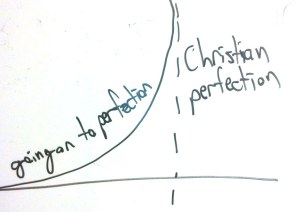
The goal of the Christian life is a state that John Wesley called Christian perfection. He got hammered by the 18th century British Calvinists for using this term and spent a whole lot of energy trying to explain and qualify what he meant by it. Christian perfection does not mean that we don’t make any mistakes. It is rather taken from Jesus’ exhortation in Matthew 5:48 to “be perfect, therefore, as your heavenly Father is perfect,” and the account of perfect love in 1 John 4:12: “No one has ever seen God; if we love one another, God lives in us, and his love is perfected in us.”
Christian perfection is the state of having all the fear and self-justification driven out of your heart so that your motivation for every act is love of God and neighbor. You still might not do the right thing every time, but Christian perfection would mean your heart is always in the right place. John Wesley asked all of his pastors a question that makes Methodist pastors today squirm a whole lot: “Do you expect to be made perfect in love in this life?” If you answer no, then you can’t be ordained. But the terms in which 21st century pop-evangelicalism describes sin makes it seem like a heresy to say yes.
It’s a paradoxical question to consider, because what it really asks is not whether we have the ability within ourselves to not make any mistakes, but whether we trust in God enough to believe that He can kill all of the selfish sinful motives in our hearts and fill us completely with love. If you don’t believe in Christian perfection, then you’re saying God has a different purpose for humanity than making us one with Him and each other by perfecting us in love.
Some Christians say God’s purpose is to “glorify Himself,” feeling that God’s sovereignty can only be absolute if He is ultimately aloof from the fate of His creation. Some would argue that describing the triumph of love as God’s most fundamental goal depicts God as being “co-dependent” on His dysfunctional creatures and less than fully in charge. I can appreciate this concern (as well as the fact that I depict it imperfectly). But as a Methodist, I would say that God does indeed glorify Himself through perfecting the world in love since that is how the Bible explains His nature (1 John 4) and His goal for creation (John 17).
The way I illustrate Christian perfection is through calculus: the graph of a hyperbolic curve. A hyperbolic curve starts with a slope of zero (a flat horizontal line) and increases over time to a slope of infinity (a flat vertical line). It’s impossible for a curve ever to become a straight-line, but it can get closer and closer to a straight-line over the course of an infinite distance. Christian perfection is the straight-line that our curve approaches as God sanctifies us. The more that we trust Jesus and allow the Spirit to transform us, the more we will “go on to perfection,” as John Wesley would say.
If we are ever perfected in love, we won’t notice it because noticing it shows that we are still taking pleasure even slightly in our correctness which indicates the residual presence of that bubble of self-justification that needs to get popped again. Love is only perfect as a grace which passes through us, “a light which shines through the darkness without being seized by it” (John 1:5). If I grab it and say mine (which I have never not done), then I haven’t yet arrived. I believe that God has the power to perfect me with His love. I also know that I am not there as long as there is part of me that continues to perform instead of worship.
Previous Post

January 25, 2013
Sex-trafficking, colonialism, and miscommunication
Next Post
January 27, 2013 Danceable Homiletics #1: Ring Them Bells (featuring Brian Zahnd)
Browse Our Archives
Select a Category Advent Beauty Will Save the World Bible Big Picture: Ephesians Bloggers Book Christian salvation and the Beautitudes Culture Daily Office Danceable Homiletics Deadly Sins Deep Roots: Genesis Devotions Dominican Republic May 2011 El Principio Misericordia (The Mercy Principle) Five verses God tattooed on my heart Fundraising FutureGospel Good Biblical Words Henri Nouwen Interview Jennings' Christian Imagination Jesus inside the beltway Jesus Is My Candidate Jesus vs the Pharisees Jesus vs. Plato Journey to Eternity Looking Back on 2012 Love Actually Monday Merton Monday Merton Music Occupy the manger On Earth As It Is In Heaven Original Sin Podcast Poetry Politics Prayer Psalm 119 Radical Jesus 101 Reviews Sermon on the Mount Sermons Spanish Bible study Special Series Spiritual but not religious Synchroblog Theology Things that made me think Thomas a Kempis Ugliness Into Beauty Uncategorized Viaje Dominicano 2013 Walking in the Valley (Lent) Welcome: It's More than a Mat Wild Goose 2013 Wrestling
Select a Month March 2022 January 2022 December 2021 September 2021 April 2021 September 2020 August 2020 July 2020 June 2020 May 2020 April 2020 March 2020 February 2020 January 2020 December 2019 November 2019 October 2019 September 2019 August 2019 June 2019 May 2019 April 2019 March 2019 February 2019 January 2019 December 2018 November 2018 October 2018 September 2018 August 2018 July 2018 June 2018 May 2018 April 2018 March 2018 February 2018 January 2018 December 2017 November 2017 October 2017 September 2017 August 2017 July 2017 June 2017 May 2017 April 2017 March 2017 February 2017 January 2017 December 2016 November 2016 October 2016 September 2016 August 2016 July 2016 June 2016 May 2016 April 2016 March 2016 February 2016 January 2016 December 2015 November 2015 October 2015 September 2015 August 2015 July 2015 June 2015 May 2015 April 2015 February 2015 January 2015 December 2014 November 2014 October 2014 September 2014 August 2014 July 2014 June 2014 May 2014 April 2014 March 2014 February 2014 January 2014 December 2013 November 2013 October 2013 September 2013 August 2013 July 2013 June 2013 May 2013 April 2013 March 2013 February 2013 January 2013 December 2012 November 2012 October 2012 September 2012 August 2012 July 2012 June 2012 May 2012 April 2012 February 2012 January 2012 December 2011 November 2011 October 2011 September 2011 August 2011 July 2011 June 2011 May 2011
Follow Us!
TAKE THE
Religious Wisdom Quiz
How many times does the Bible mention the word "love"?
Select your answer to see how you score.
700 Over 300 100 500
Related posts from Mercy Not Sacrifice

Why Does The Knowledge of Good And Evil...


When God's A Cop, Every Cop Is God

TRENDING AT PATHEOS Progressive Christian

What Being a Modern-Day Apostle Means to Me
In my last column, I discussed the ins and outs of modern-day...

Did Ancient China Once Worship the God of...
Across human history, a common thread weaves through the origins of the...

Love Your Neighbor – Including Earth-Kin: Lev. 19,...
God’s command to love your neighbor means acting in an ethical and...

Lead a Church Study of “Jesus and Lao...
Guest writer Jack Thomas (The Irreverent Reverend) reflects on leading his church...

Pastoral Wisdom for Responding to Sermon Pushback
Getting sermon pushback on your social justice sermon? Learn practical, Proverbs-based strategies...

Principles for Understanding the Apostolic Ministry Today
Whenever people discover that my formal ministry title is "apostle," as in...
view all Progressive Christian blogs
Ad-Free & Subscriber Log-In Subscription Support
- About Us
- 2026 Calendar
- Videos
- Podcasts
- Library of World Religions
- Faith In Media Tracker
- Advertise With Us
- Write for Us
- Privacy Policy
- Terms of Service
- Do Not Sell My Data
- Contact Us
- Radiant Digital
- Manage Newsletter Subscriptions
- Unsubscribe From Notifications
- Sitemap
Copyright 2008-2026, Patheos. All rights reserved.
Subscription Support Ad-Free & Subscriber Log-In
Follow Patheos