
BuddhistCatholicContemplativeEvangelicalGeneral ChristianHinduJewishLatter-day SaintMuslimNew VisionsProgressive Christian
Beliefs
- Buddhist
- Catholic
- Contemplative
- Evangelical
- General Christian
- Hindu
- Jewish
- Latter-day Saint
- More Voices
- Muslim
- New Visions
- Pagan
- Progressive Christian
Topics
- Religion News
- Food and Religion
- Sports and Religion
- Religious Art
- Religious Music and Entertainment
- Religious Events
- History and Religion
- Style and Religion
- Politics and Religion
- Women in Religion
- Recreation Outdoors and Religion
- Business Finance and Religion
- Careers Workplace and Religion
- Education and Religion
- Family Parenting and Religion
- Health Fitness and Religion
- Home and Religion
- Relationships and Religion
- Technology and Religion
- Travel and Religion
Columnists
- Buddhist Columnists
- Business Finance and Religion Columnists
- Careers Workplace and Religion Columnists
- Catholic Columnists
- Contemplative Columnists
- Education and Religion Columnists
- Evangelists Columnists
- Family Parenting and Religion Columnists
- General Christian Columnists
- Health Fitness and Religion Columnists
- Hindu Columnists
- History and Religion Columnists
- Home and Religion Columnists
- Jewish Columnists
- More Voices Columnists
- Latter Day Columnists
- Muslim Columnists
- New Visions Columnists
- Nonreligious Columnists
- Pagan Columnists
- Politics and Religion Columnists
- Progressive Columnists
- Recreation Outdoors and Religion Columnists
- Relationships and Religion Columnists
- Religion News Columnists
- Religious Art Columnists
- Religious Events Columnists
- Religious Music and Entertainment Columnists
- Sports and Religion Columnists
- Style and Religion Columnists
- Technology and Religion Columnists
- Travel and Religion Columnists
- Women in Religion Columnists
Resource Library
- 2026 Calendar
- Library of World Religions
- The 100 Most Holy Places on Earth
- Patheos Answers
- Podcasts
- Videos
- Faith Leaders Database
- Anglican Episcopalian
- Bahai
- Baptist
- Buddhism
- Christianity
- Confucianism
- Eastern Orthodoxy
- Hinduism
- Holiness and Pentecostal
- ISKCON
- Islam
- Judaism
- Lutheran
- Methodist
- The Church of Jesus Christ of Latter-day Saints
- New Age
- Paganism
- Presbytarian and Reformed
- Protestantism
- Religion Behind the Scenes
- Roman Catholic
- Scientology
- Shia Islam
- Sikhism
- Sufism
- Sunni Islam
- Taoism
- Zen
- See all religions
Research Tools
 Ad-Free & Subscriber Log-In Subscription Support
Ad-Free & Subscriber Log-In Subscription Support
Follow Patheos 

- Trending:
- Forgiveness
- |
- Marriage
- |
- Consciousness
- |
- Death Penalty
- |
- Election
- |
- Halloween
 Mercy Not Sacrifice
-
More
- Home
- Progressive Christian
- Submission As Leadership, Marriage As Mutual Servanthood
Submission As Leadership, Marriage As Mutual Servanthood
Last updated on: July 17, 2014 at 2:30 pm by Morgan Guyton
Submission As Leadership, Marriage As Mutual Servanthood 2014-07-17T14:30:29-05:00 Morgan Guyton
Patheos Explore the world's faith through different perspectives on religion and spirituality! Patheos has the views of the prevalent religions and spiritualities of the world.
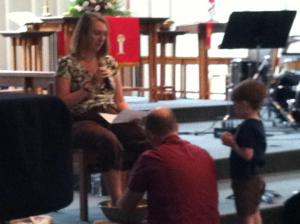 Few verses in the Bible have been more damaging historically to women in Western civilization than Ephesians 5:22 — “Wives, submit to your husbands as to the Lord.” This has been a go-to verse in the argument against giving the women the right to vote or letting them have careers outside the home; more drastically it has been used to counsel women in abusive relationships not to leave their husbands since they should submit to them even if they’re violent. It was because of this history that my wife Cheryl and I decided to tackle this verse in the first sermon that we preached together seven years ago at our wedding, also because the passage from which it’s taken — Ephesians 5:21-33 — has beautiful wisdom to share about marriage when the social and Biblical context for the passage is properly understood. This past weekend at Burke United Methodist Church, we preached together on this passage again, washing each others’ feet while the other one spoke in order to model our understanding that submission is the form that Christian leadership takes.
It is critical to understand first of all the social context in which Paul was writing to the Ephesians. Roman civilization was legally organized according to households. The patriarchal head of each household represented his household in all public civic life. He was called the paterfamilias, and he had absolute power and authority over everything that happened in his household. He could sell his children into slavery or divorce his wife for any reason provided he paid back the dowry to her parents. He could put babies to death if they were deformed or ugly-looking to him. Legally speaking, no one could question what a man did inside the walls of his own castle. It was only when he had a quarrel with a different household that the public judicial system got involved. Understanding the absolute power of the Roman paterfamilias helps us to recognize that when Paul says that “the husband is head of the wife as Christ is head of the church,” he is referencing the legal reality of his society, not God’s eternal design for marriage!
The reason I feel confident making that claim is because of what I read in Galatians 3:28: “There is neither Jew nor Greek, neither slave nor free, nor is there male and female, for you are all one in Christ Jesus.” Despite the fact that it has taken Christians two millennia to live into the kingdom reality that Paul lays out in Galatians 3:28, equality between genders is a Biblical concept, not a recent secular innovation. Christian theologians often talk about life in the kingdom as an already but not yet reality. Galatians 3:28 gives us a depiction of what the human relations should look like in the kingdom of God based on what Christ has already established. Ephesians 5:22-24 tells wives how to live in the structure of Roman society which has not yet been made into God’s kingdom. The point of Ephesians 5:21-33 is not to reinforce pagan conceptions of gender hierarchy but to exhort men and women living in a fallen social order to be servants to one another in marriage using language tailored to each of their first century socialized roles.
Jesus tells us in Mark 10:42-44 that we have no business using pagan models of top-down authority in our life together as Christians: “You know that those who are regarded as rulers of the Gentiles lord it over them, and their high officials exercise authority over them. Not so with you. Instead, whoever wants to become great among you must be your servant, and whoever wants to be first must be slave of all.” This passage is the basis for which Christians get the concept of “servant leadership.” It’s very trendy today to talk about leadership in the evangelical megachurch world, but I don’t hear a lot about servanthood. Maybe it’s because servanthood doesn’t draw much of a crowd. But Jesus is unequivocal that we lead by being servants, not just by serving.
There’s a very important distinction to be made between servanthood and service. When Jesus says to be a slave of all, he is talking about the radical self-abasement that he models in washing his disciple’s feet. In our era of volunteerism, we have learned how to engage in service towards needy people without submitting ourselves to them as servants. Service without servanthood is almost more oppressive than not serving at all; it creates shame and dependency rather than empowerment. The person “serving” can leave feeling good about themselves for putting in their quota of compassion for the month, but nothing about the underlying power structures in the world has changed as a result. Servanthood on the other hand means submitting yourself to another person for the sake of lifting him or her up. When Jesus washes His disciples’ feet, He is not just helping or serving them; He is putting Himself beneath them. So Christian leadership is not service in the sense of making decisions for other people or doing what they don’t know how to do for themselves; it is putting ourselves beneath others for the sake of their empowerment. True Christian leadership, as described in Mark 10:42-44, is submission.
That’s why it’s nonsense to try to extrapolate a power hierarchy out of Ephesians 5:22 based on Paul’s use of the word “submit.” When we put Ephesians 5:22-24 in the same Biblical canon with Mark 10:42-44, what we get is that Paul is telling wives to be servant leaders to their husbands, which is the same thing Paul tells husbands to do for their wives in a different way in Ephesians 5:25-28. This is why foot-washing is such an excellent symbol of the mutual servanthood in marriage. Who is submitting when a wife washes her husband’s feet? Who is in charge when a husband washes his wife’s feet? Neither and both in both cases. It is submission to wash and submission to be washed. When done correctly, servant leadership makes it impossible to distinguish who is in charge. This is certainly a scandal to the pagan understanding of authority, but it should not be to Christians. When Christian men use Ephesians 5:22 to make themselves into Gentile princes, then the wife will continue to be sanctified by her humility, but the husband is precluding himself from the imitation of Christ’s servanthood.
Even though the first century pagan model for gender relations has cast a two thousand year shadow over many Christian marriages, we have made considerable progress in our understanding of gender relations over the last century that should be celebrated, not mourned. The more that women are valued as equal and the more that husbands and wives strive to be servants to their spouses, the more we conform to God’s vision for life in His kingdom. There are multiple currents at play in the turbulence our society has experienced since the upheaval of the 1960’s. Some are entirely destructive, unholy, and contrary to God’s vision for humanity, but the growth of equality between the genders is not. This equality takes its holy kingdom form when it is established not through arm-wrestling over rights and self-interests but through the mutual submission of Christian servanthood. Let me give Paul the last word on this from Philippians 2:1-7:
Therefore if you have any encouragement from being united with Christ, if any comfort from his love, if any common sharing in the Spirit, if any tenderness and compassion, then make my joy complete by being like-minded, having the same love, being one in spirit and of one mind. Do nothing out of selfish ambition or vain conceit. Rather, in humility value others above yourselves,not looking to your own interests but submitting to the interests of the others.
In your relationships with one another, have the same mindset as Christ Jesus:
Who, being in very nature God,
did not consider equality with God something to be used to his own advantage;
rather, he made himself nothing
by taking the very nature of a servant,
being made in human likeness.
And being found in appearance as a man,
he submitted himself
by becoming obedient to death —
even death on a cross!
Previous Post

August 23, 2012
3 gospel stories made into Atlas Shrugged
Next Post
August 28, 2012 My Mondays with Mary
Browse Our Archives
Select a Category Advent Beauty Will Save the World Bible Big Picture: Ephesians Bloggers Book Christian salvation and the Beautitudes Culture Daily Office Danceable Homiletics Deadly Sins Deep Roots: Genesis Devotions Dominican Republic May 2011 El Principio Misericordia (The Mercy Principle) Five verses God tattooed on my heart Fundraising FutureGospel Good Biblical Words Henri Nouwen Interview Jennings' Christian Imagination Jesus inside the beltway Jesus Is My Candidate Jesus vs the Pharisees Jesus vs. Plato Journey to Eternity Looking Back on 2012 Love Actually Monday Merton Monday Merton Music Occupy the manger On Earth As It Is In Heaven Original Sin Podcast Poetry Politics Prayer Psalm 119 Radical Jesus 101 Reviews Sermon on the Mount Sermons Spanish Bible study Special Series Spiritual but not religious Synchroblog Theology Things that made me think Thomas a Kempis Ugliness Into Beauty Uncategorized Viaje Dominicano 2013 Walking in the Valley (Lent) Welcome: It's More than a Mat Wild Goose 2013 Wrestling
Select a Month March 2022 January 2022 December 2021 September 2021 April 2021 September 2020 August 2020 July 2020 June 2020 May 2020 April 2020 March 2020 February 2020 January 2020 December 2019 November 2019 October 2019 September 2019 August 2019 June 2019 May 2019 April 2019 March 2019 February 2019 January 2019 December 2018 November 2018 October 2018 September 2018 August 2018 July 2018 June 2018 May 2018 April 2018 March 2018 February 2018 January 2018 December 2017 November 2017 October 2017 September 2017 August 2017 July 2017 June 2017 May 2017 April 2017 March 2017 February 2017 January 2017 December 2016 November 2016 October 2016 September 2016 August 2016 July 2016 June 2016 May 2016 April 2016 March 2016 February 2016 January 2016 December 2015 November 2015 October 2015 September 2015 August 2015 July 2015 June 2015 May 2015 April 2015 February 2015 January 2015 December 2014 November 2014 October 2014 September 2014 August 2014 July 2014 June 2014 May 2014 April 2014 March 2014 February 2014 January 2014 December 2013 November 2013 October 2013 September 2013 August 2013 July 2013 June 2013 May 2013 April 2013 March 2013 February 2013 January 2013 December 2012 November 2012 October 2012 September 2012 August 2012 July 2012 June 2012 May 2012 April 2012 February 2012 January 2012 December 2011 November 2011 October 2011 September 2011 August 2011 July 2011 June 2011 May 2011
Follow Us!
TAKE THE
Religious Wisdom Quiz
How was the New Covenant different from the Old Covenant?
Select your answer to see how you score.
It would be written on their hearts It was only for priests It abolished God’s law It required more sacrifices
Related posts from Mercy Not Sacrifice


"All People Are Holy": The Theology Of Alexandria...

Epimenides And The Plague Of Athens

Dehumanization Is The Real Enemy
TRENDING AT PATHEOS Progressive Christian

What Being a Modern-Day Apostle Means to Me
In my last column, I discussed the ins and outs of modern-day...

Did Ancient China Once Worship the God of...
Across human history, a common thread weaves through the origins of the...

Love Your Neighbor – Including Earth-Kin: Lev. 19,...
God’s command to love your neighbor means acting in an ethical and...

Lead a Church Study of “Jesus and Lao...
Guest writer Jack Thomas (The Irreverent Reverend) reflects on leading his church...

Pastoral Wisdom for Responding to Sermon Pushback
Getting sermon pushback on your social justice sermon? Learn practical, Proverbs-based strategies...

Principles for Understanding the Apostolic Ministry Today
Whenever people discover that my formal ministry title is "apostle," as in...
view all Progressive Christian blogs
Ad-Free & Subscriber Log-In Subscription Support
- About Us
- 2026 Calendar
- Videos
- Podcasts
- Library of World Religions
- Faith In Media Tracker
- Advertise With Us
- Write for Us
- Privacy Policy
- Terms of Service
- Do Not Sell My Data
- Contact Us
- Radiant Digital
- Manage Newsletter Subscriptions
- Unsubscribe From Notifications
- Sitemap
Copyright 2008-2026, Patheos. All rights reserved.
Subscription Support Ad-Free & Subscriber Log-In
Follow Patheos