
BuddhistCatholicContemplativeEvangelicalGeneral ChristianHinduJewishLatter-day SaintMuslimNew VisionsProgressive Christian
Beliefs
- Buddhist
- Catholic
- Contemplative
- Evangelical
- General Christian
- Hindu
- Jewish
- Latter-day Saint
- More Voices
- Muslim
- New Visions
- Pagan
- Progressive Christian
Topics
- Religion News
- Food and Religion
- Sports and Religion
- Religious Art
- Religious Music and Entertainment
- Religious Events
- History and Religion
- Style and Religion
- Politics and Religion
- Women in Religion
- Recreation Outdoors and Religion
- Business Finance and Religion
- Careers Workplace and Religion
- Education and Religion
- Family Parenting and Religion
- Health Fitness and Religion
- Home and Religion
- Relationships and Religion
- Technology and Religion
- Travel and Religion
Columnists
- Buddhist Columnists
- Business Finance and Religion Columnists
- Careers Workplace and Religion Columnists
- Catholic Columnists
- Contemplative Columnists
- Education and Religion Columnists
- Evangelists Columnists
- Family Parenting and Religion Columnists
- General Christian Columnists
- Health Fitness and Religion Columnists
- Hindu Columnists
- History and Religion Columnists
- Home and Religion Columnists
- Jewish Columnists
- More Voices Columnists
- Latter Day Columnists
- Muslim Columnists
- New Visions Columnists
- Nonreligious Columnists
- Pagan Columnists
- Politics and Religion Columnists
- Progressive Columnists
- Recreation Outdoors and Religion Columnists
- Relationships and Religion Columnists
- Religion News Columnists
- Religious Art Columnists
- Religious Events Columnists
- Religious Music and Entertainment Columnists
- Sports and Religion Columnists
- Style and Religion Columnists
- Technology and Religion Columnists
- Travel and Religion Columnists
- Women in Religion Columnists
Resource Library
- 2026 Calendar
- Library of World Religions
- The 100 Most Holy Places on Earth
- Patheos Answers
- Podcasts
- Videos
- Faith Leaders Database
- Anglican Episcopalian
- Bahai
- Baptist
- Buddhism
- Christianity
- Confucianism
- Eastern Orthodoxy
- Hinduism
- Holiness and Pentecostal
- ISKCON
- Islam
- Judaism
- Lutheran
- Methodist
- The Church of Jesus Christ of Latter-day Saints
- New Age
- Paganism
- Presbytarian and Reformed
- Protestantism
- Religion Behind the Scenes
- Roman Catholic
- Scientology
- Shia Islam
- Sikhism
- Sufism
- Sunni Islam
- Taoism
- Zen
- See all religions
Research Tools
 Ad-Free & Subscriber Log-In Subscription Support
Ad-Free & Subscriber Log-In Subscription Support
Follow Patheos 

- Trending:
- Forgiveness
- |
- Marriage
- |
- Consciousness
- |
- Death Penalty
- |
- Election
- |
- Halloween
 McNamara's Blog
- Home
- Catholic
- The Struggle for an African American Priesthood
The Struggle for an African American Priesthood
Last updated on: June 6, 2020 at 8:49 am by Pat McNamara
The Struggle for an African American Priesthood 2020-06-06T08:49:00-06:00 Pat McNamara
Patheos Explore the world's faith through different perspectives on religion and spirituality! Patheos has the views of the prevalent religions and spiritualities of the world.
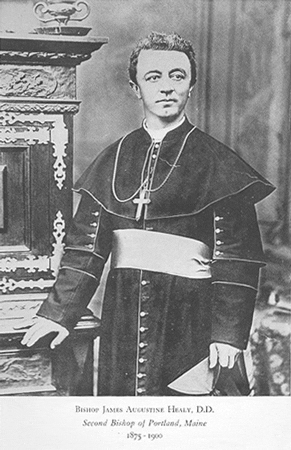
In 1854, James Augustine Healy was the first African American priest ordained in the United States.
“The Dignity of the Priesthood”
In a sermon on “The True Priesthood,” delivered at Brooklyn’s St. Ambrose Church in May 1886, Father Daniel Sheehy declared to his parishioners:
What a dignity, the priesthood! Its duties are great. They are commissioned to lead the people to victory. Yours, too, is a duty. They are commanded to teach. You are commanded to learn. They in their own sphere are bid to command; you to obey.
Priests were the officers in God’s army, and their very person was considered sacred. They had an immense dignity, but that dignity didn’t extend to African American men, who weren’t allowed in the priesthood.
“Passing for White”: The Healy Brothers
Not unless they “passed for white,” like the three Healy brothers, children of a Black slave and her white owner. When in 1854 James was the first priest of African descent ordained in America, this wasn’t made public. The same was true for Patrick in the Jesuits, and Alexander, a Boston priest. Why? Because of two factors: Catholic prejudice and fear of an anti-Catholic backlash.
In 1874, Patrick was named president of Georgetown, and James became a bishop in Maine the following year. When Rome’s prestigious North American College opened in 1859, Alexander was considered for rector, but at least one bishop objected:
He has African blood and it shows distinctly in his exterior. This, in a large number of American youths, might lessen the respect they ought to feel for the first superior in a house.
Not until the 1950’s was all this made public. A Georgetown student then defaced Patrick’s portrait. At the time the university excluded African Americans. Although it now celebrates Healy as America’s first Black university president, Georgetown overlooks the great pains previously taken to hide that from the public.
The Ordeal of Father Tolton
Augustus Tolton was born a slave in Missouri. His racial identity was no secret, and no American seminary would take him. Ordained in Rome in 1886, the American bishops considered sending him to Africa. Instead he went to Quincy, Illinois. Later he became pastor of Chicago’s first African American parish, St. Monica’s, on the South Side.
“Good Father Gus,” as he was known (perhaps patronizingly), had it tough. Many Catholics refused to accept him as a “real” priest, including his clerical colleagues. Frequent racist abuse and constant stress hastened his early death at 43. Today Father Tolton’s canonization cause is well underway; in June 2019, Pope Francis declared him “Venerable.” He was a martyr to the cause of Black freedom at a time when the altar was segregated.
Desegregating the Altar
Many Northern white Catholics considered Black priests a novelty if not an oddity. In the South, however, the notion of Black priests being raised to the same level as white ones was seen as a threat to the Jim Crow system that dominated the post-Civil War South for a century.
In spite of this, in 1871 the Josephite Fathers and Brothers were formed to serve African Americans. In his book Desegregating the Altar, one of the best ever written on American Catholic history, Stephen Ochs notes that they faced a tough battle advocating for African American priests. Opposition from both Catholics and non-Catholics was fierce.
In Georgia, the notoriously racist Tom Watson, a future U.S. Senator, attacked the Josephites for ordaining Black priests. In June 1914, his Watson’s Jeffersonian Weekly addressed what Watson called “The Sinister Portent of Negro Priests”:
Now when these black men are taught by white priests that they are your equals, and that in being received into the priesthood, they are better than you, what are to be the ultimate consequences? I do not address this vital question to non-Catholics only; I most earnestly implore the Catholics themselves to consider it.
Many Southern Catholic bishops agreed. New Orleans Archbishop James Blenk banned Black priests. In Georgia, Bishop Benjamin Kiely, a Civil War veteran, was buried with a Confederate flag. Several openly employed racist terminology. In his memoir*,* Church historian John Tracy Ellis recalled that Cardinal John Glennon of St. Louis was well known for “his dislike of Blacks.”
Epilogue
At the start of the twentieth century, Father John Slattery, head of the Josephites, frequently preached against Catholic racism. Eventually he left the Church in frustration and disgust. Ochs notes that during this same period Vatican authorities, not American bishops, took the lead to actively promote a Black priesthood. They at least didn’t fear Southern racism. In 1920, German Divine Word Fathers started the first African American seminary in Mississippi.
The ordeal of the Black priest, as Ochs has called it, lasted well into the twentieth century. While the Civil Rights Movement did a lot to change that, we can’t ignore this terrible blemish on American Catholic history, when the color of one’s skin was an impediment to ordination. The Josephites did what they could, but again it was a hard struggle inside and outside the Church. Today, at least, their experience reminds us today of the true meaning of the word “Catholic”: “universal.”
(Photo Source: Wikimedia Commons)
Previous Post

June 5, 2020
A House Divided: The American Bishops and the Civil War
Next Post
June 7, 2020 “It’s About Time They Got Here”: Catholics and the Civil Rights Movement
Browse Our Archives
Select a Category African-American Catholics Alabama Catholics American Catholic History American Catholic women American History Anniversaries Anti-Catholicism Arkansas Catholics Benedictines Bishops Blessed John Henry Newman Book Reviews Books Boston College Brooklyn churches Brothers California Catholics Capuchins Cardinals Carlo Carretto Carmelites Catholic authors Catholic Cemeteries Catholic Historians Catholic History in Less Than 5 Minutes Catholic musicians Catholic Poetry Catholic Press Catholic School Textbook Catholic University of America Catholic Worker Catholics and Music Catholics and Race Catholics in Politics Catholics in the American Revolution Catholics in the Military Catholics in the Movies Catholics in the South Catholics in the West Catholics on Stage Catjolic Women Catolic Poetry Charles de Foucauld Children's Masses Christian Brothers Christmas Church Reform Civil Rights Movement Civil War Colleges and universities Converts D.C. Catholics Deaf Catholics Dominicans. Dorothy Day English Catholics Florida Catholics Fordham University Franciscans French Catholics Georgetown University German Americans Good Shepherd Sisters Hispanic Catholics Historians and Archivists Holy Cross Fathers Holy Name Society Idaho Catholics Illinois Catholics Indian Wars Indiana Catholics Irish Americans Irish Catholicism Italian Americans Italian Catholics Jesuits Josephite Sisters Kentucky Catholics Know-Nothings Laetare Medal Recipients laity Liturgical Movement Maine Catholics Manhattan College Maryland Catholicism Michigan Catholics Middle Ages Minnesota Catholics Missionaries Mississippi Catholics Missouri Catholics Monasteries Montana Catholics Native Americans New England Catholicism New Jersey Catholics New York Catholics North American College Ohio Catholics Oratorians Oregon Catholics Parish Mission Parishes Passionists Pat McNamara's Books Paulists Pennsylvania Catholics Popes Presidents Priests Quotations Religious Orders Rhode Island Catholics Saints Salesians Seminarians Seminaries Sermons Servants of God Siisters of Charity Sisters of Mercy South Carolina Catholics Spanish-American War Sports St. Francis of Assiai St. John Henry Newman Suplicians Tennessee Catholics Texas Catholics The year in review Thomas Merton Throwback Thursday Photograph Trappists Uncategorized University of Notre Dame Video Presentations Vincentians Virginia Catholics Visitation Nuns Washington West Point West Virginia Catholics West Viriginia Catholics Wisconsin Catholicism Women Religious World War II
Select a Month December 2020 June 2020 May 2020 April 2020 March 2020 March 2019 February 2019 January 2019 December 2018 November 2018 November 2014 October 2014 September 2014 August 2014 July 2014 June 2014 May 2014 December 2013 November 2013 October 2013 August 2013 July 2013 June 2013 May 2013 April 2013 March 2013 February 2013 January 2013 December 2012 November 2012 October 2012 September 2012 August 2012 July 2012 June 2012 April 2012 March 2012 December 2011 November 2011 October 2011 September 2011 August 2011 July 2011 June 2011 May 2011 April 2011 March 2011 February 2011 January 2011 December 2010 November 2010 October 2010 January 2010 December 2009 November 2009 October 2009 September 2009 August 2009 July 2009 June 2009 May 2009 April 2009 March 2009 February 2009 January 2009 December 2008
Follow Us!
TAKE THE
Religious Wisdom Quiz
What is the Christian principle about judging by appearances?
Select your answer to see how you score.
Do not judge by outward appearance See clothes first Judge quickly Copy others' opinions
Related posts from McNamara's Blog

American Catholics and Race in 2020: A Church...

“It’s About Time They Got Here”: Catholics and the...
A House Divided: The American Bishops and the...
TRENDING AT PATHEOS Catholic

Creation, Preservation, and Teleology in Catholic Theology
As I write this, it is very early Monday morning. Like millions...

The Parable Of The Sower And The Word...
One of Christ’s most famous parables is that of the sower who...

Rejecting Doom: Christian Hope And Human Action
Christianity is a religion of hope. We are to have hope and...

Why I Choose the Eucharist Over the Sermon
Choose the Eucharist, Not the Sermon What are we supposed to get...

5 Design Elements Found in Spiritually Rooted Homes
Putting Spirituality Into Home Decor Our homes are more than our living...

Credo: A Story of God Told with the...
About 10 years ago, I began to imagine a personal "Credo" that...
view all Catholic blogs
Ad-Free & Subscriber Log-In Subscription Support
- About Us
- 2026 Calendar
- Videos
- Podcasts
- Library of World Religions
- Faith In Media Tracker
- Advertise With Us
- Write for Us
- Privacy Policy
- Terms of Service
- Do Not Sell My Data
- Contact Us
- Radiant Digital
- Manage Newsletter Subscriptions
- Unsubscribe From Notifications
- Sitemap
Copyright 2008-2026, Patheos. All rights reserved.
Subscription Support Ad-Free & Subscriber Log-In
Follow Patheos