
BuddhistCatholicContemplativeEvangelicalGeneral ChristianHinduJewishLatter-day SaintMuslimNew VisionsProgressive Christian
Beliefs
- Buddhist
- Catholic
- Contemplative
- Evangelical
- General Christian
- Hindu
- Jewish
- Latter-day Saint
- More Voices
- Muslim
- New Visions
- Pagan
- Progressive Christian
Topics
- Religion News
- Food and Religion
- Sports and Religion
- Religious Art
- Religious Music and Entertainment
- Religious Events
- History and Religion
- Style and Religion
- Politics and Religion
- Women in Religion
- Recreation Outdoors and Religion
- Business Finance and Religion
- Careers Workplace and Religion
- Education and Religion
- Family Parenting and Religion
- Health Fitness and Religion
- Home and Religion
- Relationships and Religion
- Technology and Religion
- Travel and Religion
Columnists
- Buddhist Columnists
- Business Finance and Religion Columnists
- Careers Workplace and Religion Columnists
- Catholic Columnists
- Contemplative Columnists
- Education and Religion Columnists
- Evangelists Columnists
- Family Parenting and Religion Columnists
- General Christian Columnists
- Health Fitness and Religion Columnists
- Hindu Columnists
- History and Religion Columnists
- Home and Religion Columnists
- Jewish Columnists
- More Voices Columnists
- Latter Day Columnists
- Muslim Columnists
- New Visions Columnists
- Nonreligious Columnists
- Pagan Columnists
- Politics and Religion Columnists
- Progressive Columnists
- Recreation Outdoors and Religion Columnists
- Relationships and Religion Columnists
- Religion News Columnists
- Religious Art Columnists
- Religious Events Columnists
- Religious Music and Entertainment Columnists
- Sports and Religion Columnists
- Style and Religion Columnists
- Technology and Religion Columnists
- Travel and Religion Columnists
- Women in Religion Columnists
Resource Library
- 2026 Calendar
- Library of World Religions
- The 100 Most Holy Places on Earth
- Patheos Answers
- Podcasts
- Videos
- Faith Leaders Database
- Anglican Episcopalian
- Bahai
- Baptist
- Buddhism
- Christianity
- Confucianism
- Eastern Orthodoxy
- Hinduism
- Holiness and Pentecostal
- ISKCON
- Islam
- Judaism
- Lutheran
- Methodist
- The Church of Jesus Christ of Latter-day Saints
- New Age
- Paganism
- Presbytarian and Reformed
- Protestantism
- Religion Behind the Scenes
- Roman Catholic
- Scientology
- Shia Islam
- Sikhism
- Sufism
- Sunni Islam
- Taoism
- Zen
- See all religions
Research Tools
 Ad-Free & Subscriber Log-In Subscription Support
Ad-Free & Subscriber Log-In Subscription Support
Follow Patheos 

- Trending:
- Forgiveness
- |
- Marriage
- |
- Consciousness
- |
- Death Penalty
- |
- Election
- |
- Halloween
 McNamara's Blog
- Home
- Catholic
- Holy Name Rally at Ebbets Field Attracts 60,000 Catholic Men, May 1941
Holy Name Rally at Ebbets Field Attracts 60,000 Catholic Men, May 1941
Last updated on: January 3, 2019 at 2:20 pm by Pat McNamara
Holy Name Rally at Ebbets Field Attracts 60,000 Catholic Men, May 1941 2019-01-03T14:20:40-07:00 Pat McNamara
Patheos Explore the world's faith through different perspectives on religion and spirituality! Patheos has the views of the prevalent religions and spiritualities of the world.
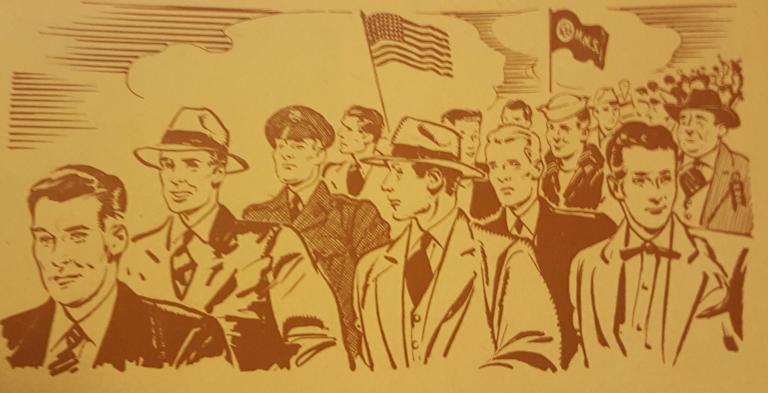 Since the Feast of the Holy Name of Jesus is celebrated as an optional memorial in today’s liturgical calendar, it offers a good opportunity to look at the Holy Name Society and its place in pre-conciliar Catholic life. Founded by the Dominicans in the 1200’s to combat heresy, the society promoted devotion to the Holy Name of Jesus, and to combat blasphemy and profanity.
For Catholics in the pre-television/pre-Vatican II era, social organizations like the Knights, the Ancient Order of Hibernians, and the National Council of Catholic Women held a prominent place in their lives. For Catholic men, this especially included the Holy Name Society. What Charles Morris writes of Catholic Philadelphia in the 1930’s and 1940’s applies equally to other major urban centers:
The rows of neat brick houses were invariable centered around, and dwarfed by, an imposing cluster of granite buildings– the Catholic church, always of neo-Gothic design, built to the scale of a medium-size cathedral; the parish school, sometimes even a high school; the rectory; the convent; one or more annexes for meeting rooms, overflow classes, perhaps even an auditorium. Few contemporary religions could match Catholicism’s hold on the faithful.
Estimating that Mass attendance “hovered around 90 percent,” Morris argues that the Catholicism of this era was as much a culture as a religion, adding: “It was not uncommon for the majority of adults to belong to parish organizations like the Sodality and the Holy Name Society.” (I still have a copy of my grandfather’s Holy Name manual from 1941.)
The Holy Name Society was introduced to America in the 1870’s by Father Tom Burke, a popular Dominican preacher from Ireland. In Brooklyn and elsewhere, it soon became a mainstay of Catholic life. By the 1890’s, it had 80,000 members across Long Island. Around this time, the first rallies were held in Suffolk. The first Brooklyn rally held at Ebbets Field in 1937 attracted some 60,000 men alone. By the early 1950’s, diocesan-wide rallies were seeing crowds of up to 100,000 Catholic men.
What happened at these rallies? The format was simple enough: a parade and a speaker, all designed to promote Catholic patriotism, unity and manhood. Good Catholic men, it was emphasized, went to Church and supported it financially; they sent their children to Catholic school; they joined parish organizations like the Knights and Holy Name, which aimed to strengthen their faith. In May 1941, a front-page Brooklyn Eagle article described the annual Holy Name rally at Ebbets Field:
With colors flying, bands playing and Irish pipers skirling, 60,000 Brooklyn Catholic men and boys marched in a three-hour parade along Bedford Avenue, which served as a colorful preview to the annual rally of the borough’s Holy Name Societies in Ebbets Field yesterday.
At Ebbets Field, the keynote speaker, Monsignor James Griffiths, spoke on the need for prayer in a time of war. Catholic patriotism was affirmed: “The ceremonies started with the massing of American flags, papal flags and the individual banners of each of the societies and the singing of the ‘Star-Spangled Banner.’” Then the Holy Name Litany, a lengthy prayer, was read, the Holy Name pledge was recited, and a papal blessing was read. The pledge read:
Blessed be God. Blessed be His Holy Name. Blessed be Jesus Christ true God and true Man. Blessed be the Name of Jesus. I believe O Jesus., that Thou are the Christ, the Son of the Living God. I proclaim my love for the Vicar of Christ on Earth. I believe all the sacred truths which the Holy Catholic Church believes and teaches. I promise to give good example by the regular practice of my faith. In honor of His Divine Name I pledge myself against perjury, blasphemy, profanity and obscene speech. I pledge my loyalty to the flag of my country, and to the God given principles of freedom, justice and happiness for which it stands. I pledge my support to all lawful authority both civil and religious. I dedicate myself to the honor of the Sacred Name of Jesus Christ and beg that He will keep me faithful to these pledges until Death.
By the 1960’s, the Holy Name rallies had declined in numbers nationwide, but the society is still strong among the City of New York’s uniformed services, especially the Police Department. On this Feast of the Holy Name of Jesus, then, we remember a forgotten aspect of pre-conciliar Catholic life and culture in an attempt to rediscover our Catholic past.
The above drawing is taken from One Hundredth Anniversary, Roman Catholic Diocese of Brooklyn, 1853-1953 (Brooklyn, N.Y.: The Tablet Publishing Co., 1953), 111.
Previous Post

January 2, 2019
"A Shame and a Scandal": Black Catholics Fight Racism
Next Post
January 4, 2019 Newly Made Saints: St. Manuel Gonzalez Garcia (1877-1940)
Browse Our Archives
Select a Category African-American Catholics Alabama Catholics American Catholic History American Catholic women American History Anniversaries Anti-Catholicism Arkansas Catholics Benedictines Bishops Blessed John Henry Newman Book Reviews Books Boston College Brooklyn churches Brothers California Catholics Capuchins Cardinals Carlo Carretto Carmelites Catholic authors Catholic Cemeteries Catholic Historians Catholic History in Less Than 5 Minutes Catholic musicians Catholic Poetry Catholic Press Catholic School Textbook Catholic University of America Catholic Worker Catholics and Music Catholics and Race Catholics in Politics Catholics in the American Revolution Catholics in the Military Catholics in the Movies Catholics in the South Catholics in the West Catholics on Stage Catjolic Women Catolic Poetry Charles de Foucauld Children's Masses Christian Brothers Christmas Church Reform Civil Rights Movement Civil War Colleges and universities Converts D.C. Catholics Deaf Catholics Dominicans. Dorothy Day English Catholics Florida Catholics Fordham University Franciscans French Catholics Georgetown University German Americans Good Shepherd Sisters Hispanic Catholics Historians and Archivists Holy Cross Fathers Holy Name Society Idaho Catholics Illinois Catholics Indian Wars Indiana Catholics Irish Americans Irish Catholicism Italian Americans Italian Catholics Jesuits Josephite Sisters Kentucky Catholics Know-Nothings Laetare Medal Recipients laity Liturgical Movement Maine Catholics Manhattan College Maryland Catholicism Michigan Catholics Middle Ages Minnesota Catholics Missionaries Mississippi Catholics Missouri Catholics Monasteries Montana Catholics Native Americans New England Catholicism New Jersey Catholics New York Catholics North American College Ohio Catholics Oratorians Oregon Catholics Parish Mission Parishes Passionists Pat McNamara's Books Paulists Pennsylvania Catholics Popes Presidents Priests Quotations Religious Orders Rhode Island Catholics Saints Salesians Seminarians Seminaries Sermons Servants of God Siisters of Charity Sisters of Mercy South Carolina Catholics Spanish-American War Sports St. Francis of Assiai St. John Henry Newman Suplicians Tennessee Catholics Texas Catholics The year in review Thomas Merton Throwback Thursday Photograph Trappists Uncategorized University of Notre Dame Video Presentations Vincentians Virginia Catholics Visitation Nuns Washington West Point West Virginia Catholics West Viriginia Catholics Wisconsin Catholicism Women Religious World War II
Select a Month December 2020 June 2020 May 2020 April 2020 March 2020 March 2019 February 2019 January 2019 December 2018 November 2018 November 2014 October 2014 September 2014 August 2014 July 2014 June 2014 May 2014 December 2013 November 2013 October 2013 August 2013 July 2013 June 2013 May 2013 April 2013 March 2013 February 2013 January 2013 December 2012 November 2012 October 2012 September 2012 August 2012 July 2012 June 2012 April 2012 March 2012 December 2011 November 2011 October 2011 September 2011 August 2011 July 2011 June 2011 May 2011 April 2011 March 2011 February 2011 January 2011 December 2010 November 2010 October 2010 January 2010 December 2009 November 2009 October 2009 September 2009 August 2009 July 2009 June 2009 May 2009 April 2009 March 2009 February 2009 January 2009 December 2008
Follow Us!
TAKE THE
Religious Wisdom Quiz
What did Eve eat in the Garden of Eden?
Select your answer to see how you score.
Bread Fruit from the Tree of Knowledge A vine branch An unclean animal
Related posts from McNamara's Blog

St. John Henry Newman and the “Special Charm...

American Catholics and Race in 2020: A Church...

“It’s About Time They Got Here”: Catholics and the...

The Struggle for an African American Priesthood
TRENDING AT PATHEOS Catholic

Rejecting Doom: Christian Hope And Human Action
Christianity is a religion of hope. We are to have hope and...

It’s What Comes From Within Which Matters
One of the most difficult things for us to understand is why...

Why I Choose the Eucharist Over the Sermon
Choose the Eucharist, Not the Sermon What are we supposed to get...

5 Design Elements Found in Spiritually Rooted Homes
Putting Spirituality Into Home Decor Our homes are more than our living...

Credo: A Story of God Told with the...
About 10 years ago, I began to imagine a personal "Credo" that...

The Anatomy of Divine Revelation in Catholic Thought
The claim that God has made Himself known to human beings is...
view all Catholic blogs
Ad-Free & Subscriber Log-In Subscription Support
- About Us
- 2026 Calendar
- Videos
- Podcasts
- Library of World Religions
- Faith In Media Tracker
- Advertise With Us
- Write for Us
- Privacy Policy
- Terms of Service
- Do Not Sell My Data
- Contact Us
- Radiant Digital
- Manage Newsletter Subscriptions
- Unsubscribe From Notifications
- Sitemap
Copyright 2008-2026, Patheos. All rights reserved.
Subscription Support Ad-Free & Subscriber Log-In
Follow Patheos