
BuddhistCatholicContemplativeEvangelicalGeneral ChristianHinduJewishLatter-day SaintMuslimNew VisionsProgressive Christian
Beliefs
- Buddhist
- Catholic
- Contemplative
- Evangelical
- General Christian
- Hindu
- Jewish
- Latter-day Saint
- More Voices
- Muslim
- New Visions
- Pagan
- Progressive Christian
Topics
- Religion News
- Food and Religion
- Sports and Religion
- Religious Art
- Religious Music and Entertainment
- Religious Events
- History and Religion
- Style and Religion
- Politics and Religion
- Women in Religion
- Recreation Outdoors and Religion
- Business Finance and Religion
- Careers Workplace and Religion
- Education and Religion
- Family Parenting and Religion
- Health Fitness and Religion
- Home and Religion
- Relationships and Religion
- Technology and Religion
- Travel and Religion
Columnists
- Buddhist Columnists
- Business Finance and Religion Columnists
- Careers Workplace and Religion Columnists
- Catholic Columnists
- Contemplative Columnists
- Education and Religion Columnists
- Evangelists Columnists
- Family Parenting and Religion Columnists
- General Christian Columnists
- Health Fitness and Religion Columnists
- Hindu Columnists
- History and Religion Columnists
- Home and Religion Columnists
- Jewish Columnists
- More Voices Columnists
- Latter Day Columnists
- Muslim Columnists
- New Visions Columnists
- Nonreligious Columnists
- Pagan Columnists
- Politics and Religion Columnists
- Progressive Columnists
- Recreation Outdoors and Religion Columnists
- Relationships and Religion Columnists
- Religion News Columnists
- Religious Art Columnists
- Religious Events Columnists
- Religious Music and Entertainment Columnists
- Sports and Religion Columnists
- Style and Religion Columnists
- Technology and Religion Columnists
- Travel and Religion Columnists
- Women in Religion Columnists
Resource Library
- 2026 Calendar
- Library of World Religions
- The 100 Most Holy Places on Earth
- Patheos Answers
- Podcasts
- Videos
- Faith Leaders Database
- Anglican Episcopalian
- Bahai
- Baptist
- Buddhism
- Christianity
- Confucianism
- Eastern Orthodoxy
- Hinduism
- Holiness and Pentecostal
- ISKCON
- Islam
- Judaism
- Lutheran
- Methodist
- The Church of Jesus Christ of Latter-day Saints
- New Age
- Paganism
- Presbytarian and Reformed
- Protestantism
- Religion Behind the Scenes
- Roman Catholic
- Scientology
- Shia Islam
- Sikhism
- Sufism
- Sunni Islam
- Taoism
- Zen
- See all religions
Research Tools
 Ad-Free & Subscriber Log-In Subscription Support
Ad-Free & Subscriber Log-In Subscription Support
Follow Patheos 

- Trending:
- Forgiveness
- |
- Marriage
- |
- Consciousness
- |
- Death Penalty
- |
- Election
- |
- Halloween
 McNamara's Blog
- Home
- Catholic
- The Sisters of Mercy in Early San Francisco
The Sisters of Mercy in Early San Francisco
Last updated on: December 4, 2018 at 3:50 am by Pat McNamara
The Sisters of Mercy in Early San Francisco 2018-12-04T03:50:34-07:00 Pat McNamara
Patheos Explore the world's faith through different perspectives on religion and spirituality! Patheos has the views of the prevalent religions and spiritualities of the world.
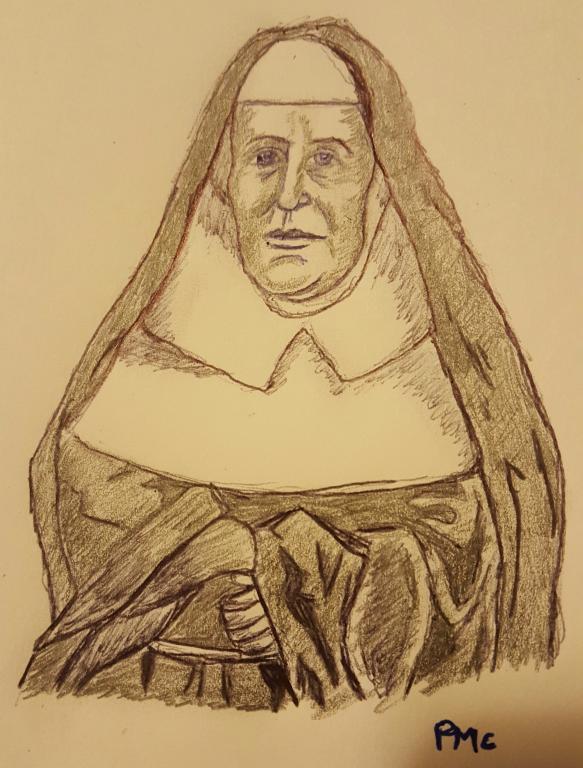 In the summer of 1854, a young Irish priest named Hugh Gallagher traveled back to his homeland from a far-off city on the other side of the world known as San Francisco. Father Gallagher’s job was to recruit women religious for work in this growing city that needed the kind of help they were best qualified for: teaching children, tending to the poor and sick, nursing the dying.
Soon after he arrived, Father Gallagher approached the Mother Superior of the Sisters of Mercy convent in Kinsale, County Cork. Eight volunteers were taken. A twenty-five-year old Sister, Mary Baptist Russell, was chosen to lead the group on the eight-thousand mile-journey to San Francisco. It would be her first stint as a Mother Superior. Described by one historian as a “fine business woman,” through the course of five decades she would oversee the establishment of “what amounted to a privately sponsored welfare department in San Francisco and Sacramento.”
Born Katherine Russell to an distinguished if not affluent Catholic family in Northern Ireland, she took the name Mary Baptist when she joined the Sisters of Mercy at nineteen. As a young girl, during the height of the Irish Famine, she had volunteered to help poor families. She visited “the sick and poor in their wretched homes, and collect[ed] from door to door the weekly subscriptions of those who were a little better off, and also prepar[ed] her share of the clothing which was distributed to the poor.” In the process, her biographer notes, she discovered “what was to be the work of her life.”
The Sisters of Mercy were a perfect fit for her, a women’s religious community that was active at a time when most were strictly contemplative. They took a special vow of service to “the poor, sick, and ignorant.” Their spirituality flows from founder Catherine McAuley’s (1778-1841) understanding of Christ as mercy itself. For Catherine, mercy was “the principal path pointed out by Jesus Christ to those who are desirous of following Him.” Her charism, writes Mercy Sister Kathleen Healy, “is expressed in prayer and service for the poor.”
The first Six Sisters of Mercy came to America in 1843. Beginning in Pittsburgh, they spread throughout the country. What did they do? They taught school, nursed the sick, ran orphanages and hospitals, residences for women and the aged, vocational training schools and nurseries. By the 1850’s, though, they still hadn’t yet made any inroads on the West Coast. That would be left to the eight Sisters from Kinsale.
The trip from Ireland to San Francisco took three months. Since John Sutter first discovered gold in California in 1848, the village once known as Yerba Buena had grown from three hundred to a city of some 35,000 replete with violence, robbery and mayhem galore. As one historian writes, “San Francisco was then in its raw beginnings.” Russell’s biographer comments: “There was a fine field of labor for Irish Sisters of Mercy.”
They soon established themselves in a small house on Vallejo Street in January 1855 and started nursing the sick and teaching. Anti-Catholicism was a vital presence in California life as the infamous Know-Nothing Party, pledged to eliminate Catholic influence in the United States, elected a governor shortly before the Sisters arrived. The Mayor of San Francisco, Stephen Palfrey Webb, was a Know-Nothing. Protestant doctors in the city hospitals banned the Sisters from visiting patients.
But that Fall, when a cholera epidemic hit the city, the Sisters were out in full force. Their actions did much to alleviate prejudice against them and their Church. One journalist wrote that the Sisters
hurried to offer their services. They did not stop to inquire whether the sufferers were Protestants or Catholics, Americans or foreigners, but with the noblest devotion applied themselves to their relief. One Sister might be seen bathing the limbs of a sufferer, another chafing the extremities, a third applying the remedies, while others with pitying faces were calming the fears of those supposed to be dying. The idea of danger never seems to have occurred to these noble women; they heeded nothing of the kind.
Eventually Mother Russell bought the old city hospital and turned it into St. Mary’s, the first Catholic hospital on the West Coast. Under his leadership, the Sisters were responsible for many “firsts,” including the first homes for unwed mothers in the West and the first subscription library in Sacramento. In the 1870’s, they became the first women to enter San Quentin to visit the prisoners.
They also founded unemployment bureaus, offered adult education, and ran homes for the aged. It was hard work. They wrestled with what one historian calls “smell, noise, inhumanity and poverty” on a daily basis. In 1868 a smallpox epidemic hit the city. The Sisters lived among the victims ministering to them for ten months. But Mother Russell never complained. One Sister said of her: “I would look at her working and scrubbing and feel ashamed of myself and say, ‘She is a fine lady, and look what she does; so how can I complain?'”
One Sister recalled that Mother Russell “had always been remarkable for her skill in nursing and comforting the sick and dying; fear was unknown to her.” Another said: “She provided wedding dresses for brides too poor to purchase them. She visited men in prisons. She stole from the hospital linen supply to give to the poor… One time, she pulled her own mattress down the stairs to give it to a poor man.” Through it all, Mother Russell had what observers described as an aura of peace about her: “When one would go to talk with her, it was almost like going to Confession. You would come away light-hearted.”
By the 1890’s, San Francisco had a strong Catholic presence. And much of the credit for building a Catholic infrastructure therein goes to the Sisters of Mercy under the leadership of Mother Baptist Russell. Her name, it was said, “was a household word all over San Francisco.”
In the summer of 1898, most of the nationwide news coverage focused on the Spanish-American War. But in San Francisco the main news was the passing of a 69-year-old nun, one of the city’s first residents and a backbone of Catholic life in the city now known as “the Paris of the West.” Over fifty priests and thousands of San Franciscans attended the funeral who had brought what Shakespeare called “the quality of mercy” to a booming, lawless town.
(*The above drawing of Mother Russell is by Pat McNamara.)
Previous Post

December 3, 2018
The Feast of St. Francis Xavier (1506-1552)
Next Post
December 5, 2018 Brooklyn Catholic Architect Receives Notre Dame's Laetare Medal, 1884
Browse Our Archives
Select a Category African-American Catholics Alabama Catholics American Catholic History American Catholic women American History Anniversaries Anti-Catholicism Arkansas Catholics Benedictines Bishops Blessed John Henry Newman Book Reviews Books Boston College Brooklyn churches Brothers California Catholics Capuchins Cardinals Carlo Carretto Carmelites Catholic authors Catholic Cemeteries Catholic Historians Catholic History in Less Than 5 Minutes Catholic musicians Catholic Poetry Catholic Press Catholic School Textbook Catholic University of America Catholic Worker Catholics and Music Catholics and Race Catholics in Politics Catholics in the American Revolution Catholics in the Military Catholics in the Movies Catholics in the South Catholics in the West Catholics on Stage Catjolic Women Catolic Poetry Charles de Foucauld Children's Masses Christian Brothers Christmas Church Reform Civil Rights Movement Civil War Colleges and universities Converts D.C. Catholics Deaf Catholics Dominicans. Dorothy Day English Catholics Florida Catholics Fordham University Franciscans French Catholics Georgetown University German Americans Good Shepherd Sisters Hispanic Catholics Historians and Archivists Holy Cross Fathers Holy Name Society Idaho Catholics Illinois Catholics Indian Wars Indiana Catholics Irish Americans Irish Catholicism Italian Americans Italian Catholics Jesuits Josephite Sisters Kentucky Catholics Know-Nothings Laetare Medal Recipients laity Liturgical Movement Maine Catholics Manhattan College Maryland Catholicism Michigan Catholics Middle Ages Minnesota Catholics Missionaries Mississippi Catholics Missouri Catholics Monasteries Montana Catholics Native Americans New England Catholicism New Jersey Catholics New York Catholics North American College Ohio Catholics Oratorians Oregon Catholics Parish Mission Parishes Passionists Pat McNamara's Books Paulists Pennsylvania Catholics Popes Presidents Priests Quotations Religious Orders Rhode Island Catholics Saints Salesians Seminarians Seminaries Sermons Servants of God Siisters of Charity Sisters of Mercy South Carolina Catholics Spanish-American War Sports St. Francis of Assiai St. John Henry Newman Suplicians Tennessee Catholics Texas Catholics The year in review Thomas Merton Throwback Thursday Photograph Trappists Uncategorized University of Notre Dame Video Presentations Vincentians Virginia Catholics Visitation Nuns Washington West Point West Virginia Catholics West Viriginia Catholics Wisconsin Catholicism Women Religious World War II
Select a Month December 2020 June 2020 May 2020 April 2020 March 2020 March 2019 February 2019 January 2019 December 2018 November 2018 November 2014 October 2014 September 2014 August 2014 July 2014 June 2014 May 2014 December 2013 November 2013 October 2013 August 2013 July 2013 June 2013 May 2013 April 2013 March 2013 February 2013 January 2013 December 2012 November 2012 October 2012 September 2012 August 2012 July 2012 June 2012 April 2012 March 2012 December 2011 November 2011 October 2011 September 2011 August 2011 July 2011 June 2011 May 2011 April 2011 March 2011 February 2011 January 2011 December 2010 November 2010 October 2010 January 2010 December 2009 November 2009 October 2009 September 2009 August 2009 July 2009 June 2009 May 2009 April 2009 March 2009 February 2009 January 2009 December 2008
Follow Us!
TAKE THE
Religious Wisdom Quiz
What was the primary trade route in Biblical times?
Select your answer to see how you score.
Royal Road Silk Road Spice Route Mediterranean Route
Related posts from McNamara's Blog
As St. Patrick’s Day Approaches: An Irish American...
Before Alcoholics Anonymous: Father Mathew and the Pledge
Brooklyn Catholic Architect Receives Notre Dame's Laetare Medal,...
All Hallows College, Ireland (1840)
TRENDING AT PATHEOS Catholic

Creation, Preservation, and Teleology in Catholic Theology
As I write this, it is very early Monday morning. Like millions...

The Parable Of The Sower And The Word...
One of Christ’s most famous parables is that of the sower who...

Rejecting Doom: Christian Hope And Human Action
Christianity is a religion of hope. We are to have hope and...

Why I Choose the Eucharist Over the Sermon
Choose the Eucharist, Not the Sermon What are we supposed to get...

5 Design Elements Found in Spiritually Rooted Homes
Putting Spirituality Into Home Decor Our homes are more than our living...

Credo: A Story of God Told with the...
About 10 years ago, I began to imagine a personal "Credo" that...
view all Catholic blogs
Ad-Free & Subscriber Log-In Subscription Support
- About Us
- 2026 Calendar
- Videos
- Podcasts
- Library of World Religions
- Faith In Media Tracker
- Advertise With Us
- Write for Us
- Privacy Policy
- Terms of Service
- Do Not Sell My Data
- Contact Us
- Radiant Digital
- Manage Newsletter Subscriptions
- Unsubscribe From Notifications
- Sitemap
Copyright 2008-2026, Patheos. All rights reserved.
Subscription Support Ad-Free & Subscriber Log-In
Follow Patheos