
BuddhistCatholicContemplativeEvangelicalGeneral ChristianHinduJewishLatter-day SaintMuslimNew VisionsProgressive Christian
Beliefs
- Buddhist
- Catholic
- Contemplative
- Evangelical
- General Christian
- Hindu
- Jewish
- Latter-day Saint
- More Voices
- Muslim
- New Visions
- Pagan
- Progressive Christian
Topics
- Religion News
- Food and Religion
- Sports and Religion
- Religious Art
- Religious Music and Entertainment
- Religious Events
- History and Religion
- Style and Religion
- Politics and Religion
- Women in Religion
- Recreation Outdoors and Religion
- Business Finance and Religion
- Careers Workplace and Religion
- Education and Religion
- Family Parenting and Religion
- Health Fitness and Religion
- Home and Religion
- Relationships and Religion
- Technology and Religion
- Travel and Religion
Columnists
- Buddhist Columnists
- Business Finance and Religion Columnists
- Careers Workplace and Religion Columnists
- Catholic Columnists
- Contemplative Columnists
- Education and Religion Columnists
- Evangelists Columnists
- Family Parenting and Religion Columnists
- General Christian Columnists
- Health Fitness and Religion Columnists
- Hindu Columnists
- History and Religion Columnists
- Home and Religion Columnists
- Jewish Columnists
- More Voices Columnists
- Latter Day Columnists
- Muslim Columnists
- New Visions Columnists
- Nonreligious Columnists
- Pagan Columnists
- Politics and Religion Columnists
- Progressive Columnists
- Recreation Outdoors and Religion Columnists
- Relationships and Religion Columnists
- Religion News Columnists
- Religious Art Columnists
- Religious Events Columnists
- Religious Music and Entertainment Columnists
- Sports and Religion Columnists
- Style and Religion Columnists
- Technology and Religion Columnists
- Travel and Religion Columnists
- Women in Religion Columnists
Resource Library
- 2026 Calendar
- Library of World Religions
- The 100 Most Holy Places on Earth
- Patheos Answers
- Podcasts
- Videos
- Faith Leaders Database
- Anglican Episcopalian
- Bahai
- Baptist
- Buddhism
- Christianity
- Confucianism
- Eastern Orthodoxy
- Hinduism
- Holiness and Pentecostal
- ISKCON
- Islam
- Judaism
- Lutheran
- Methodist
- The Church of Jesus Christ of Latter-day Saints
- New Age
- Paganism
- Presbytarian and Reformed
- Protestantism
- Religion Behind the Scenes
- Roman Catholic
- Scientology
- Shia Islam
- Sikhism
- Sufism
- Sunni Islam
- Taoism
- Zen
- See all religions
Research Tools
 Ad-Free & Subscriber Log-In Subscription Support
Ad-Free & Subscriber Log-In Subscription Support
Follow Patheos 

- Trending:
- Forgiveness
- |
- Marriage
- |
- Consciousness
- |
- Death Penalty
- |
- Election
- |
- Halloween
 McNamara's Blog
- Home
- Catholic
- Gerard Manley Hopkins: Finding God in All Things
Gerard Manley Hopkins: Finding God in All Things
Last updated on: December 20, 2018 at 4:52 am by Pat McNamara
Gerard Manley Hopkins: Finding God in All Things 2018-12-20T04:52:25-07:00 Pat McNamara
Patheos Explore the world's faith through different perspectives on religion and spirituality! Patheos has the views of the prevalent religions and spiritualities of the world.
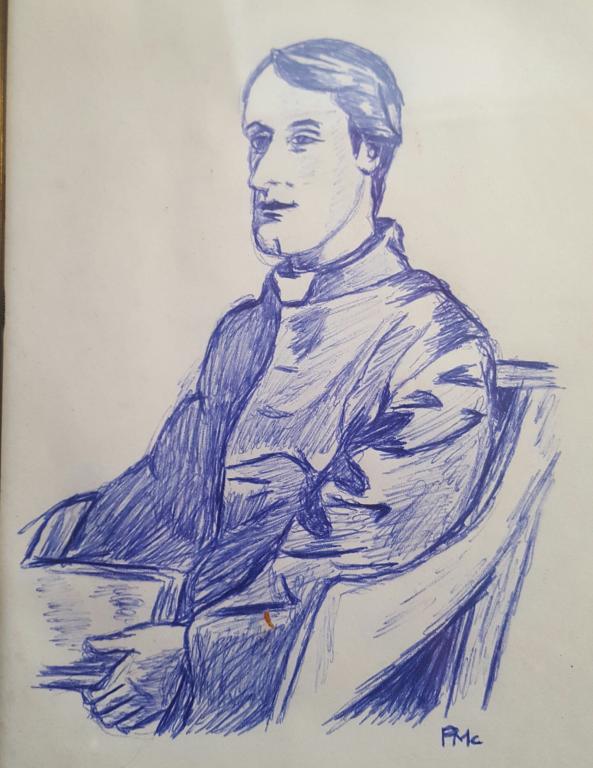 In 1800’s England, becoming Catholic was, writes historian Hugh Trevor-Roper, “a fate worse than death.” Englishmen, one contemporary observed, feared Catholics “more than they fear heathens.” When England’s Roman Catholic hierarchy was re-established in 1850, three centuries after the Reformation, effigies of bishops were burned in the streets and “No Popery!” was graffiti’d on walls.
Still, many converted, thanks largely to the Oxford Movement. This started in the 1830’s as an attempt to reclaim Anglicanism’s prophetic role, but led many Romeward, including John Henry Newman, one of its leaders. In 1864, to explain his decision, Newman wrote Apologia Pro Vita Sua (“A Defense of His Life”), perhaps the greatest spiritual autobiography in the English language. As a result, his influence was stronger than ever, especially in Oxford.
On October 21, 1866, Newman received into the Catholic Church a twenty-two year old Oxford undergraduate named Gerard Manley Hopkins, who seemed destined for a great career at Oxford (at least until his conversion). If Newman is remembered as a master of English prose, Hopkins is considered the Victorian era’s greatest poet.
Born into a wealthy, cultured family on July 28, 1844, Hopkins received the best education possible. At Oxford, he befriended future Poet Laureate Robert Bridges, who would publish Hopkins’s poetry. A small, frail man, Hopkins attracted people, writes biographer Robert Martin, by his “openness and spontaneity. He bubbled with uncomplicated humor.”
At Oxford he wrote poems and dabbled in “High Church” Anglicanism, which emphasized ecclesiastical ephemera such as elaborate vestments and decorated altars, candlesticks and incense. Many Oxford men were attracted to these without ever converting. As Anglican clergy, they simply adopted their favorite aspects, such as birettas and cassocks, for example.
Three things really attracted Hopkins to Rome: its doctrine of transubstantiation, its sacramental worldview, and its universality. The “trivialness of life,” he wrote, was “done away with by the Incarnation.” God, he felt, “must have made His Church such as to attract and convince the poor and unlearned as well as the learned.” Other important factors included
Its consolations, its marvelous ideal of holiness, the faith and devotion of its children, its multiplicity, its array of saints and martyrs, its consistency and unity, its glowing prayers, the daring majesty of its claims, etc. etc.
Although Hopkins’s conversion disappointed his parents, they didn’t abandon him. His father felt he was “throwing a pure life and a somewhat unusual intellect away.” While Hopkins might doubt himself at times, he never doubted his decision to convert. It was God, Hopkins insisted, “Who makes the decision and not I.”
After Oxford, Hopkins considered his calling. In May 1868, he simply wrote: “Resolved to be a religious.” That Fall he joined the Jesuits, resolving not to write poetry and concentrate on his religious vocation. Over the next nine years, he studied philosophy, read theology, and taught school. Of his ordination on September 23, 1877, he commented: “I was by God’s mercy deeply touched.”
Hopkins never abandoned his poet’s eye. In August 1874, for example, he wrote: “As we drove home the stars came out thick: I leant back to look at them and my heart opening more than usual praised our Lord to and in whom all that beauty comes home.” A tragic event the following year prompted him to write again.
Reading of a shipwreck that killed five German nuns, Hopkins’s religious superior expressed his wish that someone would write a poem on it. Hopkins soon composed a lengthy poem, “The Wreck of the Deutschland.” A meditation on suffering, the English Jesuits rejected it for their monthly periodical. Hopkins’s sister said: “I wish those nuns had stayed at home.”
In twelve years of priesthood, Hopkins served at several English and Irish schools and parishes. In neither capacity did he truly succeed. As a teacher, he was considered eccentric and somewhat ineffective. His erudite sermons to working-class congregations frequently missed the mark. His superiors wrote: “He is clever, well-trained… but has never succeeded well.”
Hopkins suffered many disappointments. Urban poverty discouraged and depressed him. In Ireland, he was treated as an outsider by his fellow Catholics. He wondered how effective his life as a religious had been; later poems like “Thou art Indeed Just, Lord,” reflected this. Still, he wrote shortly before his death, “I do not waver… I never had since my conversion to the Church.”
On June 8, 1889, Hopkins died of typhoid fever in Dublin at forty-four. Friends and family considered his Jesuit life a failure. Robert Bridges bitterly wrote: “He seems to have been entirely lost and destroyed by those Jesuits.” Yet Hopkins’s last words were: “I am so happy. I am so happy.”
No obituary mentioned poetry. Hopkins had only showed his poems to close friends. In 1918, Bridges had them published. Hopkins was praised for his originality and immediacy, what he himself called the “dearest freshness deep down things,” influencing later poets such as W.H. Auden and Dylan Thomas.
In his greatest poems, Ellsberg writes, Hopkins appropriates “nature to find religious meaning.” This is true in “God’s Grandeur” and “The Windhover.” Robert Martin suggests that Ignatian spirituality allowed Hopkins “to find a sacramental vision” in a way not available elsewhere. In this sense, then, Hopkins’s Jesuit life was a success. For a Jesuit, Father Philip Endean writes, is a “contemplative in action,” who finds “God in all things.” Hopkins leads others to do the same through his poetry.
NOTE: If you’ve never read Hopkins before, I suggest starting with Margaret Ellsberg’s wonderful The Gospel in Gerard Manley Hopkins. It’s an excellent combination of biography, commentary, spiritual reflection, and a nice selection of his greatest poems. I find myself going back to it again and again.
The above drawing of Hopkins is by Pat McNamara.
Next Post

December 21, 2018 What's in a Name? Canisius College, Buffalo, New York (1870)
Browse Our Archives
Select a Category African-American Catholics Alabama Catholics American Catholic History American Catholic women American History Anniversaries Anti-Catholicism Arkansas Catholics Benedictines Bishops Blessed John Henry Newman Book Reviews Books Boston College Brooklyn churches Brothers California Catholics Capuchins Cardinals Carlo Carretto Carmelites Catholic authors Catholic Cemeteries Catholic Historians Catholic History in Less Than 5 Minutes Catholic musicians Catholic Poetry Catholic Press Catholic School Textbook Catholic University of America Catholic Worker Catholics and Music Catholics and Race Catholics in Politics Catholics in the American Revolution Catholics in the Military Catholics in the Movies Catholics in the South Catholics in the West Catholics on Stage Catjolic Women Catolic Poetry Charles de Foucauld Children's Masses Christian Brothers Christmas Church Reform Civil Rights Movement Civil War Colleges and universities Converts D.C. Catholics Deaf Catholics Dominicans. Dorothy Day English Catholics Florida Catholics Fordham University Franciscans French Catholics Georgetown University German Americans Good Shepherd Sisters Hispanic Catholics Historians and Archivists Holy Cross Fathers Holy Name Society Idaho Catholics Illinois Catholics Indian Wars Indiana Catholics Irish Americans Irish Catholicism Italian Americans Italian Catholics Jesuits Josephite Sisters Kentucky Catholics Know-Nothings Laetare Medal Recipients laity Liturgical Movement Maine Catholics Manhattan College Maryland Catholicism Michigan Catholics Middle Ages Minnesota Catholics Missionaries Mississippi Catholics Missouri Catholics Monasteries Montana Catholics Native Americans New England Catholicism New Jersey Catholics New York Catholics North American College Ohio Catholics Oratorians Oregon Catholics Parish Mission Parishes Passionists Pat McNamara's Books Paulists Pennsylvania Catholics Popes Presidents Priests Quotations Religious Orders Rhode Island Catholics Saints Salesians Seminarians Seminaries Sermons Servants of God Siisters of Charity Sisters of Mercy South Carolina Catholics Spanish-American War Sports St. Francis of Assiai St. John Henry Newman Suplicians Tennessee Catholics Texas Catholics The year in review Thomas Merton Throwback Thursday Photograph Trappists Uncategorized University of Notre Dame Video Presentations Vincentians Virginia Catholics Visitation Nuns Washington West Point West Virginia Catholics West Viriginia Catholics Wisconsin Catholicism Women Religious World War II
Select a Month December 2020 June 2020 May 2020 April 2020 March 2020 March 2019 February 2019 January 2019 December 2018 November 2018 November 2014 October 2014 September 2014 August 2014 July 2014 June 2014 May 2014 December 2013 November 2013 October 2013 August 2013 July 2013 June 2013 May 2013 April 2013 March 2013 February 2013 January 2013 December 2012 November 2012 October 2012 September 2012 August 2012 July 2012 June 2012 April 2012 March 2012 December 2011 November 2011 October 2011 September 2011 August 2011 July 2011 June 2011 May 2011 April 2011 March 2011 February 2011 January 2011 December 2010 November 2010 October 2010 January 2010 December 2009 November 2009 October 2009 September 2009 August 2009 July 2009 June 2009 May 2009 April 2009 March 2009 February 2009 January 2009 December 2008
Follow Us!
TAKE THE
Religious Wisdom Quiz
Which Psalm opens with "Blessed is the man"?
Select your answer to see how you score.
Psalm 51 Psalm 119 Psalm 1 Psalm 23
Related posts from McNamara's Blog

St. John Henry Newman and the “Special Charm...

John Wayne and the Catholic Church
McNamara's Catholic Poets: Monsignor Robert Hugh Benson
Saint Aloysius Gonzaga: A Reflection for Troubled Times
TRENDING AT PATHEOS Catholic

Rejecting Doom: Christian Hope And Human Action
Christianity is a religion of hope. We are to have hope and...

It’s What Comes From Within Which Matters
One of the most difficult things for us to understand is why...

Why I Choose the Eucharist Over the Sermon
Choose the Eucharist, Not the Sermon What are we supposed to get...

5 Design Elements Found in Spiritually Rooted Homes
Putting Spirituality Into Home Decor Our homes are more than our living...

Credo: A Story of God Told with the...
About 10 years ago, I began to imagine a personal "Credo" that...

The Anatomy of Divine Revelation in Catholic Thought
The claim that God has made Himself known to human beings is...
view all Catholic blogs
Ad-Free & Subscriber Log-In Subscription Support
- About Us
- 2026 Calendar
- Videos
- Podcasts
- Library of World Religions
- Faith In Media Tracker
- Advertise With Us
- Write for Us
- Privacy Policy
- Terms of Service
- Do Not Sell My Data
- Contact Us
- Radiant Digital
- Manage Newsletter Subscriptions
- Unsubscribe From Notifications
- Sitemap
Copyright 2008-2026, Patheos. All rights reserved.
Subscription Support Ad-Free & Subscriber Log-In
Follow Patheos