
BuddhistCatholicContemplativeEvangelicalGeneral ChristianHinduJewishLatter-day SaintMuslimNew VisionsProgressive Christian
Beliefs
- Buddhist
- Catholic
- Contemplative
- Evangelical
- General Christian
- Hindu
- Jewish
- Latter-day Saint
- More Voices
- Muslim
- New Visions
- Pagan
- Progressive Christian
Topics
- Religion News
- Food and Religion
- Sports and Religion
- Religious Art
- Religious Music and Entertainment
- Religious Events
- History and Religion
- Style and Religion
- Politics and Religion
- Women in Religion
- Recreation Outdoors and Religion
- Business Finance and Religion
- Careers Workplace and Religion
- Education and Religion
- Family Parenting and Religion
- Health Fitness and Religion
- Home and Religion
- Relationships and Religion
- Technology and Religion
- Travel and Religion
Columnists
- Buddhist Columnists
- Business Finance and Religion Columnists
- Careers Workplace and Religion Columnists
- Catholic Columnists
- Contemplative Columnists
- Education and Religion Columnists
- Evangelists Columnists
- Family Parenting and Religion Columnists
- General Christian Columnists
- Health Fitness and Religion Columnists
- Hindu Columnists
- History and Religion Columnists
- Home and Religion Columnists
- Jewish Columnists
- More Voices Columnists
- Latter Day Columnists
- Muslim Columnists
- New Visions Columnists
- Nonreligious Columnists
- Pagan Columnists
- Politics and Religion Columnists
- Progressive Columnists
- Recreation Outdoors and Religion Columnists
- Relationships and Religion Columnists
- Religion News Columnists
- Religious Art Columnists
- Religious Events Columnists
- Religious Music and Entertainment Columnists
- Sports and Religion Columnists
- Style and Religion Columnists
- Technology and Religion Columnists
- Travel and Religion Columnists
- Women in Religion Columnists
Resource Library
- 2026 Calendar
- Library of World Religions
- The 100 Most Holy Places on Earth
- Patheos Answers
- Podcasts
- Videos
- Faith Leaders Database
- Anglican Episcopalian
- Bahai
- Baptist
- Buddhism
- Christianity
- Confucianism
- Eastern Orthodoxy
- Hinduism
- Holiness and Pentecostal
- ISKCON
- Islam
- Judaism
- Lutheran
- Methodist
- The Church of Jesus Christ of Latter-day Saints
- New Age
- Paganism
- Presbytarian and Reformed
- Protestantism
- Religion Behind the Scenes
- Roman Catholic
- Scientology
- Shia Islam
- Sikhism
- Sufism
- Sunni Islam
- Taoism
- Zen
- See all religions
Research Tools
 Ad-Free & Subscriber Log-In Subscription Support
Ad-Free & Subscriber Log-In Subscription Support
Follow Patheos 

- Trending:
- Forgiveness
- |
- Marriage
- |
- Consciousness
- |
- Death Penalty
- |
- Election
- |
- Halloween
 McNamara's Blog
- Home
- Catholic
- Franciscans Found New York City’s First Italian Parish, 1866
Franciscans Found New York City’s First Italian Parish, 1866
Last updated on: October 4, 2014 at 6:51 am by Pat McNamara
Franciscans Found New York City’s First Italian Parish, 1866 2014-10-04T06:51:52-06:00 Pat McNamara
Patheos Explore the world's faith through different perspectives on religion and spirituality! Patheos has the views of the prevalent religions and spiritualities of the world.
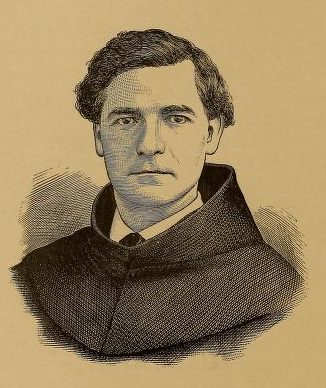
Father Anacletus De Angelis, O.F.M. (1836-1905), was Pastor of St. Anthony’s from 1878 to 1890.
St. Anthony of Padua, New York, New York (1866)
THERE can be little doubt but that the Catholic navigator Gomez, at the close of the first quarter of the sixteenth century, entered our harbor on the feast of the great Franciscan, St. Anthony of Padua; and, himself a Portuguese, felt especial devotion to that glory of his native land. We draw this conclusion from the fact that other coast names are those of summer feasts, and in the name of St. Anthony applied to our noble Hudson, we see the first dedication to that great saint.
No church, however, bore his name until the year 1859, when a zealous Italian priest was touched by the condition of his poor countrymen in New York. Many of these, having none to address them in their native tongue, had fallen into utter neglect of their religious duties, while the revolutionary element, full of hatred of religion and the priesthood, did all in their power to weaken the pious impressions of early training; and the devouring wolves of religious proselytism, who cared little for the temporal or eternal future of their victims, so that they lured them from Rome, strained every nerve and lavished money to seduce the poor Italians from their faith.
Rev. Mr. Sanguinetti obtained a lease of the church building in Canal Street which had been used by the congregation of St. Vincent de Paul, and with the sanction and encouragement of the Most Reverend Archbishop, began to collect his scattered countrymen and endeavored to revive piety and devotion among them. His labors were for from fruitless ; but difficulties arose, and the spirit of evil was not so easily driven from a field that he claimed. The good priest, after struggling for more than a year, lost heart, and, thoroughly discouraged, abandoned the mission which he had undertaken. But the Church of St. Anthony of Padua was not to be merelv a name.
The wants of the Italians had become evident, and many among them were not disposed to let the project fail. The Most Reverend Archbishop mentioned his difficulty to the Very Rev. Pamfilio da Magliano, then Provincial of the Franciscans at Allegheny. Nothing could be more consoling to that excellent religious man, and he gladly undertook to establish a church for his countrymen. The Rev. Leo Pacilio, an accomplished Neapolitan priest, was sent to commence the good work. Selecting a portion of the city where no Catholic church existed, he looked for a suitable building. Prudence suggested economy, and finding in Sullivan Street a Methodist church on leasehold property that could be acquired on reasonable terms, he secured it, and soon fitted it up for the use of the Italian congregation whom he gathered.
The church was solemnly dedicated on the 10th day of April, 1866, by the Most Reverend Archbishop, now Cardinal McCloskey, assisted by the Very Rev. William Starrs, V.G.; and the Rev. Francis McNeirny, secretary. After the usual ceremonies setting apart this building for the service of the Church, the altar was adorned, and a Solemn High Mass celebrated by the Very Rev. Pamfilo da Magliano, Father Leo da Saracena as deacon, and Father Andrew Pfeiffer as subdeacon. The Most Reverend Archbishop preached the dedicatory sermon; and after the Post Communion, the pastor. Rev. Leo Pacilio, returned thanks to the Archbishop in Italian, expressing the gratitude of his flock. In the evening, at vespers, the Rt. Rev. Bishop Lynch of Charleston gave benediction, and an Italian sermon was delivered by the learned Dr. De Concilio of Jersey City. The Fathers at first took up their abode in part of the building, which they found arranged so as to be adapted to the purpose, and zealously began their labors.
When the success of St. Anthony’s was no longer in doubt, a more convenient residence was obtained. The Italians soon found their way fi-om all parts to the new church, and benefited by the ministrations of the Franciscans. Father Leo was succeeded by F, Joachim Guerrini. The convent was then for some years the residence of the Provincial of the Order in this country. The Very Rev. James Titta, who was attached to the church from 1871, remained when made Provincial, and after the conclusion of his term. He was a native of Gombitelli, and after his ordination in 1854 belonged to the choir of the Lateran Basilica. He died Guardian of the Convent and pastor of St. Anthony’s, March 11, 1877, highly esteemed by the flock which he had directed, now embracing not only Italians but many English-speaking Catholics, who have learned to appreciate the sons of St. Francis of Assisi. The present Guardian of the Convent and pastor of Rev. of the church is the Rev. Father Anacletus, O.S.F.
Such is, in brief, the history of the church dedicated to the great Franciscan saint, in whose honor Father Louis Hennepin, two centuries ago, named the cataract on the Upper Mississippi, still known as the Falls of St. Anthony ; and in whose honor the Spanish Franciscans soon after named a mission in Texas, which has now become an episcopal see. The Fathers at our New York church neglect no means to diffuse piety among- their flock. The Society of St. Vincent de Paid, so zealous in relieving the poor, is well established ; and there is also the Italian Benevolent Society of St. Anthony. They have organized rosary and temperance societies for both English and Italian-speaking Catholics, with the Children of Mary, and a Sodality of the Holy Angels, and a Society of the Sacred Heart. The Franciscans have a Third Order, for persons of both sexes living in the world, but following to some extent the rule of St. Francis. There are Tertiaries connected with this church, and also the Confraternity of the Cord of St. Francis. Education has received special care. The late Father James Titta bought a suitable building and established a parish school, in which English and Italian are taught; the boys by lay teachers, the girls by the Missionary Sisters of the Third Order of St. Francis.
The field open for the labors of the Fathers of the Church of St. Anthony is one that day by day increases. Under the old rule in Italy, living was low; and in no part of the world perhaps was there a more contented population. The dream of Italian unity has been realized, and it has resulted in a profligate and expensive court, a civil administration reckless of expense, a standing army that takes nearly a million of men, in the prime of life, from the pursuits of industry, and compels the rest of the community to support them. The seizure of church property and its sale did little to fill the exchequer, drained by the new outlays. Taxes were multiplied, and many small cultivators were forced to abandon the lands held by their ancestors for centuries.
New Italy drove her children by the thousands from her shores, to seek a livelihood in other lands. The emigration to America took a rapid development, and with the worthy and industrious came, of course, many whose evil courses made them gladly seek a change. The City of New York, the natural centre of immigration, has received Italians by thousands, so that they are now found in all branches of trade and labor, the unskilled taking in many cases the Work on railroads and other improvements, which was formerly almost exclusively performed by the stalwart men from Ireland. These emigrants, in a new and strange country, with none of the influence of their parish priest or religious — their quiet rural homes exchanged for city tenements— were exposed to a loss of faith. It will thus be seen that the Church of St. Anthony of Padua, being the only one in the city devoted exclusively to the care of the spiritual interests of the Italian residents, has an immense work.
John Gilmary Shea, The Catholic Churches of New York City (New York: Lawrence G. Goulding & Co., 1878), 178-182.
Previous Post

October 1, 2014
A Poem by St. Therese of Lisieux (1873-1897)
Browse Our Archives
Select a Category African-American Catholics Alabama Catholics American Catholic History American Catholic women American History Anniversaries Anti-Catholicism Arkansas Catholics Benedictines Bishops Blessed John Henry Newman Book Reviews Books Boston College Brooklyn churches Brothers California Catholics Capuchins Cardinals Carlo Carretto Carmelites Catholic authors Catholic Cemeteries Catholic Historians Catholic History in Less Than 5 Minutes Catholic musicians Catholic Poetry Catholic Press Catholic School Textbook Catholic University of America Catholic Worker Catholics and Music Catholics and Race Catholics in Politics Catholics in the American Revolution Catholics in the Military Catholics in the Movies Catholics in the South Catholics in the West Catholics on Stage Catjolic Women Catolic Poetry Charles de Foucauld Children's Masses Christian Brothers Christmas Church Reform Civil Rights Movement Civil War Colleges and universities Converts D.C. Catholics Deaf Catholics Dominicans. Dorothy Day English Catholics Florida Catholics Fordham University Franciscans French Catholics Georgetown University German Americans Good Shepherd Sisters Hispanic Catholics Historians and Archivists Holy Cross Fathers Holy Name Society Idaho Catholics Illinois Catholics Indian Wars Indiana Catholics Irish Americans Irish Catholicism Italian Americans Italian Catholics Jesuits Josephite Sisters Kentucky Catholics Know-Nothings Laetare Medal Recipients laity Liturgical Movement Maine Catholics Manhattan College Maryland Catholicism Michigan Catholics Middle Ages Minnesota Catholics Missionaries Mississippi Catholics Missouri Catholics Monasteries Montana Catholics Native Americans New England Catholicism New Jersey Catholics New York Catholics North American College Ohio Catholics Oratorians Oregon Catholics Parish Mission Parishes Passionists Pat McNamara's Books Paulists Pennsylvania Catholics Popes Presidents Priests Quotations Religious Orders Rhode Island Catholics Saints Salesians Seminarians Seminaries Sermons Servants of God Siisters of Charity Sisters of Mercy South Carolina Catholics Spanish-American War Sports St. Francis of Assiai St. John Henry Newman Suplicians Tennessee Catholics Texas Catholics The year in review Thomas Merton Throwback Thursday Photograph Trappists Uncategorized University of Notre Dame Video Presentations Vincentians Virginia Catholics Visitation Nuns Washington West Point West Virginia Catholics West Viriginia Catholics Wisconsin Catholicism Women Religious World War II
Select a Month December 2020 June 2020 May 2020 April 2020 March 2020 March 2019 February 2019 January 2019 December 2018 November 2018 November 2014 October 2014 September 2014 August 2014 July 2014 June 2014 May 2014 December 2013 November 2013 October 2013 August 2013 July 2013 June 2013 May 2013 April 2013 March 2013 February 2013 January 2013 December 2012 November 2012 October 2012 September 2012 August 2012 July 2012 June 2012 April 2012 March 2012 December 2011 November 2011 October 2011 September 2011 August 2011 July 2011 June 2011 May 2011 April 2011 March 2011 February 2011 January 2011 December 2010 November 2010 October 2010 January 2010 December 2009 November 2009 October 2009 September 2009 August 2009 July 2009 June 2009 May 2009 April 2009 March 2009 February 2009 January 2009 December 2008
Follow Us!
TAKE THE
Religious Wisdom Quiz
What color is the first horse in Revelation 6?
Select your answer to see how you score.
Red White Pale Black
Related posts from McNamara's Blog

This Week in America: What Would St. Francis...
St. Joseph‘s School for the Deaf Celebrates 150...
Who’s It Named For? Archbishop Thomas E. Molloy...
TRENDING AT PATHEOS Catholic

The Parable Of The Sower And The Word...
One of Christ’s most famous parables is that of the sower who...

Rejecting Doom: Christian Hope And Human Action
Christianity is a religion of hope. We are to have hope and...

Why I Choose the Eucharist Over the Sermon
Choose the Eucharist, Not the Sermon What are we supposed to get...

5 Design Elements Found in Spiritually Rooted Homes
Putting Spirituality Into Home Decor Our homes are more than our living...

Credo: A Story of God Told with the...
About 10 years ago, I began to imagine a personal "Credo" that...

The Anatomy of Divine Revelation in Catholic Thought
The claim that God has made Himself known to human beings is...
view all Catholic blogs
Ad-Free & Subscriber Log-In Subscription Support
- About Us
- 2026 Calendar
- Videos
- Podcasts
- Library of World Religions
- Faith In Media Tracker
- Advertise With Us
- Write for Us
- Privacy Policy
- Terms of Service
- Do Not Sell My Data
- Contact Us
- Radiant Digital
- Manage Newsletter Subscriptions
- Unsubscribe From Notifications
- Sitemap
Copyright 2008-2026, Patheos. All rights reserved.
Subscription Support Ad-Free & Subscriber Log-In
Follow Patheos