
BuddhistCatholicContemplativeEvangelicalGeneral ChristianHinduJewishLatter-day SaintMuslimNew VisionsProgressive Christian
Beliefs
- Buddhist
- Catholic
- Contemplative
- Evangelical
- General Christian
- Hindu
- Jewish
- Latter-day Saint
- More Voices
- Muslim
- New Visions
- Pagan
- Progressive Christian
Topics
- Religion News
- Food and Religion
- Sports and Religion
- Religious Art
- Religious Music and Entertainment
- Religious Events
- History and Religion
- Style and Religion
- Politics and Religion
- Women in Religion
- Recreation Outdoors and Religion
- Business Finance and Religion
- Careers Workplace and Religion
- Education and Religion
- Family Parenting and Religion
- Health Fitness and Religion
- Home and Religion
- Relationships and Religion
- Technology and Religion
- Travel and Religion
Columnists
- Buddhist Columnists
- Business Finance and Religion Columnists
- Careers Workplace and Religion Columnists
- Catholic Columnists
- Contemplative Columnists
- Education and Religion Columnists
- Evangelists Columnists
- Family Parenting and Religion Columnists
- General Christian Columnists
- Health Fitness and Religion Columnists
- Hindu Columnists
- History and Religion Columnists
- Home and Religion Columnists
- Jewish Columnists
- More Voices Columnists
- Latter Day Columnists
- Muslim Columnists
- New Visions Columnists
- Nonreligious Columnists
- Pagan Columnists
- Politics and Religion Columnists
- Progressive Columnists
- Recreation Outdoors and Religion Columnists
- Relationships and Religion Columnists
- Religion News Columnists
- Religious Art Columnists
- Religious Events Columnists
- Religious Music and Entertainment Columnists
- Sports and Religion Columnists
- Style and Religion Columnists
- Technology and Religion Columnists
- Travel and Religion Columnists
- Women in Religion Columnists
Resource Library
- 2026 Calendar
- Library of World Religions
- The 100 Most Holy Places on Earth
- Patheos Answers
- Podcasts
- Videos
- Faith Leaders Database
- Anglican Episcopalian
- Bahai
- Baptist
- Buddhism
- Christianity
- Confucianism
- Eastern Orthodoxy
- Hinduism
- Holiness and Pentecostal
- ISKCON
- Islam
- Judaism
- Lutheran
- Methodist
- The Church of Jesus Christ of Latter-day Saints
- New Age
- Paganism
- Presbytarian and Reformed
- Protestantism
- Religion Behind the Scenes
- Roman Catholic
- Scientology
- Shia Islam
- Sikhism
- Sufism
- Sunni Islam
- Taoism
- Zen
- See all religions
Research Tools
 Ad-Free & Subscriber Log-In Subscription Support
Ad-Free & Subscriber Log-In Subscription Support
Follow Patheos 

- Trending:
- Forgiveness
- |
- Marriage
- |
- Consciousness
- |
- Death Penalty
- |
- Election
- |
- Halloween
 McNamara's Blog
- Home
- Catholic
- The “White Benedictines” of Arkansas (1874)
The “White Benedictines” of Arkansas (1874)
Last updated on: June 13, 2014 at 3:16 am by Pat McNamara
The “White Benedictines” of Arkansas (1874) 2014-06-13T03:16:52-06:00 Pat McNamara
Patheos Explore the world's faith through different perspectives on religion and spirituality! Patheos has the views of the prevalent religions and spiritualities of the world.
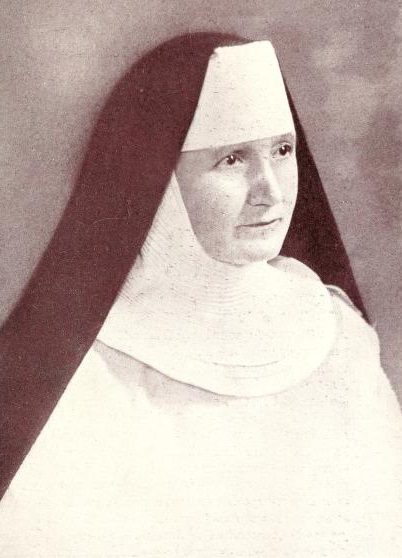 BENEDICTINE SISTERS OF MT. OLIVE (White Benedictines) (1874)
As American History cannot be studied thoroughly unless viewed with a European background, likewise the history of our humble Convent leads us across the sea, over mountains and valleys, until our wandering mind reaches a quaint, picturesque Convent, nestling high up on a peak of the Swiss Alps: it is the Benedictine Convent “Maria Rickenbach.” There in 1862 and again in 1867 two virgins, (Sister M. Agnes Dali and Sister M. Beatrice Renggle) who later were destined by God to found a Convent in Arkansas, solemnly pronounced their vows as daughters of St. Benedict. In response to an appeal to take up missionary work in America, the above mentioned Sisters (with three others) left Switzerland in August, 1874, and the same year they establlished the Benedictine Convent in Clyde, Missouri.
Ever solicitous for the salvation of souls we find these same Sisters ready to obey when asked to undergo the obstacles of founding a Convent in Arkansas. The last quarter of the Nineteenth century witnessed a slow but steady increase in the Catholic population of Northeast Arkansas. To insure the priceless gift of our holy religion also to the younger generations, it became imperative to open Catholic schools at least in the larger centers of population. Very Rev. Father J. E. Weibel, who was then in charge of the missions in Northeast Arkansas, applied to different religious communities to send Sisters to Pocahontas, Ark., not only to take charge of the schools but also to establish a Convent there. When it seemed that all appeals were made in vain, the Rt. Rev. Abbot Conrad, 0. S. B., of Conception, Mo., came to the assistance. He made arrangements to send Sisters from the Benedictine Convents in Clyde and in Maryville, Mo. (The last named Convent has since been transferred to Yankton, South Dakota.)
The first four Sisters reached Pocahontas in the evening of December 13, 1887, and were given a most cordial welcome by citizens of the town. The four Sisters were: Mother M. Agnes Dali, now the senior member of the Community; Mother M. Beatrice Renggle, the first Superioress; Sister M. Walburga McFadden and Sister M. Frances Metzler.
The late Rt. Rev. Bishop Edward Fitzgerald, D.D., donated twenty-four acres of ground to the Sisters. The original Convent building in Pocahontas was an old log-house which had witnessed a scene of strife and bloodshed during the unfortunate days of the Civil War. The humble furnishings were in harmony with the building. Seventy-three cents, willing hands to perform any labor, and an ardent zeal coupled with undaunted energy, were the capital to start the undertaking. That not only the strictest but also the most ingenious economy had to be practiced, need not be mentioned. Animated with confidence in Divine Providence, the Sisters cheerfully faced poverty and privations. God blessed the work and slowly but surely the mustard-seed took root.
June 24, 1888, the Rt. Rev. Bishop Fitzgerald blessed the Convent under the title “Maria Stein,”— “Our Lady of the Rock”— in remembrance of the famous shrine of the same name in Switzerland; moreover, the Convent is built on a rocky hill. Gradually the Community increased in membership, and the Sisters were thus enabled to carry out their prime object — the education of youth in parochial schools. For a number of years the Sisters also conducted schools for colored children in Pocahontas and in Jonesboro.
In accordance with a desire of the RL Rev. Bishop Fitzgerald, the Sisters— in 1893— were affiliated to the Congregation of Mount Olive, in Rome, and adopted the white habit worn by the members of that Congregation, retammg, however, the vows and rules of St. Benedict.
In 1898 the Mother-house and novitiate were transferred from Pocahontas to Jonesboro. The new Holy Angels Convent in Jonesboro was dedicated July 10, 1898, by the Rt. Rev. Bishop Fitzgerald. The need of a hospital for this rapidly developing section of Arkansas became more and more apparent. With the consent of the Rt. Rev. Ordinary, the Sisters made arrangements to found a hospital. A frame residence, adjacent to the Convent property, was purchased; the house was immediately remodeled to suit its new mission, and the hospital was opened July 5, 1900. In May, 1901, another residence was purchased and connected with the original hospital. To provide larger and more commodious quarters for the sick and infirm, the Sisters erected a new hospital, equipped with all modern conveniences and appliances, and on January 1, 1906, the new St. Bernard’s Hospital was opened to the public.
Simultaneously with the hospital, a spacious Convent Chapel was erected. The first services in this new sanctuary were celebrated on the Feast of St. Joseph, 1906. The Chapel was formally dedicated by the Rt. Rev. Bishop John B. Morris, D.D., on May 22, 1907.
The Community of the Benedictine Sisters of the Congregation of Mt. Olive is a diocesan institution and is independent of any other House. The principal aims of the institution are to teach the youth in parochial schools and to attend the sick in hospitals. The Sisters conduct parochial schools in the diocese of Little Rock, Ark., and Dallas, Texas. They also have charge of the domestic duties at Little Rock College and St, John’s Seminary, both founded by Rt. Rev. Rishop Morris, D. D.
Like to all the religious institutions, so also to this particular community, may be applied the words: “The harvest indeed is great, but the laborers are few.” (St. Matthew x., 37).
Elinor Tong Dehey, ed., Religious Orders of Women in the United States (Hammond, IN: W.B. Conkey, 1913), 258-262.
Previous Post

June 13, 2014
Atonement Friars Received Into the Church, 1909
Browse Our Archives
Select a Category African-American Catholics Alabama Catholics American Catholic History American Catholic women American History Anniversaries Anti-Catholicism Arkansas Catholics Benedictines Bishops Blessed John Henry Newman Book Reviews Books Boston College Brooklyn churches Brothers California Catholics Capuchins Cardinals Carlo Carretto Carmelites Catholic authors Catholic Cemeteries Catholic Historians Catholic History in Less Than 5 Minutes Catholic musicians Catholic Poetry Catholic Press Catholic School Textbook Catholic University of America Catholic Worker Catholics and Music Catholics and Race Catholics in Politics Catholics in the American Revolution Catholics in the Military Catholics in the Movies Catholics in the South Catholics in the West Catholics on Stage Catjolic Women Catolic Poetry Charles de Foucauld Children's Masses Christian Brothers Christmas Church Reform Civil Rights Movement Civil War Colleges and universities Converts D.C. Catholics Deaf Catholics Dominicans. Dorothy Day English Catholics Florida Catholics Fordham University Franciscans French Catholics Georgetown University German Americans Good Shepherd Sisters Hispanic Catholics Historians and Archivists Holy Cross Fathers Holy Name Society Idaho Catholics Illinois Catholics Indian Wars Indiana Catholics Irish Americans Irish Catholicism Italian Americans Italian Catholics Jesuits Josephite Sisters Kentucky Catholics Know-Nothings Laetare Medal Recipients laity Liturgical Movement Maine Catholics Manhattan College Maryland Catholicism Michigan Catholics Middle Ages Minnesota Catholics Missionaries Mississippi Catholics Missouri Catholics Monasteries Montana Catholics Native Americans New England Catholicism New Jersey Catholics New York Catholics North American College Ohio Catholics Oratorians Oregon Catholics Parish Mission Parishes Passionists Pat McNamara's Books Paulists Pennsylvania Catholics Popes Presidents Priests Quotations Religious Orders Rhode Island Catholics Saints Salesians Seminarians Seminaries Sermons Servants of God Siisters of Charity Sisters of Mercy South Carolina Catholics Spanish-American War Sports St. Francis of Assiai St. John Henry Newman Suplicians Tennessee Catholics Texas Catholics The year in review Thomas Merton Throwback Thursday Photograph Trappists Uncategorized University of Notre Dame Video Presentations Vincentians Virginia Catholics Visitation Nuns Washington West Point West Virginia Catholics West Viriginia Catholics Wisconsin Catholicism Women Religious World War II
Select a Month December 2020 June 2020 May 2020 April 2020 March 2020 March 2019 February 2019 January 2019 December 2018 November 2018 November 2014 October 2014 September 2014 August 2014 July 2014 June 2014 May 2014 December 2013 November 2013 October 2013 August 2013 July 2013 June 2013 May 2013 April 2013 March 2013 February 2013 January 2013 December 2012 November 2012 October 2012 September 2012 August 2012 July 2012 June 2012 April 2012 March 2012 December 2011 November 2011 October 2011 September 2011 August 2011 July 2011 June 2011 May 2011 April 2011 March 2011 February 2011 January 2011 December 2010 November 2010 October 2010 January 2010 December 2009 November 2009 October 2009 September 2009 August 2009 July 2009 June 2009 May 2009 April 2009 March 2009 February 2009 January 2009 December 2008
Follow Us!
TAKE THE
Religious Wisdom Quiz
What is the Christian teaching about humility?
Select your answer to see how you score.
Value others above yourself Demand honor Be proud always Boast often
Related posts from McNamara's Blog
Prayer and Action: The Forgotten History of the Liturgical...
National Catholic Sisters Week 2019: An Appreciation

Nuns as Sex Slaves: Fact, Fiction, and Maria...
TRENDING AT PATHEOS Catholic

Rejecting Doom: Christian Hope And Human Action
Christianity is a religion of hope. We are to have hope and...

It’s What Comes From Within Which Matters
One of the most difficult things for us to understand is why...

Why I Choose the Eucharist Over the Sermon
Choose the Eucharist, Not the Sermon What are we supposed to get...

5 Design Elements Found in Spiritually Rooted Homes
Putting Spirituality Into Home Decor Our homes are more than our living...

Credo: A Story of God Told with the...
About 10 years ago, I began to imagine a personal "Credo" that...

The Anatomy of Divine Revelation in Catholic Thought
The claim that God has made Himself known to human beings is...
view all Catholic blogs
Ad-Free & Subscriber Log-In Subscription Support
- About Us
- 2026 Calendar
- Videos
- Podcasts
- Library of World Religions
- Faith In Media Tracker
- Advertise With Us
- Write for Us
- Privacy Policy
- Terms of Service
- Do Not Sell My Data
- Contact Us
- Radiant Digital
- Manage Newsletter Subscriptions
- Unsubscribe From Notifications
- Sitemap
Copyright 2008-2026, Patheos. All rights reserved.
Subscription Support Ad-Free & Subscriber Log-In
Follow Patheos