
BuddhistCatholicContemplativeEvangelicalGeneral ChristianHinduJewishLatter-day SaintMuslimNew VisionsProgressive Christian
Beliefs
- Buddhist
- Catholic
- Contemplative
- Evangelical
- General Christian
- Hindu
- Jewish
- Latter-day Saint
- More Voices
- Muslim
- New Visions
- Pagan
- Progressive Christian
Topics
- Religion News
- Food and Religion
- Sports and Religion
- Religious Art
- Religious Music and Entertainment
- Religious Events
- History and Religion
- Style and Religion
- Politics and Religion
- Women in Religion
- Recreation Outdoors and Religion
- Business Finance and Religion
- Careers Workplace and Religion
- Education and Religion
- Family Parenting and Religion
- Health Fitness and Religion
- Home and Religion
- Relationships and Religion
- Technology and Religion
- Travel and Religion
Columnists
- Buddhist Columnists
- Business Finance and Religion Columnists
- Careers Workplace and Religion Columnists
- Catholic Columnists
- Contemplative Columnists
- Education and Religion Columnists
- Evangelists Columnists
- Family Parenting and Religion Columnists
- General Christian Columnists
- Health Fitness and Religion Columnists
- Hindu Columnists
- History and Religion Columnists
- Home and Religion Columnists
- Jewish Columnists
- More Voices Columnists
- Latter Day Columnists
- Muslim Columnists
- New Visions Columnists
- Nonreligious Columnists
- Pagan Columnists
- Politics and Religion Columnists
- Progressive Columnists
- Recreation Outdoors and Religion Columnists
- Relationships and Religion Columnists
- Religion News Columnists
- Religious Art Columnists
- Religious Events Columnists
- Religious Music and Entertainment Columnists
- Sports and Religion Columnists
- Style and Religion Columnists
- Technology and Religion Columnists
- Travel and Religion Columnists
- Women in Religion Columnists
Resource Library
- 2026 Calendar
- Library of World Religions
- The 100 Most Holy Places on Earth
- Patheos Answers
- Podcasts
- Videos
- Faith Leaders Database
- Anglican Episcopalian
- Bahai
- Baptist
- Buddhism
- Christianity
- Confucianism
- Eastern Orthodoxy
- Hinduism
- Holiness and Pentecostal
- ISKCON
- Islam
- Judaism
- Lutheran
- Methodist
- The Church of Jesus Christ of Latter-day Saints
- New Age
- Paganism
- Presbytarian and Reformed
- Protestantism
- Religion Behind the Scenes
- Roman Catholic
- Scientology
- Shia Islam
- Sikhism
- Sufism
- Sunni Islam
- Taoism
- Zen
- See all religions
Research Tools
 Ad-Free & Subscriber Log-In Subscription Support
Ad-Free & Subscriber Log-In Subscription Support
Follow Patheos 

- Trending:
- Forgiveness
- |
- Marriage
- |
- Consciousness
- |
- Death Penalty
- |
- Election
- |
- Halloween
 McNamara's Blog
- Home
- Catholic
- St. John the Baptist Church, Brooklyn, New York (1868)
St. John the Baptist Church, Brooklyn, New York (1868)
Last updated on: June 24, 2014 at 7:42 am by Pat McNamara
St. John the Baptist Church, Brooklyn, New York (1868) 2014-06-24T07:42:52-06:00 Pat McNamara
Patheos Explore the world's faith through different perspectives on religion and spirituality! Patheos has the views of the prevalent religions and spiritualities of the world.
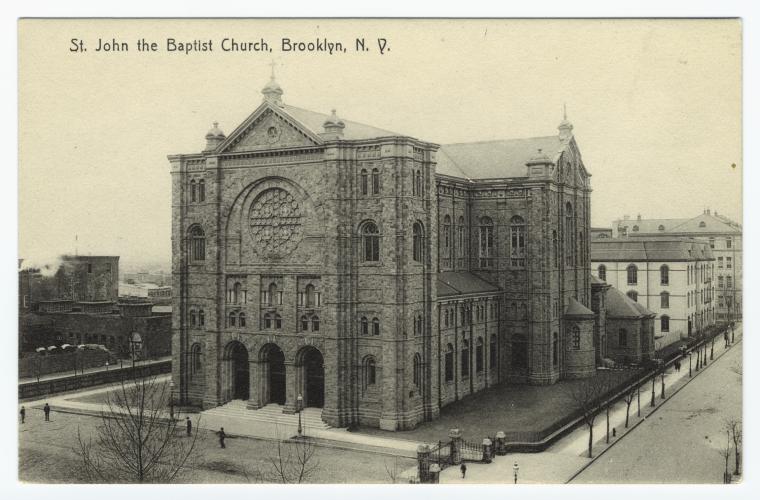 During Bishop John Loughlin’s administration, there were but two religious communities of priests in the Diocese of Brooklyn. The first to gain admittance were the priests of the Congregation of the Mission. In the spring of 1868, Rev. Edward M. Smith of that congregation came to Brooklyn to open a new field for the special work of his community. He secured an entire block of ground bounded by Lewis, Stuyvesant and Willoughby Avenues, and Hart Street, 600 feet by 200 feet. The cottage upon the property was transformed into a community house, and a room was made into a chapel, where on July 12, 1868, the first Mass was celebrated for the benefit of the twelve or fifteen persons who formed the first congregation. On the same day, Bishop Loughlin laid the cornerstone of a frame church which was to do service for some twenty years.
In 1869, the Bishop laid the cornerstone of the College of St. John the Baptist, which opened in September of the following year. Rev. John T. Landry was president of the college. Father Smith was succeeded as pastor of the church by Rev. J. Quigley, but in 1870 Father Smith returned and remained until 1874, when he went to Illinois. Father Landry resigned the presidency in 1875, and his unexpired term was filled out by Rev. James A. Maloney. In the meantime, Rev. P.M. O’Regan had been acting as president of the college. September 1877 found Rev. A.J. Meyer both president of the college and pastor of the church. In 1882, Father Meyer was called upon to succeed Right Rev. C.M. Du Bois, D.D. , as Bishop of Galveston, Texas. Father Meyer shrank from the dignity and the responsibilities of episcopate. His sole ambition was to be a Lazarist, and to die a devoted of St. Vincent de Paul. He pleaded his failing sight among excuses; finally succeeded in escaping the mitre; years of services to his congregation as president of St. Vincent’s College at Los Angeles, Cal., and of Kenrick Seminary, St. Louis, Mo., he died as he wished, a Lazarist.
In 1882, Rev. Jeremiah A. Hartnett became president of St. John’s College and pastor of the church. He had been vice president for some time, and was therefore thoroughly conversant with the needs of the parish. The congregation had outgrown the old frame church, and the need of a new one was greatly felt. Father Hartnett set to work at once to provide for the wants of his people, and on June 24, 1888, Bishop Loughlin laid the cornerstone. The church is 208 feet long, nave including, side chapel 85 feet, width of transept 135 feet, depth of chancel 50 feet, and height of ceiling from the floor, 95 feet. The material used is blue granite, and the style of architecture is Roman.
It was dedicated in May, 1894, by Bishop McDonnell of Brooklyn. In 1890, Father Hartnett built a wing on the Hart Street side of the college, which was to be used as the Diocesan Seminary. On the occasion of Bishop Lougllin’s golden jubilee, the clergy of the diocese resolved to present their Bishop with a testimonial worthy of the occasion. The Bishop had long cherished the idea of establishing a diocesan seminary, and his devoted clergy decided to give him the satisfaction of seeing the realization of his hopes. He was delighted with the project, and selected the ground adjoining St John’s College as the site of his future seminary. The cornerstone was laid on September 29, 1889, and the seminary was opened for the reception of students in the fall of 1891.
After a pastorate of fifteen years, Father Hartnett was transferred to the motherhouse of the Lazarists at Germantown, Pa. Rev. James J. Sullivan, the next pastor of St. John’s and president of the college, remained scarcely two years. He was succeeded by Rev. Patrick S. McHale, who had been pastor of the Church of the Immaculate Conception, Baltimore. Finding the old frame parochial school building on Lewis Avenue inadequate to meet the wants of the parish, Father McHale undertook the erection of a substantial building immediately opposite to the college. The cornerstone was laid in May, 1903, by Monsignor Patrick J. McNamara, vicar general of the diocese. The cost of this building is estimated at about $100,000. In 1906, Father McHale was called to Germantown to become assistant to Rev. James McGill, Visitor, and also to act as Rector of St. Vincent’s Seminary. Father McHale was succeeded by the Very Rev. John W. Moore, C.M. Father Moore has doubled the capacity of college by building a new wing on the Avenue side and fitted it up with furnished classrooms. He also provided a large swimming pool, gymnasium, basketball court and athletic field enclosed by a concrete wall ten high. The new building was dedicated by Cardinal Logue, Archbishop of Armagh, on the occasion of his visit to the college in May 1908. The interior of the church was beautified, a marble baldachino added to the main altar, many paintings obtained. The school is in the charge of the Sisters of Charity, has an attendance of 1,200. In the college, 700 students are enrolled.
The Catholic Church in the United States, Volume III (New York: Office of Catholic Publications, 1914), 562-564.
Next Post

June 25, 2014 Mission to Non-Catholics, Williamsburg, Brooklyn, 1904
Browse Our Archives
Select a Category African-American Catholics Alabama Catholics American Catholic History American Catholic women American History Anniversaries Anti-Catholicism Arkansas Catholics Benedictines Bishops Blessed John Henry Newman Book Reviews Books Boston College Brooklyn churches Brothers California Catholics Capuchins Cardinals Carlo Carretto Carmelites Catholic authors Catholic Cemeteries Catholic Historians Catholic History in Less Than 5 Minutes Catholic musicians Catholic Poetry Catholic Press Catholic School Textbook Catholic University of America Catholic Worker Catholics and Music Catholics and Race Catholics in Politics Catholics in the American Revolution Catholics in the Military Catholics in the Movies Catholics in the South Catholics in the West Catholics on Stage Catjolic Women Catolic Poetry Charles de Foucauld Children's Masses Christian Brothers Christmas Church Reform Civil Rights Movement Civil War Colleges and universities Converts D.C. Catholics Deaf Catholics Dominicans. Dorothy Day English Catholics Florida Catholics Fordham University Franciscans French Catholics Georgetown University German Americans Good Shepherd Sisters Hispanic Catholics Historians and Archivists Holy Cross Fathers Holy Name Society Idaho Catholics Illinois Catholics Indian Wars Indiana Catholics Irish Americans Irish Catholicism Italian Americans Italian Catholics Jesuits Josephite Sisters Kentucky Catholics Know-Nothings Laetare Medal Recipients laity Liturgical Movement Maine Catholics Manhattan College Maryland Catholicism Michigan Catholics Middle Ages Minnesota Catholics Missionaries Mississippi Catholics Missouri Catholics Monasteries Montana Catholics Native Americans New England Catholicism New Jersey Catholics New York Catholics North American College Ohio Catholics Oratorians Oregon Catholics Parish Mission Parishes Passionists Pat McNamara's Books Paulists Pennsylvania Catholics Popes Presidents Priests Quotations Religious Orders Rhode Island Catholics Saints Salesians Seminarians Seminaries Sermons Servants of God Siisters of Charity Sisters of Mercy South Carolina Catholics Spanish-American War Sports St. Francis of Assiai St. John Henry Newman Suplicians Tennessee Catholics Texas Catholics The year in review Thomas Merton Throwback Thursday Photograph Trappists Uncategorized University of Notre Dame Video Presentations Vincentians Virginia Catholics Visitation Nuns Washington West Point West Virginia Catholics West Viriginia Catholics Wisconsin Catholicism Women Religious World War II
Select a Month December 2020 June 2020 May 2020 April 2020 March 2020 March 2019 February 2019 January 2019 December 2018 November 2018 November 2014 October 2014 September 2014 August 2014 July 2014 June 2014 May 2014 December 2013 November 2013 October 2013 August 2013 July 2013 June 2013 May 2013 April 2013 March 2013 February 2013 January 2013 December 2012 November 2012 October 2012 September 2012 August 2012 July 2012 June 2012 April 2012 March 2012 December 2011 November 2011 October 2011 September 2011 August 2011 July 2011 June 2011 May 2011 April 2011 March 2011 February 2011 January 2011 December 2010 November 2010 October 2010 January 2010 December 2009 November 2009 October 2009 September 2009 August 2009 July 2009 June 2009 May 2009 April 2009 March 2009 February 2009 January 2009 December 2008
Follow Us!
TAKE THE
Religious Wisdom Quiz
What does the Greek word 'Christos' mean?
Select your answer to see how you score.
Savior Anointed One Redeemer Lord
Related posts from McNamara's Blog
St. Joseph‘s School for the Deaf Celebrates 150...
Who’s It Named For? Archbishop Thomas E. Molloy...
Three Giants of Brooklyn Catholicism
Who's It Named For? Corrigan Hall, Seton Hall...
TRENDING AT PATHEOS Catholic

Creation, Preservation, and Teleology in Catholic Theology
As I write this, it is very early Monday morning. Like millions...

The Parable Of The Sower And The Word...
One of Christ’s most famous parables is that of the sower who...

Rejecting Doom: Christian Hope And Human Action
Christianity is a religion of hope. We are to have hope and...

Why I Choose the Eucharist Over the Sermon
Choose the Eucharist, Not the Sermon What are we supposed to get...

5 Design Elements Found in Spiritually Rooted Homes
Putting Spirituality Into Home Decor Our homes are more than our living...

Credo: A Story of God Told with the...
About 10 years ago, I began to imagine a personal "Credo" that...
view all Catholic blogs
Ad-Free & Subscriber Log-In Subscription Support
- About Us
- 2026 Calendar
- Videos
- Podcasts
- Library of World Religions
- Faith In Media Tracker
- Advertise With Us
- Write for Us
- Privacy Policy
- Terms of Service
- Do Not Sell My Data
- Contact Us
- Radiant Digital
- Manage Newsletter Subscriptions
- Unsubscribe From Notifications
- Sitemap
Copyright 2008-2026, Patheos. All rights reserved.
Subscription Support Ad-Free & Subscriber Log-In
Follow Patheos