
BuddhistCatholicContemplativeEvangelicalGeneral ChristianHinduJewishLatter-day SaintMuslimNew VisionsProgressive Christian
Beliefs
- Buddhist
- Catholic
- Contemplative
- Evangelical
- General Christian
- Hindu
- Jewish
- Latter-day Saint
- More Voices
- Muslim
- New Visions
- Pagan
- Progressive Christian
Topics
- Religion News
- Food and Religion
- Sports and Religion
- Religious Art
- Religious Music and Entertainment
- Religious Events
- History and Religion
- Style and Religion
- Politics and Religion
- Women in Religion
- Recreation Outdoors and Religion
- Business Finance and Religion
- Careers Workplace and Religion
- Education and Religion
- Family Parenting and Religion
- Health Fitness and Religion
- Home and Religion
- Relationships and Religion
- Technology and Religion
- Travel and Religion
Columnists
- Buddhist Columnists
- Business Finance and Religion Columnists
- Careers Workplace and Religion Columnists
- Catholic Columnists
- Contemplative Columnists
- Education and Religion Columnists
- Evangelists Columnists
- Family Parenting and Religion Columnists
- General Christian Columnists
- Health Fitness and Religion Columnists
- Hindu Columnists
- History and Religion Columnists
- Home and Religion Columnists
- Jewish Columnists
- More Voices Columnists
- Latter Day Columnists
- Muslim Columnists
- New Visions Columnists
- Nonreligious Columnists
- Pagan Columnists
- Politics and Religion Columnists
- Progressive Columnists
- Recreation Outdoors and Religion Columnists
- Relationships and Religion Columnists
- Religion News Columnists
- Religious Art Columnists
- Religious Events Columnists
- Religious Music and Entertainment Columnists
- Sports and Religion Columnists
- Style and Religion Columnists
- Technology and Religion Columnists
- Travel and Religion Columnists
- Women in Religion Columnists
Resource Library
- 2026 Calendar
- Library of World Religions
- The 100 Most Holy Places on Earth
- Patheos Answers
- Podcasts
- Videos
- Faith Leaders Database
- Anglican Episcopalian
- Bahai
- Baptist
- Buddhism
- Christianity
- Confucianism
- Eastern Orthodoxy
- Hinduism
- Holiness and Pentecostal
- ISKCON
- Islam
- Judaism
- Lutheran
- Methodist
- The Church of Jesus Christ of Latter-day Saints
- New Age
- Paganism
- Presbytarian and Reformed
- Protestantism
- Religion Behind the Scenes
- Roman Catholic
- Scientology
- Shia Islam
- Sikhism
- Sufism
- Sunni Islam
- Taoism
- Zen
- See all religions
Research Tools
 Ad-Free & Subscriber Log-In Subscription Support
Ad-Free & Subscriber Log-In Subscription Support
Follow Patheos 

- Trending:
- Forgiveness
- |
- Marriage
- |
- Consciousness
- |
- Death Penalty
- |
- Election
- |
- Halloween
 McNamara's Blog
- Home
- Catholic
- Mission to Non-Catholics, Williamsburg, Brooklyn, 1904
Mission to Non-Catholics, Williamsburg, Brooklyn, 1904
Last updated on: June 25, 2014 at 8:03 am by Pat McNamara
Mission to Non-Catholics, Williamsburg, Brooklyn, 1904 2014-06-25T08:03:22-06:00 Pat McNamara
Patheos Explore the world's faith through different perspectives on religion and spirituality! Patheos has the views of the prevalent religions and spiritualities of the world.
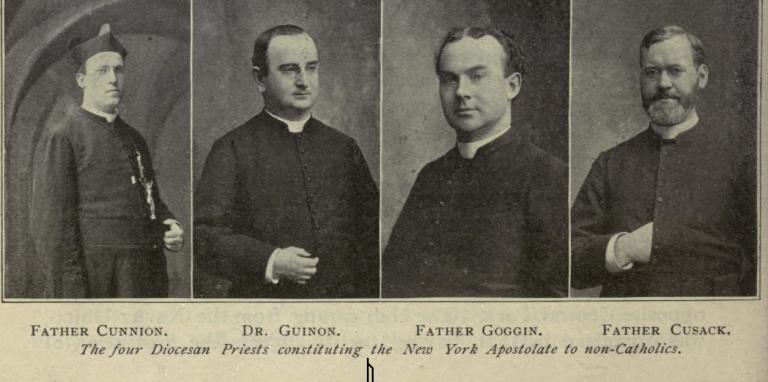 NON-CATHOLIC MISSIONS BY APOSTOLATE FATHERS. They Strive to Remove Wrong Notions Regarding Catholic Dogma and Practices. READY TO ANSWER ALL QUERIES. Many Catholic Communities of Missionary Priests and Brothers and Sisters in Brooklyn. (The Brooklyn Eagle, November 1, 1904, p. 9.)
The non-Catholic missions conducted under the auspices of the Apostolate Fathers form one of the most important features of the auxiliary work being carried on by the Catholic Church in this country. Very few, even among Catholics, know anything of this branch of missionary work in which some of the ablest priests in this country are engaged. Attention to it has been attracted in the last few weeks by the non-Catholic mission given in the Church of Sts. Peter and Paul in the Eastern District, of which the Rev. John L. Belford is pastor. This mission was conducted by the Apostolate Fathers of Manhattan, who have their headquarters in St. Teresa’s Church, at Rutgers and Henry Streets.
This band of Apostolate Fathers has become noted by reason of the fact that it was from it that Pope Pius X selected the new auxiliary bishop of the New York diocese, the Rev. Thomas F. Cusack. Bishop Cusack had labored for years among the non-Catholics and his promotion, while it was a surprise, nevertheless is known to have been for the tireless service he has given in the cause of spreading Catholic truth, not only in this city, but throughout the country.
The mission given at Sts. Peter and Paul Church was successful in every respect. As a result of it in the neighborhood of seventy converts were won over to the Church.
There is a generally mistaken notion, even among Catholics, of the object of the non-Catholic missions conducted by the Apostolate Fathers. The purpose is not, as supposed, to win over converts to the Church, but solely to remove the wrong notions among non-Catholics regarding Catholic dogma and Catholic practices. While the Apostolate Fathers are ready and anxious to strive to win converts to the faith, it is no exaggeration to say that they are better pleased when they can eradicate from the mind of a non-Catholic mistaken ideas of Catholic worship and bring the person holding such ideas to a full and unbiased revelation of the truth than they when they win over half a dozen converts.
There is reason, too, in the view taken by the Apostolate Fathers of non-Catholic missionary work. If a non-Catholic, they say, is permitted to retain the erroneous impressions he holds concerning Catholic dogma, there is no chance of ever converting him to the faith. On the other hand, if a non-Catholic should be sufficiently interested in the teachings of the Catholic religion to endeavor to have corrected any erroneous impressions he may have, the Apostolate Fathers feel that if they haven’t made a convert of such a man, after they have made known the truth to him, they at least have left him on the road to conversion.
The Apostolate Fathers, however, are not seeking proselytes. While they assume that there should be some converts as a result of their missions, they, nevertheless, leave non-Catholics to decide for themselves whether or not they should embrace the Catholic faith. They never give a mission that they don’t win over some converts, but as a matter of fact they would not be disappointed if the missions were unproductive in this respect.
“Give us a hearing; that is all we want,” say the Apostolate Fathers. “The American people are big enough and broad enough to hear every man who has a message to communicate. When they have heard us we leave it to themselves to decide whether or not the calumnies that have been uttered concerning the Catholic Church are true. It is our purpose to disprove these calumnies, and so long as we can get a respectful hearing we are cofndient that we can disprove them. With that we are satisfied. If, when we are through, the non-Catholics who have heard us feel that they should embrace the Catholic faith, we will welcome them with open arms. But our work is not that of apostatizing.”
There are bands for conducting non-Catholic missions, besides that of the New York diocese, in Pittsburg, Cleveland, Providence, Hartford, St. Paul and Dubuque.
The movement was started about ten years ago in the West. The missionary band in Manhattan has been organized for seven years and it has conducted missions all over the country in that time, although its labors are confined principally to this city. The members make frequent excursions into the rural districts up the state. They say they prefer to talk to country audiences, because it is in the country districts that the greatest prejudice and the most erroneous impressions regarding the Catholic Church exist. And the members of the apostolic bands have the love of combat developed to such a degree that they would rather talk to an audience made of men holding the deepest non-Catholic prejudices than they would to one made of their own people. After talking to such an audience they feel that they have gained a victory.
The Apostolate Fathers are received well everywhere. They always get a respectful hearing. They make it their business never to engage in controversies with clergymen of opposite faiths. If the latter choose to take issue with them, they keep silent. But they keep on preaching to their non-Catholic audiences, regardless of what the opposing clergymen may say or do, so long as they can find men to talk to and reason with.
One of the valuable aids of the Apostolate Fathers in their missionary work among non-Catholics is the question box. At every church where they conduct a mission they have a question box in which they invite their hearers to deposit questions, which they will answer, on matters of faith and morals. At their big missions it is not unusual for the Apostolate Fathers of Manhattan to have 200 or more questions a might set before them. To answer 200 questions in one night, besides conducting the regular services, is a difficult task, but they tackle as many questions as they can, and those that they haven’t time to answer they let go until the following night.
There are certain questions that the Apostolate Fathers meet everywhere in the course of their work. Among these are queries regarding the papal infallibility, confession and divorce. The Apostolate Fathers are well up on these questions and there is no query connected with them that they cannot answer.
It would be impossible to enumerate here all the questions that the Apostolate Fathers are called upon to answer in their missionary work. There are some which can be disposed of in a couple of words; some prompted by prejudice and ignorance and some which, it is evident, are dictated by a real desire to learn the truth concerning real historical facts.
The Apostolate Fathers are never unprepared to answer a question. They are trained in the work and they are never caught napping. And their answers are never superficial, either, but go right down into the heart of the subject.
The miissionary priests do not give all their time to the answering of questions at these non-Catholic missions. They regard the dogmatic sermon as one of the most important features of their work. The exercises usually open with the reciting of the Lord’s Prayer, which is followed by scriptural reading, after which comes the sermon and then the answering of questions.
The Catholic hierarchy in this country regards the results accomplished by the Apostolate Fathers as among the greatest achievements of the Church in the United States. The bishops of the Church all over the country have taken up the movement enthusiastically, and it is being gradually extended. Particular attention is being given to the South where the Catholic population is relatively small and where great ignorance of Catholic forms exists.
The members of the missionary band of the archdiocese of New York are: the Rev. William J. Guinan, D.D., the Rev. W.A. Courtney, the Rev. M.A. Reilly, the Rev. Andrew Roche and the Rev. Thomas F. Kane.
Previous Post

June 24, 2014
St. John the Baptist Church, Brooklyn, New York (1868)
Browse Our Archives
Select a Category African-American Catholics Alabama Catholics American Catholic History American Catholic women American History Anniversaries Anti-Catholicism Arkansas Catholics Benedictines Bishops Blessed John Henry Newman Book Reviews Books Boston College Brooklyn churches Brothers California Catholics Capuchins Cardinals Carlo Carretto Carmelites Catholic authors Catholic Cemeteries Catholic Historians Catholic History in Less Than 5 Minutes Catholic musicians Catholic Poetry Catholic Press Catholic School Textbook Catholic University of America Catholic Worker Catholics and Music Catholics and Race Catholics in Politics Catholics in the American Revolution Catholics in the Military Catholics in the Movies Catholics in the South Catholics in the West Catholics on Stage Catjolic Women Catolic Poetry Charles de Foucauld Children's Masses Christian Brothers Christmas Church Reform Civil Rights Movement Civil War Colleges and universities Converts D.C. Catholics Deaf Catholics Dominicans. Dorothy Day English Catholics Florida Catholics Fordham University Franciscans French Catholics Georgetown University German Americans Good Shepherd Sisters Hispanic Catholics Historians and Archivists Holy Cross Fathers Holy Name Society Idaho Catholics Illinois Catholics Indian Wars Indiana Catholics Irish Americans Irish Catholicism Italian Americans Italian Catholics Jesuits Josephite Sisters Kentucky Catholics Know-Nothings Laetare Medal Recipients laity Liturgical Movement Maine Catholics Manhattan College Maryland Catholicism Michigan Catholics Middle Ages Minnesota Catholics Missionaries Mississippi Catholics Missouri Catholics Monasteries Montana Catholics Native Americans New England Catholicism New Jersey Catholics New York Catholics North American College Ohio Catholics Oratorians Oregon Catholics Parish Mission Parishes Passionists Pat McNamara's Books Paulists Pennsylvania Catholics Popes Presidents Priests Quotations Religious Orders Rhode Island Catholics Saints Salesians Seminarians Seminaries Sermons Servants of God Siisters of Charity Sisters of Mercy South Carolina Catholics Spanish-American War Sports St. Francis of Assiai St. John Henry Newman Suplicians Tennessee Catholics Texas Catholics The year in review Thomas Merton Throwback Thursday Photograph Trappists Uncategorized University of Notre Dame Video Presentations Vincentians Virginia Catholics Visitation Nuns Washington West Point West Virginia Catholics West Viriginia Catholics Wisconsin Catholicism Women Religious World War II
Select a Month December 2020 June 2020 May 2020 April 2020 March 2020 March 2019 February 2019 January 2019 December 2018 November 2018 November 2014 October 2014 September 2014 August 2014 July 2014 June 2014 May 2014 December 2013 November 2013 October 2013 August 2013 July 2013 June 2013 May 2013 April 2013 March 2013 February 2013 January 2013 December 2012 November 2012 October 2012 September 2012 August 2012 July 2012 June 2012 April 2012 March 2012 December 2011 November 2011 October 2011 September 2011 August 2011 July 2011 June 2011 May 2011 April 2011 March 2011 February 2011 January 2011 December 2010 November 2010 October 2010 January 2010 December 2009 November 2009 October 2009 September 2009 August 2009 July 2009 June 2009 May 2009 April 2009 March 2009 February 2009 January 2009 December 2008
Follow Us!
TAKE THE
Religious Wisdom Quiz
Who was healed by touching the hem of Jesus’ garment?
Select your answer to see how you score.
A woman with an issue of blood A blind man A leper A centurion
Related posts from McNamara's Blog

St. John Henry Newman and the “Special Charm...
John Wayne and the Catholic Church
McNamara's Catholic Poets: Monsignor Robert Hugh Benson
TRENDING AT PATHEOS Catholic

The Parable Of The Sower And The Word...
One of Christ’s most famous parables is that of the sower who...

Rejecting Doom: Christian Hope And Human Action
Christianity is a religion of hope. We are to have hope and...

Why I Choose the Eucharist Over the Sermon
Choose the Eucharist, Not the Sermon What are we supposed to get...

5 Design Elements Found in Spiritually Rooted Homes
Putting Spirituality Into Home Decor Our homes are more than our living...

Credo: A Story of God Told with the...
About 10 years ago, I began to imagine a personal "Credo" that...

The Anatomy of Divine Revelation in Catholic Thought
The claim that God has made Himself known to human beings is...
view all Catholic blogs
Ad-Free & Subscriber Log-In Subscription Support
- About Us
- 2026 Calendar
- Videos
- Podcasts
- Library of World Religions
- Faith In Media Tracker
- Advertise With Us
- Write for Us
- Privacy Policy
- Terms of Service
- Do Not Sell My Data
- Contact Us
- Radiant Digital
- Manage Newsletter Subscriptions
- Unsubscribe From Notifications
- Sitemap
Copyright 2008-2026, Patheos. All rights reserved.
Subscription Support Ad-Free & Subscriber Log-In
Follow Patheos