
BuddhistCatholicContemplativeEvangelicalGeneral ChristianHinduJewishLatter-day SaintMuslimNew VisionsProgressive Christian
Beliefs
- Buddhist
- Catholic
- Contemplative
- Evangelical
- General Christian
- Hindu
- Jewish
- Latter-day Saint
- More Voices
- Muslim
- New Visions
- Pagan
- Progressive Christian
Topics
- Religion News
- Food and Religion
- Sports and Religion
- Religious Art
- Religious Music and Entertainment
- Religious Events
- History and Religion
- Style and Religion
- Politics and Religion
- Women in Religion
- Recreation Outdoors and Religion
- Business Finance and Religion
- Careers Workplace and Religion
- Education and Religion
- Family Parenting and Religion
- Health Fitness and Religion
- Home and Religion
- Relationships and Religion
- Technology and Religion
- Travel and Religion
Columnists
- Buddhist Columnists
- Business Finance and Religion Columnists
- Careers Workplace and Religion Columnists
- Catholic Columnists
- Contemplative Columnists
- Education and Religion Columnists
- Evangelists Columnists
- Family Parenting and Religion Columnists
- General Christian Columnists
- Health Fitness and Religion Columnists
- Hindu Columnists
- History and Religion Columnists
- Home and Religion Columnists
- Jewish Columnists
- More Voices Columnists
- Latter Day Columnists
- Muslim Columnists
- New Visions Columnists
- Nonreligious Columnists
- Pagan Columnists
- Politics and Religion Columnists
- Progressive Columnists
- Recreation Outdoors and Religion Columnists
- Relationships and Religion Columnists
- Religion News Columnists
- Religious Art Columnists
- Religious Events Columnists
- Religious Music and Entertainment Columnists
- Sports and Religion Columnists
- Style and Religion Columnists
- Technology and Religion Columnists
- Travel and Religion Columnists
- Women in Religion Columnists
Resource Library
- 2026 Calendar
- Library of World Religions
- The 100 Most Holy Places on Earth
- Patheos Answers
- Podcasts
- Videos
- Faith Leaders Database
- Anglican Episcopalian
- Bahai
- Baptist
- Buddhism
- Christianity
- Confucianism
- Eastern Orthodoxy
- Hinduism
- Holiness and Pentecostal
- ISKCON
- Islam
- Judaism
- Lutheran
- Methodist
- The Church of Jesus Christ of Latter-day Saints
- New Age
- Paganism
- Presbytarian and Reformed
- Protestantism
- Religion Behind the Scenes
- Roman Catholic
- Scientology
- Shia Islam
- Sikhism
- Sufism
- Sunni Islam
- Taoism
- Zen
- See all religions
Research Tools
 Ad-Free & Subscriber Log-In Subscription Support
Ad-Free & Subscriber Log-In Subscription Support
Follow Patheos 

- Trending:
- Forgiveness
- |
- Marriage
- |
- Consciousness
- |
- Death Penalty
- |
- Election
- |
- Halloween
 McNamara's Blog
- Home
- Catholic
- Controversial Catholic Editor James A. McMaster Dies, 1886
Controversial Catholic Editor James A. McMaster Dies, 1886
Last updated on: June 10, 2014 at 9:35 am by Pat McNamara
Controversial Catholic Editor James A. McMaster Dies, 1886 2014-06-10T09:35:55-06:00 Pat McNamara
Patheos Explore the world's faith through different perspectives on religion and spirituality! Patheos has the views of the prevalent religions and spiritualities of the world.
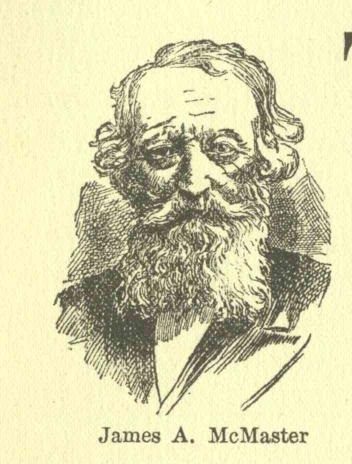 JAMES A. M’MASTER DEAD. CAREER OF THE NOTED CATHOLIC EDITOR CLOSED. THE MAN WHO FOR MANY YEARS FOUGHT, IN THE “FREEMAN’S JOURNAL,” THE BATTLES OF HIS CHURCH. (The New York Times, December 30, 1886)
James A. McMaster, the veteran editor of the Freeman’s Journal, died yesterday morning at 9 0’clock in St. Mary’s General Hospital, at Buffalo and St. Mark’s avenues, Brooklyn. Mr. McMaster had been an inmate of the hospital for the last two weeks. His death was to a complication of disorders, aggravated by a fall received a short time before he entered the hospital. His son Alphonsus, Dr. Byrne, the visiting physician of St. Mary’s Hospital, Fathers O’Boyle and O’Shebee, and several of the Sisters of Charity were with him at the time of his death. The arrangements for the funeral have not yet been completed.
James A. McMaster was born in Duanesburg, N.Y., April 1, 1820. He came of Scotch ancestry, and his family came into this State by way of Vermont. His father, the Rev. Gilbert McMaster, was a rigid Presbyterian clergyman. There being meager opportunities for his education elsewhere, it was conducted at home, his father acting as instructor. As the elder McMaster was a devoted student of the classics, the younger was reading Latin and Greek when were conversant with words of no more than two syllables in their own speech. In his seventeenth year he entered the Sophomore class of Union College. On leaving college, in his twentieth year, he began the study of the law, but did not long retain his interest in it.
He turned to theology and began to prepare himself at the Protestant Epsicopal Theological Seminary in this city for the ministry. The religious agitation of which Newman and Manning were factors in England had spread to New York, and had affected the minds of a number of the seminarians. High Church ideas had come into vogue, and were being carried to their extreme by such devotees as Arthur Carey and Clarence Walworth, a son of the Chancellor. Young McMaster fell under their influence and followed in their course. Arthur Carey was prepared for ordination at this time, but his views had caused the church authorities to hesitate about admitting him to the priesthood. And while this hesitancy was soon justified when Carey and Walworth soon afterward went out of the pale of the Episcopal Church and into that of the Roman Catholic, quickly followed by McMaster. All these journeyed to Trond, in Belgium, where they entered the Redemptorist novitiate. McMaster remained there only about a year. His desire for discipline and study could not overcome the disputatiousness of his race and blood. The life of a religieux was not his vocation. He was better fitted for the church militant. Prompted by his own inclination, as well as by the advice of his superiors, he left the Redemptorist novitiate and returned to this city.
Religious bigotry was then prevalent. Native Americanism was rampant. Broken heads were not uncommon at church doors, and the figure of a convert to Roman Catholicism was peculiarly inviting to attacks from objectors to his creed. This was a condition of affairs that stirred all the faculties of McMaster. He went into the fray eagerly, and soon showed extraordinary polemical skill in articles written by him for the Freeman’s Journal. These attracted the attention of Archbishop Hughes, who was glad to find and encourage a layman so able and so earnest in the maintenance of his church against all assailants. So Mr. McMaster succeeded to the editorship of the Freeman’s Journal and became the valued assistant of the Archbishop in his sturdy battling for what he believed the rights of Catholics in a free land. Like the Archbishop, he was aggressive. He had bold things to say and he said them without fear. He shrank from no adversary. He became the target of every opponent of his church, but he returned every shot they fired at him. His reputation spread until he was regarded throughout the land as chief in what thousands of good citizens thought was a bold scheme to make Rome the director of the United States.
When Archbishop Hughes brought up the public school question it was McMaster who lent his strongest aid in support of the theory that Catholics should not be taxed for maintenance of places of instruction to which they could not conscientiously send their children, because the articles of their faith were not taught in them. His earnest advocacy of a theory so unpopular made him the most assailed man in the United States, excepting his patron. The elder [James Gordon] Bennett, for whose lack of heartiness in support of the faith in which he was born in the land whence his own ancestors had come, McMaster felt scorn and contempt, and to whose jibes or sneers of delicate side thrusts he always gave a vigorous response, about this time, in a period of playfulness, dubbed him “the Abbé.” The title became fixed. For more than 30 years James McMaster has been out of public sight, and the Abbé McMaster has stood for him.
Even the strong personality of John Hughes was not sufficient to make that of McMaster subject altogether. He made excursions into politics and delivered himself in a ponderous way of doubtful religious doctrine, until at last the Archbishop was compelled to discard the Freeman’s Journal as organ and to accept it only occasionally as a mouthpiece. In politics McMaster was a States Rights Democrat. The Wilmot Proviso was not to his liking. He thought that slaveholders’ rights of property should be coextensive with the Nation. For weak Buchanan he had a hearty contempt. Stephen A. Douglas was his hero. Yet when the war broke out he parted company with Douglas and became a fierce advocate of the South. By his bitter attacks on the Government he went far to overcome in the minds of many Union men patriotically afraid of the advances of the Catholic Church the good impression produced on them by the ardent support given it by Archbishop Hughes. It became evident that the Abbé McMaster needed to be disciplined for political heresy. By President Lincoln’s order he was put into Fort Lafayette and kept there for about eleven months, during which the Freeman’s Journal was not published. Since the war he has not been as prominent as before, yet he has retained a wonderful amount of influence among Catholics, to the poorer educated of whom his ex cathedra way of writing made him seem the embodiment of learning in theology. With the authorities of the church he has not been in good odor because of its bold way of expounding its laws and because of his somewhat ill-tempered treatment of even the highest among them at times.
Mr. McMaster was a commanding figure on the street as well as in religious journalism. He was more than 6 feet in height, with a big but spare frame, and until within two or three years he walked as firmly and erect as an athlete. He had no fear of any man, and was as willing to dispute in a crowd on matters on which he had conviction as by the medium of his pen. He was social, and accustomed to resort to places where men gather who have opinions to express or who wish to learn the ideas of their fellow-citizens on public topics. In the Astor House he was often to be found in the center of interested auditors. Bad language was his only bane in such a place. He would rebuke its user and leave him. He preached an exalted rule of life and he tried to follow it.
In 1855 Mr. McMaster married a West Virginia lady, by whom he had four children. She died in 1872, and he was always too true to her memory to marry again. Two of his three daughters are inmates of a Carmelite Convent in Baltimore. His oldest daughter is a member of the Society of the Holy Child Jesus, whose house is at Sharon, Penn. His son, Alphonsus McMaster, has assisted his father on the Freeman’s Journal.
Previous Post

June 9, 2014
African-American Sisters Start School in Washington, D.C., 1892
Browse Our Archives
Select a Category African-American Catholics Alabama Catholics American Catholic History American Catholic women American History Anniversaries Anti-Catholicism Arkansas Catholics Benedictines Bishops Blessed John Henry Newman Book Reviews Books Boston College Brooklyn churches Brothers California Catholics Capuchins Cardinals Carlo Carretto Carmelites Catholic authors Catholic Cemeteries Catholic Historians Catholic History in Less Than 5 Minutes Catholic musicians Catholic Poetry Catholic Press Catholic School Textbook Catholic University of America Catholic Worker Catholics and Music Catholics and Race Catholics in Politics Catholics in the American Revolution Catholics in the Military Catholics in the Movies Catholics in the South Catholics in the West Catholics on Stage Catjolic Women Catolic Poetry Charles de Foucauld Children's Masses Christian Brothers Christmas Church Reform Civil Rights Movement Civil War Colleges and universities Converts D.C. Catholics Deaf Catholics Dominicans. Dorothy Day English Catholics Florida Catholics Fordham University Franciscans French Catholics Georgetown University German Americans Good Shepherd Sisters Hispanic Catholics Historians and Archivists Holy Cross Fathers Holy Name Society Idaho Catholics Illinois Catholics Indian Wars Indiana Catholics Irish Americans Irish Catholicism Italian Americans Italian Catholics Jesuits Josephite Sisters Kentucky Catholics Know-Nothings Laetare Medal Recipients laity Liturgical Movement Maine Catholics Manhattan College Maryland Catholicism Michigan Catholics Middle Ages Minnesota Catholics Missionaries Mississippi Catholics Missouri Catholics Monasteries Montana Catholics Native Americans New England Catholicism New Jersey Catholics New York Catholics North American College Ohio Catholics Oratorians Oregon Catholics Parish Mission Parishes Passionists Pat McNamara's Books Paulists Pennsylvania Catholics Popes Presidents Priests Quotations Religious Orders Rhode Island Catholics Saints Salesians Seminarians Seminaries Sermons Servants of God Siisters of Charity Sisters of Mercy South Carolina Catholics Spanish-American War Sports St. Francis of Assiai St. John Henry Newman Suplicians Tennessee Catholics Texas Catholics The year in review Thomas Merton Throwback Thursday Photograph Trappists Uncategorized University of Notre Dame Video Presentations Vincentians Virginia Catholics Visitation Nuns Washington West Point West Virginia Catholics West Viriginia Catholics Wisconsin Catholicism Women Religious World War II
Select a Month December 2020 June 2020 May 2020 April 2020 March 2020 March 2019 February 2019 January 2019 December 2018 November 2018 November 2014 October 2014 September 2014 August 2014 July 2014 June 2014 May 2014 December 2013 November 2013 October 2013 August 2013 July 2013 June 2013 May 2013 April 2013 March 2013 February 2013 January 2013 December 2012 November 2012 October 2012 September 2012 August 2012 July 2012 June 2012 April 2012 March 2012 December 2011 November 2011 October 2011 September 2011 August 2011 July 2011 June 2011 May 2011 April 2011 March 2011 February 2011 January 2011 December 2010 November 2010 October 2010 January 2010 December 2009 November 2009 October 2009 September 2009 August 2009 July 2009 June 2009 May 2009 April 2009 March 2009 February 2009 January 2009 December 2008
Follow Us!
TAKE THE
Religious Wisdom Quiz
Which harvest festival is also called the Feast of Booths?
Select your answer to see how you score.
Sukkot Hanukkah Passover Purim
Related posts from McNamara's Blog

St. John Henry Newman and the “Special Charm...
John Wayne and the Catholic Church
McNamara's Catholic Poets: Monsignor Robert Hugh Benson
TRENDING AT PATHEOS Catholic

Rejecting Doom: Christian Hope And Human Action
Christianity is a religion of hope. We are to have hope and...

It’s What Comes From Within Which Matters
One of the most difficult things for us to understand is why...

Why I Choose the Eucharist Over the Sermon
Choose the Eucharist, Not the Sermon What are we supposed to get...

5 Design Elements Found in Spiritually Rooted Homes
Putting Spirituality Into Home Decor Our homes are more than our living...

Credo: A Story of God Told with the...
About 10 years ago, I began to imagine a personal "Credo" that...

The Anatomy of Divine Revelation in Catholic Thought
The claim that God has made Himself known to human beings is...
view all Catholic blogs
Ad-Free & Subscriber Log-In Subscription Support
- About Us
- 2026 Calendar
- Videos
- Podcasts
- Library of World Religions
- Faith In Media Tracker
- Advertise With Us
- Write for Us
- Privacy Policy
- Terms of Service
- Do Not Sell My Data
- Contact Us
- Radiant Digital
- Manage Newsletter Subscriptions
- Unsubscribe From Notifications
- Sitemap
Copyright 2008-2026, Patheos. All rights reserved.
Subscription Support Ad-Free & Subscriber Log-In
Follow Patheos