
BuddhistCatholicContemplativeEvangelicalGeneral ChristianHinduJewishLatter-day SaintMuslimNew VisionsProgressive Christian
Beliefs
- Buddhist
- Catholic
- Contemplative
- Evangelical
- General Christian
- Hindu
- Jewish
- Latter-day Saint
- More Voices
- Muslim
- New Visions
- Pagan
- Progressive Christian
Topics
- Religion News
- Food and Religion
- Sports and Religion
- Religious Art
- Religious Music and Entertainment
- Religious Events
- History and Religion
- Style and Religion
- Politics and Religion
- Women in Religion
- Recreation Outdoors and Religion
- Business Finance and Religion
- Careers Workplace and Religion
- Education and Religion
- Family Parenting and Religion
- Health Fitness and Religion
- Home and Religion
- Relationships and Religion
- Technology and Religion
- Travel and Religion
Columnists
- Buddhist Columnists
- Business Finance and Religion Columnists
- Careers Workplace and Religion Columnists
- Catholic Columnists
- Contemplative Columnists
- Education and Religion Columnists
- Evangelists Columnists
- Family Parenting and Religion Columnists
- General Christian Columnists
- Health Fitness and Religion Columnists
- Hindu Columnists
- History and Religion Columnists
- Home and Religion Columnists
- Jewish Columnists
- More Voices Columnists
- Latter Day Columnists
- Muslim Columnists
- New Visions Columnists
- Nonreligious Columnists
- Pagan Columnists
- Politics and Religion Columnists
- Progressive Columnists
- Recreation Outdoors and Religion Columnists
- Relationships and Religion Columnists
- Religion News Columnists
- Religious Art Columnists
- Religious Events Columnists
- Religious Music and Entertainment Columnists
- Sports and Religion Columnists
- Style and Religion Columnists
- Technology and Religion Columnists
- Travel and Religion Columnists
- Women in Religion Columnists
Resource Library
- 2026 Calendar
- Library of World Religions
- The 100 Most Holy Places on Earth
- Patheos Answers
- Podcasts
- Videos
- Faith Leaders Database
- Anglican Episcopalian
- Bahai
- Baptist
- Buddhism
- Christianity
- Confucianism
- Eastern Orthodoxy
- Hinduism
- Holiness and Pentecostal
- ISKCON
- Islam
- Judaism
- Lutheran
- Methodist
- The Church of Jesus Christ of Latter-day Saints
- New Age
- Paganism
- Presbytarian and Reformed
- Protestantism
- Religion Behind the Scenes
- Roman Catholic
- Scientology
- Shia Islam
- Sikhism
- Sufism
- Sunni Islam
- Taoism
- Zen
- See all religions
Research Tools
 Ad-Free & Subscriber Log-In Subscription Support
Ad-Free & Subscriber Log-In Subscription Support
Follow Patheos 

- Trending:
- Forgiveness
- |
- Marriage
- |
- Consciousness
- |
- Death Penalty
- |
- Election
- |
- Halloween
 McNamara's Blog
- Home
- Catholic
- Catholic Sermons: “Holy Mass a Treasure” (1912)
Catholic Sermons: “Holy Mass a Treasure” (1912)
Last updated on: June 1, 2014 at 5:01 am by Pat McNamara
Catholic Sermons: “Holy Mass a Treasure” (1912) 2014-06-01T05:01:37-06:00 Pat McNamara
Patheos Explore the world's faith through different perspectives on religion and spirituality! Patheos has the views of the prevalent religions and spiritualities of the world.
**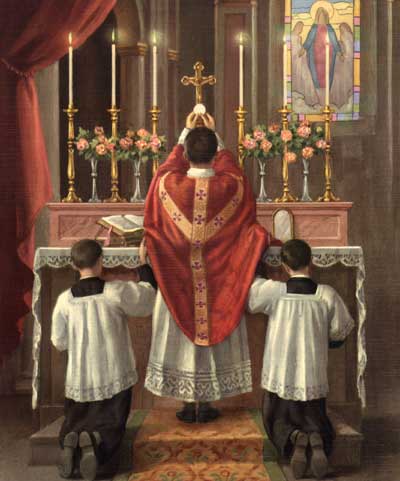 **In further considering the First Commandment of the Church it is to be noted that there is no other difference between the Third Commandment of God and the First Commandment of the Church except that the Church, inspired by the Holy Ghost and following Apostolic tradition, orders the Sunday to be observed instead of the Sabbath, and also orders the observance of some feasts. Since we can show God no greater honor, nor serve Him more agreeably than by offering the sublime sacrifice of Holy Mass, the Church, for the purpose of making obligatory especially the worthy celebration of the Sunday, commands that Catholics under pain of grievous sin must assist at Holy Mass upon the days of obligation.
God has always been well pleased with sacrifice. Cain and Abel offered sacrifice to God, because doubtless they had seen their parents do so. We may reasonably suppose that God Himself, as the teacher of our first parents in all things, instructed them to honor Him by sacrifice. Later He ordained explicitly the various sacrifices that should be offered Him. But the sacrifices of the Old Law as compared to the Holy Sacrifice of the Mass were but as a shadow compared to reality.
Holy Mass is the true burnt offering whereby is offered to the Most High that honor which is due Him. By no sacrifice is God more glorified than by the Holy Sacrifice of the Mass, which the Saviour has left with His Church in order to offer to the Father a most perfect honor. In Holy Mass God is honored by God, by the Divine Person Jesus Christ. Christ there lays Himself down upon the Altar as the sacrificial victim, and through His act of abasement glorifies the most Holy Trinity in as perfect a manner as it can ever be glorified. This is an act of adoration for God, before which all the sacrifices of praise of mankind vanish, as do the stars before the sunlight. A single Mass honors God infinitely more than the praise of all the Angels and Saints in Heaven.
And by assisting at Holy Mass we offer God, through Christ our Lord, an infinite honor, an infinite homage. Holy Mass is, furthermore, the best thank offering for blessings received. Untold blessings has God shown you, blessings for body and soul, life, good health, sound senses and straight limbs, raiment and food, good parents and a Christian up-bringing, the gift of faith, and many opportunities for good, rescues from spiritual perils, and frequent forgiveness of sins. Realizing the innumerable benefits of God and our own unworthiness, an oppressive feeling is upon us, and seeing that we are poorer before God than the most poverty-stricken beggar in our midst, in shame we cover our face, crying out with David: “What shall I render to the Lord for all the things that He hath rendered to me?” (Ps. cxv, 12). The holy Sacrifice of the Mass was therefore specially instituted for our grateful acknowledgment of the blessings received from God, and for this reason it is called in particular the Eucharist, which means thanksgiving. Christ Himself taught us this by His example, when, at the celebration of the first Mass on Maundy Thursday, He lifted up His eyes to Heaven and gave thanks to His Heavenly Father.
Holy Mass is also the most potent sacrifice of petition. Each one of you knows from his own experience the many needs of mankind. We retire at night with a heart full of cares; and so do we arise in the morning conscious of many needs. See, however, all the graces which we require, be they for soul or body, we may purchase in the most effective way through the Holy Sacrifice of the Mass. Christ Himself gave us assurance that whenever we should ask for a grace in His Name, we should attain it. “Amen, Amen I say to you: If you ask the Father anything in My Name, He will give it to you” (John xvi, 23). In the Holy Sacrifice of the Mass we not only ask in the name of Jesus, but Christ Himself asks for us, and He Himself presents our petition to the heavenly Father. With confidence may we therefore offer in holy Mass our necessities, our needs, our wants, and Jesus Himself takes care of them upon the Altar. “He that spared not even His Own Son,” says St. Paul, “but delivered Him up for us all, how hath He not also, with Him, given us all things.”
Holy Mass is the spiritual sun of the human race, which pours its rays on good and bad, and there is probably no uman soul on God s earth so depraved who could not from hearing holy Mass derive profit and grace. Indeed, history records many conversions wrought by the devout attendance at Mass. Holy Mass is, again, a sacrifice of atonement that has the power to appease God, to bring about the remission of our guilt and punishment, and the remission of the temporary punishment of the holy Souls in Purgatory. For in the holy Mass the innocent Lamb of God is sacrificed, who takes away the sins of the world, whose Blood cries to Heaven not for vengeance, as did Abel s blood, but for grace and pardon. It is the opinion of theologians that holy
Mass effaces venial sins in the one who attends the Mass and who repents, at least in general, of all his sins. St. Augustine says this distinctly: “If anyone hears Mass with devotion, he will not fall into mortal sin, and his venial sins will be remitted.” To this end the priest offers up for himself and for those around him, the Host, to the Lord God, saying: “Accept, O Holy Father, Almighty eternal God, this spotless Host, which I, thy unworthy servant, offer to Thee.”
Theologians say, furthermore, that through the holy Sacrifice of the Mass we can make satisfaction even for mortal sins already remitted, especially for those that have escaped our memory, and which for this reason we have never confessed. Holy Mass may be the means of leading us to pardon for sin, because through the Mass we may merit with God the grace to rightly perceive our sins, to repent, confess and do penance for them. The Council of Trent states this in the words: “Appeased through the offering up of this sacrifice, God grants the grace of repentance, and by means of this penance remits even crimes and monstrous sins” (Less. 22, c. 2). God alone knows the number of the souls who, through the extraordinary graces that flowed to them through the holy Sacrifice of the Mass, have worked their way out of long servitude of sin to a holy life.
The holy Sacrifice of the Mass is of such supreme benefit that we may thereby attain the remission of punishment due to sin. In truth, if holy Mass were not our shield, what might restrain the wrath of God? “Cursing and lying, murder and robbery, impurity and adultery are prevalent,” laments the Prophet Osee. Is it any better in these days of ours? And yet the good Lord looks on patiently. He allows the sun to rise, and gives rain and increase to the fruits of the earth. He looks on patiently, observes St. Gregory, because for the sins of men there is, not merely daily, but hourly, and from every quarter of the globe, offered to Him a sacrifice, not of beasts and inanimate creatures, but of the true Flesh and true Blood of Jesus, His only begotten Son, the Lamb which taketh away the sins of the world..
From what I have said you may understand how valuable is the holy Sacrifice of the Mass, and how absolutely necessary it is for our salvation. Therefore, even n no commandment of the Church would demand it, we should have to consider as very lukewarm any Catholic who, having the opportunity to hear a holy Mass, would neglect to do so. Far from criticising, therefore, the Commandment of the Church, who as our Mother cares for the salvation of her children, we ought to give thanks that every Catholic is obliged to attend at Mass at least on Sundays and holydays, because this act of worship is without doubt absolutely indispensable for the Catholic in working out the salvation of his soul.
Rev. P. Hehel, S.J., Short Sermons on Catholic Doctrine: A Plain and Practical Exposition of the Faith in a Series of Brief Discourses for the Ecclesiastical Year(New York: Joseph F, Wagner, 1912), 101-104.
Previous Post

June 1, 2014
Who's Buried in Catholic Cemeteries: "Nonpareil" Dempsey (1862-1895)
Next Post
June 2, 2014 Former Know-Nothing Converts to Catholicism
Browse Our Archives
Select a Category African-American Catholics Alabama Catholics American Catholic History American Catholic women American History Anniversaries Anti-Catholicism Arkansas Catholics Benedictines Bishops Blessed John Henry Newman Book Reviews Books Boston College Brooklyn churches Brothers California Catholics Capuchins Cardinals Carlo Carretto Carmelites Catholic authors Catholic Cemeteries Catholic Historians Catholic History in Less Than 5 Minutes Catholic musicians Catholic Poetry Catholic Press Catholic School Textbook Catholic University of America Catholic Worker Catholics and Music Catholics and Race Catholics in Politics Catholics in the American Revolution Catholics in the Military Catholics in the Movies Catholics in the South Catholics in the West Catholics on Stage Catjolic Women Catolic Poetry Charles de Foucauld Children's Masses Christian Brothers Christmas Church Reform Civil Rights Movement Civil War Colleges and universities Converts D.C. Catholics Deaf Catholics Dominicans. Dorothy Day English Catholics Florida Catholics Fordham University Franciscans French Catholics Georgetown University German Americans Good Shepherd Sisters Hispanic Catholics Historians and Archivists Holy Cross Fathers Holy Name Society Idaho Catholics Illinois Catholics Indian Wars Indiana Catholics Irish Americans Irish Catholicism Italian Americans Italian Catholics Jesuits Josephite Sisters Kentucky Catholics Know-Nothings Laetare Medal Recipients laity Liturgical Movement Maine Catholics Manhattan College Maryland Catholicism Michigan Catholics Middle Ages Minnesota Catholics Missionaries Mississippi Catholics Missouri Catholics Monasteries Montana Catholics Native Americans New England Catholicism New Jersey Catholics New York Catholics North American College Ohio Catholics Oratorians Oregon Catholics Parish Mission Parishes Passionists Pat McNamara's Books Paulists Pennsylvania Catholics Popes Presidents Priests Quotations Religious Orders Rhode Island Catholics Saints Salesians Seminarians Seminaries Sermons Servants of God Siisters of Charity Sisters of Mercy South Carolina Catholics Spanish-American War Sports St. Francis of Assiai St. John Henry Newman Suplicians Tennessee Catholics Texas Catholics The year in review Thomas Merton Throwback Thursday Photograph Trappists Uncategorized University of Notre Dame Video Presentations Vincentians Virginia Catholics Visitation Nuns Washington West Point West Virginia Catholics West Viriginia Catholics Wisconsin Catholicism Women Religious World War II
Select a Month December 2020 June 2020 May 2020 April 2020 March 2020 March 2019 February 2019 January 2019 December 2018 November 2018 November 2014 October 2014 September 2014 August 2014 July 2014 June 2014 May 2014 December 2013 November 2013 October 2013 August 2013 July 2013 June 2013 May 2013 April 2013 March 2013 February 2013 January 2013 December 2012 November 2012 October 2012 September 2012 August 2012 July 2012 June 2012 April 2012 March 2012 December 2011 November 2011 October 2011 September 2011 August 2011 July 2011 June 2011 May 2011 April 2011 March 2011 February 2011 January 2011 December 2010 November 2010 October 2010 January 2010 December 2009 November 2009 October 2009 September 2009 August 2009 July 2009 June 2009 May 2009 April 2009 March 2009 February 2009 January 2009 December 2008
Follow Us!
TAKE THE
Religious Wisdom Quiz
Which prophet was exiled to Babylon and saw a vision of four living creatures?
Select your answer to see how you score.
Jeremiah Hosea Joel Ezekiel
Related posts from McNamara's Blog
Saint Aloysius Gonzaga: A Reflection for Troubled Times
“I No Longer Call You Slaves”: Race, Religion,...
New Biography of St. Aloysius Hits the Mark

What's in a Name? Canisius College, Buffalo, New...
TRENDING AT PATHEOS Catholic

Rejecting Doom: Christian Hope And Human Action
Christianity is a religion of hope. We are to have hope and...

It’s What Comes From Within Which Matters
One of the most difficult things for us to understand is why...

Why I Choose the Eucharist Over the Sermon
Choose the Eucharist, Not the Sermon What are we supposed to get...

5 Design Elements Found in Spiritually Rooted Homes
Putting Spirituality Into Home Decor Our homes are more than our living...

Credo: A Story of God Told with the...
About 10 years ago, I began to imagine a personal "Credo" that...

The Anatomy of Divine Revelation in Catholic Thought
The claim that God has made Himself known to human beings is...
view all Catholic blogs
Ad-Free & Subscriber Log-In Subscription Support
- About Us
- 2026 Calendar
- Videos
- Podcasts
- Library of World Religions
- Faith In Media Tracker
- Advertise With Us
- Write for Us
- Privacy Policy
- Terms of Service
- Do Not Sell My Data
- Contact Us
- Radiant Digital
- Manage Newsletter Subscriptions
- Unsubscribe From Notifications
- Sitemap
Copyright 2008-2026, Patheos. All rights reserved.
Subscription Support Ad-Free & Subscriber Log-In
Follow Patheos