
BuddhistCatholicContemplativeEvangelicalGeneral ChristianHinduJewishLatter-day SaintMuslimNew VisionsProgressive Christian
Beliefs
- Buddhist
- Catholic
- Contemplative
- Evangelical
- General Christian
- Hindu
- Jewish
- Latter-day Saint
- More Voices
- Muslim
- New Visions
- Pagan
- Progressive Christian
Topics
- Religion News
- Food and Religion
- Sports and Religion
- Religious Art
- Religious Music and Entertainment
- Religious Events
- History and Religion
- Style and Religion
- Politics and Religion
- Women in Religion
- Recreation Outdoors and Religion
- Business Finance and Religion
- Careers Workplace and Religion
- Education and Religion
- Family Parenting and Religion
- Health Fitness and Religion
- Home and Religion
- Relationships and Religion
- Technology and Religion
- Travel and Religion
Columnists
- Buddhist Columnists
- Business Finance and Religion Columnists
- Careers Workplace and Religion Columnists
- Catholic Columnists
- Contemplative Columnists
- Education and Religion Columnists
- Evangelists Columnists
- Family Parenting and Religion Columnists
- General Christian Columnists
- Health Fitness and Religion Columnists
- Hindu Columnists
- History and Religion Columnists
- Home and Religion Columnists
- Jewish Columnists
- More Voices Columnists
- Latter Day Columnists
- Muslim Columnists
- New Visions Columnists
- Nonreligious Columnists
- Pagan Columnists
- Politics and Religion Columnists
- Progressive Columnists
- Recreation Outdoors and Religion Columnists
- Relationships and Religion Columnists
- Religion News Columnists
- Religious Art Columnists
- Religious Events Columnists
- Religious Music and Entertainment Columnists
- Sports and Religion Columnists
- Style and Religion Columnists
- Technology and Religion Columnists
- Travel and Religion Columnists
- Women in Religion Columnists
Resource Library
- 2026 Calendar
- Library of World Religions
- The 100 Most Holy Places on Earth
- Patheos Answers
- Podcasts
- Videos
- Faith Leaders Database
- Anglican Episcopalian
- Bahai
- Baptist
- Buddhism
- Christianity
- Confucianism
- Eastern Orthodoxy
- Hinduism
- Holiness and Pentecostal
- ISKCON
- Islam
- Judaism
- Lutheran
- Methodist
- The Church of Jesus Christ of Latter-day Saints
- New Age
- Paganism
- Presbytarian and Reformed
- Protestantism
- Religion Behind the Scenes
- Roman Catholic
- Scientology
- Shia Islam
- Sikhism
- Sufism
- Sunni Islam
- Taoism
- Zen
- See all religions
Research Tools
 Ad-Free & Subscriber Log-In Subscription Support
Ad-Free & Subscriber Log-In Subscription Support
Follow Patheos 

- Trending:
- Forgiveness
- |
- Marriage
- |
- Consciousness
- |
- Death Penalty
- |
- Election
- |
- Halloween
 McNamara's Blog
- Home
- Catholic
- Parish Mission for Deaf Catholics, 1899
Parish Mission for Deaf Catholics, 1899
Last updated on: May 31, 2014 at 4:23 am by Pat McNamara
Parish Mission for Deaf Catholics, 1899 2014-05-31T04:23:42-06:00 Pat McNamara
Patheos Explore the world's faith through different perspectives on religion and spirituality! Patheos has the views of the prevalent religions and spiritualities of the world.
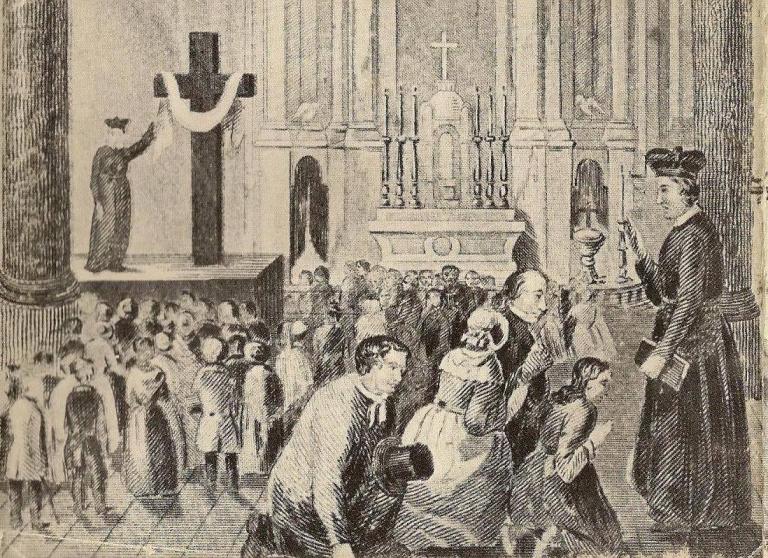 The New York Mission to Deaf Mutes
By Rev. Joseph Rockwell, S.J.
The Woodstock Letters, Vol. XXVIII (1899): 248-252.
For some years back, a Father of the Society has been in charge of the deaf mutes of New York City. He preaches to them in the sign language every Sunday afternoon, at St. Francis Xavier’s, and looks after the spiritual interests of the deaf and dumb, who are scattered over the large area of New York City, Brooklyn, and Jersey City. Father Becker has been in charge during the past year, and he has been unsparing in his efforts to bring joy and brightness into the lives of our deaf and dumb friends. Some do not come regularly to the Sunday afternoon instructions, on account of distance or poverty. Others, who would come, stay away for the ordinary pleas common to weak human nature— apathy, ignorance, and the hundred and one fictitious excuses which the world, the flesh, and the devil invent. In order to stir these up and to stimulate even the fervent ones to higher and better things, a week’s mission was given in 1897 and again in 1898, with most encouraging and consoling results. Again this year a similar mission was given with equally gratifying results. A week’s mission was given to the men and another to the women. As it is impossible to have all the exercises of a mission, owing to the distances which the deaf have to come, only one service a day was had; viz., the instruction, sermon and benediction in the evening.
Every evening Father Becker opened with an instruction, and after half an hour’s signing he was succeeded by the writer, who gave a mission sermon on the truths of the first week of the Spiritual Exercises [of St. Ignatius Loyola]. After the sermon, benediction of the Blessed Sacrament was given. The academic hall, where the Sunday afternoon instructions are regularly held, was in use for other purposes on some of the evenings, and we held our exercises in the lower church during the men’s mission. We found the church very well suited to our purpose, for the light was perfect. This is the great problem to be considered in preaching to the deaf. If the light is too poor you may as well adjourn. You must have plenty of light on the face of the speaker, not behind him, for bright lights dazzle the eyes of the audience. In the church we found everything perfectly satisfactory, and as the upper church was used for the Lenten services for the people of the parish, we had the whole lower church to ourselves. A few outsiders, that is, persons not deaf and dumb, came, out of curiosity maybe, but they were welcome, for the more who know about the work for the deaf and dumb, the more chances there will be of spreading an interest in the work and saving this unheeded flock. The average attendance at the men’s mission was seventy-five each night, at the women’s mission eighty-five each night. About one hundred and sixty confessions were heard; a most consoling result indeed. One woman came a distance of four miles with an infant in her arms, having no one with whom to leave the child. This is a little indication of the general good will and earnestness.
The women’s mission was held during Holy Week, and on Easter we had the solemn closing of both missions. On that day a greater crowd was present than I ever witnessed. Nearly 150 appeared in all their Easter regalia, and a spirit of joy and happiness pervaded the whole assembly. The mothers brought their children, and while the priest was speaking eloquently with his fingers, the children were chattering; for they were not deaf and dumb. Perhaps you are not aware that the offspring of deaf and dumb parents are rarely deaf. Lately some Prof. Bell of Washington wrote a newspaper article foreboding ill to the race by the intermarriage of deaf mutes and the hereditary transmission of the malady. I think his views are exaggerated. Anyhow it is foolish and impossible to prevent their maariages. A deaf mute should never marry a person who is not deaf. Their condition is too unequal, and in a short time it inevitably leads to serious domestic disturbance. Even though the children of these marriages be not deaf and dumb, still they grow up practically deaf and dumb, until they are of school age, because the parents cannot teach them how to talk, and the children, living in the midst of silence, find their lips sealed through want of use. In spite of all this, the children present on Easter day succeeded in making their presence visible and audible, but they did not disturb anyone but the preacher, as the audience was unconscious of their chattering. He ignored it, and so all went on merrily, and everyone was happy, even the children.
At the end, the Papal Benediction was given, and articles of piety were blessed. All showed their appreciation of the mission by saying that they wished it would last a week longer. They are indeed grateful and appreciative and capable of elevation, if only we take hold and do a little something for them. A practical proof of the good done, may be gathered from the fact that two notorious drunkards were so impressed by the denunciation of the curse of intemperance, that they took the pledge for five years. They may not keep their promise, but whether they do or not, the fear of God entered their hearts for the time being.
A ludicrous incident occurred on the Saturday evening on which the women were going to confession. Owing to the many choir rehearsals for Easter, it happened that the hall in which the deaf were assembled was needed for a choir rehearsal. So we gave the front of the hall to the choir, and the rear to the deaf and dumb. The seating capacity of the hall is about 400. After the confessions were over, the deaf and dumb were waiting, eager to have a few words of advice before going home. The circumstances were most unfavorable. To get up and preach to a congregation, in the presence of a gesticulating choirmaster and in the strange midst of a medley of harmony and discord, was something that could hardly be exacted of the bravest of men. However, the deaf insisted. They were not a bit disturbed by the noises of the choir, and choir was not a bit disturbed by their silent discourses, as the deaf ocucpied the rear of the hall. So the problem resolved itself into this—had the preacher sufficient power of concentration be oblivious or deaf to the shrieks that were dinning in his ears? It would be a battle of silence against noise. The choir exercise consisted chiefly of the mechanical reading of notes. It was not music, but downright noise. He continued to try. The next problem was, to find a place to stand, for you must be elevated to be seen by the deaf. The platform, his usual point of vantage, had been usurped by the choir leader. He began on the floor, but all the deaf were craning their necks to try to see him; so he mounted a bench, and then was witnessed a scene which would be characterized as a comedy by a dramatic critic. Just picture it to yourselves. I leave it to your imaginations—the simultaneous progress of a choir rehearsal and of a mission sermon. I believe the deaf and dumb hardly appreciated the ludicrousness of the situation, they were so eager to get some profitable advice, but with me it was different; I was quite penetrated with a sense of the comical in the surroundings, and I could not resist the temptation to amuse the deaf by commenting on the discordant turbulence which was around them. I then passed on to some salutary remarks on the way to prepare for the morrow. It was too much of a strain on my nerves to stand it long, and after about ten minutes I dismissed them with a blessing.
In New York the deaf show the results of the care which has been bestowed on them by the Sisters and by our Fathers. There are quite a number of weekly communicants among them, who are exemplary in their lives and are striving as earnestly and successfully as other people to be good. On the other hand there are very many who are not models at all, for the opposite reasons—want of care, and the contaminating influences of education at non-Catholic, or as they are stupidly and erroneously called non-sectarian schools. You can see the two classes in close contrast in New York; and from the study of their condition there, those who are interested in their well-being can get encouraging lessons. While their condition is far from ideal, it displays many consoling and gratifying features which show plainly enough what can be accomplished, and what is especially needed for their well-being. In a former article I have described at length the condition of the deaf in New York. Therefore I shall not detain you longer in that great city.
Previous Post

May 30, 2014
Catholics on Stage: Blanche Walsh (1873-1915)
Next Post
May 31, 2014 Catholic Poetry: "Our Lady of the May" by J. Corson Miller
Browse Our Archives
Select a Category African-American Catholics Alabama Catholics American Catholic History American Catholic women American History Anniversaries Anti-Catholicism Arkansas Catholics Benedictines Bishops Blessed John Henry Newman Book Reviews Books Boston College Brooklyn churches Brothers California Catholics Capuchins Cardinals Carlo Carretto Carmelites Catholic authors Catholic Cemeteries Catholic Historians Catholic History in Less Than 5 Minutes Catholic musicians Catholic Poetry Catholic Press Catholic School Textbook Catholic University of America Catholic Worker Catholics and Music Catholics and Race Catholics in Politics Catholics in the American Revolution Catholics in the Military Catholics in the Movies Catholics in the South Catholics in the West Catholics on Stage Catjolic Women Catolic Poetry Charles de Foucauld Children's Masses Christian Brothers Christmas Church Reform Civil Rights Movement Civil War Colleges and universities Converts D.C. Catholics Deaf Catholics Dominicans. Dorothy Day English Catholics Florida Catholics Fordham University Franciscans French Catholics Georgetown University German Americans Good Shepherd Sisters Hispanic Catholics Historians and Archivists Holy Cross Fathers Holy Name Society Idaho Catholics Illinois Catholics Indian Wars Indiana Catholics Irish Americans Irish Catholicism Italian Americans Italian Catholics Jesuits Josephite Sisters Kentucky Catholics Know-Nothings Laetare Medal Recipients laity Liturgical Movement Maine Catholics Manhattan College Maryland Catholicism Michigan Catholics Middle Ages Minnesota Catholics Missionaries Mississippi Catholics Missouri Catholics Monasteries Montana Catholics Native Americans New England Catholicism New Jersey Catholics New York Catholics North American College Ohio Catholics Oratorians Oregon Catholics Parish Mission Parishes Passionists Pat McNamara's Books Paulists Pennsylvania Catholics Popes Presidents Priests Quotations Religious Orders Rhode Island Catholics Saints Salesians Seminarians Seminaries Sermons Servants of God Siisters of Charity Sisters of Mercy South Carolina Catholics Spanish-American War Sports St. Francis of Assiai St. John Henry Newman Suplicians Tennessee Catholics Texas Catholics The year in review Thomas Merton Throwback Thursday Photograph Trappists Uncategorized University of Notre Dame Video Presentations Vincentians Virginia Catholics Visitation Nuns Washington West Point West Virginia Catholics West Viriginia Catholics Wisconsin Catholicism Women Religious World War II
Select a Month December 2020 June 2020 May 2020 April 2020 March 2020 March 2019 February 2019 January 2019 December 2018 November 2018 November 2014 October 2014 September 2014 August 2014 July 2014 June 2014 May 2014 December 2013 November 2013 October 2013 August 2013 July 2013 June 2013 May 2013 April 2013 March 2013 February 2013 January 2013 December 2012 November 2012 October 2012 September 2012 August 2012 July 2012 June 2012 April 2012 March 2012 December 2011 November 2011 October 2011 September 2011 August 2011 July 2011 June 2011 May 2011 April 2011 March 2011 February 2011 January 2011 December 2010 November 2010 October 2010 January 2010 December 2009 November 2009 October 2009 September 2009 August 2009 July 2009 June 2009 May 2009 April 2009 March 2009 February 2009 January 2009 December 2008
Follow Us!
TAKE THE
Religious Wisdom Quiz
What did Eve eat in the Garden of Eden?
Select your answer to see how you score.
Bread Fruit from the Tree of Knowledge A vine branch An unclean animal
Related posts from McNamara's Blog
Saint Aloysius Gonzaga: A Reflection for Troubled Times
“I No Longer Call You Slaves”: Race, Religion,...
St. Joseph‘s School for the Deaf Celebrates 150...
Who’s It Named For? Archbishop Thomas E. Molloy...
TRENDING AT PATHEOS Catholic

Rejecting Doom: Christian Hope And Human Action
Christianity is a religion of hope. We are to have hope and...

It’s What Comes From Within Which Matters
One of the most difficult things for us to understand is why...

Why I Choose the Eucharist Over the Sermon
Choose the Eucharist, Not the Sermon What are we supposed to get...

5 Design Elements Found in Spiritually Rooted Homes
Putting Spirituality Into Home Decor Our homes are more than our living...

Credo: A Story of God Told with the...
About 10 years ago, I began to imagine a personal "Credo" that...

The Anatomy of Divine Revelation in Catholic Thought
The claim that God has made Himself known to human beings is...
view all Catholic blogs
Ad-Free & Subscriber Log-In Subscription Support
- About Us
- 2026 Calendar
- Videos
- Podcasts
- Library of World Religions
- Faith In Media Tracker
- Advertise With Us
- Write for Us
- Privacy Policy
- Terms of Service
- Do Not Sell My Data
- Contact Us
- Radiant Digital
- Manage Newsletter Subscriptions
- Unsubscribe From Notifications
- Sitemap
Copyright 2008-2026, Patheos. All rights reserved.
Subscription Support Ad-Free & Subscriber Log-In
Follow Patheos