
BuddhistCatholicContemplativeEvangelicalGeneral ChristianHinduJewishLatter-day SaintMuslimNew VisionsProgressive Christian
Beliefs
- Buddhist
- Catholic
- Contemplative
- Evangelical
- General Christian
- Hindu
- Jewish
- Latter-day Saint
- More Voices
- Muslim
- New Visions
- Pagan
- Progressive Christian
Topics
- Religion News
- Food and Religion
- Sports and Religion
- Religious Art
- Religious Music and Entertainment
- Religious Events
- History and Religion
- Style and Religion
- Politics and Religion
- Women in Religion
- Recreation Outdoors and Religion
- Business Finance and Religion
- Careers Workplace and Religion
- Education and Religion
- Family Parenting and Religion
- Health Fitness and Religion
- Home and Religion
- Relationships and Religion
- Technology and Religion
- Travel and Religion
Columnists
- Buddhist Columnists
- Business Finance and Religion Columnists
- Careers Workplace and Religion Columnists
- Catholic Columnists
- Contemplative Columnists
- Education and Religion Columnists
- Evangelists Columnists
- Family Parenting and Religion Columnists
- General Christian Columnists
- Health Fitness and Religion Columnists
- Hindu Columnists
- History and Religion Columnists
- Home and Religion Columnists
- Jewish Columnists
- More Voices Columnists
- Latter Day Columnists
- Muslim Columnists
- New Visions Columnists
- Nonreligious Columnists
- Pagan Columnists
- Politics and Religion Columnists
- Progressive Columnists
- Recreation Outdoors and Religion Columnists
- Relationships and Religion Columnists
- Religion News Columnists
- Religious Art Columnists
- Religious Events Columnists
- Religious Music and Entertainment Columnists
- Sports and Religion Columnists
- Style and Religion Columnists
- Technology and Religion Columnists
- Travel and Religion Columnists
- Women in Religion Columnists
Resource Library
- 2026 Calendar
- Library of World Religions
- The 100 Most Holy Places on Earth
- Patheos Answers
- Podcasts
- Videos
- Faith Leaders Database
- Anglican Episcopalian
- Bahai
- Baptist
- Buddhism
- Christianity
- Confucianism
- Eastern Orthodoxy
- Hinduism
- Holiness and Pentecostal
- ISKCON
- Islam
- Judaism
- Lutheran
- Methodist
- The Church of Jesus Christ of Latter-day Saints
- New Age
- Paganism
- Presbytarian and Reformed
- Protestantism
- Religion Behind the Scenes
- Roman Catholic
- Scientology
- Shia Islam
- Sikhism
- Sufism
- Sunni Islam
- Taoism
- Zen
- See all religions
Research Tools
 Ad-Free & Subscriber Log-In Subscription Support
Ad-Free & Subscriber Log-In Subscription Support
Follow Patheos 

- Trending:
- Forgiveness
- |
- Marriage
- |
- Consciousness
- |
- Death Penalty
- |
- Election
- |
- Halloween
 McNamara's Blog
- Home
- Catholic
- Military Mass During the Civil War, 1864
Military Mass During the Civil War, 1864
Last updated on: May 26, 2014 at 7:05 am by Pat McNamara
Military Mass During the Civil War, 1864 2014-05-26T07:05:07-06:00 Pat McNamara
Patheos Explore the world's faith through different perspectives on religion and spirituality! Patheos has the views of the prevalent religions and spiritualities of the world.
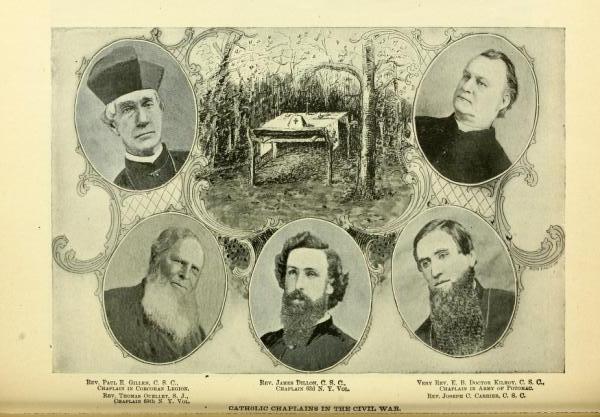 FATHER CORBY’S DESCRIPTION OF A MILITARY MASS
On or about the 4th day of September, 1864, Gen. Meagher, who was on a visit with Gen. Hancock at the time, prior to his departure for the department of Gen. Sherman, to whom he had been assigned for duty, proposed an anniversary celebration for the brigade. The brigade was now three years old. As usual, he wished to have the anniversary commemorated in a religious manner. He therefore, asked me, if I would be so kind as to arrange a Solemn High Mass for the occasion. I was only too glad to do him this favor. Invitations were sent out to various other commanders to join us in the celebration. These invitations were accepted by quite a number of other commands, and by the following generals, namely: Hancock, Miles, Birney, Gibbons, Mott, De Trobriand, and, of course, Meagher himself would be expected.
Details of men with willing hands were directed in clearing up, beautifying the grounds, planting pine and cedar trees, and making the entire camp like fairy-grounds. A beautiful chapel tent was erected, and a grand avenue lined with evergreens led to the front entrance of the grounds and to the chapel, which was on a slight eminence. Seats were provided for the invited guests as far as possible. About nine o’clock the bugles were sounded, and the whole brigade, at this signal, began to make preparations to receive their guests. With military precision every man reported, and in a short time one could see the ranks formed in perfect order.
Precisely at ten o’clock, the hour fixed for service, the guests began to arrive. The generals were seated first, and, as each company, battalion, or regiment of invited troops arrived, place was allotted them, the members of the brigade “doing the honors.” The Rev. Thomas Ouellet, S.J., Paul E. Gillen, C.S.C, and the writer, appeared before a simple altar, dressed in modest taste, at the very moment ten o’clock was sounded by the bugle. By this time we had become experienced in such celebrations, and it is with some laudable pride that we refer to them now. Gen. Meagher, being well versed in the ceremonies of the Mass, acted as Master of Ceremonies, in as far as the music and the military duties were concerned. As soon as the priests are ready, the Asperges me was announced, and, instead of a grand choir, such as is heard in the royal cathedrals of Christendom, the bugles, followed by the report of numerous guns, announced the beginning.
Then, under the direction of Gen. Meagher, at the Introibo various military bands discourse solemn music until after the Credo, when, again, by a sign from the Master of Ceremonies to the Officer of the Day, another discharge, a grand salute of guns, testify to Credo in unum Deum— “I believe in one God.” The bugle follows with its well-known notes, “tara-taran-tara,” and again the bands play. Now their music is soft, low, and sweet, suitable to the devotion that immediately disposes the faithful for the more sacred portion of the Mass. The Sanctus, Sanctus, Sanctus rouses all to a fixed attention and is accompanied by a sudden rattle of dozens of kettle-drums, with an occasional thundering sound from the bass drums. Shortly after this comes that moment of moments in the offering of the sublime mysteries.
The preparatory is over, and now you see men bow down in deep devotion as the priest leans over the altar and takes up the Host. Here, at a sign from the Master of Ceremonies, the bugle notes, “tara-taran-tara,” ring out over the tented fields, and the same grand evidence of respect and faith is given by the sound of cannon and the roll of musketry, as the sublime words, full of power and purpose— the supreme words of Consecration— are pronounced. Soft music is again in order at intervals, until the end, which is proclaimed in turn by guns, drums, and bugles.
Thus we see how God is served, even in camp. We behold the highest honors paid to Him by the solemn offering of the Holy Sacrifice, infinitely holier than that offered in the Temple of Solomon, amid the splendor of glittering gold and the flashing light of precious stones. No military equipage is too fine, no military honors too great, no music too sweet or too sublime, no respect too profound, in honor of the great God in the transcendent Mystery of His love and mercy— a Mystery offered on Mount Calvary, when Nature herself spoke in greatest reverence and covered her face in darkness; to hide it from the too great majesty of the Divine Being.
Our Church and Country: The Catholic Pages of American History, Volume I (New York: The Catholic Historical League of America, 1905), 104-105.

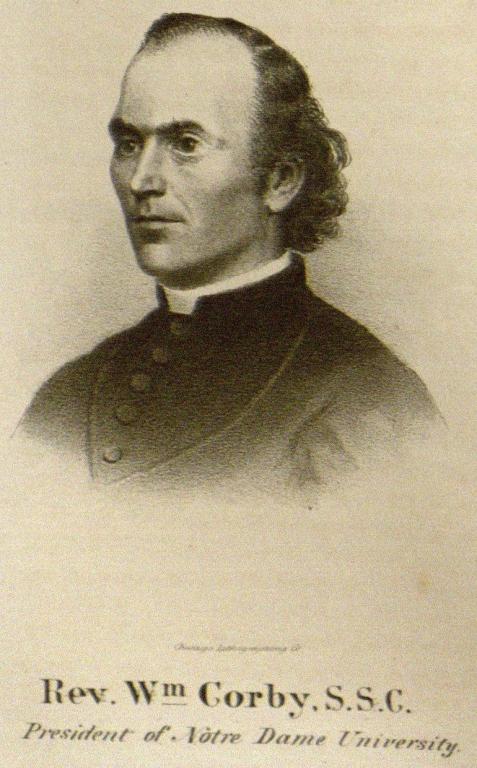
NOTE: The above account is taken from the wartime memoirs of Rev. William Corby, C.S.C. (1833-1897), who served as a Chaplain with the Irish Brigade for three years in the Civil War. After the war, he twice served as President of the University of Notre Dame. Corby Hall on the campus was named in his honor. The Holy Cross community sent more chaplain-priests to serve the troops during the Civil War than any other diocese or religious community. Brigadier General Thomas Francis Meagher (1823-1867) helped organize the Irish Brigade, originally composed of the 69th New York (“the Fighting 69th”), the 63rd New York, and the 88th New York. (Other units were added later.) Father Corby’s memoirs, published in 1893, were a bestseller. They are still in print today.
Previous Post

May 25, 2014
My Youtube Commercial!
Browse Our Archives
Select a Category African-American Catholics Alabama Catholics American Catholic History American Catholic women American History Anniversaries Anti-Catholicism Arkansas Catholics Benedictines Bishops Blessed John Henry Newman Book Reviews Books Boston College Brooklyn churches Brothers California Catholics Capuchins Cardinals Carlo Carretto Carmelites Catholic authors Catholic Cemeteries Catholic Historians Catholic History in Less Than 5 Minutes Catholic musicians Catholic Poetry Catholic Press Catholic School Textbook Catholic University of America Catholic Worker Catholics and Music Catholics and Race Catholics in Politics Catholics in the American Revolution Catholics in the Military Catholics in the Movies Catholics in the South Catholics in the West Catholics on Stage Catjolic Women Catolic Poetry Charles de Foucauld Children's Masses Christian Brothers Christmas Church Reform Civil Rights Movement Civil War Colleges and universities Converts D.C. Catholics Deaf Catholics Dominicans. Dorothy Day English Catholics Florida Catholics Fordham University Franciscans French Catholics Georgetown University German Americans Good Shepherd Sisters Hispanic Catholics Historians and Archivists Holy Cross Fathers Holy Name Society Idaho Catholics Illinois Catholics Indian Wars Indiana Catholics Irish Americans Irish Catholicism Italian Americans Italian Catholics Jesuits Josephite Sisters Kentucky Catholics Know-Nothings Laetare Medal Recipients laity Liturgical Movement Maine Catholics Manhattan College Maryland Catholicism Michigan Catholics Middle Ages Minnesota Catholics Missionaries Mississippi Catholics Missouri Catholics Monasteries Montana Catholics Native Americans New England Catholicism New Jersey Catholics New York Catholics North American College Ohio Catholics Oratorians Oregon Catholics Parish Mission Parishes Passionists Pat McNamara's Books Paulists Pennsylvania Catholics Popes Presidents Priests Quotations Religious Orders Rhode Island Catholics Saints Salesians Seminarians Seminaries Sermons Servants of God Siisters of Charity Sisters of Mercy South Carolina Catholics Spanish-American War Sports St. Francis of Assiai St. John Henry Newman Suplicians Tennessee Catholics Texas Catholics The year in review Thomas Merton Throwback Thursday Photograph Trappists Uncategorized University of Notre Dame Video Presentations Vincentians Virginia Catholics Visitation Nuns Washington West Point West Virginia Catholics West Viriginia Catholics Wisconsin Catholicism Women Religious World War II
Select a Month December 2020 June 2020 May 2020 April 2020 March 2020 March 2019 February 2019 January 2019 December 2018 November 2018 November 2014 October 2014 September 2014 August 2014 July 2014 June 2014 May 2014 December 2013 November 2013 October 2013 August 2013 July 2013 June 2013 May 2013 April 2013 March 2013 February 2013 January 2013 December 2012 November 2012 October 2012 September 2012 August 2012 July 2012 June 2012 April 2012 March 2012 December 2011 November 2011 October 2011 September 2011 August 2011 July 2011 June 2011 May 2011 April 2011 March 2011 February 2011 January 2011 December 2010 November 2010 October 2010 January 2010 December 2009 November 2009 October 2009 September 2009 August 2009 July 2009 June 2009 May 2009 April 2009 March 2009 February 2009 January 2009 December 2008
Follow Us!
TAKE THE
Religious Wisdom Quiz
Which official opposed Nehemiah's wall-building and sent open letters to Jerusalem?
Select your answer to see how you score.
Geshem Haggai Tobiah Sanballat
Related posts from McNamara's Blog

The Struggle for an African American Priesthood
A House Divided: The American Bishops and the...
A Great Book for Memorial Day-- Catholics and...
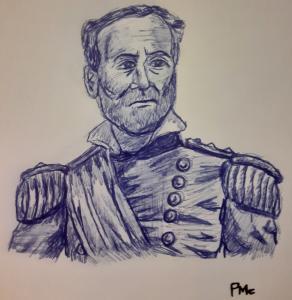
General Sherman Speaks at Notre Dame, 1865
TRENDING AT PATHEOS Catholic

Rejecting Doom: Christian Hope And Human Action
Christianity is a religion of hope. We are to have hope and...

It’s What Comes From Within Which Matters
One of the most difficult things for us to understand is why...

Why I Choose the Eucharist Over the Sermon
Choose the Eucharist, Not the Sermon What are we supposed to get...

5 Design Elements Found in Spiritually Rooted Homes
Putting Spirituality Into Home Decor Our homes are more than our living...

Credo: A Story of God Told with the...
About 10 years ago, I began to imagine a personal "Credo" that...

The Anatomy of Divine Revelation in Catholic Thought
The claim that God has made Himself known to human beings is...
view all Catholic blogs
Ad-Free & Subscriber Log-In Subscription Support
- About Us
- 2026 Calendar
- Videos
- Podcasts
- Library of World Religions
- Faith In Media Tracker
- Advertise With Us
- Write for Us
- Privacy Policy
- Terms of Service
- Do Not Sell My Data
- Contact Us
- Radiant Digital
- Manage Newsletter Subscriptions
- Unsubscribe From Notifications
- Sitemap
Copyright 2008-2026, Patheos. All rights reserved.
Subscription Support Ad-Free & Subscriber Log-In
Follow Patheos