
BuddhistCatholicContemplativeEvangelicalGeneral ChristianHinduJewishLatter-day SaintMuslimNew VisionsProgressive Christian
Beliefs
- Buddhist
- Catholic
- Contemplative
- Evangelical
- General Christian
- Hindu
- Jewish
- Latter-day Saint
- More Voices
- Muslim
- New Visions
- Pagan
- Progressive Christian
Topics
- Religion News
- Food and Religion
- Sports and Religion
- Religious Art
- Religious Music and Entertainment
- Religious Events
- History and Religion
- Style and Religion
- Politics and Religion
- Women in Religion
- Recreation Outdoors and Religion
- Business Finance and Religion
- Careers Workplace and Religion
- Education and Religion
- Family Parenting and Religion
- Health Fitness and Religion
- Home and Religion
- Relationships and Religion
- Technology and Religion
- Travel and Religion
Columnists
- Buddhist Columnists
- Business Finance and Religion Columnists
- Careers Workplace and Religion Columnists
- Catholic Columnists
- Contemplative Columnists
- Education and Religion Columnists
- Evangelists Columnists
- Family Parenting and Religion Columnists
- General Christian Columnists
- Health Fitness and Religion Columnists
- Hindu Columnists
- History and Religion Columnists
- Home and Religion Columnists
- Jewish Columnists
- More Voices Columnists
- Latter Day Columnists
- Muslim Columnists
- New Visions Columnists
- Nonreligious Columnists
- Pagan Columnists
- Politics and Religion Columnists
- Progressive Columnists
- Recreation Outdoors and Religion Columnists
- Relationships and Religion Columnists
- Religion News Columnists
- Religious Art Columnists
- Religious Events Columnists
- Religious Music and Entertainment Columnists
- Sports and Religion Columnists
- Style and Religion Columnists
- Technology and Religion Columnists
- Travel and Religion Columnists
- Women in Religion Columnists
Resource Library
- 2026 Calendar
- Library of World Religions
- The 100 Most Holy Places on Earth
- Patheos Answers
- Podcasts
- Videos
- Faith Leaders Database
- Anglican Episcopalian
- Bahai
- Baptist
- Buddhism
- Christianity
- Confucianism
- Eastern Orthodoxy
- Hinduism
- Holiness and Pentecostal
- ISKCON
- Islam
- Judaism
- Lutheran
- Methodist
- The Church of Jesus Christ of Latter-day Saints
- New Age
- Paganism
- Presbytarian and Reformed
- Protestantism
- Religion Behind the Scenes
- Roman Catholic
- Scientology
- Shia Islam
- Sikhism
- Sufism
- Sunni Islam
- Taoism
- Zen
- See all religions
Research Tools
 Ad-Free & Subscriber Log-In Subscription Support
Ad-Free & Subscriber Log-In Subscription Support
Follow Patheos 

- Trending:
- Forgiveness
- |
- Marriage
- |
- Consciousness
- |
- Death Penalty
- |
- Election
- |
- Halloween
 McNamara's Blog
- Home
- Catholic
- Catholics at West Point, a 1908 Survey
Catholics at West Point, a 1908 Survey
Last updated on: May 28, 2014 at 4:50 am by Pat McNamara
Catholics at West Point, a 1908 Survey 2014-05-28T04:50:33-06:00 Pat McNamara
Patheos Explore the world's faith through different perspectives on religion and spirituality! Patheos has the views of the prevalent religions and spiritualities of the world.
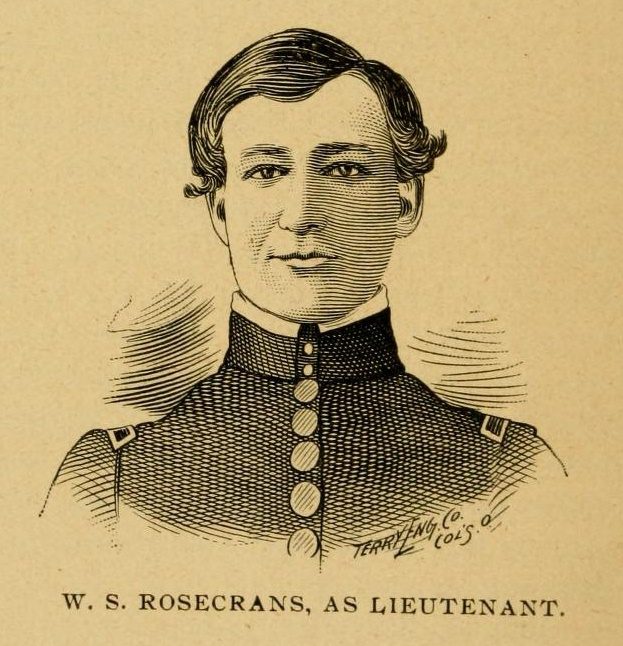
William S. Rosecrans as a Lieutenant, United States Army, in the 1840’s.
Today, the day that the Class of 2014 graduates from the United States Military Academy, offers an opportunity to look at some of the Catholic graduates West Point. During the nineteenth century, the majority of the Corps of Cadets was Protestant, and would be for a very long time. This 1908 article profiles some of the academy’s graduates who converted to Roman Catholicism, in itself not a small number:
Scannell O’Neill, “Convert Sons of West Point,” The Rosary Magazine, Vol. 32 (January 1908): 178-183.
One of the most interesting places in this interesting land of ours is the United States Military Academy at West Point, overlooking the lordly Hudson. What a world of memories a visit there calls up! No loyal American can spend a day there without returning to his home a better citizen. But the Catholic visitor, as he passes out of the church lately built on the Academy grounds, experiences a higher feeling than even that of patriotism as he calls to mind the long roll of illustrious sons of West Point numbered among our American converts.
Greater than all their victories in battle was the grace of conversion, given to some, it may be, while yet pursuing their studies, to others on the battlefield, or, perhaps, in the evening of their days. No other institution in this country has given so many soldiers to the great army of the Prince of Peace as has this military school. It may, therefore, prove interesting, as well as instructive, if we speak of these convert sons of West Point.
So far as the writer has been able to learn, General Abbott Hall Brisbane, of the Engineer Corps, was the earliest student at West Point who afterwards became a Catholic. He was graduated there in 1825, and after serving on topographical duty, and in the Indian wars, acted as engineer–in‑chief in the construction of railroads in the Southern States. Later on, General Brisbane was appointed Professor of English in the South Carolina Military Academy. (General Brisbane’s widow is remembered in religion as Sister Mary Borgia, of the Visitation Convent, Georgetown.)
After Brisbane came Lieutenant James Clark, a classmate and intimate of General Robert E. Lee, graduating in the same class (1829) with that great and good man. Lieutenant Clark resigned his position in the army in 1830 to become a soldier in the illustrious Company of Jesus. Father Clark was one of the ablest of all the American Jesuits. He was for a time President of Holy Cross College, Worcester, and Georgetown, D. C. It was a graceful tribute to this son of Loyola that he was appointed a member of the Board of Visitors to West Point at the time of the Civil War.
One year after the conversion of Clark was graduated Lucius Bellinger Northrop, classmate and lifelong friend of Jefferson Davis. General Northrop came of a family of converts, including his mother and sisters and his brother, Claudian, father of the Catholic Bishop of Charleston.
Major-General Erasmus Darwin Keyes was graduated from West Point in 1832, standing tenth in a class of forty-five. Like all of his family, General Keyes was a convert to the Church. He came of staunch old Puritan stock, but when well advanced in life he became a Catholic. He tells us in his “Autobiography” (a most delightful book) that, while serving in the Northwestern country he met Father Jaset, a Jesuit priest, who instructed him in the Catholic religion. He says it was primarily due to that good priest’s influence that, at a subsequent date, he turned Catholic. After a long life the old warrior died at Nice, October 14, 1895. His remains were conveyed to this country, and after a requiem Mass in St. Agnes’ Church, New York, his body was taken to West Point for burial. Dr. Edward L. Keyes of New York, one of the most celebrated physicians and scientists of the United States, is a son of General Keyes.
Another fine type of a convert was the late Major Henry S. Turner, graduate of West Point in 1834, hero of the Mexican and Civil wars and sometime Assistant U. S. Treasurer at St. Louis.
One day there arrived at West Point from Whitefield, Maine, a young lad of sixteen, Eliakim Parker Scammon by name, who was destined later to adorn a high place among our model Catholic American laymen. He graduated seventh in a class of forty-six in the year 1837, having for classmates Benham, Hooker and Sedgwick of the Union Army, and Bragg, Pemberton and Early, of the Confederates. Immediately upon his graduation, Lieutenant Scammon was assigned to duty as assistant professor of mathematics at his Alma Mater, where he remained until ordered to Florida to serve under General Taylor in the Seminole War.
In 1887 he married Miss Margaret Stebbins, of Springfield, Mass. (also a convert), and about the same time he was appointed assistant professor of ethics at West Point, remaining there for five years. At the end of that time he went as aide to General Scott on the Mexican campaign, but was forced by ill-health to return to the States. He was received into the Catholic Church in 1845 in old St. Peter’s Church, Barclay Street, New York.
Major-General Andrew Jackson Smith, graduated in 1838, waited until his deathbed to make his submission to the Church; but we are glad the old warrior had the grace to receive the last sacraments. The class of 1839 turned out Major-General Henry J. Hunt, the distinguished artillery officer of the Civil War, who had as classmate a born Catholic, General Edward Ord. General Hunt was in charge of all the cavalry at the battle of Gettysburg, where he made a great charge, and was chief artillery officer of the Army of the Potomac until the end of the war.
In the class of 1841 were the pious and lamented Julius Garesche, Don Carlos Buell, and Amiel Weeks Whipple; these last two destined to find their way into the Church, influenced, no doubt, by the example of their Catholic classmate. General Whipple was a New Englander, having been born in Greenwich, Mass., in the year 1818. During the battle of Chancellorsville, his division, the Third Army Corps, was much exposed, and suffered more probably in that engagement than any other division of the army. He was shot when the battle was practically at an end, and, living three days, was appointed major-general for gallantry in action. It was just at this period of his career that he was received into the Church.
Whipple’s classmate, Major-General Don Carlos Buell, was another of the many great sons of Ohio to find the true faith.In the class of 1842, of which General William Rosecrans was a member, were two other famous men who afterwards became converts to the Church— Major-General John Newton, U. S. A., and Lieutenant-General James Longstreet, of the Confederate Army. Unlike General Rosecrans, General Longstreet was to become a Catholic late in life, when family bereavement turned his mind towards religion. James Ryder Randall, author of that stirring war-poem, “Maryland, My Maryland,” had the story of his conversion from the lips of General Longstreet himself.
One of the most remarkable achievements in engineering science known to history was the plowing up of Hell Gate Channel and other points on East River, New York, in the seventies by Major-General John Newton, U. S. A., fellow classmate of Rosecrans and Longstreet. He was a fervent convert, ever ready to give a reason for the faith which was in him. Notre Dame conferred upon him the coveted Laetare medal.
Father Deshon, the last survivor of the founders of the Paulists, was a son of West Point. He was born in New London, Conn., in 1823, of Huguenot stock. He was a son of the Rev. George H. Deshon, a Congregationalist minister of New Haven. He entered West Point, from which he was graduated with distinction, and for five years was an assistant professor there. He graduated second in military engineering and first in artillery in a class of thirty-nine members. Twenty-four of these became generals in the army. At West Point he was a classmate and roommate of General Grant, and at his death he was one of the three surviving members of that class. For ten years he was an officer in active service in the regular army. He resigned from the army on October 31, 1851, and four years afterward, to the day, he became a Catholic priest. “I was always sorry that Deshon left the army,” said General Grant, once. “I believe he would have made a conspicuous mark in the Civil War.”
The next year the class held two men who are numbered among Rome’s recruits — Lieutenant Thomas Jefferson Curd and General Daniel M. Frost, C. S. A.
Lieutenant Curd had a short and pathetic life. He was a native of Kentucky, and entered the military academy while still very young. He resigned his commission in the army on becoming a Catholic in 1847. He entered the Jesuit novitiate, and was for a time a professor at Holy Cross College, Worcester. He died at the novitiate of St. Ignatius, Frederick, Maryland, at the early age of twenty-five.
General Charles Pomeroy Stone was descended from a line of Puritan ancestors who had taken part in every battle in which the American people had been engaged, and hence by heredity he was a soldier. General Stone and his sister, Fanny Cushing Parker, were converts to the Church.
But to tell the story of the remainder of these convert sons of West Point we would need twice the space that we have to give to this article, so we will refer to them simply by name. The class of 1846 graduated Major-General John Gray Foster and General Samuel D. Sturgis, two men whose names are written indelibly across the pages of the history of the Civil War, and who were also to find their way into the Church of their God.
Another distinguished convert was Washington C. Tevis, colonel of the Third Maryland Cavalry, in command of a regiment, Department of the Gulf, during the Civil War; he went to France, where he became a brigadier-general, and then to Egypt to hold a like position. Finally he fought for Pope Pius in that Pontiff’s struggle against the Italians. Then there were General William Cabell, C. S. A., General David Sloan Stanley, General Thomas Vincent, General Robert Tyler, General John S. Bowen, C. S. A., Colonel Elmer Otis, Colonel Joseph Tilford, Lieutenant
Joseph C. Ives, General Hardee, C. S. A., General Hugh Judson Kilpatrick, General Martin D. Hardin, Colonel Bullitt Alexander, Lieutenant Thomas Stockton, Major Edward McK. Hudson, General Charles MacDougall, M. D., surgeon at West Point, and his son, Captain Thomas MacDougall. His brother, Colonel William C. MacDougall, the celebrated geologist and author, followed him into the Church.
These names are taken at random and the writer does not claim to have given a complete list of the men connected with West Point who have become Catholics. He has, however, tried to be as accurate in his statements as reference to authorities bearing on the Academy could make them.
NOTE: The above article has been slightly edited due to the interests of blogging brevity.
Next Post

May 28, 2014 Manhattan College Beats CCNY 5-0 (March 31, 1900)
Browse Our Archives
Select a Category African-American Catholics Alabama Catholics American Catholic History American Catholic women American History Anniversaries Anti-Catholicism Arkansas Catholics Benedictines Bishops Blessed John Henry Newman Book Reviews Books Boston College Brooklyn churches Brothers California Catholics Capuchins Cardinals Carlo Carretto Carmelites Catholic authors Catholic Cemeteries Catholic Historians Catholic History in Less Than 5 Minutes Catholic musicians Catholic Poetry Catholic Press Catholic School Textbook Catholic University of America Catholic Worker Catholics and Music Catholics and Race Catholics in Politics Catholics in the American Revolution Catholics in the Military Catholics in the Movies Catholics in the South Catholics in the West Catholics on Stage Catjolic Women Catolic Poetry Charles de Foucauld Children's Masses Christian Brothers Christmas Church Reform Civil Rights Movement Civil War Colleges and universities Converts D.C. Catholics Deaf Catholics Dominicans. Dorothy Day English Catholics Florida Catholics Fordham University Franciscans French Catholics Georgetown University German Americans Good Shepherd Sisters Hispanic Catholics Historians and Archivists Holy Cross Fathers Holy Name Society Idaho Catholics Illinois Catholics Indian Wars Indiana Catholics Irish Americans Irish Catholicism Italian Americans Italian Catholics Jesuits Josephite Sisters Kentucky Catholics Know-Nothings Laetare Medal Recipients laity Liturgical Movement Maine Catholics Manhattan College Maryland Catholicism Michigan Catholics Middle Ages Minnesota Catholics Missionaries Mississippi Catholics Missouri Catholics Monasteries Montana Catholics Native Americans New England Catholicism New Jersey Catholics New York Catholics North American College Ohio Catholics Oratorians Oregon Catholics Parish Mission Parishes Passionists Pat McNamara's Books Paulists Pennsylvania Catholics Popes Presidents Priests Quotations Religious Orders Rhode Island Catholics Saints Salesians Seminarians Seminaries Sermons Servants of God Siisters of Charity Sisters of Mercy South Carolina Catholics Spanish-American War Sports St. Francis of Assiai St. John Henry Newman Suplicians Tennessee Catholics Texas Catholics The year in review Thomas Merton Throwback Thursday Photograph Trappists Uncategorized University of Notre Dame Video Presentations Vincentians Virginia Catholics Visitation Nuns Washington West Point West Virginia Catholics West Viriginia Catholics Wisconsin Catholicism Women Religious World War II
Select a Month December 2020 June 2020 May 2020 April 2020 March 2020 March 2019 February 2019 January 2019 December 2018 November 2018 November 2014 October 2014 September 2014 August 2014 July 2014 June 2014 May 2014 December 2013 November 2013 October 2013 August 2013 July 2013 June 2013 May 2013 April 2013 March 2013 February 2013 January 2013 December 2012 November 2012 October 2012 September 2012 August 2012 July 2012 June 2012 April 2012 March 2012 December 2011 November 2011 October 2011 September 2011 August 2011 July 2011 June 2011 May 2011 April 2011 March 2011 February 2011 January 2011 December 2010 November 2010 October 2010 January 2010 December 2009 November 2009 October 2009 September 2009 August 2009 July 2009 June 2009 May 2009 April 2009 March 2009 February 2009 January 2009 December 2008
Follow Us!
TAKE THE
Religious Wisdom Quiz
What was the name of the field bought with Judas' betrayal money?
Select your answer to see how you score.
Field of Blood Potter's Field Golgotha Aceldama
Related posts from McNamara's Blog

St. John Henry Newman and the “Special Charm...
John Wayne and the Catholic Church
McNamara's Catholic Poets: Monsignor Robert Hugh Benson
Who’s Buried in Catholic Cemeteries?
TRENDING AT PATHEOS Catholic

Rejecting Doom: Christian Hope And Human Action
Christianity is a religion of hope. We are to have hope and...

It’s What Comes From Within Which Matters
One of the most difficult things for us to understand is why...

Why I Choose the Eucharist Over the Sermon
Choose the Eucharist, Not the Sermon What are we supposed to get...

5 Design Elements Found in Spiritually Rooted Homes
Putting Spirituality Into Home Decor Our homes are more than our living...

Credo: A Story of God Told with the...
About 10 years ago, I began to imagine a personal "Credo" that...

The Anatomy of Divine Revelation in Catholic Thought
The claim that God has made Himself known to human beings is...
view all Catholic blogs
Ad-Free & Subscriber Log-In Subscription Support
- About Us
- 2026 Calendar
- Videos
- Podcasts
- Library of World Religions
- Faith In Media Tracker
- Advertise With Us
- Write for Us
- Privacy Policy
- Terms of Service
- Do Not Sell My Data
- Contact Us
- Radiant Digital
- Manage Newsletter Subscriptions
- Unsubscribe From Notifications
- Sitemap
Copyright 2008-2026, Patheos. All rights reserved.
Subscription Support Ad-Free & Subscriber Log-In
Follow Patheos