
BuddhistCatholicContemplativeEvangelicalGeneral ChristianHinduJewishLatter-day SaintMuslimNew VisionsProgressive Christian
Beliefs
- Buddhist
- Catholic
- Contemplative
- Evangelical
- General Christian
- Hindu
- Jewish
- Latter-day Saint
- More Voices
- Muslim
- New Visions
- Pagan
- Progressive Christian
Topics
- Religion News
- Food and Religion
- Sports and Religion
- Religious Art
- Religious Music and Entertainment
- Religious Events
- History and Religion
- Style and Religion
- Politics and Religion
- Women in Religion
- Recreation Outdoors and Religion
- Business Finance and Religion
- Careers Workplace and Religion
- Education and Religion
- Family Parenting and Religion
- Health Fitness and Religion
- Home and Religion
- Relationships and Religion
- Technology and Religion
- Travel and Religion
Columnists
- Buddhist Columnists
- Business Finance and Religion Columnists
- Careers Workplace and Religion Columnists
- Catholic Columnists
- Contemplative Columnists
- Education and Religion Columnists
- Evangelists Columnists
- Family Parenting and Religion Columnists
- General Christian Columnists
- Health Fitness and Religion Columnists
- Hindu Columnists
- History and Religion Columnists
- Home and Religion Columnists
- Jewish Columnists
- More Voices Columnists
- Latter Day Columnists
- Muslim Columnists
- New Visions Columnists
- Nonreligious Columnists
- Pagan Columnists
- Politics and Religion Columnists
- Progressive Columnists
- Recreation Outdoors and Religion Columnists
- Relationships and Religion Columnists
- Religion News Columnists
- Religious Art Columnists
- Religious Events Columnists
- Religious Music and Entertainment Columnists
- Sports and Religion Columnists
- Style and Religion Columnists
- Technology and Religion Columnists
- Travel and Religion Columnists
- Women in Religion Columnists
Resource Library
- 2026 Calendar
- Library of World Religions
- The 100 Most Holy Places on Earth
- Patheos Answers
- Podcasts
- Videos
- Faith Leaders Database
- Anglican Episcopalian
- Bahai
- Baptist
- Buddhism
- Christianity
- Confucianism
- Eastern Orthodoxy
- Hinduism
- Holiness and Pentecostal
- ISKCON
- Islam
- Judaism
- Lutheran
- Methodist
- The Church of Jesus Christ of Latter-day Saints
- New Age
- Paganism
- Presbytarian and Reformed
- Protestantism
- Religion Behind the Scenes
- Roman Catholic
- Scientology
- Shia Islam
- Sikhism
- Sufism
- Sunni Islam
- Taoism
- Zen
- See all religions
Research Tools
 Ad-Free & Subscriber Log-In Subscription Support
Ad-Free & Subscriber Log-In Subscription Support
Follow Patheos 

- Trending:
- Forgiveness
- |
- Marriage
- |
- Consciousness
- |
- Death Penalty
- |
- Election
- |
- Halloween
 McNamara's Blog
- Home
- Catholic
- The Poor Clares Come to the U.S., 1875
The Poor Clares Come to the U.S., 1875
Last updated on: November 17, 2013 at 4:48 am by Pat McNamara
The Poor Clares Come to the U.S., 1875 2013-11-17T04:48:51-07:00 Pat McNamara
Patheos Explore the world's faith through different perspectives on religion and spirituality! Patheos has the views of the prevalent religions and spiritualities of the world.
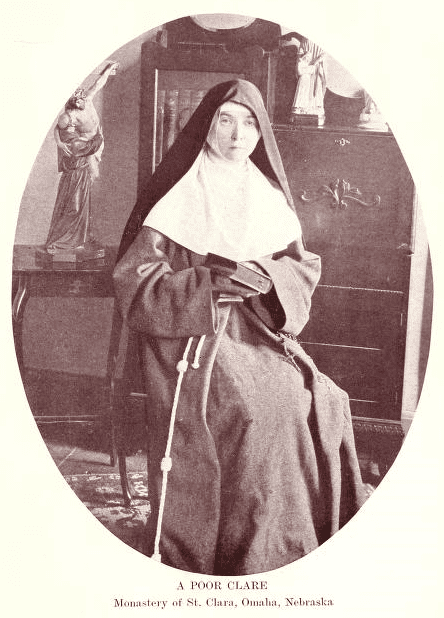 THE POOR CLARES (1875)
Religious orders being an integral part of the Church, naturally share in her trials and triumphs. Whenever the Church has been assailed, religious orders usually have had to bear the brunt of the battle; and the greatest glories of the Church have, as a rule, been due to the influence of religious orders.
But religious orders are also affected in a way peculiar to themselves. That extraordinary fervor which attended the beginning and the dissemination of every religious institute is generally of short duration. After a while these institutes settle down to a certain groove, traced out and hedged in by numerous precepts and regulations; but while this may be a necessity to safeguard the individual, it not seldom serves to depress and hamper the action of the entire body. Again, religious orders, just like individuals, have their periods of fervor and also their times of remissness. Sometimes, too, they may, on account of particular circumstances, deviate from their original plan and purpose, without, however, entirely losing their character of usefulness.
The Order of the Poor Clares has had its own trials and difficulties. Revolutions and persecutions have at times decimated its monasteries. Sometimes the Religious were suppressed wholesale in some particular country. Their monasteries were confiscated, and the Sisters exiled from the land after being subjected to so many hardships and privations. Some were even put to death, or died in consequence of the suffering they had to endure. Yet in spite of every obstacle, the Order lives and flourishes at the present day throughout the Catholic world, animated with the same spirit as that which permeated the holy foundress, Saint Clare, nearly eight centuries ago.
About the year 1792, some Poor Clares, driven from France by the Revolution, came to the United States and took up their abode at Georgetown, D.C.; here they opened a school for their support but they were unable to establish a permanent institution, and upon the death of the Abbess, purchased and with her companions returned to their European Convent.
The permanent establishment of the Poor Clares in this country is due to the courage and perseverance of two noble ladies of Rome, sisters by nature as well as by religion, Sister Maria Maddalena Bentivoglio and Sister Maria Costanza Bentivoglio. Their parents were Domenico Bentivoglio, Count of Bologna, and Angela Sandred, a descendant from a noble French family.
Count Domenico fought in the wars under Napoleon I, holding the rank of a colonel. After Napoleon’s defeat, he returned to his palatial residence in Bologna, but soon afterwards removed with his family to Rome, at the request of Pope Gregory XVI. Count Domenico also served as a general in the Papal army and did service under both Pope Gregory XVI and Pope Pius IX. He passed through eventful days and many facts could be related concerning his career.
The two eldest daughters, Agatha and Paola, were placed for their education in the Monastery of the Poor Clares Urbanists of San-Silvestro-in-capite, founded by Blessed Margaret Colonna. When the Blessed Madeleine Barat, foundress of the Society of the Sacred Heart, came to Rome to open a house of her Society, she lived for a time in this Monastery of San Silvestro. Here she made the acquaintance of the Bentivoglio family, whose intimate friend she ever afterward remained.
As soon as Blessed Madeleine Barat succeeded in establishing her Society in the Monastery of the Trinitá de’ Monti, Agatha hastened to join the Society and her sisters were sent there for their education.
Out of the seven daughters in this noble family two contracted marriage; the other five became religious, two entering the Society of the Sacred Heart, one joining the Oblates of San Francesca Romana, and two, namely Annetta and Costanza, became Poor Clares.
In 1875, in obedience to His Holiness, Pope Pius IX, and the Most Rev. Father General of the Order, these two Sisters—Sister Maddalena Bentivoglio and Sister Maria Costanza Bentivoglio—left their Monastery of San-Lorenzo-in-Panisperna in Rome to come to the United States.
Their history, from their arrival in New York, October 11, 1875, is one of many sufferings, trials, and disappointments. Having been especially recommended to the care of the American Provincial of the Franciscan Fathers, he arranged for the Sisters to go to Cleveland, Ohio, from New Orleans—whither they had gone from awaiting a diocesan location for their American foundation.
Some months after their establishment in Cleveland—in compliance with the request of the Franciscan Provincial—plans were made for the arrival of a band of Poor Clare, from the Community at Dusseldorf, Germany. The intention of the Rev. Provincial was the fusion of the two Communities and the conforming of the Italian Sisters to the customs and usages of the newcomers.
On December 15, 1877, the new Community—with Mother M. Veronic a as Abbess and Mother Josepha as Vicaress—arrived in Cleveland and at once became established at the Monastery of the Poor Clares from Italy.
The following year witnessed the separation of the Poor Clares in Cleveland. Through the generosity of one of this country’s noblest men—Mr. John A. Creighton of Omaha, Nebraska—the Italian Sisters were enabled to found, the City of Omaha, a Monastery of their Order, according to the primitive observance of the First Rule of St. Clare. Mr. Creighton, assisted by his equally noble and zealous wife, neglected nothing that would tend to the thorough and comfortable establishment of the Poor Clares in Omaha.
From this Monastery of St. Clare—located at Hamilton Ave., and 29th Street, in that city—two other important foundations have been made; in 1885, the Monastery of St. Clare, Magazine Street and Henry Clay Avenue, New Orleans, La., was established, and in 1897 was established the Monastery of St. Clare, Kentucky Avenue, Evansville, Indiana.
From the Monastery at Cleveland was founded, in 1893, the Monastery of the Poor Clares at the corner of 53rd and Laflin Streets, in Chicago, Illinois. The Most Rev. Patrick A, Feehan—first Archbishop of Chicago—came in person to dedicate this Monastery on its completion, thereby showing his pleasure in having in his Archdiocese a Community whose prayers are all-powerful at the throne of the Almighty.
In the year 1906, the Poor Clares in Evansville established a Monastery in Boston, Mass., at 38 Bennett Street.
In 1909, from the Monastery in Boston was founded the Monastery of St. Clare at Bordentown, New Jersey.
The Poor Clares throughout the world observe the Rule drawn up by St. Clare, and approved by Pope Innocent IV, August 9, 1253.
Their life is contemplative, a life of reparation and intercession for the needs of Holy Church and particularly for the conversion of sinners. The hours of the day and part of the night are devoted to prayer, and manual labor; the Sisters rise at midnight for the recitation of the Divine Office; they have the daily Exposition of the Blessed Sacrament for a certain time, and often during the midnight hour. The Poor Clares do all kind of Church work, vestments, embroidery, and the making of altar breads for Missions and Churches.
The Rule requires of the candidate to the Order one year of novitiate, after which Perpetual Vows of Poverty, Chastity, Obedience and Enclosure could be made. But experience having proved the necessity of a longer period of probation, many house of the Order addressed petitions to this effect to the Holy See with the result that the length of time of probation now differs somewhat in the different monasteries.
The Monasteries of the Poor Clares are each independent, each having its own Abbess and its own novitiate. Some are under the jurisdiction of the Father General of the Franciscan Order, the others under the bishop of the diocese.
The habit of the Poor Clares is of gray frieze—a mixture of natural brown and white—made in tunic form with a cord of gray linen worn as a girdle.
Elinor Tong Dehey, Religious Orders of Women in the United States (Hammond, IN: W.B. Conkey, 1913), 271-276.

Browse Our Archives
Select a Category African-American Catholics Alabama Catholics American Catholic History American Catholic women American History Anniversaries Anti-Catholicism Arkansas Catholics Benedictines Bishops Blessed John Henry Newman Book Reviews Books Boston College Brooklyn churches Brothers California Catholics Capuchins Cardinals Carlo Carretto Carmelites Catholic authors Catholic Cemeteries Catholic Historians Catholic History in Less Than 5 Minutes Catholic musicians Catholic Poetry Catholic Press Catholic School Textbook Catholic University of America Catholic Worker Catholics and Music Catholics and Race Catholics in Politics Catholics in the American Revolution Catholics in the Military Catholics in the Movies Catholics in the South Catholics in the West Catholics on Stage Catjolic Women Catolic Poetry Charles de Foucauld Children's Masses Christian Brothers Christmas Church Reform Civil Rights Movement Civil War Colleges and universities Converts D.C. Catholics Deaf Catholics Dominicans. Dorothy Day English Catholics Florida Catholics Fordham University Franciscans French Catholics Georgetown University German Americans Good Shepherd Sisters Hispanic Catholics Historians and Archivists Holy Cross Fathers Holy Name Society Idaho Catholics Illinois Catholics Indian Wars Indiana Catholics Irish Americans Irish Catholicism Italian Americans Italian Catholics Jesuits Josephite Sisters Kentucky Catholics Know-Nothings Laetare Medal Recipients laity Liturgical Movement Maine Catholics Manhattan College Maryland Catholicism Michigan Catholics Middle Ages Minnesota Catholics Missionaries Mississippi Catholics Missouri Catholics Monasteries Montana Catholics Native Americans New England Catholicism New Jersey Catholics New York Catholics North American College Ohio Catholics Oratorians Oregon Catholics Parish Mission Parishes Passionists Pat McNamara's Books Paulists Pennsylvania Catholics Popes Presidents Priests Quotations Religious Orders Rhode Island Catholics Saints Salesians Seminarians Seminaries Sermons Servants of God Siisters of Charity Sisters of Mercy South Carolina Catholics Spanish-American War Sports St. Francis of Assiai St. John Henry Newman Suplicians Tennessee Catholics Texas Catholics The year in review Thomas Merton Throwback Thursday Photograph Trappists Uncategorized University of Notre Dame Video Presentations Vincentians Virginia Catholics Visitation Nuns Washington West Point West Virginia Catholics West Viriginia Catholics Wisconsin Catholicism Women Religious World War II
Select a Month December 2020 June 2020 May 2020 April 2020 March 2020 March 2019 February 2019 January 2019 December 2018 November 2018 November 2014 October 2014 September 2014 August 2014 July 2014 June 2014 May 2014 December 2013 November 2013 October 2013 August 2013 July 2013 June 2013 May 2013 April 2013 March 2013 February 2013 January 2013 December 2012 November 2012 October 2012 September 2012 August 2012 July 2012 June 2012 April 2012 March 2012 December 2011 November 2011 October 2011 September 2011 August 2011 July 2011 June 2011 May 2011 April 2011 March 2011 February 2011 January 2011 December 2010 November 2010 October 2010 January 2010 December 2009 November 2009 October 2009 September 2009 August 2009 July 2009 June 2009 May 2009 April 2009 March 2009 February 2009 January 2009 December 2008
Follow Us!
TAKE THE
Religious Wisdom Quiz
True or False: The Corinthians were told that love is patient and kind.
Select your answer to see how you score.
TRUE FALSE
Related posts from McNamara's Blog
National Catholic Sisters Week 2019: An Appreciation
Nuns as Sex Slaves: Fact, Fiction, and Maria...

St. Mary Euphrasia and the Good Shepherd Charism
TRENDING AT PATHEOS Catholic

The Parable Of The Sower And The Word...
One of Christ’s most famous parables is that of the sower who...

Rejecting Doom: Christian Hope And Human Action
Christianity is a religion of hope. We are to have hope and...

Why I Choose the Eucharist Over the Sermon
Choose the Eucharist, Not the Sermon What are we supposed to get...

5 Design Elements Found in Spiritually Rooted Homes
Putting Spirituality Into Home Decor Our homes are more than our living...

Credo: A Story of God Told with the...
About 10 years ago, I began to imagine a personal "Credo" that...

The Anatomy of Divine Revelation in Catholic Thought
The claim that God has made Himself known to human beings is...
view all Catholic blogs
Ad-Free & Subscriber Log-In Subscription Support
- About Us
- 2026 Calendar
- Videos
- Podcasts
- Library of World Religions
- Faith In Media Tracker
- Advertise With Us
- Write for Us
- Privacy Policy
- Terms of Service
- Do Not Sell My Data
- Contact Us
- Radiant Digital
- Manage Newsletter Subscriptions
- Unsubscribe From Notifications
- Sitemap
Copyright 2008-2026, Patheos. All rights reserved.
Subscription Support Ad-Free & Subscriber Log-In
Follow Patheos