
BuddhistCatholicContemplativeEvangelicalGeneral ChristianHinduJewishLatter-day SaintMuslimNew VisionsProgressive Christian
Beliefs
- Buddhist
- Catholic
- Contemplative
- Evangelical
- General Christian
- Hindu
- Jewish
- Latter-day Saint
- More Voices
- Muslim
- New Visions
- Pagan
- Progressive Christian
Topics
- Religion News
- Food and Religion
- Sports and Religion
- Religious Art
- Religious Music and Entertainment
- Religious Events
- History and Religion
- Style and Religion
- Politics and Religion
- Women in Religion
- Recreation Outdoors and Religion
- Business Finance and Religion
- Careers Workplace and Religion
- Education and Religion
- Family Parenting and Religion
- Health Fitness and Religion
- Home and Religion
- Relationships and Religion
- Technology and Religion
- Travel and Religion
Columnists
- Buddhist Columnists
- Business Finance and Religion Columnists
- Careers Workplace and Religion Columnists
- Catholic Columnists
- Contemplative Columnists
- Education and Religion Columnists
- Evangelists Columnists
- Family Parenting and Religion Columnists
- General Christian Columnists
- Health Fitness and Religion Columnists
- Hindu Columnists
- History and Religion Columnists
- Home and Religion Columnists
- Jewish Columnists
- More Voices Columnists
- Latter Day Columnists
- Muslim Columnists
- New Visions Columnists
- Nonreligious Columnists
- Pagan Columnists
- Politics and Religion Columnists
- Progressive Columnists
- Recreation Outdoors and Religion Columnists
- Relationships and Religion Columnists
- Religion News Columnists
- Religious Art Columnists
- Religious Events Columnists
- Religious Music and Entertainment Columnists
- Sports and Religion Columnists
- Style and Religion Columnists
- Technology and Religion Columnists
- Travel and Religion Columnists
- Women in Religion Columnists
Resource Library
- 2026 Calendar
- Library of World Religions
- The 100 Most Holy Places on Earth
- Patheos Answers
- Podcasts
- Videos
- Faith Leaders Database
- Anglican Episcopalian
- Bahai
- Baptist
- Buddhism
- Christianity
- Confucianism
- Eastern Orthodoxy
- Hinduism
- Holiness and Pentecostal
- ISKCON
- Islam
- Judaism
- Lutheran
- Methodist
- The Church of Jesus Christ of Latter-day Saints
- New Age
- Paganism
- Presbytarian and Reformed
- Protestantism
- Religion Behind the Scenes
- Roman Catholic
- Scientology
- Shia Islam
- Sikhism
- Sufism
- Sunni Islam
- Taoism
- Zen
- See all religions
Research Tools
 Ad-Free & Subscriber Log-In Subscription Support
Ad-Free & Subscriber Log-In Subscription Support
Follow Patheos 

- Trending:
- Forgiveness
- |
- Marriage
- |
- Consciousness
- |
- Death Penalty
- |
- Election
- |
- Halloween
 McNamara's Blog
- Home
- Catholic
- First American Bishop Eulogizes President Washington, 1800
First American Bishop Eulogizes President Washington, 1800
Last updated on: February 10, 2013 at 5:42 am by Pat McNamara
First American Bishop Eulogizes President Washington, 1800 2013-02-10T05:42:55-07:00 Pat McNamara
Patheos Explore the world's faith through different perspectives on religion and spirituality! Patheos has the views of the prevalent religions and spiritualities of the world.
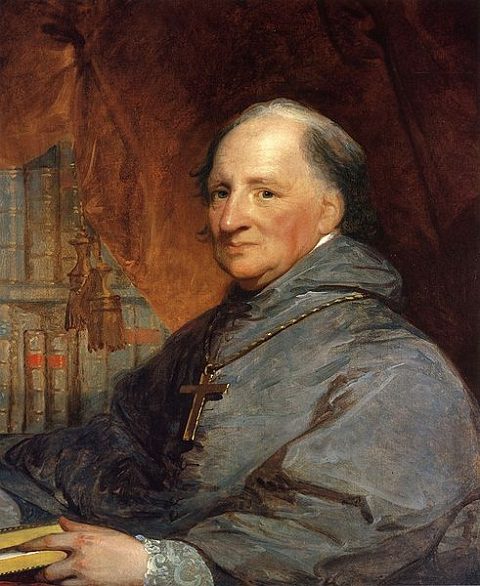 Bishop John Carroll’s Eulogy on the Death of President Washington, February 22nd, 1800
When the death of men distinguished by superior talents, high endowments, and eminent virtues to their country, demands the expression of public mourning and grief their loss is accompanied generally with this mitigation, that, however grievous and painful, it is not irreparable; and that the void, caused by their mortality, will perhaps be filled up by others, uniting equal abilities with the same zeal and watchfulness for the general welfare. Hope then wipes off the tears, with which sorrow bedews the grave of departed worth. But on the present occasion no such consolation can be administered; for he, whose expectations are so sanguine, dares not promise again to his country the union of so many splendid and useful virtues, as adorned that illustrious Man, whose memory excites our grateful and tender sensibility, and at whose tomb the homages of his country is to be solemnly offered on this day. Whether we consult our own experience, by bringing into comparison with Washington, any of our contemporaries, most eminent for their talents, virtues and services; or whether we search through the pages of history, to discover in them a character of equal fame, justice and truth will acknowledge, that he stands super-eminent and unrivalled in the annals of mankind; and that no one before him, acting in such a variety of new and arduous situations, bore with him to the grave a reputation as clear from lawless ambition, and as undefiled by injustice or oppression; a reputation neither depressed by indolence, or weakened by irresolution, nor shadowed by those imperfections which seemed to be the essential appendages of human nature, till providence exhibited in Washington this extraordinary phenomenon.
What language can be equal to the excellence of such a character? What proportion can exist between eloquence, and the tribute of praise, due to so much virtue? Nevertheless, my fellow citizens, I read in the eagerness of your attention, your desire to offer this tribute: Methinks I hear your filial piety, your tender reverence for your best friend, the Father of his Country, calling on me to bear for you, at least a feeble testimony of your unextinguishable gratitude for his services, your immortal remembrance of, and veneration for his virtues. In your name, therefore, I presume to add some grains of incense to the homage which throughout the United States every friend to their happiness now presents at the shrine of Washington. Pardon, O departed Spirit of the first of Heroes! if with the cold accents of an exhausted imagination, I likewise dare attempt to celebrate thy name, whilst so many sons of genius, ardent in youthful vigour, delineate in glowing colours the vivid features of thy mind, and the glorious deeds of thy virtuous life. With unequal steps I venture on the same career, not seeking to add lustre to the fame of Washington, or perpetuate his memory to future times; but humbly hoping, that a recital of his services will open to our countrymen the road to true honour, and kindle in their breasts the warmth of generous emulation, and real patriotism. To contribute in this manner to the best interests of his beloved country, will be to him the most gratifying commendation, if in the regions of immortality, human affairs still claim a share of his solicitude.
To superintend the movements, and operations of such a revolution; to control during its progress, jealousies, enmities, suspicions, and other conflicting passions; and from their collision, to create national and individual prosperity, peace, order, liberty and regular government required the discernment and masterly contrivance of that Supreme Director and Artist, who unites together the links and holds in his hands the chain of all human events. Contemplating, as much as is allowed to feeble mortals, his divine agency in preparing the means and conducting the progress of the American Revolution, we may presume to say, that heaven impressed a character on the life of Washington, and a temper on his soul, which eminently qualified him to bear the most conspicuous part, and be its principal instrument in accomplishing this stupendous work.
Washington beheld from his retirement, as the Jewish legislator from the summit of Mount Phasga, the flourishing prosperity of his country. Health sweetened his repose and rural occupations; his body and mind retained their usual vigor. We flattered ourselves with the expectation of his continuing long to retain them: Joy beamed in our hearts, when on every annual revolution, we gratefully hailed this, his auspicious birthday. But, alas! how dark is the cloud, that now overshadows it? The songs of festivity converted into the sobs of mourning! The prayers of thanksgiving for his health and life changed into lamentations for his death! Who feels not for him, as for his dearest friend, his protector, and his Father? Whilst he lived, we seemed to stand on loftier ground, for breathing the same air, inhabiting the same country, and enjoying the same constitution and laws, as the sublime, magnanimous Washington.
He was invested with a glory, that shed a lustre on all around him. For his country’s safety, he often had braved death, when clad in her most terrific form; he had familiarized himself with her aspect; at her approaching to cut the thread of life, he beheld her with constancy and serenity; and with his breath, as we may believe from knowing the ruling passion of his soul, he called to heaven to save his country, and recommended it to the continual protection of that Providence, which he so reverently adored. May his prayer have been heard! May those United States flourish in pure and undefiled religion, in morality, peace, union, liberty and the enjoyment of their excellent Constitution, as long as respect, honour, and veneration shall gather round the name of Washington; that is, whilst there shall be any surviving record of human events.
Peter K. Guilday, The Life and Times of John Carroll, Archbishop of Baltimore, 1735-1815 (Two Volumes) (New York: Encyclopedia Press, 1922), II, 744-747.
Previous Post

February 9, 2013
America's First Italian Bishop: Joseph Rosati, C.M. (1789-1843)
Next Post
February 11, 2013 A Momentous Day in Church History-- To Say the Least
Browse Our Archives
Select a Category African-American Catholics Alabama Catholics American Catholic History American Catholic women American History Anniversaries Anti-Catholicism Arkansas Catholics Benedictines Bishops Blessed John Henry Newman Book Reviews Books Boston College Brooklyn churches Brothers California Catholics Capuchins Cardinals Carlo Carretto Carmelites Catholic authors Catholic Cemeteries Catholic Historians Catholic History in Less Than 5 Minutes Catholic musicians Catholic Poetry Catholic Press Catholic School Textbook Catholic University of America Catholic Worker Catholics and Music Catholics and Race Catholics in Politics Catholics in the American Revolution Catholics in the Military Catholics in the Movies Catholics in the South Catholics in the West Catholics on Stage Catjolic Women Catolic Poetry Charles de Foucauld Children's Masses Christian Brothers Christmas Church Reform Civil Rights Movement Civil War Colleges and universities Converts D.C. Catholics Deaf Catholics Dominicans. Dorothy Day English Catholics Florida Catholics Fordham University Franciscans French Catholics Georgetown University German Americans Good Shepherd Sisters Hispanic Catholics Historians and Archivists Holy Cross Fathers Holy Name Society Idaho Catholics Illinois Catholics Indian Wars Indiana Catholics Irish Americans Irish Catholicism Italian Americans Italian Catholics Jesuits Josephite Sisters Kentucky Catholics Know-Nothings Laetare Medal Recipients laity Liturgical Movement Maine Catholics Manhattan College Maryland Catholicism Michigan Catholics Middle Ages Minnesota Catholics Missionaries Mississippi Catholics Missouri Catholics Monasteries Montana Catholics Native Americans New England Catholicism New Jersey Catholics New York Catholics North American College Ohio Catholics Oratorians Oregon Catholics Parish Mission Parishes Passionists Pat McNamara's Books Paulists Pennsylvania Catholics Popes Presidents Priests Quotations Religious Orders Rhode Island Catholics Saints Salesians Seminarians Seminaries Sermons Servants of God Siisters of Charity Sisters of Mercy South Carolina Catholics Spanish-American War Sports St. Francis of Assiai St. John Henry Newman Suplicians Tennessee Catholics Texas Catholics The year in review Thomas Merton Throwback Thursday Photograph Trappists Uncategorized University of Notre Dame Video Presentations Vincentians Virginia Catholics Visitation Nuns Washington West Point West Virginia Catholics West Viriginia Catholics Wisconsin Catholicism Women Religious World War II
Select a Month December 2020 June 2020 May 2020 April 2020 March 2020 March 2019 February 2019 January 2019 December 2018 November 2018 November 2014 October 2014 September 2014 August 2014 July 2014 June 2014 May 2014 December 2013 November 2013 October 2013 August 2013 July 2013 June 2013 May 2013 April 2013 March 2013 February 2013 January 2013 December 2012 November 2012 October 2012 September 2012 August 2012 July 2012 June 2012 April 2012 March 2012 December 2011 November 2011 October 2011 September 2011 August 2011 July 2011 June 2011 May 2011 April 2011 March 2011 February 2011 January 2011 December 2010 November 2010 October 2010 January 2010 December 2009 November 2009 October 2009 September 2009 August 2009 July 2009 June 2009 May 2009 April 2009 March 2009 February 2009 January 2009 December 2008
Follow Us!
TAKE THE
Religious Wisdom Quiz
What is the last book of the Bible?
Select your answer to see how you score.
Malachi Hebrews Revelation Jude
Related posts from McNamara's Blog
A House Divided: The American Bishops and the...
Saint Aloysius Gonzaga: A Reflection for Troubled Times
“I No Longer Call You Slaves”: Race, Religion,...
Who’s It Named For? Archbishop Thomas E. Molloy...
TRENDING AT PATHEOS Catholic

Rejecting Doom: Christian Hope And Human Action
Christianity is a religion of hope. We are to have hope and...

It’s What Comes From Within Which Matters
One of the most difficult things for us to understand is why...

Why I Choose the Eucharist Over the Sermon
Choose the Eucharist, Not the Sermon What are we supposed to get...

5 Design Elements Found in Spiritually Rooted Homes
Putting Spirituality Into Home Decor Our homes are more than our living...

Credo: A Story of God Told with the...
About 10 years ago, I began to imagine a personal "Credo" that...

The Anatomy of Divine Revelation in Catholic Thought
The claim that God has made Himself known to human beings is...
view all Catholic blogs
Ad-Free & Subscriber Log-In Subscription Support
- About Us
- 2026 Calendar
- Videos
- Podcasts
- Library of World Religions
- Faith In Media Tracker
- Advertise With Us
- Write for Us
- Privacy Policy
- Terms of Service
- Do Not Sell My Data
- Contact Us
- Radiant Digital
- Manage Newsletter Subscriptions
- Unsubscribe From Notifications
- Sitemap
Copyright 2008-2026, Patheos. All rights reserved.
Subscription Support Ad-Free & Subscriber Log-In
Follow Patheos