
BuddhistCatholicContemplativeEvangelicalGeneral ChristianHinduJewishLatter-day SaintMuslimNew VisionsProgressive Christian
Beliefs
- Buddhist
- Catholic
- Contemplative
- Evangelical
- General Christian
- Hindu
- Jewish
- Latter-day Saint
- More Voices
- Muslim
- New Visions
- Pagan
- Progressive Christian
Topics
- Religion News
- Food and Religion
- Sports and Religion
- Religious Art
- Religious Music and Entertainment
- Religious Events
- History and Religion
- Style and Religion
- Politics and Religion
- Women in Religion
- Recreation Outdoors and Religion
- Business Finance and Religion
- Careers Workplace and Religion
- Education and Religion
- Family Parenting and Religion
- Health Fitness and Religion
- Home and Religion
- Relationships and Religion
- Technology and Religion
- Travel and Religion
Columnists
- Buddhist Columnists
- Business Finance and Religion Columnists
- Careers Workplace and Religion Columnists
- Catholic Columnists
- Contemplative Columnists
- Education and Religion Columnists
- Evangelists Columnists
- Family Parenting and Religion Columnists
- General Christian Columnists
- Health Fitness and Religion Columnists
- Hindu Columnists
- History and Religion Columnists
- Home and Religion Columnists
- Jewish Columnists
- More Voices Columnists
- Latter Day Columnists
- Muslim Columnists
- New Visions Columnists
- Nonreligious Columnists
- Pagan Columnists
- Politics and Religion Columnists
- Progressive Columnists
- Recreation Outdoors and Religion Columnists
- Relationships and Religion Columnists
- Religion News Columnists
- Religious Art Columnists
- Religious Events Columnists
- Religious Music and Entertainment Columnists
- Sports and Religion Columnists
- Style and Religion Columnists
- Technology and Religion Columnists
- Travel and Religion Columnists
- Women in Religion Columnists
Resource Library
- 2026 Calendar
- Library of World Religions
- The 100 Most Holy Places on Earth
- Patheos Answers
- Podcasts
- Videos
- Faith Leaders Database
- Anglican Episcopalian
- Bahai
- Baptist
- Buddhism
- Christianity
- Confucianism
- Eastern Orthodoxy
- Hinduism
- Holiness and Pentecostal
- ISKCON
- Islam
- Judaism
- Lutheran
- Methodist
- The Church of Jesus Christ of Latter-day Saints
- New Age
- Paganism
- Presbytarian and Reformed
- Protestantism
- Religion Behind the Scenes
- Roman Catholic
- Scientology
- Shia Islam
- Sikhism
- Sufism
- Sunni Islam
- Taoism
- Zen
- See all religions
Research Tools
 Ad-Free & Subscriber Log-In Subscription Support
Ad-Free & Subscriber Log-In Subscription Support
Follow Patheos 

- Trending:
- Forgiveness
- |
- Marriage
- |
- Consciousness
- |
- Death Penalty
- |
- Election
- |
- Halloween
 McNamara's Blog
- Home
- Catholic
- St. John Nepomucene Neumann (1811-1860)
St. John Nepomucene Neumann (1811-1860)
Last updated on: January 5, 2013 at 6:19 am by Pat McNamara
St. John Nepomucene Neumann (1811-1860) 2013-01-05T06:19:38-07:00 Pat McNamara
Patheos Explore the world's faith through different perspectives on religion and spirituality! Patheos has the views of the prevalent religions and spiritualities of the world.
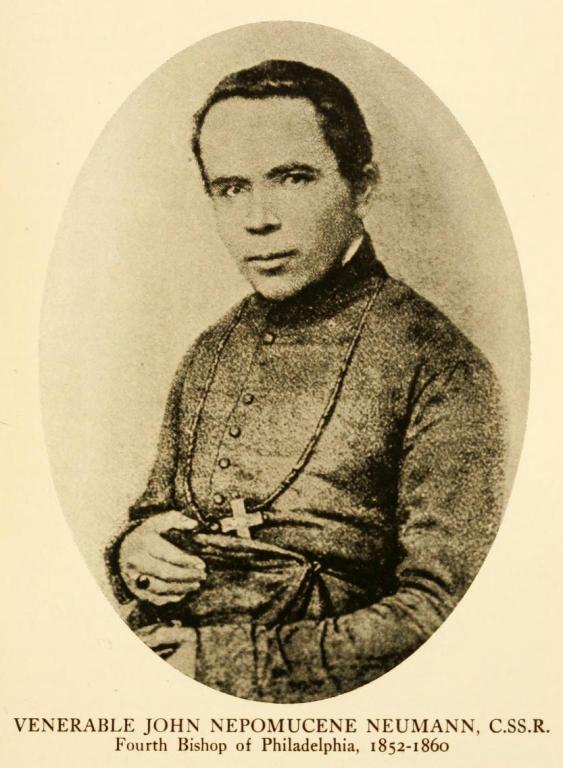 FIRST AMERICAN SOON TO BE PLACED, AFTER YEARS OF SOLICITATION BU U.S. CATHOLICS, IN THE CALENDAR OF SAINTS (The Brooklyn Eagle, February 16, 1902, 44)
Roman Catholics of the United States, who have been striving for many years to secure the canonization of a strictly American saint seem destined at last to have their wish gratified, for it is understood that the Bishop of Philadelphia will soon announce that the beatification of John Nepomucene Neumann is to take place within a few weeks. Although American Catholics have presented the names of no less than four eminently suitable candidates for sainthood and have never ceased to press their claims for recognition with most energetic persistence, this is the first occasion on which they have felt that there was much justification for the hope that their desires were at last to be realized. The announcement of Bishop Neumann’s beatification, which is so soon to be made, is one of the most important of the many preliminary steps that must be taken before the process of creating the first North American saint can be completed.
At the present time the only name that the new world has contributed to this roll of honor of the Church is that of St. Rose of Lima, a Dominican nun whose sanctity was so well recognized by those who had been acquainted with her holy life that the agitation for her canonization actually commenced within a few years after her death, in August, 1617. Fair of face and fascinating in manner, everybody loved her and the people, likening her grace and beauty to the queen of flowers, insisted upon changing her name, Isabelle, to that of Rose, and it is by that title that she has become known as one of the most perfect examples of charity, piety and devotion to her faith that the world has to offer.
While the Sacred Congregation of Rites at Rome is examining into the lives of men and women of all ages one of its most important missions at the present time is to show that the age of holy living has not passed, and it is in this connection that it will give the earliest possible attention to the claims of the four candidates for canonization that have been presented by Catholics in the United States. To ordinary layman, the man engrossed with worldly things, there may be something incongruous in the idea that the bustling nineteenth century should have produced characters sufficiently holy to be sufficiently worthy to occupy a place in the list of canonized saints, and yet there is little reason to believe that the Sacred Congregation will not be able to prove, beyond any possibility of doubt, that such men and women have lived and died in sanctity, undisturbed by the peculiarly worldly influences of modern life.
One of the most striking of the several examples which show that modern existence and saintly living are not entirely incompatible is that which may be found in life of the late Bishop Neumann. He was born in the ancient city of Prahatitz, in Bohemia, on Good Friday, March 28, 1811. His father, a stocking weaver, while not wealthy, was a man of sterling principles, charitable and religious, and the nature if the early training which his son must have received may be judged from the fact that, of six children, the three girls and two of the boys embraced the religious life.
In 1831 young Neumann entered the seminary at Budweis, but, before his theological studies were studied, he volunteered for the American missions, arriving in the this country almost penniless and a stranger, on the morning of Corpus Christi, 1835. The same day he reached New York, however, he succeeded in obtaining and interview with Bishop Dubois, who was glad enough to accept his services, a German priest being needed in this diocese. For a year, therefore, or until he was prepared for his higher orders, the young priest gave instructions in Christian doctrine to the German congregation of St. Nicholas Church, but on June 25, 1836, he was ordained a priest in old St. Patrick’s Church, and from that day, his active missionary labors commenced.
The story of the young priest’s early struggles constitutes one of the most interesting chapters in the religious history of New York. It was the time when there was comparatively little money at the disposal of the Church, and the few Catholics outside of New York were so widely separated that the missionary’s parish seemed to be almost without boundaries. Father Neumann’s first mission station, for example, was Williamsville, but from there he also attended many other places, including North Bush, five miles distant; Lancaster, six; Transit, six; Batavia, forty; Sheldon, twenty, and Niagara, fifty miles distant, while the financial difficulties which he was compelled to overcome may be imagined from a glance at his writings, in which he speaks of “living at North Bush with a native of Lorraine, who, in consideration of payment in the next life, furnishes me with board and lodgings in this,” or, when he says: “I have never yet suffered from hunger, and, as for clothes, when one garment grows too shabby to wear some one or other of my good people provides me with another.”
Four years of such hardship were sufficient to leave Father Neumann sadly broken in health, so in 1840, he joined the Redemptorists, being the first member to be professed in America, and on March 5, 1844, he was elected, in spite of all his protests, superior of the order. Always his health was delicate, for he had contracted a chronic wasting fever, and yet at no time did he find any labor too great for him to undertake. He also made it a practice to fast frequently all day and it was no rare thing for him to wear an iron cincture whose points entered his flesh, making painful wounds.
In March, 1852, Archbishop Kenrick, whose confessor he had long been, informed him that the Pope had determined to appoint him Bishop of Philadelphia. On Good Friday, 1852, Father Neumann became Bishop Neumann, and although from that day all manner of great honors were showered on him nothing tended to alter his character. No task was too mean for him to perform; no person so vile that he would not strive personally to improve his condition. Upon his elevation to the bishopric he was dispensed from the obligation of poverty which he had assumed on becoming a Redemptorist, and yet the dispensation did not result in the accumulation of wealth on his part, for his purse was always open, and, when it was empty, he did not hesitate to part with any article of value that he might have to relieve the needy. He even gave his clothing to the poor, and, as the result, was often shabbily clad,while his support of the sisterhoods, the orphan asylums and struggling congregations in his diocese was his greatest delight as long as he lived. He died on January 5, 1860, and his body was interred in St. Peter’s Church.
If the process of canonization was not so deliberate and complicated, Bishop Neumann would undoubtedly have long since been venerated as a saint. Rome never acts hastily in such matters, however, and, as the result, nearly fifteen years have elapsed since the first process tending toward his canonization was undertaken by Archbishop Ryan. Accordingly the authorities of the Philadelphia diocese have submitted to Rome much interesting data tending to show that a number of persons have been cured of bodily afflicitions by visiting the tomb of Bishop Neumann. In the meantime Bishop Neumann’s tomb has been visited by throngs of believers and unfortunately, afflicted persons may be seen there daily, praying by the hour.
Previous Post

January 4, 2013
St. Elizabeth Seton (1774-1821), By One who Knew Her
Next Post
January 17, 2013 Father Augustine F. Hewit, C.S.P. (1820-1897)
Browse Our Archives
Select a Category African-American Catholics Alabama Catholics American Catholic History American Catholic women American History Anniversaries Anti-Catholicism Arkansas Catholics Benedictines Bishops Blessed John Henry Newman Book Reviews Books Boston College Brooklyn churches Brothers California Catholics Capuchins Cardinals Carlo Carretto Carmelites Catholic authors Catholic Cemeteries Catholic Historians Catholic History in Less Than 5 Minutes Catholic musicians Catholic Poetry Catholic Press Catholic School Textbook Catholic University of America Catholic Worker Catholics and Music Catholics and Race Catholics in Politics Catholics in the American Revolution Catholics in the Military Catholics in the Movies Catholics in the South Catholics in the West Catholics on Stage Catjolic Women Catolic Poetry Charles de Foucauld Children's Masses Christian Brothers Christmas Church Reform Civil Rights Movement Civil War Colleges and universities Converts D.C. Catholics Deaf Catholics Dominicans. Dorothy Day English Catholics Florida Catholics Fordham University Franciscans French Catholics Georgetown University German Americans Good Shepherd Sisters Hispanic Catholics Historians and Archivists Holy Cross Fathers Holy Name Society Idaho Catholics Illinois Catholics Indian Wars Indiana Catholics Irish Americans Irish Catholicism Italian Americans Italian Catholics Jesuits Josephite Sisters Kentucky Catholics Know-Nothings Laetare Medal Recipients laity Liturgical Movement Maine Catholics Manhattan College Maryland Catholicism Michigan Catholics Middle Ages Minnesota Catholics Missionaries Mississippi Catholics Missouri Catholics Monasteries Montana Catholics Native Americans New England Catholicism New Jersey Catholics New York Catholics North American College Ohio Catholics Oratorians Oregon Catholics Parish Mission Parishes Passionists Pat McNamara's Books Paulists Pennsylvania Catholics Popes Presidents Priests Quotations Religious Orders Rhode Island Catholics Saints Salesians Seminarians Seminaries Sermons Servants of God Siisters of Charity Sisters of Mercy South Carolina Catholics Spanish-American War Sports St. Francis of Assiai St. John Henry Newman Suplicians Tennessee Catholics Texas Catholics The year in review Thomas Merton Throwback Thursday Photograph Trappists Uncategorized University of Notre Dame Video Presentations Vincentians Virginia Catholics Visitation Nuns Washington West Point West Virginia Catholics West Viriginia Catholics Wisconsin Catholicism Women Religious World War II
Select a Month December 2020 June 2020 May 2020 April 2020 March 2020 March 2019 February 2019 January 2019 December 2018 November 2018 November 2014 October 2014 September 2014 August 2014 July 2014 June 2014 May 2014 December 2013 November 2013 October 2013 August 2013 July 2013 June 2013 May 2013 April 2013 March 2013 February 2013 January 2013 December 2012 November 2012 October 2012 September 2012 August 2012 July 2012 June 2012 April 2012 March 2012 December 2011 November 2011 October 2011 September 2011 August 2011 July 2011 June 2011 May 2011 April 2011 March 2011 February 2011 January 2011 December 2010 November 2010 October 2010 January 2010 December 2009 November 2009 October 2009 September 2009 August 2009 July 2009 June 2009 May 2009 April 2009 March 2009 February 2009 January 2009 December 2008
Follow Us!
TAKE THE
Religious Wisdom Quiz
What city is home to the Vatican?
Select your answer to see how you score.
Jerusalem Florence Rome Bethlehem
Related posts from McNamara's Blog

St. John Henry Newman and the “Special Charm...
A House Divided: The American Bishops and the...
Saint Aloysius Gonzaga: A Reflection for Troubled Times
“I No Longer Call You Slaves”: Race, Religion,...
TRENDING AT PATHEOS Catholic

Creation, Preservation, and Teleology in Catholic Theology
As I write this, it is very early Monday morning. Like millions...

The Parable Of The Sower And The Word...
One of Christ’s most famous parables is that of the sower who...

Rejecting Doom: Christian Hope And Human Action
Christianity is a religion of hope. We are to have hope and...

Why I Choose the Eucharist Over the Sermon
Choose the Eucharist, Not the Sermon What are we supposed to get...

5 Design Elements Found in Spiritually Rooted Homes
Putting Spirituality Into Home Decor Our homes are more than our living...

Credo: A Story of God Told with the...
About 10 years ago, I began to imagine a personal "Credo" that...
view all Catholic blogs
Ad-Free & Subscriber Log-In Subscription Support
- About Us
- 2026 Calendar
- Videos
- Podcasts
- Library of World Religions
- Faith In Media Tracker
- Advertise With Us
- Write for Us
- Privacy Policy
- Terms of Service
- Do Not Sell My Data
- Contact Us
- Radiant Digital
- Manage Newsletter Subscriptions
- Unsubscribe From Notifications
- Sitemap
Copyright 2008-2026, Patheos. All rights reserved.
Subscription Support Ad-Free & Subscriber Log-In
Follow Patheos