
BuddhistCatholicContemplativeEvangelicalGeneral ChristianHinduJewishLatter-day SaintMuslimNew VisionsProgressive Christian
Beliefs
- Buddhist
- Catholic
- Contemplative
- Evangelical
- General Christian
- Hindu
- Jewish
- Latter-day Saint
- More Voices
- Muslim
- New Visions
- Pagan
- Progressive Christian
Topics
- Religion News
- Food and Religion
- Sports and Religion
- Religious Art
- Religious Music and Entertainment
- Religious Events
- History and Religion
- Style and Religion
- Politics and Religion
- Women in Religion
- Recreation Outdoors and Religion
- Business Finance and Religion
- Careers Workplace and Religion
- Education and Religion
- Family Parenting and Religion
- Health Fitness and Religion
- Home and Religion
- Relationships and Religion
- Technology and Religion
- Travel and Religion
Columnists
- Buddhist Columnists
- Business Finance and Religion Columnists
- Careers Workplace and Religion Columnists
- Catholic Columnists
- Contemplative Columnists
- Education and Religion Columnists
- Evangelists Columnists
- Family Parenting and Religion Columnists
- General Christian Columnists
- Health Fitness and Religion Columnists
- Hindu Columnists
- History and Religion Columnists
- Home and Religion Columnists
- Jewish Columnists
- More Voices Columnists
- Latter Day Columnists
- Muslim Columnists
- New Visions Columnists
- Nonreligious Columnists
- Pagan Columnists
- Politics and Religion Columnists
- Progressive Columnists
- Recreation Outdoors and Religion Columnists
- Relationships and Religion Columnists
- Religion News Columnists
- Religious Art Columnists
- Religious Events Columnists
- Religious Music and Entertainment Columnists
- Sports and Religion Columnists
- Style and Religion Columnists
- Technology and Religion Columnists
- Travel and Religion Columnists
- Women in Religion Columnists
Resource Library
- 2026 Calendar
- Library of World Religions
- The 100 Most Holy Places on Earth
- Patheos Answers
- Podcasts
- Videos
- Faith Leaders Database
- Anglican Episcopalian
- Bahai
- Baptist
- Buddhism
- Christianity
- Confucianism
- Eastern Orthodoxy
- Hinduism
- Holiness and Pentecostal
- ISKCON
- Islam
- Judaism
- Lutheran
- Methodist
- The Church of Jesus Christ of Latter-day Saints
- New Age
- Paganism
- Presbytarian and Reformed
- Protestantism
- Religion Behind the Scenes
- Roman Catholic
- Scientology
- Shia Islam
- Sikhism
- Sufism
- Sunni Islam
- Taoism
- Zen
- See all religions
Research Tools
 Ad-Free & Subscriber Log-In Subscription Support
Ad-Free & Subscriber Log-In Subscription Support
Follow Patheos 

- Trending:
- Forgiveness
- |
- Marriage
- |
- Consciousness
- |
- Death Penalty
- |
- Election
- |
- Halloween
 McNamara's Blog
- Home
- Catholic
- “How the Young Colonel Died”
“How the Young Colonel Died”
Last updated on: December 22, 2012 at 3:57 am by Pat McNamara
“How the Young Colonel Died” 2012-12-22T03:57:02-07:00 Pat McNamara
Patheos Explore the world's faith through different perspectives on religion and spirituality! Patheos has the views of the prevalent religions and spiritualities of the world.
 HOW THE YOUNG COLONEL DIED
By David Gray
You want to hear me tell you how the young Colonel died,
God help me memory will not fail on that, nor tongue be tied.
Aye, write it down and print it in your biggest type of gold.
For sure, a braver heart than his no mortal breast could hold.
T’was the second weary night of that hot and bloody June,
Through the brush along the picket we walked beneath the moon,
Behind us sixty miles of death Virginia’s thickets lay,
Before us was Cold Harbor the hell to come next day!
We talked about old Buffalo and how the girls we knew,
At the door steps with their sweethearts sat in the silver dew,
And looking at the fields below where the mist lay like a pond,
We seemed to see the long dark streets and the white lake far beyond.
Then turning sudden, “George,” he said, “ I’m glad a moon so bright
Will hold her face to mine when I be dead tomorrow night.”
We charged at noon, the Colonel led green Erin’s old brigade,
T’was Longstreet’s blazing cannon behind their breastworks played.
We charged till full in front we felt that fiery breaker swell,
A sea of rattling muskets in a storm of grape and shell.
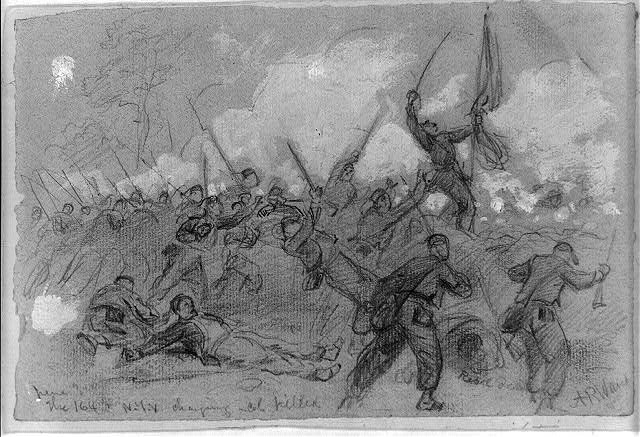
The Colonel led in fire and smoke, his sword would wave and shine,
And still the brave sound of his voice drew on the straggling line.
Then all at once our colors sank, I saw them reel and nod,
The Colonel jumped and took them before they touched the sod.
Another spring, and with a shout the rebs will mind it well,
He stood alone upon their works waved the old flag and fell.
As o’er the surf at Wicklow, I’ve seen the sea gull fly
His voice had sailed above the storm and sounded clear and high.
It seemed, I swear I had not heard the hellish rack and din,
Till then, all sudden on my ears, the thunder crash rushed in.
T’was vain to stand up longer, what could they do but yield,
Our broken remnant melted back across the bloody field.
I stayed to help the Colonel, and crept to where he lay.
A smile came tender o’er his face, but he motioned me away.
I bent to watch his parting lips, and shade him from the light,
“I’m torn to pieces, George,” he said, “go save yourself, good night.”
As tender as my mother’s that smile, came up and shone.
Once more upon his marble face, and the gallant soul was gone.
Three times, the same full moon arose and looked him face to face,
Before the rebels flung a truce above the cursed place.
We laid him near Cold Harbor, but the spot is bleak and bare.
I hate to think how I’m at home, and he still lying there.
I doubt his sleep will not be sweet, nor his loving spirit still,
Till he lies among the friendly dust of yonder slanting hill.
Where from the streets he loved so well might float their daily hum,
And the lake’s low roar upon the beach in quiet nights would come.
Ah, well, the town might plant his tomb with marble words to tell,
How the bravest of her blood was poured when young McMahon fell!
J.N. Larned, ed., Letters, Poems, and Selected Prose Writings of David Gray (Buffalo: The Courier Company, 1888), 277-280.
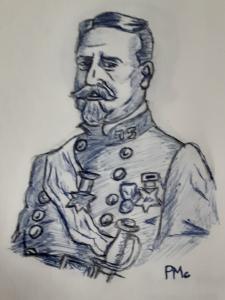
NOTE: The three McMahon brothers, James, Martin and John, all served in the Civil War. James, memorialized here in this poem, was killed at the Battle of Cold Harbor in 1864, commanding the 164th New York. His death was captured in a famous sketch by A.R. Waud. John commanded the 164th New York before him, but died of natural causes in 1863. Martin, a staff officer, became a Brigadier General and survived the war. The sons of an Irish immigrant, all three brothers attended St. John’s College (now Fordham University) in the 1850’s.
Previous Post

December 20, 2012
Monsignor Bernard O'Reilly (1820-1907)
Next Post
December 30, 2012 "St. Vincent De Paul," a Poem, 1862
Browse Our Archives
Select a Category African-American Catholics Alabama Catholics American Catholic History American Catholic women American History Anniversaries Anti-Catholicism Arkansas Catholics Benedictines Bishops Blessed John Henry Newman Book Reviews Books Boston College Brooklyn churches Brothers California Catholics Capuchins Cardinals Carlo Carretto Carmelites Catholic authors Catholic Cemeteries Catholic Historians Catholic History in Less Than 5 Minutes Catholic musicians Catholic Poetry Catholic Press Catholic School Textbook Catholic University of America Catholic Worker Catholics and Music Catholics and Race Catholics in Politics Catholics in the American Revolution Catholics in the Military Catholics in the Movies Catholics in the South Catholics in the West Catholics on Stage Catjolic Women Catolic Poetry Charles de Foucauld Children's Masses Christian Brothers Christmas Church Reform Civil Rights Movement Civil War Colleges and universities Converts D.C. Catholics Deaf Catholics Dominicans. Dorothy Day English Catholics Florida Catholics Fordham University Franciscans French Catholics Georgetown University German Americans Good Shepherd Sisters Hispanic Catholics Historians and Archivists Holy Cross Fathers Holy Name Society Idaho Catholics Illinois Catholics Indian Wars Indiana Catholics Irish Americans Irish Catholicism Italian Americans Italian Catholics Jesuits Josephite Sisters Kentucky Catholics Know-Nothings Laetare Medal Recipients laity Liturgical Movement Maine Catholics Manhattan College Maryland Catholicism Michigan Catholics Middle Ages Minnesota Catholics Missionaries Mississippi Catholics Missouri Catholics Monasteries Montana Catholics Native Americans New England Catholicism New Jersey Catholics New York Catholics North American College Ohio Catholics Oratorians Oregon Catholics Parish Mission Parishes Passionists Pat McNamara's Books Paulists Pennsylvania Catholics Popes Presidents Priests Quotations Religious Orders Rhode Island Catholics Saints Salesians Seminarians Seminaries Sermons Servants of God Siisters of Charity Sisters of Mercy South Carolina Catholics Spanish-American War Sports St. Francis of Assiai St. John Henry Newman Suplicians Tennessee Catholics Texas Catholics The year in review Thomas Merton Throwback Thursday Photograph Trappists Uncategorized University of Notre Dame Video Presentations Vincentians Virginia Catholics Visitation Nuns Washington West Point West Virginia Catholics West Viriginia Catholics Wisconsin Catholicism Women Religious World War II
Select a Month December 2020 June 2020 May 2020 April 2020 March 2020 March 2019 February 2019 January 2019 December 2018 November 2018 November 2014 October 2014 September 2014 August 2014 July 2014 June 2014 May 2014 December 2013 November 2013 October 2013 August 2013 July 2013 June 2013 May 2013 April 2013 March 2013 February 2013 January 2013 December 2012 November 2012 October 2012 September 2012 August 2012 July 2012 June 2012 April 2012 March 2012 December 2011 November 2011 October 2011 September 2011 August 2011 July 2011 June 2011 May 2011 April 2011 March 2011 February 2011 January 2011 December 2010 November 2010 October 2010 January 2010 December 2009 November 2009 October 2009 September 2009 August 2009 July 2009 June 2009 May 2009 April 2009 March 2009 February 2009 January 2009 December 2008
Follow Us!
TAKE THE
Religious Wisdom Quiz
True or False: Joseph's brothers sold him to traders for thirty pieces of silver.
Select your answer to see how you score.
TRUE FALSE
Related posts from McNamara's Blog
A House Divided: The American Bishops and the...
A Great Book for Memorial Day-- Catholics and...
General Sherman Speaks at Notre Dame, 1865
Who’s Buried in Catholic Cemeteries?
TRENDING AT PATHEOS Catholic

Rejecting Doom: Christian Hope And Human Action
Christianity is a religion of hope. We are to have hope and...

It’s What Comes From Within Which Matters
One of the most difficult things for us to understand is why...

Why I Choose the Eucharist Over the Sermon
Choose the Eucharist, Not the Sermon What are we supposed to get...

5 Design Elements Found in Spiritually Rooted Homes
Putting Spirituality Into Home Decor Our homes are more than our living...

Credo: A Story of God Told with the...
About 10 years ago, I began to imagine a personal "Credo" that...

The Anatomy of Divine Revelation in Catholic Thought
The claim that God has made Himself known to human beings is...
view all Catholic blogs
Ad-Free & Subscriber Log-In Subscription Support
- About Us
- 2026 Calendar
- Videos
- Podcasts
- Library of World Religions
- Faith In Media Tracker
- Advertise With Us
- Write for Us
- Privacy Policy
- Terms of Service
- Do Not Sell My Data
- Contact Us
- Radiant Digital
- Manage Newsletter Subscriptions
- Unsubscribe From Notifications
- Sitemap
Copyright 2008-2026, Patheos. All rights reserved.
Subscription Support Ad-Free & Subscriber Log-In
Follow Patheos