
BuddhistCatholicContemplativeEvangelicalGeneral ChristianHinduJewishLatter-day SaintMuslimNew VisionsProgressive Christian
Beliefs
- Buddhist
- Catholic
- Contemplative
- Evangelical
- General Christian
- Hindu
- Jewish
- Latter-day Saint
- More Voices
- Muslim
- New Visions
- Pagan
- Progressive Christian
Topics
- Religion News
- Food and Religion
- Sports and Religion
- Religious Art
- Religious Music and Entertainment
- Religious Events
- History and Religion
- Style and Religion
- Politics and Religion
- Women in Religion
- Recreation Outdoors and Religion
- Business Finance and Religion
- Careers Workplace and Religion
- Education and Religion
- Family Parenting and Religion
- Health Fitness and Religion
- Home and Religion
- Relationships and Religion
- Technology and Religion
- Travel and Religion
Columnists
- Buddhist Columnists
- Business Finance and Religion Columnists
- Careers Workplace and Religion Columnists
- Catholic Columnists
- Contemplative Columnists
- Education and Religion Columnists
- Evangelists Columnists
- Family Parenting and Religion Columnists
- General Christian Columnists
- Health Fitness and Religion Columnists
- Hindu Columnists
- History and Religion Columnists
- Home and Religion Columnists
- Jewish Columnists
- More Voices Columnists
- Latter Day Columnists
- Muslim Columnists
- New Visions Columnists
- Nonreligious Columnists
- Pagan Columnists
- Politics and Religion Columnists
- Progressive Columnists
- Recreation Outdoors and Religion Columnists
- Relationships and Religion Columnists
- Religion News Columnists
- Religious Art Columnists
- Religious Events Columnists
- Religious Music and Entertainment Columnists
- Sports and Religion Columnists
- Style and Religion Columnists
- Technology and Religion Columnists
- Travel and Religion Columnists
- Women in Religion Columnists
Resource Library
- 2026 Calendar
- Library of World Religions
- The 100 Most Holy Places on Earth
- Patheos Answers
- Podcasts
- Videos
- Faith Leaders Database
- Anglican Episcopalian
- Bahai
- Baptist
- Buddhism
- Christianity
- Confucianism
- Eastern Orthodoxy
- Hinduism
- Holiness and Pentecostal
- ISKCON
- Islam
- Judaism
- Lutheran
- Methodist
- The Church of Jesus Christ of Latter-day Saints
- New Age
- Paganism
- Presbytarian and Reformed
- Protestantism
- Religion Behind the Scenes
- Roman Catholic
- Scientology
- Shia Islam
- Sikhism
- Sufism
- Sunni Islam
- Taoism
- Zen
- See all religions
Research Tools
 Ad-Free & Subscriber Log-In Subscription Support
Ad-Free & Subscriber Log-In Subscription Support
Follow Patheos 

- Trending:
- Forgiveness
- |
- Marriage
- |
- Consciousness
- |
- Death Penalty
- |
- Election
- |
- Halloween
 McNamara's Blog
- Home
- Catholic
- The Jesuits in Hell’s Kitchen, 1900
The Jesuits in Hell’s Kitchen, 1900
Last updated on: November 3, 2012 at 5:17 am by Pat McNamara
The Jesuits in Hell’s Kitchen, 1900 2012-11-03T05:17:05-06:00 Pat McNamara
Patheos Explore the world's faith through different perspectives on religion and spirituality! Patheos has the views of the prevalent religions and spiritualities of the world.
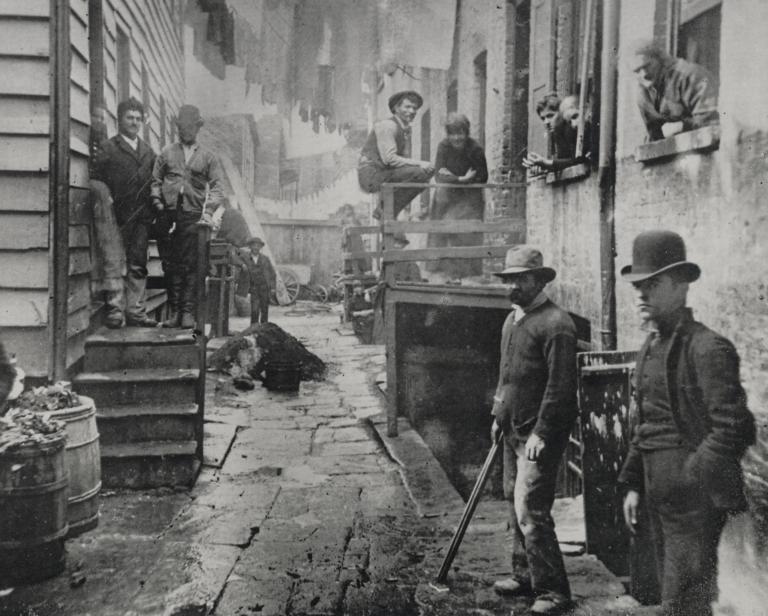 THE WORK OF OUR MISSIONARIES. MISSION IN “HELL’S KITCHEN,” NEW YORK.
A Letter from Father Stanton.
ST. JOHN’S COLLEGE, FORDHAM, October 1899
REV. AND DEAR FATHER, P.X.
You ask me for some account of our work during the mission season, and I am quite ready to comply with your wishes in this respect, but hardly know what bulk to give my roll of manuscript. You haven’t room for all we might offer for the readers of the LETTERS, so I will pass over many conspicuous and important missions with their customary crowds, wonderful conversions and spiritual éclat, and speak only of some missions that were characteristic of certain places, or classes of men, or else abounded in incidents that were more than ordinarily edifying, instructive, or amusing.
Early in the season, while resting on our oars preparatory to moving on to the first mission on the regular schedule for the year, we found we had a free week to devote to a struggling pastor who had just built a church on 54th St., on the West side of New York, and not far from the district that is known in the police records as “Hell’s Kitchen.” This energetic priest is a graduate of Ours; and to show him that the Society does not forget her pupils in the hour of their need, we offered him a complimentary mission for the sake of assembling his people in their new church, and renovating them by means of the exercises. “I have a heavy debt,” he said, “on the new parish, and cannot make you a suitable alms for your work. I believe I’ll have to defer the spiritual feast I had intended for my people till they get to know their new church, and I come to know them. Meanwhile, how can I start the societies that will bring my flock to the sacraments, such as the sodalities, the league, and the holy name society? How strike a telling blow at the drunkenness in this neighborhood, or get at the submerged tenth, or more, around me who don’t come to church at all, but yet have the faith to attend if stirred up to it?” It was hard to see one of our old boys thus handicapped and not pitch in and help him (when especially the Paulist and other congregations, and his brother pastors had contributed so liberally to encourage him) and advance his ministry in a place above all others needing the salutary influence of the Catholic Church.
When we got to the parochial residence we found ourselves facing the door of what had but recently been a Negro tenement house, constructed to hold ten families. Paint, whitewash, and disinfectants had been freely used, and the house was in fair condition for clerical occupancy. The stagnant water in the back yard had been filled with gravel, but effective plumbing and other sources of malaria were quite in evidence. However the apostolic twain, deputed for this mission, were robust enough to rise superior to their environment, although it was a new experience for them to live in the heart of a New York tenement block of the poorer class, and find it hard to get a peep at the sky through clothes lines and fire escapes littered with laundry, rags, and junk of all kinds. Across a narrow court in the rear of the priest’s house loomed up a dingy building whose upper story windows were boarded up, as no one would live on the third floor where a woman had been murdered. Around us the tenants sang, fought and swore whenever they sounded too deeply the depths of the foaming cup; and more than once was the silence of night broken with the cries of: “Help,” “Murder,” of the brawling of a notorious “gang” that infested the parish, and gave the neighborhood the dubious reputation it enjoyed in police court circles.
Usually when the hubbub became intolerable, the pastor rebuked the roysterers from his window, or, when mild means failed to bring about peace and quiet, he went down into the streets or alley ways and there by threats, expostulations and the menace of his imposing presence secured a truce from disorder and riot. A better reign of law, order, and sobriety soon began to be apparent to all, especially to the policemen, who admitted that the pastor was doing the work of a squad of officers. We found the people of the parish quick to respond to our efforts, and indeed the most of them were as good as can be found anywhere in the great metropolis. But the bad element of St. Ambrose’s were conspicuous for the vice of drunkenness. Turbulent in their cups, blasphemous in their rage over check or reproof at home, neglectful of their children, and a source of misery and scandal to all, these unhappy souls kept their respect for the priest, and doubtless would have died to defend him, or the faith that yet possessed their hearts.
Everything went on smoothly the first week—the women’s week—despite the hurried call we got one evening at supper to save a woman from the blows of an angry husband. The man was to be pitied, and not the woman his wife. She was intoxicated, as was her custom, and we returned to our abode in disgust, over our failure to keep her sober for even one week. In this, and other parts of New York, there is usually a saloon on each of the four corners made by the streets that at right angles cross the long avenues. In and out of these well lit bar-rooms move too many of the poor, the weary, the homeless, or the vicious of the big city. For five or ten cents they can procure the Horatian “ex lex et bene potus” state, which they fancy brings recreation to their tired bodies, ore releases their spirit from the remembrance of the week’s toil, or perhaps frees them from a time from their sense of hunger and misery. But much of the dissipation comes from the social glass, from the drink pour rire. Pails and half kegs of frothy decoctions are brought home, or into stables, or, as we found to our sorrow, into the junk shops and wharf houses not far from us.
The so-called junk house gangs had been the object of our hopes and fears all through the week. If we could but get them, or at least the Catholics among them, into the church to hear even one sermon, we might at least remove the great reproach from the neighborhood, and surprise the parish over some unlooked for conversions. Eleven o’clock on Saturday night found us a trifle discouraged. Our yet unshriven crowd were drinking and singing across the street, and were in a condition that left little hope of their being able to be at any of the morning Masses to hear the announcements for their mission. Half past eleven P.M. and the situation was even more deplorable. One row had just been quelled, and another disturbance was being raised just in front of the parochial residence. A soldier home on a short furlough, had excited the drunken rage of the aforesaid junk-shop band, by his show of superior walking as he passed down the street, conscious of beiong somebody. With jibes and jeers the gang surrounded him. He protested against this insult, appealed to the stars and stripes; demanded that his uniform be respected, if not himself. There was a rush and scuffle and whatever was left of the brave soldier took speedy flight into the darkness of the night. Fifteen minutes later two of the street worthies began to belabor their old father three or four floors doors or so below us. At last a policeman approached on the scene, and proceeded to drag one of the drunken sons to the station house. A hundred yards he went, pulling along his prisoner, when the ever loyal gang made a charge on the officer to rescue their comrade. The arm of the blue coat swung aloft the deadly night stick. Down it came with a sound that was sickening. That’s one skull gone, and a sick call for a certainty, thought I, hurrying out of bed and getting ready to run to the street. Another and another blow of the locust club, and the whole block was filled with cries of women, and curses of men. “Don’t hit him, don’t him,” shrieked a female voice; but the tattoo was kept up. However, I found out when I got a better view of the fight, that the officer in his humanity, had been beating the curb stine for help rather than fracturing the drink-addled pates of his assailants. The pastor was ahead of us, and was rushing to the storm centre, when one of the mob seized an empty iron ash barrel, and hurling it at the doughty policeman, knocked him insensible before us. The prisoner was freed, and in the twinkling of an eye, everybody rushed away and disappeared on the avenues or behind their own doors. It looked like a murder, and none of them cared to be accused of having a hand in it. Silence, a strange silence, just as a sudden death casts over a place, filled the entire street. The gang had been sobered at the sight of the officer falling in his blood to the ground. He was, however, not fatally injured: the numbers on his helmet and its leather band had saved him from the full force of blow inflicted. We did our best for him and returned to consider the ways and means of reforming such ungodly characters as we had just beheld in full Saturday night revel.
I managed to get two of them into the priest’s house on Sunday morning. They were still under the influence of drink, but listened to all I had to say to them. The events of the past night gave me a strong text against them and they freely admitted their need of a mission, and promised to bring the gang to the opening services of the men’s week. “Father,” they said, “some of the boys have been run in, and plenty of the rest isn’t Catholics at all, and we ain’t much ourselves.” At all the Masses we denounced the scandal and disturbance of Saturday night; and threatened to bring the ringleaders and their followers into the courts unless they repented of their ways. “Come to the mission and come to live as men and Christians. Come to receive God’s mercy and strength. The Church is your mother and you need all her helps to live and die well. She is your best friend; don’t afflict her by drunken brawling and blasphemy within a stone’s throw of her sacred altars. We know you and God wants you.” Sunday night saw a pretty well filled church, but not all our junk shop protégés were on hand. So the pastor set out with me to carry out the gospel advice—“Compelle intrare.” Aproaching the street corner we gathered in our first trio of backsliders, and marched them along. Next we mustered into our ranks a half intoxicated boy of sixteen years, and soon after moved down the crowded avenue, getting a half reluctant, shamefaced recruit here and there, until we counted some twelve or fourteen and wheeled them into the church to fill up the few vacant rear seats. This was the result of a trip around only one block, but it was enough to show that we meant business when we said we would fill the church with all the men of the parish. Next day we went to the captain of our precinct and pointed out the necessity of shortening the “beat,” or patrolling ground, of the two policemen destined for service on 54th and 55th St. West. This was to insure more quiet around the parochial residence and the church, and our request was acceded to. For the balance of the week, we enjoyed, to a more or less degree, the comforts of a civilized neighborhood. The spiritual exercises were doing their work, and on the last Saturday night of the mission, hardly a sound or disturbance of any kind marred our night’s repose. Four officers in disguise standing at the corners of 54th St. and 10th Avenue, from 11:00 P.M. until an hour after midnight, also contributed not a little to effect this unusual quiescence in our previously uproarious district. These men, however, frankly admitted that the mission, more than they, was responsible for the long desired peace and security that reigned in the locality that night. We thanked God for this consolation, and regarded our success over the gang as a sort of miracle of his reclaiming grace.
At the mission-closing 250 men gave their names as members of the newly formed Holy Name Society, and conspicuous among the throng renewing their baptismal promises were seen many of the notorious junk-shop gang. We took farewell of these worthies now, hoping to find some day that our mission produced a lasting change in their lives and taught them to safeguard their souls against the temptations of a great city.
Frater in Christo,
WM. J. STANTON, S.J.
Previous Post

October 27, 2012
Catholic Poetry
Next Post
November 27, 2012 The Sisters of the Sorrowful Mother
Browse Our Archives
Select a Category African-American Catholics Alabama Catholics American Catholic History American Catholic women American History Anniversaries Anti-Catholicism Arkansas Catholics Benedictines Bishops Blessed John Henry Newman Book Reviews Books Boston College Brooklyn churches Brothers California Catholics Capuchins Cardinals Carlo Carretto Carmelites Catholic authors Catholic Cemeteries Catholic Historians Catholic History in Less Than 5 Minutes Catholic musicians Catholic Poetry Catholic Press Catholic School Textbook Catholic University of America Catholic Worker Catholics and Music Catholics and Race Catholics in Politics Catholics in the American Revolution Catholics in the Military Catholics in the Movies Catholics in the South Catholics in the West Catholics on Stage Catjolic Women Catolic Poetry Charles de Foucauld Children's Masses Christian Brothers Christmas Church Reform Civil Rights Movement Civil War Colleges and universities Converts D.C. Catholics Deaf Catholics Dominicans. Dorothy Day English Catholics Florida Catholics Fordham University Franciscans French Catholics Georgetown University German Americans Good Shepherd Sisters Hispanic Catholics Historians and Archivists Holy Cross Fathers Holy Name Society Idaho Catholics Illinois Catholics Indian Wars Indiana Catholics Irish Americans Irish Catholicism Italian Americans Italian Catholics Jesuits Josephite Sisters Kentucky Catholics Know-Nothings Laetare Medal Recipients laity Liturgical Movement Maine Catholics Manhattan College Maryland Catholicism Michigan Catholics Middle Ages Minnesota Catholics Missionaries Mississippi Catholics Missouri Catholics Monasteries Montana Catholics Native Americans New England Catholicism New Jersey Catholics New York Catholics North American College Ohio Catholics Oratorians Oregon Catholics Parish Mission Parishes Passionists Pat McNamara's Books Paulists Pennsylvania Catholics Popes Presidents Priests Quotations Religious Orders Rhode Island Catholics Saints Salesians Seminarians Seminaries Sermons Servants of God Siisters of Charity Sisters of Mercy South Carolina Catholics Spanish-American War Sports St. Francis of Assiai St. John Henry Newman Suplicians Tennessee Catholics Texas Catholics The year in review Thomas Merton Throwback Thursday Photograph Trappists Uncategorized University of Notre Dame Video Presentations Vincentians Virginia Catholics Visitation Nuns Washington West Point West Virginia Catholics West Viriginia Catholics Wisconsin Catholicism Women Religious World War II
Select a Month December 2020 June 2020 May 2020 April 2020 March 2020 March 2019 February 2019 January 2019 December 2018 November 2018 November 2014 October 2014 September 2014 August 2014 July 2014 June 2014 May 2014 December 2013 November 2013 October 2013 August 2013 July 2013 June 2013 May 2013 April 2013 March 2013 February 2013 January 2013 December 2012 November 2012 October 2012 September 2012 August 2012 July 2012 June 2012 April 2012 March 2012 December 2011 November 2011 October 2011 September 2011 August 2011 July 2011 June 2011 May 2011 April 2011 March 2011 February 2011 January 2011 December 2010 November 2010 October 2010 January 2010 December 2009 November 2009 October 2009 September 2009 August 2009 July 2009 June 2009 May 2009 April 2009 March 2009 February 2009 January 2009 December 2008
Follow Us!
TAKE THE
Religious Wisdom Quiz
What does the name "Jesus" mean?
Select your answer to see how you score.
The Lord Saves Prince of Peace Son of Man Chosen One
Related posts from McNamara's Blog
Saint Aloysius Gonzaga: A Reflection for Troubled Times
“I No Longer Call You Slaves”: Race, Religion,...

St. Joseph‘s School for the Deaf Celebrates 150...
Who’s It Named For? Archbishop Thomas E. Molloy...
TRENDING AT PATHEOS Catholic

The Parable Of The Sower And The Word...
One of Christ’s most famous parables is that of the sower who...

Rejecting Doom: Christian Hope And Human Action
Christianity is a religion of hope. We are to have hope and...

Why I Choose the Eucharist Over the Sermon
Choose the Eucharist, Not the Sermon What are we supposed to get...

5 Design Elements Found in Spiritually Rooted Homes
Putting Spirituality Into Home Decor Our homes are more than our living...

Credo: A Story of God Told with the...
About 10 years ago, I began to imagine a personal "Credo" that...

The Anatomy of Divine Revelation in Catholic Thought
The claim that God has made Himself known to human beings is...
view all Catholic blogs
Ad-Free & Subscriber Log-In Subscription Support
- About Us
- 2026 Calendar
- Videos
- Podcasts
- Library of World Religions
- Faith In Media Tracker
- Advertise With Us
- Write for Us
- Privacy Policy
- Terms of Service
- Do Not Sell My Data
- Contact Us
- Radiant Digital
- Manage Newsletter Subscriptions
- Unsubscribe From Notifications
- Sitemap
Copyright 2008-2026, Patheos. All rights reserved.
Subscription Support Ad-Free & Subscriber Log-In
Follow Patheos