
BuddhistCatholicContemplativeEvangelicalGeneral ChristianHinduJewishLatter-day SaintMuslimNew VisionsProgressive Christian
Beliefs
- Buddhist
- Catholic
- Contemplative
- Evangelical
- General Christian
- Hindu
- Jewish
- Latter-day Saint
- More Voices
- Muslim
- New Visions
- Pagan
- Progressive Christian
Topics
- Religion News
- Food and Religion
- Sports and Religion
- Religious Art
- Religious Music and Entertainment
- Religious Events
- History and Religion
- Style and Religion
- Politics and Religion
- Women in Religion
- Recreation Outdoors and Religion
- Business Finance and Religion
- Careers Workplace and Religion
- Education and Religion
- Family Parenting and Religion
- Health Fitness and Religion
- Home and Religion
- Relationships and Religion
- Technology and Religion
- Travel and Religion
Columnists
- Buddhist Columnists
- Business Finance and Religion Columnists
- Careers Workplace and Religion Columnists
- Catholic Columnists
- Contemplative Columnists
- Education and Religion Columnists
- Evangelists Columnists
- Family Parenting and Religion Columnists
- General Christian Columnists
- Health Fitness and Religion Columnists
- Hindu Columnists
- History and Religion Columnists
- Home and Religion Columnists
- Jewish Columnists
- More Voices Columnists
- Latter Day Columnists
- Muslim Columnists
- New Visions Columnists
- Nonreligious Columnists
- Pagan Columnists
- Politics and Religion Columnists
- Progressive Columnists
- Recreation Outdoors and Religion Columnists
- Relationships and Religion Columnists
- Religion News Columnists
- Religious Art Columnists
- Religious Events Columnists
- Religious Music and Entertainment Columnists
- Sports and Religion Columnists
- Style and Religion Columnists
- Technology and Religion Columnists
- Travel and Religion Columnists
- Women in Religion Columnists
Resource Library
- 2026 Calendar
- Library of World Religions
- The 100 Most Holy Places on Earth
- Patheos Answers
- Podcasts
- Videos
- Faith Leaders Database
- Anglican Episcopalian
- Bahai
- Baptist
- Buddhism
- Christianity
- Confucianism
- Eastern Orthodoxy
- Hinduism
- Holiness and Pentecostal
- ISKCON
- Islam
- Judaism
- Lutheran
- Methodist
- The Church of Jesus Christ of Latter-day Saints
- New Age
- Paganism
- Presbytarian and Reformed
- Protestantism
- Religion Behind the Scenes
- Roman Catholic
- Scientology
- Shia Islam
- Sikhism
- Sufism
- Sunni Islam
- Taoism
- Zen
- See all religions
Research Tools
 Ad-Free & Subscriber Log-In Subscription Support
Ad-Free & Subscriber Log-In Subscription Support
Follow Patheos 

- Trending:
- Forgiveness
- |
- Marriage
- |
- Consciousness
- |
- Death Penalty
- |
- Election
- |
- Halloween
 McNamara's Blog
- Home
- Catholic
- The Church of the Immaculate Conception, East Fourteenth Street (1855)
The Church of the Immaculate Conception, East Fourteenth Street (1855)
Last updated on: December 8, 2011 at 8:04 am by Pat McNamara
The Church of the Immaculate Conception, East Fourteenth Street (1855) 2011-12-08T08:04:00-07:00 Pat McNamara
Patheos Explore the world's faith through different perspectives on religion and spirituality! Patheos has the views of the prevalent religions and spiritualities of the world.
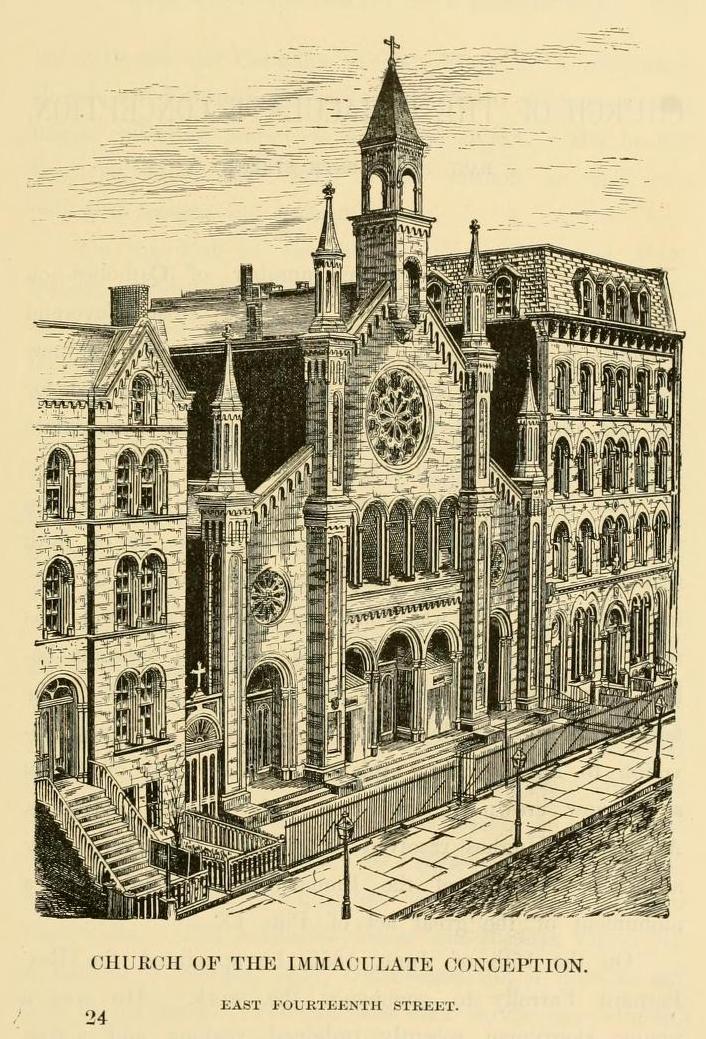
CHURCH OF THE IMMACULATE CONCEPTION.
EAST FOURTEENTH STREET.
IN view of the increasing number of Catholics on the east side of the city, the Most Reverend Archbishop Hughes, in 1853, secured lots for a new church, which were, however, subsequently exchanged for the site now occupied by the Church of the Immaculate Conception. The late Sovereign Pontiff, the great Pius IX., on the 8th of December, 1854, declared it to be of faith that the Blessed Virgin Mary was never subject to original sin and that she was conceived without sin, and was thus ever immaculate.
Such had been the constant belief in the Church, though not distinctly defined. The faithful throughout the world showed their love and devotion to Mary, hailing this act of the Vicar of Christ as a new crown of glory to their beloved patroness. Archbishop Hughes resolved to erect on the site already acquired a church of the Immaculate Conception as a monument of the great act of Pius IX.
On the 15th of June, 1855, he appointed the Rev. Bernard Farrelly to commence the work. He was a young clergyman recently ordained, zealous and active. He collected the Catholics of his district in a temporary church on Fifteenth Street, on the 15th of August, and .began collecting money to erect the church. His health, however, failed, and early in the autumn he was compelled to resign the undertaking.
On the 20th of October, the Most Reverend Archbishop confided the undertaking to the Rev. John Ryan, an active and zealous priest who had already organized the first church at Yonkers, and erected the Church of St. Francis Xavier in New York City. He undertook the task of building up a church in the parochial district assigned to him, with all the zeal he had displayed in other fields. He soon enlarged the temporary chapel, in order to accommodate the faithful and give all the opportunity of hearing mass.
eanwhile the corner-stone of the new church was laid with appropriate ceremonies by the Very Rev. William Starrs, on the 8th of December, 1855, the Archbishop being absent. It was a time of financial distress and panic. Thousands were unemployed, and it was difficult to undertake and carry on the most essential work. The Rev. Mr. Ryan went on collecting for two years, pushing on the work of his church meanwhile. The ladies, to honor the Blessed Virgin by a fair, in November, 1857, contributed not a little to aid him in his work.The fair was held in the new church, and was visited by the Most Reverend Archbishop.
He ascended the platform where the altar was soon to be erected, and addressed the large audience gathered there to hear him. He expressed his delight at their number and at the beauty of the church:
It is a proof, of your faith and your zeal to promote so noble a work. When the dogma of which the church is to be a memorial and a monument was proclaimed as an article of faith, I was but four or five feet distant from the Holy Father. Just at that moment I resolved on my return to New York to erect a church to commemorate the event. I knew that the Catholics of this city would enable me to carry out that resolution, but I desire especially that the ladies of New York and the children, the daughters of Mary shall have the credit and honor of this church, raised as a monument of the Immaculate Conception. I feel happy that I have not been deceived or disappointed. How consoling to those who have contributed to this church, as well as to those who conduct and patronize this fair, to reflect that when they and all of us have passed away, and are consigned to our last resting-place, to make way for another generation, many a heart will come before the altar to be here erected, burdened with a load of misery, to send petitions from this shrine of grace and mercy that many such a heart will depart from here lightened of its burden, full of joy, of peace, and happiness.
The fair met with great success, so that the pastor was enabled to complete his church. It was dedicated on May 16th, 1858. The Most Reverend Archbishop, interested in a work which he had suggested and encouraged, came in person to bless the work, accompanied by the Rt. Rev. John Loughlin, D.D., Bishop of Brooklyn, and the Rt. Rev. John Barry, D.D., Bishop of Savannah. Besides the pastor of the new church and his assistant, the Rev. Eugene Maguire, there were present clergymen from nearly all the city churches.
The ceremony of dedication took place at eight o’clock, with the usual imposing effect, and the edifice of stone and brick was no longer a common house, but a temple sacredly set apart for the service of the Living God under the invocation of the Blessed Virgin Mary, conceived without sin. The awful sacrifice of the mass was soon offered with solemn pontifical rite at the newly hallowed altar, by the Right Reverend Bishop Loughlin of Brooklyn, with deacon and subdeacon.
His Grace Archbishop Hughes then delivered a sermon, taking as his text the words of the Psalmist: “How lovely are thy tabernacles, O Lord of hosts. My soul longeth and fainteth for the courts of the Lord. My heart and my flesh have rejoiced in the living God. For the sparrow hath found herself a house: and the turtle a nest for herself, where she may lay her young ones. Thy altars, Lord of hosts: my king, and my God.” (Psalm Ixiii. 2-4.) After dwelling on the nature of the consecration and dedication of churches, he said:
This church has received not merely the ordinary blessing-. There is a most important consideration to be added to the sacred ceremony. It is the first church on earth which has been set apart to the honor of the dogmatical doctrine of the immaculate nature of the mother of Christ. The church is doubtless dedicated, as all others are, to the Supreme Being, but it is placed under the special care of the Blessed Virgin as Mary Immaculate. It is the first sacred consecration to the truth of the Immaculate Conception as to the declaration that the Holy Virgin was never sullied by any taint of original sin.” He then explained the doctrine, so generally misunderstood; went over the ceremony of dedication, and showed how consonant it was with Scripture and the early records of Christendom. “For so unworthy a minister of Christ as myself,” he continued, “I think it sufficient happiness that I have lived to see this last great evidence of the mercy of God to man pronounced as a doctrine by the Head of the Church on earth. I had the happiness to be present at the time that the Immaculate Conception was so declared, and I could not help thinking even then how well it would be for the Catholics of New York to consecrate a temple to God in honor of the event as an event for which every pious Christian can never cease to bless God.”
The zealous founder of the church remained its pastor till his death, March 22nd, 1861. He had been assisted during his pastorship by the Rev. Messrs. McEvoy, Lutz, Maguire, and Oliver O’Hara. The Rev. Dr. William Plowden Morrogh was then appointed, and his pastorship extended till his death, in Italy, October 23rd, 1875. During his long incumbency he was assisted by the Rev. Messrs. C. A. Farrell, P. J. Maguire, John J. Hughes, George C. Murphy, and Patrick Malone.
Dr. Morrogh was a priest of learning and ability, who went from St. Joseph’s Seminary to the Propaganda, where he won his doctor’s cap. On his return, he was President of St. Joseph’s Theological Seminary and pastor of the Church of Our Lady of Mercy. He erected, early in 1864, a fine school-house adjoining the church, and finished it thoroughly. Finding the church too small, he began, about 1871, to extend it to Fifteenth Street. Notwithstanding his failing health, he was able to complete this work, making it one of the finest churches in the city.
The altar is of marble, surmounted by four stained chancel windows, on which are representations of the Saviour, the Blessed Virgin, St. Joseph, and St. Ann. Under these windows are statues of the Blessed Virgin and child, St. Catharine, St. Teresa, St. Peter, and St. Paul. Handsome altars, dedicated to St. Joseph and the Virgin, stand at either side of the grand altar, while figures of St. Patrick, St. Vincent de Paul, St. Andrew, and St. Bridget, decorate the stained windows at either side of the sanctuary.
The assistants during the term of Dr. Morrogh were the Rev. Richard Brennan, Rev. Christopher A. Farrell, Rev. William Hussey, Rev. F. St. John, Rev. J. Profillat. Rev. P. McGuire, Rev. John Hughes, Rev. George C. Murphy, Rev. P. Malone, and Rev. John S. Colton. The church has, since 1875, had as parish priest the Rev. John Edwards, who is assisted in his arduous duties by the Rev. Patrick Malone, the Rev. John Doyle, the Rev. Denis P. O’Flynn, and the Rev. Edward Slattery.
The parish schools, organized soon after the erection of the church, have been fostered with zealous care. Boys number 926, under the direction of seventeen lay teachers, while the girls, guided by the Sisters, number 1,136. The Catholic population of the parish, by actual count in 1878, was 16,940. There are many flourishing societies connected with the church and the Ladies’ Sodality of the Blessed Virgin, the Sodalities of the Holy Infancy, of the Holy Angels, of the Holy Name; the Living Rosary, Sodality of the Sacred Heart of Jesus, Young Men’s Immaculate Conception Sodality, St. Aloysius Sodality, the Immaculate Conception Mutual Benefit Temperance Society, and Conference of the Society of St. Vincent de Paul.
John Gilmary Shea, The Catholic Churches of New York City, With Sketches of Their History and the Lives of Their Pastors (New York: L.G. Goudling, 1878), 370-376.
Previous Post

December 7, 2011
Marchioness Ellen McLaughlin (1829-1915), Brooklyn, New York
Next Post
December 9, 2011 Father Alfred Young, C.S.P. (1831-1900): Church Musician
Browse Our Archives
Select a Category African-American Catholics Alabama Catholics American Catholic History American Catholic women American History Anniversaries Anti-Catholicism Arkansas Catholics Benedictines Bishops Blessed John Henry Newman Book Reviews Books Boston College Brooklyn churches Brothers California Catholics Capuchins Cardinals Carlo Carretto Carmelites Catholic authors Catholic Cemeteries Catholic Historians Catholic History in Less Than 5 Minutes Catholic musicians Catholic Poetry Catholic Press Catholic School Textbook Catholic University of America Catholic Worker Catholics and Music Catholics and Race Catholics in Politics Catholics in the American Revolution Catholics in the Military Catholics in the Movies Catholics in the South Catholics in the West Catholics on Stage Catjolic Women Catolic Poetry Charles de Foucauld Children's Masses Christian Brothers Christmas Church Reform Civil Rights Movement Civil War Colleges and universities Converts D.C. Catholics Deaf Catholics Dominicans. Dorothy Day English Catholics Florida Catholics Fordham University Franciscans French Catholics Georgetown University German Americans Good Shepherd Sisters Hispanic Catholics Historians and Archivists Holy Cross Fathers Holy Name Society Idaho Catholics Illinois Catholics Indian Wars Indiana Catholics Irish Americans Irish Catholicism Italian Americans Italian Catholics Jesuits Josephite Sisters Kentucky Catholics Know-Nothings Laetare Medal Recipients laity Liturgical Movement Maine Catholics Manhattan College Maryland Catholicism Michigan Catholics Middle Ages Minnesota Catholics Missionaries Mississippi Catholics Missouri Catholics Monasteries Montana Catholics Native Americans New England Catholicism New Jersey Catholics New York Catholics North American College Ohio Catholics Oratorians Oregon Catholics Parish Mission Parishes Passionists Pat McNamara's Books Paulists Pennsylvania Catholics Popes Presidents Priests Quotations Religious Orders Rhode Island Catholics Saints Salesians Seminarians Seminaries Sermons Servants of God Siisters of Charity Sisters of Mercy South Carolina Catholics Spanish-American War Sports St. Francis of Assiai St. John Henry Newman Suplicians Tennessee Catholics Texas Catholics The year in review Thomas Merton Throwback Thursday Photograph Trappists Uncategorized University of Notre Dame Video Presentations Vincentians Virginia Catholics Visitation Nuns Washington West Point West Virginia Catholics West Viriginia Catholics Wisconsin Catholicism Women Religious World War II
Select a Month December 2020 June 2020 May 2020 April 2020 March 2020 March 2019 February 2019 January 2019 December 2018 November 2018 November 2014 October 2014 September 2014 August 2014 July 2014 June 2014 May 2014 December 2013 November 2013 October 2013 August 2013 July 2013 June 2013 May 2013 April 2013 March 2013 February 2013 January 2013 December 2012 November 2012 October 2012 September 2012 August 2012 July 2012 June 2012 April 2012 March 2012 December 2011 November 2011 October 2011 September 2011 August 2011 July 2011 June 2011 May 2011 April 2011 March 2011 February 2011 January 2011 December 2010 November 2010 October 2010 January 2010 December 2009 November 2009 October 2009 September 2009 August 2009 July 2009 June 2009 May 2009 April 2009 March 2009 February 2009 January 2009 December 2008
Follow Us!
TAKE THE
Religious Wisdom Quiz
What does the Greek word 'Christos' mean?
Select your answer to see how you score.
Savior Anointed One Redeemer Lord
Related posts from McNamara's Blog

St. John Henry Newman and the “Special Charm...

American Catholics and Race in 2020: A Church...

“It’s About Time They Got Here”: Catholics and the...

The Struggle for an African American Priesthood
TRENDING AT PATHEOS Catholic

Creation, Preservation, and Teleology in Catholic Theology
As I write this, it is very early Monday morning. Like millions...

The Parable Of The Sower And The Word...
One of Christ’s most famous parables is that of the sower who...

Rejecting Doom: Christian Hope And Human Action
Christianity is a religion of hope. We are to have hope and...

Why I Choose the Eucharist Over the Sermon
Choose the Eucharist, Not the Sermon What are we supposed to get...

5 Design Elements Found in Spiritually Rooted Homes
Putting Spirituality Into Home Decor Our homes are more than our living...

Credo: A Story of God Told with the...
About 10 years ago, I began to imagine a personal "Credo" that...
view all Catholic blogs
Ad-Free & Subscriber Log-In Subscription Support
- About Us
- 2026 Calendar
- Videos
- Podcasts
- Library of World Religions
- Faith In Media Tracker
- Advertise With Us
- Write for Us
- Privacy Policy
- Terms of Service
- Do Not Sell My Data
- Contact Us
- Radiant Digital
- Manage Newsletter Subscriptions
- Unsubscribe From Notifications
- Sitemap
Copyright 2008-2026, Patheos. All rights reserved.
Subscription Support Ad-Free & Subscriber Log-In
Follow Patheos