
BuddhistCatholicContemplativeEvangelicalGeneral ChristianHinduJewishLatter-day SaintMuslimNew VisionsProgressive Christian
Beliefs
- Buddhist
- Catholic
- Contemplative
- Evangelical
- General Christian
- Hindu
- Jewish
- Latter-day Saint
- More Voices
- Muslim
- New Visions
- Pagan
- Progressive Christian
Topics
- Religion News
- Food and Religion
- Sports and Religion
- Religious Art
- Religious Music and Entertainment
- Religious Events
- History and Religion
- Style and Religion
- Politics and Religion
- Women in Religion
- Recreation Outdoors and Religion
- Business Finance and Religion
- Careers Workplace and Religion
- Education and Religion
- Family Parenting and Religion
- Health Fitness and Religion
- Home and Religion
- Relationships and Religion
- Technology and Religion
- Travel and Religion
Columnists
- Buddhist Columnists
- Business Finance and Religion Columnists
- Careers Workplace and Religion Columnists
- Catholic Columnists
- Contemplative Columnists
- Education and Religion Columnists
- Evangelists Columnists
- Family Parenting and Religion Columnists
- General Christian Columnists
- Health Fitness and Religion Columnists
- Hindu Columnists
- History and Religion Columnists
- Home and Religion Columnists
- Jewish Columnists
- More Voices Columnists
- Latter Day Columnists
- Muslim Columnists
- New Visions Columnists
- Nonreligious Columnists
- Pagan Columnists
- Politics and Religion Columnists
- Progressive Columnists
- Recreation Outdoors and Religion Columnists
- Relationships and Religion Columnists
- Religion News Columnists
- Religious Art Columnists
- Religious Events Columnists
- Religious Music and Entertainment Columnists
- Sports and Religion Columnists
- Style and Religion Columnists
- Technology and Religion Columnists
- Travel and Religion Columnists
- Women in Religion Columnists
Resource Library
- 2026 Calendar
- Library of World Religions
- The 100 Most Holy Places on Earth
- Patheos Answers
- Podcasts
- Videos
- Faith Leaders Database
- Anglican Episcopalian
- Bahai
- Baptist
- Buddhism
- Christianity
- Confucianism
- Eastern Orthodoxy
- Hinduism
- Holiness and Pentecostal
- ISKCON
- Islam
- Judaism
- Lutheran
- Methodist
- The Church of Jesus Christ of Latter-day Saints
- New Age
- Paganism
- Presbytarian and Reformed
- Protestantism
- Religion Behind the Scenes
- Roman Catholic
- Scientology
- Shia Islam
- Sikhism
- Sufism
- Sunni Islam
- Taoism
- Zen
- See all religions
Research Tools
 Ad-Free & Subscriber Log-In Subscription Support
Ad-Free & Subscriber Log-In Subscription Support
Follow Patheos 

- Trending:
- Forgiveness
- |
- Marriage
- |
- Consciousness
- |
- Death Penalty
- |
- Election
- |
- Halloween
 McNamara's Blog
- Home
- Catholic
- “Angel of the Battlefield”: Sister Anthony O’Connell, S.C. (1811-1897)
“Angel of the Battlefield”: Sister Anthony O’Connell, S.C. (1811-1897)
Last updated on: May 24, 2011 at 5:43 am by Pat McNamara
“Angel of the Battlefield”: Sister Anthony O’Connell, S.C. (1811-1897) 2011-05-24T05:43:00-06:00 Pat McNamara
Patheos Explore the world's faith through different perspectives on religion and spirituality! Patheos has the views of the prevalent religions and spiritualities of the world.
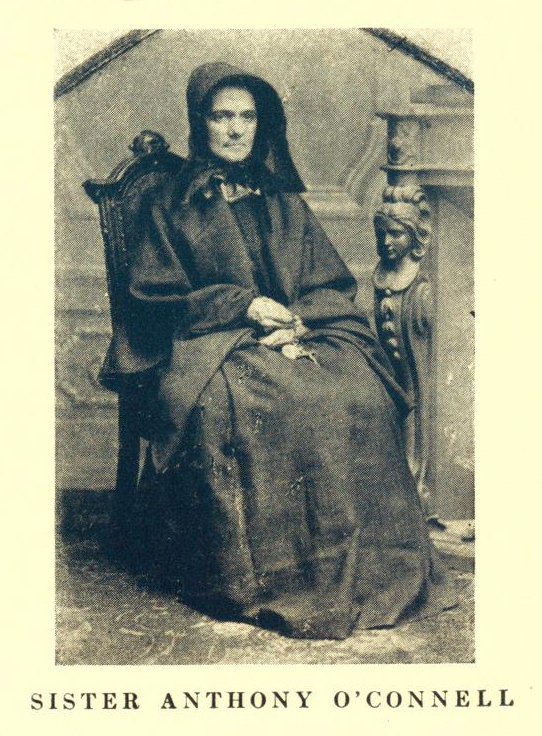
On December 8, 1897, the Feast of the Immaculate Conception, Sister Anthony O’Connell, died in her eighty-sixth year, having worn the religious habit of a Sister of Charity for sixty-three years. Synchronizing her departure with the soft and sweet harmony of the of the convent bell announcing the evening Angelus, the “Angel of the Battlefield” answered the call of the God of Battles. This happy co-incidence brought consolation to the Irish hearts about her, as there is an Irish legend which has it that those souls which depart to the ringing of the Angelus go straight to heaven. Her death brought forth expressions of regret from many military organizations, which took formal action in manifestation of their regard for this faithful nun. The William H. Lytle Post, Grand Army of the Republic, passed the following resolution of respect:
Whereas, the venerable Sister Anthony departed from this life on Wednesday afternoon, after a life of usefulness in taking care of the sick and boundless charity; and whereas, she was one of the most active nurses in the war, doing many kind, silent acts; and whereas she will be buried from St. Peter’s Cathedral Saturday, at 9 o’clock; therefore be it resolved, that in order to show our gratitude and affection for her and appreciation of her services as an Army nurse, we attend her funeral and invite all other posts to participate with us.
“In the Cathedral,” according to the Cincinnati Commercial, “the temple of the religion she loved and worked and prayed for, two veterans of the Grand Army of the Republic, bearing aloft flags of their country draped in somber black, stood sentinels at the bier. There was the procession of prelates and priests and companies of Sisters of Charity instead of the rank and file of soldiery; there were the embroidered robes and black habits in place of the Blue and the Gray; there were candles instead of camp fires; there was the chime of bells and the chanting of the choir instead of the call of trumpets and the beat of drums; there was the organ pealing instead of the musketry roll; there was the fragrance of incense instead of the smoke of the battlefield; there was the bier and the sable pall instead of the hospital stretcher; there were the whispered prayers of two thousand people on bended knees for the repose of the soul of Sister Anthony. The morning light streamed softly and dimly through the stained-glass windows, and electric lights took the place of the stars in heaven’s blue canopy, but it was the bivouac of the dead. The ministering angel to soldiers, the comfort of widows and orphans, come to do her honor, were soldiers, orphans, and widows; those who had been poor and sick and unfortunate, her greatest care in life.”
Ellen Ryan Jolly, Nuns of the Battlefield (Providence: The Providence Visitor Press, 1927), 53-54.
NOTE
Sister Anthony was a native of Limerick, Ireland, who, coming to America as a child, entered the Community at Emmitsburg, and, after settling in Cincinnati in 1837, was successively in charge of the orphans at St. Peter’s Orphan Asylum, St. Aloysius Asylum (1853), and St. Joseph Orphanage (1854). During the Civil War Sister Anthony played a part like that of Florence Nightingale in the Crimea. She sprang into action at once, not only in the wards of St. John’s, which was soon filled to overflowing with wounded soldiers, but on the battlefield as well.
“To the soldiers of both armies,” says Juettner, “her name had a magic ring of wonderful power. To them she was the incarnation of angelic goodness that seemed like a visitation from realms celestial. On the battlefield of Shiloh, amid a veritable ocean of blood, she performed the most revolting duties to these poor soldiers. Neither the cries of anguish of the dying nor the unbearable stench from dead bodies could check her in her ministrations. To the young soldier that lay, fatally wounded, upon that bloody ground and was thinking of a lone mother at home, Sister Anthony brought the comfort and peace of a mother’s care. In such moments, it was the instinct of the woman in her that enabled her to soothe the aching heart while relieving the pangs of physical suffering.
Then again she stood bravely and attentively at the side of George Blackman, helping him in his operative work on the deck of one of the floating hospitals of the Ohio River. Limbs were quickly amputated and consigned to a watery grave. There seemed to be no limit to Blackman’s endurance. But no matter how hard the work or how trying the scene, Sister Anthony was always at her post, her only regret being that she could not do more for her fellow-men, for her country and for her God. It was this kind of a record that has perpetuated her name beside those of the most famous commanders.”
Otto Juettner, Daniel Drake (Cincinnati, 1909), 418-419.
Previous Post

May 24, 2011
This Week's Column at Patheos
Next Post
May 25, 2011 Father Walter Elliott, C.S.P. (1842-1928): Union Army Veteran
Browse Our Archives
Select a Category African-American Catholics Alabama Catholics American Catholic History American Catholic women American History Anniversaries Anti-Catholicism Arkansas Catholics Benedictines Bishops Blessed John Henry Newman Book Reviews Books Boston College Brooklyn churches Brothers California Catholics Capuchins Cardinals Carlo Carretto Carmelites Catholic authors Catholic Cemeteries Catholic Historians Catholic History in Less Than 5 Minutes Catholic musicians Catholic Poetry Catholic Press Catholic School Textbook Catholic University of America Catholic Worker Catholics and Music Catholics and Race Catholics in Politics Catholics in the American Revolution Catholics in the Military Catholics in the Movies Catholics in the South Catholics in the West Catholics on Stage Catjolic Women Catolic Poetry Charles de Foucauld Children's Masses Christian Brothers Christmas Church Reform Civil Rights Movement Civil War Colleges and universities Converts D.C. Catholics Deaf Catholics Dominicans. Dorothy Day English Catholics Florida Catholics Fordham University Franciscans French Catholics Georgetown University German Americans Good Shepherd Sisters Hispanic Catholics Historians and Archivists Holy Cross Fathers Holy Name Society Idaho Catholics Illinois Catholics Indian Wars Indiana Catholics Irish Americans Irish Catholicism Italian Americans Italian Catholics Jesuits Josephite Sisters Kentucky Catholics Know-Nothings Laetare Medal Recipients laity Liturgical Movement Maine Catholics Manhattan College Maryland Catholicism Michigan Catholics Middle Ages Minnesota Catholics Missionaries Mississippi Catholics Missouri Catholics Monasteries Montana Catholics Native Americans New England Catholicism New Jersey Catholics New York Catholics North American College Ohio Catholics Oratorians Oregon Catholics Parish Mission Parishes Passionists Pat McNamara's Books Paulists Pennsylvania Catholics Popes Presidents Priests Quotations Religious Orders Rhode Island Catholics Saints Salesians Seminarians Seminaries Sermons Servants of God Siisters of Charity Sisters of Mercy South Carolina Catholics Spanish-American War Sports St. Francis of Assiai St. John Henry Newman Suplicians Tennessee Catholics Texas Catholics The year in review Thomas Merton Throwback Thursday Photograph Trappists Uncategorized University of Notre Dame Video Presentations Vincentians Virginia Catholics Visitation Nuns Washington West Point West Virginia Catholics West Viriginia Catholics Wisconsin Catholicism Women Religious World War II
Select a Month December 2020 June 2020 May 2020 April 2020 March 2020 March 2019 February 2019 January 2019 December 2018 November 2018 November 2014 October 2014 September 2014 August 2014 July 2014 June 2014 May 2014 December 2013 November 2013 October 2013 August 2013 July 2013 June 2013 May 2013 April 2013 March 2013 February 2013 January 2013 December 2012 November 2012 October 2012 September 2012 August 2012 July 2012 June 2012 April 2012 March 2012 December 2011 November 2011 October 2011 September 2011 August 2011 July 2011 June 2011 May 2011 April 2011 March 2011 February 2011 January 2011 December 2010 November 2010 October 2010 January 2010 December 2009 November 2009 October 2009 September 2009 August 2009 July 2009 June 2009 May 2009 April 2009 March 2009 February 2009 January 2009 December 2008
Follow Us!
TAKE THE
Religious Wisdom Quiz
What was the first plague on Egypt?
Select your answer to see how you score.
Hail Death of the Firstborn Nile turned to Blood Lice
Related posts from McNamara's Blog

St. John Henry Newman and the “Special Charm...

American Catholics and Race in 2020: A Church...

“It’s About Time They Got Here”: Catholics and the...

The Struggle for an African American Priesthood
TRENDING AT PATHEOS Catholic

Creation, Preservation, and Teleology in Catholic Theology
As I write this, it is very early Monday morning. Like millions...

The Parable Of The Sower And The Word...
One of Christ’s most famous parables is that of the sower who...

Rejecting Doom: Christian Hope And Human Action
Christianity is a religion of hope. We are to have hope and...

Why I Choose the Eucharist Over the Sermon
Choose the Eucharist, Not the Sermon What are we supposed to get...

5 Design Elements Found in Spiritually Rooted Homes
Putting Spirituality Into Home Decor Our homes are more than our living...

Credo: A Story of God Told with the...
About 10 years ago, I began to imagine a personal "Credo" that...
view all Catholic blogs
Ad-Free & Subscriber Log-In Subscription Support
- About Us
- 2026 Calendar
- Videos
- Podcasts
- Library of World Religions
- Faith In Media Tracker
- Advertise With Us
- Write for Us
- Privacy Policy
- Terms of Service
- Do Not Sell My Data
- Contact Us
- Radiant Digital
- Manage Newsletter Subscriptions
- Unsubscribe From Notifications
- Sitemap
Copyright 2008-2026, Patheos. All rights reserved.
Subscription Support Ad-Free & Subscriber Log-In
Follow Patheos