
BuddhistCatholicContemplativeEvangelicalGeneral ChristianHinduJewishLatter-day SaintMuslimNew VisionsProgressive Christian
Beliefs
- Buddhist
- Catholic
- Contemplative
- Evangelical
- General Christian
- Hindu
- Jewish
- Latter-day Saint
- More Voices
- Muslim
- New Visions
- Pagan
- Progressive Christian
Topics
- Religion News
- Food and Religion
- Sports and Religion
- Religious Art
- Religious Music and Entertainment
- Religious Events
- History and Religion
- Style and Religion
- Politics and Religion
- Women in Religion
- Recreation Outdoors and Religion
- Business Finance and Religion
- Careers Workplace and Religion
- Education and Religion
- Family Parenting and Religion
- Health Fitness and Religion
- Home and Religion
- Relationships and Religion
- Technology and Religion
- Travel and Religion
Columnists
- Buddhist Columnists
- Business Finance and Religion Columnists
- Careers Workplace and Religion Columnists
- Catholic Columnists
- Contemplative Columnists
- Education and Religion Columnists
- Evangelists Columnists
- Family Parenting and Religion Columnists
- General Christian Columnists
- Health Fitness and Religion Columnists
- Hindu Columnists
- History and Religion Columnists
- Home and Religion Columnists
- Jewish Columnists
- More Voices Columnists
- Latter Day Columnists
- Muslim Columnists
- New Visions Columnists
- Nonreligious Columnists
- Pagan Columnists
- Politics and Religion Columnists
- Progressive Columnists
- Recreation Outdoors and Religion Columnists
- Relationships and Religion Columnists
- Religion News Columnists
- Religious Art Columnists
- Religious Events Columnists
- Religious Music and Entertainment Columnists
- Sports and Religion Columnists
- Style and Religion Columnists
- Technology and Religion Columnists
- Travel and Religion Columnists
- Women in Religion Columnists
Resource Library
- 2026 Calendar
- Library of World Religions
- The 100 Most Holy Places on Earth
- Patheos Answers
- Podcasts
- Videos
- Faith Leaders Database
- Anglican Episcopalian
- Bahai
- Baptist
- Buddhism
- Christianity
- Confucianism
- Eastern Orthodoxy
- Hinduism
- Holiness and Pentecostal
- ISKCON
- Islam
- Judaism
- Lutheran
- Methodist
- The Church of Jesus Christ of Latter-day Saints
- New Age
- Paganism
- Presbytarian and Reformed
- Protestantism
- Religion Behind the Scenes
- Roman Catholic
- Scientology
- Shia Islam
- Sikhism
- Sufism
- Sunni Islam
- Taoism
- Zen
- See all religions
Research Tools
 Ad-Free & Subscriber Log-In Subscription Support
Ad-Free & Subscriber Log-In Subscription Support
Follow Patheos 

- Trending:
- Forgiveness
- |
- Marriage
- |
- Consciousness
- |
- Death Penalty
- |
- Election
- |
- Halloween
 McNamara's Blog
- Home
- Catholic
- Convert and Poet: Mary Ann Spooner (1794-1877)
Convert and Poet: Mary Ann Spooner (1794-1877)
Last updated on: April 14, 2011 at 5:55 am by Pat McNamara
Convert and Poet: Mary Ann Spooner (1794-1877) 2011-04-14T05:55:00-06:00 Pat McNamara
Patheos Explore the world's faith through different perspectives on religion and spirituality! Patheos has the views of the prevalent religions and spiritualities of the world.
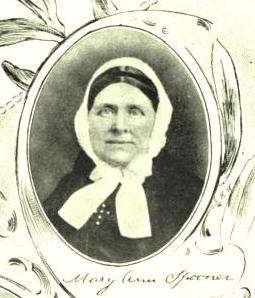
MRS. MARY ANN SPOONER.
Mrs. Mary Ann Spooner, the daughter of Prosper Wetmore and Catharine McEwen, and granddaughter of the Rev. Izrahiah Wetmore, pastor for many years of the Presbyterian Church of Stratford, Conn., was born July, 1794, in New York City. She was married March, 1831, to Colonel Alden Spooner, who established in 1811, the first newspaper in Brooklyn, The Long Island Star. The church (St. Ann’s Episcopal) in which she was married stood where now is the entrance to the Brooklyn bridge.
Previous to her marriage, she taught in Brooklyn, and on becoming a widow with one child, a daughter, she opened a little school in the suburbs for a short time only, when she removed to Lockport, N. Y., to reside in the family of Mr. Hiram McCollum, whose children she instructed. She removed successively to Buffalo and Rochester. In the latter city she passed the last eleven years of her life, expiring peacefully at St. Mary’s Hospital, surrounded by her daughter, kind friends and the devoted Sisters, on Dec. 17, 1877, aged 83 years, and was burled in Stratford, Conn., in one of the oldest burial places in the country.
Though Mrs. Spooner was reared in a Presbyterian family, she never joined that communion, but became a member of the Episcopalian, and taught the first Sunday school class in old St. Ann’s. In 1842 she embraced the Catholic faith, remaining firm and fervent therein to the close of her life.
Mrs. Spooner began to write at the age of fifteen and continued at intervals until within a month of her death. In 1848 she collected a volume for publication, entitled Gathered Leaves, receiving high encomiums from Halleck, Irving and Bryant. Her later effusions appeared in the newspapers. An “Essay on Genius” was read at the Brooklyn Lyceum in 1834.
Mrs. Spooner dedicated her poems “The Christophers” and “The Infalllbilites” to His Holiness, Pope Pius IX., having a copy illuminated and presented to the Holy Father through the medium of the Prefect of the Propaganda, who handed it to His Holiness, telling him they were sent by a young lady of 80 summers. The Pope laughingly replied: “I am likewise a youth of 80 winters.” His Holiness was much pleased with the offering and the loving thought that prompted it, and sent his special blessing, with a silver medal and his photograph bearing a few words in his own handwriting, through the Very Rev. Vicar-General of the diocese of Rochester.
Mrs. Spooner was of artistic temperament in other lines than literary. She sketched and painted, but a delicate eye-sight debarred her persevering study in art. She drew a picture of St. Ann’s Church before its demolition, which was copied into a recent history of Brooklyn, without, however, giving credit to the author. Several other sketches of various subjects are in existence.
Her many endearing qualities, noble deeds and generous acts need not be recorded here. She was proud to be an American and her daughter, Mrs. Wilber of Lockport, N. Y., is now proud to place her venerated mother’s name among the Catholic women writers of America.
NIAGARA.
(Written at the Falls, August 4, 1829.)
Oh I scene of wondrous beauty! Let my soul
Pour its deep tribute unto thee, my God.
Here, at Earth’s noble altar, here, where swells
With ceaseless voice that shakes the solid earth,
Though mountain piled thy high transcending praise;
Yea, waves an incense hallowed pure and bright,
As wakes an image of most holy things.
Oh! let the spirit of the glorious scene
Imbue my soul and lift it unto thee!
Here, the deep record of the earth-swept flood,
And thy almighty Power are yet preserved;
And here, long treasured from the eye of faith,
Nature unveils the beauty of our earth.
As from her deep Baptism soft, once more,
Amid rejoicing waves she chastened rose,
The radiant signet, on her happy brow,
Token of peace, of hope, of tender love!
And what a majesty surrounds this scene
That pictures forth the attributes of God!
Yea, shrinks the spirit at the awful view!
The mighty Power that formed, and can destroy;
The spirits Purity, that upward springs;
The vast Eternity we cannot grasp;
And Mercy’s coronal that crowns the whole!
On, on, as these delightful waves, may I
My destined course through rapid time pursue,
And yield my spirit at the certain verge,
As prompt, as pure, as spring these parted waves;
My Savior’s glories imaged as it rise,
As on this soaring wreath, light’s living hues!
Immortelles of Catholic Columbian Literature, Compiled from the Works of American Catholic Women Writers, by the Ursulines of New York (Illustrated) (Akron, OH: D.H. McBride & Co., 1897), p. 64.
Next Post

April 15, 2011 School Play, St. James Academy, Brooklyn, 1856
Browse Our Archives
Select a Category African-American Catholics Alabama Catholics American Catholic History American Catholic women American History Anniversaries Anti-Catholicism Arkansas Catholics Benedictines Bishops Blessed John Henry Newman Book Reviews Books Boston College Brooklyn churches Brothers California Catholics Capuchins Cardinals Carlo Carretto Carmelites Catholic authors Catholic Cemeteries Catholic Historians Catholic History in Less Than 5 Minutes Catholic musicians Catholic Poetry Catholic Press Catholic School Textbook Catholic University of America Catholic Worker Catholics and Music Catholics and Race Catholics in Politics Catholics in the American Revolution Catholics in the Military Catholics in the Movies Catholics in the South Catholics in the West Catholics on Stage Catjolic Women Catolic Poetry Charles de Foucauld Children's Masses Christian Brothers Christmas Church Reform Civil Rights Movement Civil War Colleges and universities Converts D.C. Catholics Deaf Catholics Dominicans. Dorothy Day English Catholics Florida Catholics Fordham University Franciscans French Catholics Georgetown University German Americans Good Shepherd Sisters Hispanic Catholics Historians and Archivists Holy Cross Fathers Holy Name Society Idaho Catholics Illinois Catholics Indian Wars Indiana Catholics Irish Americans Irish Catholicism Italian Americans Italian Catholics Jesuits Josephite Sisters Kentucky Catholics Know-Nothings Laetare Medal Recipients laity Liturgical Movement Maine Catholics Manhattan College Maryland Catholicism Michigan Catholics Middle Ages Minnesota Catholics Missionaries Mississippi Catholics Missouri Catholics Monasteries Montana Catholics Native Americans New England Catholicism New Jersey Catholics New York Catholics North American College Ohio Catholics Oratorians Oregon Catholics Parish Mission Parishes Passionists Pat McNamara's Books Paulists Pennsylvania Catholics Popes Presidents Priests Quotations Religious Orders Rhode Island Catholics Saints Salesians Seminarians Seminaries Sermons Servants of God Siisters of Charity Sisters of Mercy South Carolina Catholics Spanish-American War Sports St. Francis of Assiai St. John Henry Newman Suplicians Tennessee Catholics Texas Catholics The year in review Thomas Merton Throwback Thursday Photograph Trappists Uncategorized University of Notre Dame Video Presentations Vincentians Virginia Catholics Visitation Nuns Washington West Point West Virginia Catholics West Viriginia Catholics Wisconsin Catholicism Women Religious World War II
Select a Month December 2020 June 2020 May 2020 April 2020 March 2020 March 2019 February 2019 January 2019 December 2018 November 2018 November 2014 October 2014 September 2014 August 2014 July 2014 June 2014 May 2014 December 2013 November 2013 October 2013 August 2013 July 2013 June 2013 May 2013 April 2013 March 2013 February 2013 January 2013 December 2012 November 2012 October 2012 September 2012 August 2012 July 2012 June 2012 April 2012 March 2012 December 2011 November 2011 October 2011 September 2011 August 2011 July 2011 June 2011 May 2011 April 2011 March 2011 February 2011 January 2011 December 2010 November 2010 October 2010 January 2010 December 2009 November 2009 October 2009 September 2009 August 2009 July 2009 June 2009 May 2009 April 2009 March 2009 February 2009 January 2009 December 2008
Follow Us!
TAKE THE
Religious Wisdom Quiz
Who prayed three times a day facing Jerusalem?
Select your answer to see how you score.
Ezekiel Jonah Micah Daniel
Related posts from McNamara's Blog

St. John Henry Newman and the “Special Charm...

American Catholics and Race in 2020: A Church...

“It’s About Time They Got Here”: Catholics and the...

The Struggle for an African American Priesthood
TRENDING AT PATHEOS Catholic

Rejecting Doom: Christian Hope And Human Action
Christianity is a religion of hope. We are to have hope and...

It’s What Comes From Within Which Matters
One of the most difficult things for us to understand is why...

Why I Choose the Eucharist Over the Sermon
Choose the Eucharist, Not the Sermon What are we supposed to get...

5 Design Elements Found in Spiritually Rooted Homes
Putting Spirituality Into Home Decor Our homes are more than our living...

Credo: A Story of God Told with the...
About 10 years ago, I began to imagine a personal "Credo" that...

The Anatomy of Divine Revelation in Catholic Thought
The claim that God has made Himself known to human beings is...
view all Catholic blogs
Ad-Free & Subscriber Log-In Subscription Support
- About Us
- 2026 Calendar
- Videos
- Podcasts
- Library of World Religions
- Faith In Media Tracker
- Advertise With Us
- Write for Us
- Privacy Policy
- Terms of Service
- Do Not Sell My Data
- Contact Us
- Radiant Digital
- Manage Newsletter Subscriptions
- Unsubscribe From Notifications
- Sitemap
Copyright 2008-2026, Patheos. All rights reserved.
Subscription Support Ad-Free & Subscriber Log-In
Follow Patheos