
BuddhistCatholicContemplativeEvangelicalGeneral ChristianHinduJewishLatter-day SaintMuslimNew VisionsProgressive Christian
Beliefs
- Buddhist
- Catholic
- Contemplative
- Evangelical
- General Christian
- Hindu
- Jewish
- Latter-day Saint
- More Voices
- Muslim
- New Visions
- Pagan
- Progressive Christian
Topics
- Religion News
- Food and Religion
- Sports and Religion
- Religious Art
- Religious Music and Entertainment
- Religious Events
- History and Religion
- Style and Religion
- Politics and Religion
- Women in Religion
- Recreation Outdoors and Religion
- Business Finance and Religion
- Careers Workplace and Religion
- Education and Religion
- Family Parenting and Religion
- Health Fitness and Religion
- Home and Religion
- Relationships and Religion
- Technology and Religion
- Travel and Religion
Columnists
- Buddhist Columnists
- Business Finance and Religion Columnists
- Careers Workplace and Religion Columnists
- Catholic Columnists
- Contemplative Columnists
- Education and Religion Columnists
- Evangelists Columnists
- Family Parenting and Religion Columnists
- General Christian Columnists
- Health Fitness and Religion Columnists
- Hindu Columnists
- History and Religion Columnists
- Home and Religion Columnists
- Jewish Columnists
- More Voices Columnists
- Latter Day Columnists
- Muslim Columnists
- New Visions Columnists
- Nonreligious Columnists
- Pagan Columnists
- Politics and Religion Columnists
- Progressive Columnists
- Recreation Outdoors and Religion Columnists
- Relationships and Religion Columnists
- Religion News Columnists
- Religious Art Columnists
- Religious Events Columnists
- Religious Music and Entertainment Columnists
- Sports and Religion Columnists
- Style and Religion Columnists
- Technology and Religion Columnists
- Travel and Religion Columnists
- Women in Religion Columnists
Resource Library
- 2026 Calendar
- Library of World Religions
- The 100 Most Holy Places on Earth
- Patheos Answers
- Podcasts
- Videos
- Faith Leaders Database
- Anglican Episcopalian
- Bahai
- Baptist
- Buddhism
- Christianity
- Confucianism
- Eastern Orthodoxy
- Hinduism
- Holiness and Pentecostal
- ISKCON
- Islam
- Judaism
- Lutheran
- Methodist
- The Church of Jesus Christ of Latter-day Saints
- New Age
- Paganism
- Presbytarian and Reformed
- Protestantism
- Religion Behind the Scenes
- Roman Catholic
- Scientology
- Shia Islam
- Sikhism
- Sufism
- Sunni Islam
- Taoism
- Zen
- See all religions
Research Tools
 Ad-Free & Subscriber Log-In Subscription Support
Ad-Free & Subscriber Log-In Subscription Support
Follow Patheos 

- Trending:
- Forgiveness
- |
- Marriage
- |
- Consciousness
- |
- Death Penalty
- |
- Election
- |
- Halloween
 McNamara's Blog
- Home
- Catholic
- “BEFORE LENT”: A Conference by St. Euphrasia Pelletier (1796-1868)
“BEFORE LENT”: A Conference by St. Euphrasia Pelletier (1796-1868)
Last updated on: March 8, 2011 at 6:01 am by Pat McNamara
“BEFORE LENT”: A Conference by St. Euphrasia Pelletier (1796-1868) 2011-03-08T06:01:00-07:00 Pat McNamara
Patheos Explore the world's faith through different perspectives on religion and spirituality! Patheos has the views of the prevalent religions and spiritualities of the world.

St. Euphrasia Pelletier (1796-1868), foundress of the Sisters of the Good Shepherd.
Lent is approaching, my dear daughters, and with it fresh streams of grace, of spiritual life and of means of perfection. Prepare yourselves beforehand to spend it well. According to the mind of the Church, the time between Septuagesima Sunday and Ash Wednesday should be spent in preparing for the blessed forty days, and in several Religious Orders the fast begins from Septuagesima week.
It is evident that Lent was instituted by the Apostles in memory of Our Lord’s fast in the desert. In the first ages of the Church this holy fast was observed very rigorously. They ate but once in the day, towards evening, and then partook only of vegetables, herbs and fruit, a little fish being allowed on rare occasions. Moreover, the fast extended to Sundays; later they were omitted be cause of certain erroneous opinions held by heretics. A few days in Quinquagesima week were added to make up for the Sundays, and thus preserve the number of forty days.
At the present day the Church has mitigated the fast of Lent. It is a concession made to the needs of the times and because of the weakness of constitutions. But we must not, on this account, suppose that the Church has dispensed us from the obligation of doing penance; on the contrary, during these holy days she unceasingly exhorts all the faithful to the exercise of severe mortification by the solemnity of her rites, the mournfulness of her chants, by frequent sermons, etc.
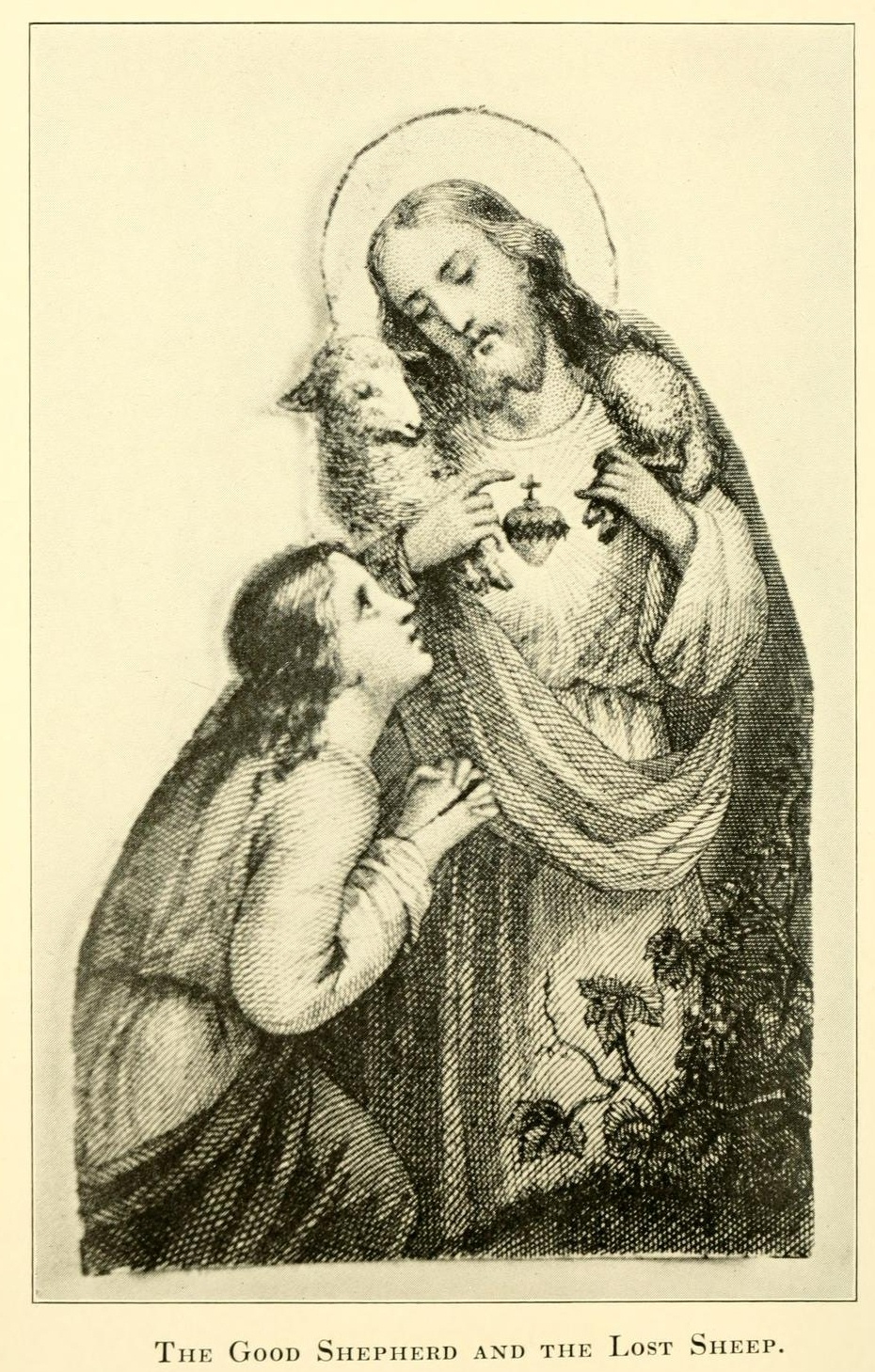
Christ the Good Shepherd, the model of the community.
Therefore, those amongst you who are not strong enough to fast must remember, nevertheless, that they ought to redouble their self-denials, their assiduity and zeal in the accomplishment of their duties; pray with more fervour, and practise greater charity and more exact obedience.
Lent is a propitious season for every one. It is propitious for souls seeking to overcome the evil inclinations of nature; for those who desire to enter deeply into the delights of an interior life, and for all of us who wish to devote ourselves to works of zeal, by labouring to restore souls to God.
In fact, how could we think that Our Lord would be deaf to the entreaties of His beloved spouses when He sees them humbled and prostrate between the vestibule and the altar, as victims for sinners, forgetting themselves to seek His glory in all things? Let us not allow this season of mercy and grace to pass without fruit, remembering that it is a time of salvation ; we should know how to profit by it. You can all become saints during these forty days of penance and benediction.

The House of the Good Shepherd, Manhattan, was founded on East 17th Street in 1857.
A sister may not be able to fast but she can abstain; another cannot abstain, but she can very well deprive herself in the refectory of something which is not necessary. Our Lent is not rendered very severe by our austerities, but we should be more silent during these holy days; we are recommended to observe longer intervals of silence than we do usually.
I wish it to be remembered that the bell for the morning silence rings at half-past eight, and it should be kept till the recreation hour. I recommend you to observe it perfectly. We should not only keep silence in words, we should also refrain from “wandering and useless thoughts, and avoid noise in opening and shutting doors. I remember when visiting a Carmelite convent the Superior called my attention to the latch of the door which had wool round it. “It is to prevent noise,” she said, “our holy Mother recommended silence so strongly.”
You will tell me, my dear daughters, that I never cease speaking to you of the necessity of silence. It is true, but time is so precious that those who lose a single moment of it in useless words do themselves and others a very great injury without perceiving it. The practice of silence will be a powerful aid in accomplishing all the objects which our zeal has in view.
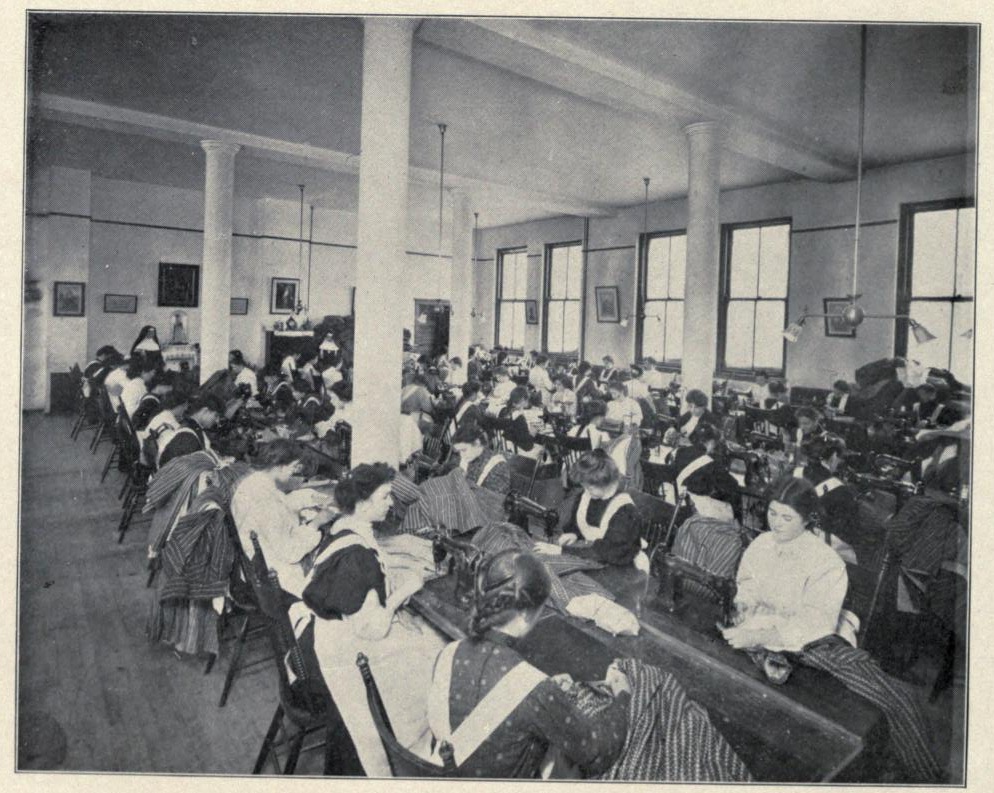
Students at the House of the Good Shepherd, Chicago, founded in 1859.
It is in silence that we hear the secret intimations of divine Providence, and by it we shall soon reach” that perfection which is so necessary to each if they are to contribute efficaciously to the works of the Institute. In our holy Congregation prayer, an interior life, solitude, should be our chief though not our only end; but the one will lead to the other, for no labour will bear fruit for the salvation of souls unless the necessary light for conducting souls to God has been first gained in prayer and silence.
A career of labour opens before us; I see a multitude of paths which we are called upon to tread; we must, therefore, set to work with energy without losing a moment. Meanwhile, let us thank God for granting us these few days of recollection and solitude, because by recollecting ourselves we shall redouble our strength, to employ it afterwards in God s service and for His honour. Yes, our labours, our arduous duties are increasing; works are proposed to us, our convents ask for subjects, several bishops are renewing their entreaties; they earnestly desire to have our holy Congregation in their dioceses. You would be grieved were I to tell you all the good works which we are obliged to defer for want of subjects.

The House of the Good Shepherd, founded on High Street in Newark, New Jersey, in 1875.
Once more then I say, recollect yourselves during these holy days in order to pray much ; prepare for labour, because we have great works before us; enter more than ever into the spirit of your holy vocation, give up all self-seeking, avoid speaking of yourselves, forget yourselves and let others for get you; this will be the best penance you can perform.
Carefully repress a spirit of levity, endeavour to become interior religious, souls hidden in God, and do nothing except to glorify Him and give Him pleasure. Only in solitude and in silence can God make His voice heard in your heart. It is of absolute necessity in our vocation that self-sacrifice and the practice of an interior life should be a habit.
The Royal Prophet says: Thy law is my meditation, night and day, and we ought all to be able to say this, my dear daughters, that is we should be interior and silent. Silence constitutes the delight and peace of a community. Observe that our works flourish most in those of our Houses where regularity and silence are best practised.
Oh, if we understood what it is to disturb a servant of God, occupied in fighting for God in prayer. It is then that the words of the Canticle of Canticles may well be applied: Wake not my beloved, because prayer is a combat or sleep, and those who speak in a loud tone in the cloisters, who make a noise in the choir, interrupt this union of God with His creature. In silence great thoughts are conceived and great things accomplished.
Oh! how I love those souls who in silence and in prayer bring about the perfection of their works. Great will be their reward. Pray for the souls confided to your care, that they may be converted and become worthy to approach the Banquet of the Paschal Lamb prepared for them by the Church.
MAXIM
Silence and a spirit of prayer will give us the prudence and gravity which are so suitable to us in our vocation.
Mother Mary of St. Euphrasia Pelletier, Conferences and Instructions (1907)
NOTE
In 1815, a young Frenchwoman named Virginie Rose Pelletier (1796-1868) joined the Sisters of the Refuge, a religious community founded in France in 1641. It was founded to help women on society’s fringes: the poor, the homeless, the prostitutes. Virginie took the religious name Euphrasia. By age 29 she was head of the community. The work of the Sisters, however, was confined solely to France, and she wanted to expand their ministry worldwide.
In 1835, Mother Euphrasia founded the Sisters of Good Shepherd, a community modeled on the compassionate Christ, to find the “lost sheep.” In 1842, she sent the first Sisters to America, founding homes in cities nationwide. By the time of her death, the community had over two thousand members and 110 houses worldwide. She was beatified in 1933, and canonized seven years later by Pope Pius XII. (The above talk was part of a series given to her Sisters.)
Septuagesima Sunday refers to the third Sunday before the beginning of Lent. “Septuagesima” means “seventieth,” and here it refers to the seventieth day before Easter Sunday. In the early Church, Christians began their fast immediately after Septuagesima Sunday.
Previous Post

March 7, 2011
Father Henry H. Wyman, C.S.P. (1849-1929): Convert, Author, Pastor
Next Post
March 9, 2011 The Brooklyn Irish in the Civil War: Major George F. Tait (1837-1919)
Browse Our Archives
Select a Category African-American Catholics Alabama Catholics American Catholic History American Catholic women American History Anniversaries Anti-Catholicism Arkansas Catholics Benedictines Bishops Blessed John Henry Newman Book Reviews Books Boston College Brooklyn churches Brothers California Catholics Capuchins Cardinals Carlo Carretto Carmelites Catholic authors Catholic Cemeteries Catholic Historians Catholic History in Less Than 5 Minutes Catholic musicians Catholic Poetry Catholic Press Catholic School Textbook Catholic University of America Catholic Worker Catholics and Music Catholics and Race Catholics in Politics Catholics in the American Revolution Catholics in the Military Catholics in the Movies Catholics in the South Catholics in the West Catholics on Stage Catjolic Women Catolic Poetry Charles de Foucauld Children's Masses Christian Brothers Christmas Church Reform Civil Rights Movement Civil War Colleges and universities Converts D.C. Catholics Deaf Catholics Dominicans. Dorothy Day English Catholics Florida Catholics Fordham University Franciscans French Catholics Georgetown University German Americans Good Shepherd Sisters Hispanic Catholics Historians and Archivists Holy Cross Fathers Holy Name Society Idaho Catholics Illinois Catholics Indian Wars Indiana Catholics Irish Americans Irish Catholicism Italian Americans Italian Catholics Jesuits Josephite Sisters Kentucky Catholics Know-Nothings Laetare Medal Recipients laity Liturgical Movement Maine Catholics Manhattan College Maryland Catholicism Michigan Catholics Middle Ages Minnesota Catholics Missionaries Mississippi Catholics Missouri Catholics Monasteries Montana Catholics Native Americans New England Catholicism New Jersey Catholics New York Catholics North American College Ohio Catholics Oratorians Oregon Catholics Parish Mission Parishes Passionists Pat McNamara's Books Paulists Pennsylvania Catholics Popes Presidents Priests Quotations Religious Orders Rhode Island Catholics Saints Salesians Seminarians Seminaries Sermons Servants of God Siisters of Charity Sisters of Mercy South Carolina Catholics Spanish-American War Sports St. Francis of Assiai St. John Henry Newman Suplicians Tennessee Catholics Texas Catholics The year in review Thomas Merton Throwback Thursday Photograph Trappists Uncategorized University of Notre Dame Video Presentations Vincentians Virginia Catholics Visitation Nuns Washington West Point West Virginia Catholics West Viriginia Catholics Wisconsin Catholicism Women Religious World War II
Select a Month December 2020 June 2020 May 2020 April 2020 March 2020 March 2019 February 2019 January 2019 December 2018 November 2018 November 2014 October 2014 September 2014 August 2014 July 2014 June 2014 May 2014 December 2013 November 2013 October 2013 August 2013 July 2013 June 2013 May 2013 April 2013 March 2013 February 2013 January 2013 December 2012 November 2012 October 2012 September 2012 August 2012 July 2012 June 2012 April 2012 March 2012 December 2011 November 2011 October 2011 September 2011 August 2011 July 2011 June 2011 May 2011 April 2011 March 2011 February 2011 January 2011 December 2010 November 2010 October 2010 January 2010 December 2009 November 2009 October 2009 September 2009 August 2009 July 2009 June 2009 May 2009 April 2009 March 2009 February 2009 January 2009 December 2008
Follow Us!
TAKE THE
Religious Wisdom Quiz
How did Jesus heal the mute and deaf man in Decapolis?
Select your answer to see how you score.
Anointed his head Said "Go in peace" Put fingers in ears and touched tongue Gave bread
Related posts from McNamara's Blog

St. John Henry Newman and the “Special Charm...

American Catholics and Race in 2020: A Church...

“It’s About Time They Got Here”: Catholics and the...

The Struggle for an African American Priesthood
TRENDING AT PATHEOS Catholic

The Parable Of The Sower And The Word...
One of Christ’s most famous parables is that of the sower who...

Rejecting Doom: Christian Hope And Human Action
Christianity is a religion of hope. We are to have hope and...

Why I Choose the Eucharist Over the Sermon
Choose the Eucharist, Not the Sermon What are we supposed to get...

5 Design Elements Found in Spiritually Rooted Homes
Putting Spirituality Into Home Decor Our homes are more than our living...

Credo: A Story of God Told with the...
About 10 years ago, I began to imagine a personal "Credo" that...

The Anatomy of Divine Revelation in Catholic Thought
The claim that God has made Himself known to human beings is...
view all Catholic blogs
Ad-Free & Subscriber Log-In Subscription Support
- About Us
- 2026 Calendar
- Videos
- Podcasts
- Library of World Religions
- Faith In Media Tracker
- Advertise With Us
- Write for Us
- Privacy Policy
- Terms of Service
- Do Not Sell My Data
- Contact Us
- Radiant Digital
- Manage Newsletter Subscriptions
- Unsubscribe From Notifications
- Sitemap
Copyright 2008-2026, Patheos. All rights reserved.
Subscription Support Ad-Free & Subscriber Log-In
Follow Patheos