
BuddhistCatholicContemplativeEvangelicalGeneral ChristianHinduJewishLatter-day SaintMuslimNew VisionsProgressive Christian
Beliefs
- Buddhist
- Catholic
- Contemplative
- Evangelical
- General Christian
- Hindu
- Jewish
- Latter-day Saint
- More Voices
- Muslim
- New Visions
- Pagan
- Progressive Christian
Topics
- Religion News
- Food and Religion
- Sports and Religion
- Religious Art
- Religious Music and Entertainment
- Religious Events
- History and Religion
- Style and Religion
- Politics and Religion
- Women in Religion
- Recreation Outdoors and Religion
- Business Finance and Religion
- Careers Workplace and Religion
- Education and Religion
- Family Parenting and Religion
- Health Fitness and Religion
- Home and Religion
- Relationships and Religion
- Technology and Religion
- Travel and Religion
Columnists
- Buddhist Columnists
- Business Finance and Religion Columnists
- Careers Workplace and Religion Columnists
- Catholic Columnists
- Contemplative Columnists
- Education and Religion Columnists
- Evangelists Columnists
- Family Parenting and Religion Columnists
- General Christian Columnists
- Health Fitness and Religion Columnists
- Hindu Columnists
- History and Religion Columnists
- Home and Religion Columnists
- Jewish Columnists
- More Voices Columnists
- Latter Day Columnists
- Muslim Columnists
- New Visions Columnists
- Nonreligious Columnists
- Pagan Columnists
- Politics and Religion Columnists
- Progressive Columnists
- Recreation Outdoors and Religion Columnists
- Relationships and Religion Columnists
- Religion News Columnists
- Religious Art Columnists
- Religious Events Columnists
- Religious Music and Entertainment Columnists
- Sports and Religion Columnists
- Style and Religion Columnists
- Technology and Religion Columnists
- Travel and Religion Columnists
- Women in Religion Columnists
Resource Library
- 2026 Calendar
- Library of World Religions
- The 100 Most Holy Places on Earth
- Patheos Answers
- Podcasts
- Videos
- Faith Leaders Database
- Anglican Episcopalian
- Bahai
- Baptist
- Buddhism
- Christianity
- Confucianism
- Eastern Orthodoxy
- Hinduism
- Holiness and Pentecostal
- ISKCON
- Islam
- Judaism
- Lutheran
- Methodist
- The Church of Jesus Christ of Latter-day Saints
- New Age
- Paganism
- Presbytarian and Reformed
- Protestantism
- Religion Behind the Scenes
- Roman Catholic
- Scientology
- Shia Islam
- Sikhism
- Sufism
- Sunni Islam
- Taoism
- Zen
- See all religions
Research Tools
 Ad-Free & Subscriber Log-In Subscription Support
Ad-Free & Subscriber Log-In Subscription Support
Follow Patheos 

- Trending:
- Forgiveness
- |
- Marriage
- |
- Consciousness
- |
- Death Penalty
- |
- Election
- |
- Halloween
 McNamara's Blog
- Home
- Catholic
- What Do Priests Do (and Wear)?
What Do Priests Do (and Wear)?
Last updated on: February 10, 2011 at 9:14 am by Pat McNamara
What Do Priests Do (and Wear)? 2011-02-10T09:14:00-07:00 Pat McNamara
Patheos Explore the world's faith through different perspectives on religion and spirituality! Patheos has the views of the prevalent religions and spiritualities of the world.
Here’s an answer from The Brooklyn Eagle, October 18, 1890:
In each parish there is a pastor and one, two or three assistants, according to the size and needs of the congregation. Mass has to be said every morning, beginning generally about 6 o’clock, sometimes twice on Sunday, with a sermon, Sunday school and vespers, after which, during the week, the sick have to be visited, the parish generally supervised, the schools looked after, children instructed, sermons prepared and, heaviest of all loads to the pastor, the debts of the church provided against.

Born in Philadelphia, son of a Quaker father and a Catholic mother, Isaac Howell served as pastor of St. Mary’s Church in Elizabeth, New Jersey, until his death in 1866. For much of the 1800’s, Catholic priests wore suits and ties. This was a custom that was brought over from England. Formal clerical garb wasn’t mandated until the 1880’s.
On Saturday afternoons and evenings, and on the eves of the festivals and holy days confessions are heard, which means being cooped up in a box about 3 feet by 4 for five or six hours, chilled by draughts in winter, stifled by heat in summer, poisoned by fetid breaths and listening to the thousand and one woes and abominations of erring manhood. For all these the priest must have consolation, encouragement, reproof and admonition. The wicked must be directed to the paths of penitence, the just strengthened and urged to perseverance. The labors of the confessional are probably the most trying and exacting of a priest’s duties.

Born in Ireland, Father Michael King spent most of his priesthood in California, serving for forty years as pastor of Immaculate Conception Church in Oakland. The beard covering his throat was popular among Protestant and Catholic clergy during the 1800’s. In the days before central heating, it kept their throats warm while they preached in the pulpit during the winter.
Then he must be ready at any moment of the day to answer the sick calls, and no matter how virulent the pestilence or disgusting the disease, there is not a moment for hesitation before hastening to the sick bed, even though at the peril of life itself. To their eternal honor be it said that priests of this and every other land have never refused to take their lives in their hands at the call of duty, and history is full of the records of those who have fallen martyrs to the heroism with which they sought to relieve the spiritual and often the temporal wants of those committed to their charge.

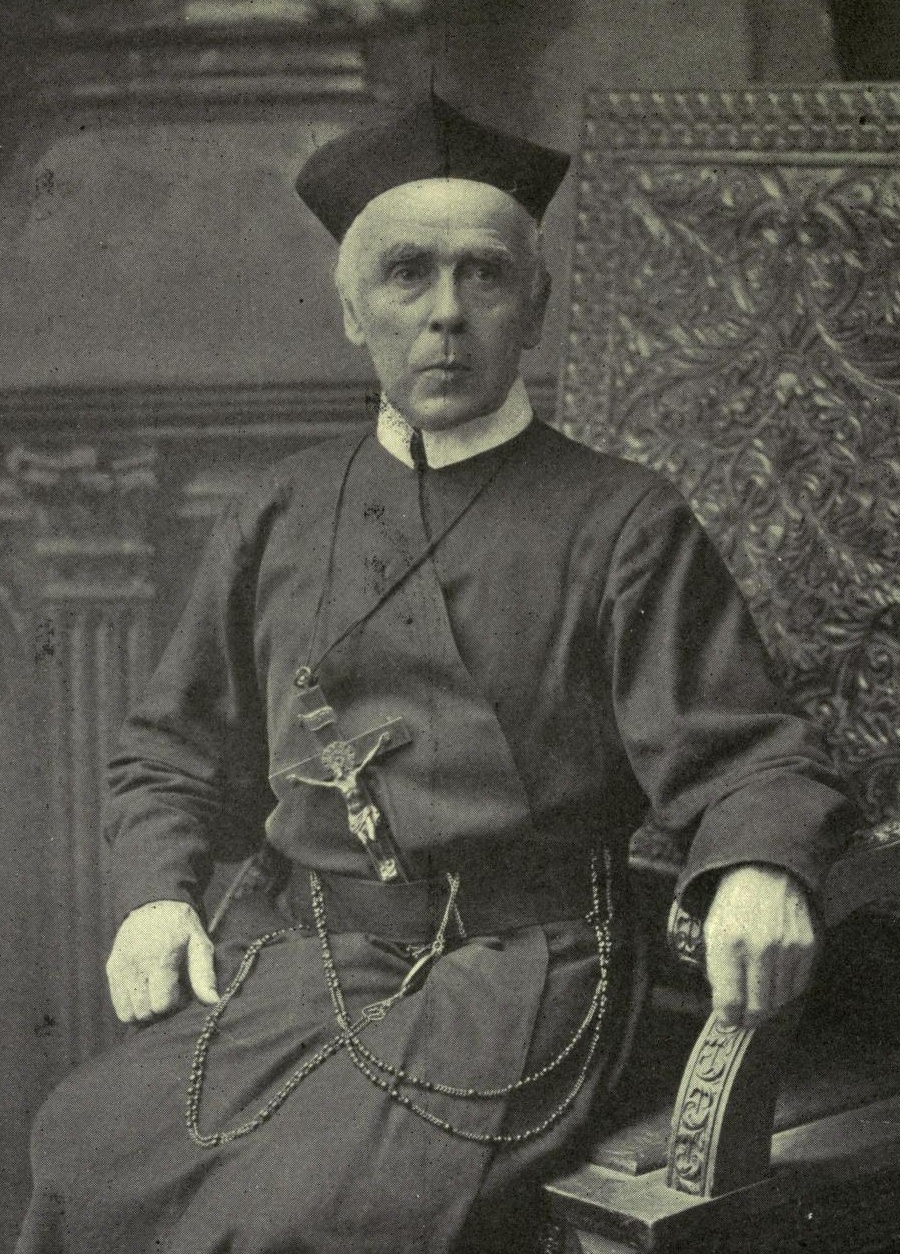
Born in Ireland, Father James Hughes served in Hartford, Connecticut, for nearly fifty years. Seen here in full vestments, he died in 1895, just before receiving the news that he had been named a Monsignor.
For all this work, continued year in and year out till he falls in harness, the priest receives the good will and love of his people and superiors, the approval of his own conscience, and no matter how long or successful his term of service a maximum salary of $1,000 a year— if the parish affords it. It must be admitted that the calling is not a very alluring one to those who love ease and fat returns.

By the mid-1800’s, most priests tended to be clean-shaven. The exceptions were German priests, Benedictine monks, and Franciscan friars. Seen here is Father Isidore Robot (1837-1887), a French Benedictine who played a major role in establishing the Church in Oklahoma.
For all this he is entitled to a salary— is he is a pastor— of $1,000 a year, and to $600 if he is an assistant. He must get his salary if he can— out of the revenues of the parish to which he is attached. The parish supplies him with a house. He must find the rest himself, and if there is anything lacking the privation must be endured with the hope that the sure wages provided in the hereafter will repay for all that was wanting here below in creature comforts.

Many priests belonging to religious orders had their own unique habits. Seen here is Father John Pinasco (1837-1897), an Italian-born Jesuit who served as President of both the University of Santa Clara and the University of San Francisco.
No matter how long a priest may be pastor his salary will never increase beyond the $1,000 limit, even if he reaches the pastorship of the richest and grandest church in the diocese. There is no such thing for a Catholic priest as a call with a $10,000 echo to it. In some dioceses the maximum salary is less than $1,000, and it takes very little knowledge of the geography of Long Island to know that there are many Catholic parishes where the revenues could not afford $1,000 in salaries. The pastor must get along with what comes and trust to Providence for the rest.
The Redemptorists were founded in 1700’s Italy, but most who came here in the 1800’s were German. Seen above in their distinctive habit is Father John Hespelin, C.Ss.R. (1821-1899), the first pastor of Holy Cross Church in Baltimore’s Federal Hill section.
The bishop’s salary is a pro rata tax fixed for each parish, to pay according to its standing. It is called he cathedraticum. As his duties are more extensive and expensive than a pastor’s the sum is therefore greater. It is one of the reasons why a good sum should be raised for Bishop Loughlin’s jubilee purse, that he has rarely asked his pastors for the cathedraticum. The venerable prelate has led so simple and unassuming a life that very little suffices for his personal needs. Hence, the diocese has not been asked for the salary, which might have amounted to several thousand dollars according to the average standard.

Born in Ireland, Father John B. Hogan (1829-1901) joined the Sulpicians, a religious community devoted to training future priests, in France. He later taught in American seminaries. He is seen here in the tabs commonly worn by French priests.
There is no more hardworking, industrious and self sacrificing body of men than the secular clergy, and they are the glory of the American church and one of the best elements of our American citizenship, a bulwark of morality and the highest intelligence, and an impenetrable barrier against all the subversive theories of socialistic or anarchistic violence.

Born in Brooklyn in 1852, Father Peter Scharoun joined the Conventual Franciscans and served in their parishes throughout the United States, including Indiana and New Jersey.
A priest in the street must wear the distinctive dress of his calling. He cannot go to the theater, to horse races. He cannot sue anyone in a civil court for temporal affairs until all amicable resources are exhausted. If he brings matters of church discipline into a civil court he incurs a special excommunication which extends to all who aid or abet him. In their homes ecclesiastics wear a long coat reaching to the ground and called a cassock. For priests it is black, signifying that they are dead to the world.

Born in Ireland, Father Michael O’Dwyer was pastor of St. Mary’s Church in Elmira, New York, from 1882 until his death in 1908. Seen here in his top hat and frock coat, his outfit is a combination of secular and religious garb.
The beretta is worn in everyday life and in the sanctuary at the less solemn portions of the mass, but never at the altar, in actual celebration, except in one part of the world. In China, owing to the public custom of never appearing in public uncovered, Pope Paul V (1605-1621) granted the missionaries the privilege of wearing a beretta all through mass, but it must not be the cap worn in every day life. In no other part of the world is this privilege allowed even to the pope himself. The little skull cap some priest wear is called a zucchetto, and was worn originally to protect the head made bare by the shaving in tonsure. It cannot be worn during the solemn parts of the mass.

The skull cap known as the zucchetto was rarely worn by American priests, except for monks and friars. Seen above is Father Clarence A. Walworth (1820-1900), a founding member of the Paulists, America’s first religious community of priests. This photograph was taken after he left the Paulists and was serving as a pastor in upstate New York.
Previous Post

February 9, 2011
Chicago’s African-American Catholics, 1890
Next Post
February 11, 2011 The Marist Brothers in the United States, 1914
Browse Our Archives
Select a Category African-American Catholics Alabama Catholics American Catholic History American Catholic women American History Anniversaries Anti-Catholicism Arkansas Catholics Benedictines Bishops Blessed John Henry Newman Book Reviews Books Boston College Brooklyn churches Brothers California Catholics Capuchins Cardinals Carlo Carretto Carmelites Catholic authors Catholic Cemeteries Catholic Historians Catholic History in Less Than 5 Minutes Catholic musicians Catholic Poetry Catholic Press Catholic School Textbook Catholic University of America Catholic Worker Catholics and Music Catholics and Race Catholics in Politics Catholics in the American Revolution Catholics in the Military Catholics in the Movies Catholics in the South Catholics in the West Catholics on Stage Catjolic Women Catolic Poetry Charles de Foucauld Children's Masses Christian Brothers Christmas Church Reform Civil Rights Movement Civil War Colleges and universities Converts D.C. Catholics Deaf Catholics Dominicans. Dorothy Day English Catholics Florida Catholics Fordham University Franciscans French Catholics Georgetown University German Americans Good Shepherd Sisters Hispanic Catholics Historians and Archivists Holy Cross Fathers Holy Name Society Idaho Catholics Illinois Catholics Indian Wars Indiana Catholics Irish Americans Irish Catholicism Italian Americans Italian Catholics Jesuits Josephite Sisters Kentucky Catholics Know-Nothings Laetare Medal Recipients laity Liturgical Movement Maine Catholics Manhattan College Maryland Catholicism Michigan Catholics Middle Ages Minnesota Catholics Missionaries Mississippi Catholics Missouri Catholics Monasteries Montana Catholics Native Americans New England Catholicism New Jersey Catholics New York Catholics North American College Ohio Catholics Oratorians Oregon Catholics Parish Mission Parishes Passionists Pat McNamara's Books Paulists Pennsylvania Catholics Popes Presidents Priests Quotations Religious Orders Rhode Island Catholics Saints Salesians Seminarians Seminaries Sermons Servants of God Siisters of Charity Sisters of Mercy South Carolina Catholics Spanish-American War Sports St. Francis of Assiai St. John Henry Newman Suplicians Tennessee Catholics Texas Catholics The year in review Thomas Merton Throwback Thursday Photograph Trappists Uncategorized University of Notre Dame Video Presentations Vincentians Virginia Catholics Visitation Nuns Washington West Point West Virginia Catholics West Viriginia Catholics Wisconsin Catholicism Women Religious World War II
Select a Month December 2020 June 2020 May 2020 April 2020 March 2020 March 2019 February 2019 January 2019 December 2018 November 2018 November 2014 October 2014 September 2014 August 2014 July 2014 June 2014 May 2014 December 2013 November 2013 October 2013 August 2013 July 2013 June 2013 May 2013 April 2013 March 2013 February 2013 January 2013 December 2012 November 2012 October 2012 September 2012 August 2012 July 2012 June 2012 April 2012 March 2012 December 2011 November 2011 October 2011 September 2011 August 2011 July 2011 June 2011 May 2011 April 2011 March 2011 February 2011 January 2011 December 2010 November 2010 October 2010 January 2010 December 2009 November 2009 October 2009 September 2009 August 2009 July 2009 June 2009 May 2009 April 2009 March 2009 February 2009 January 2009 December 2008
Follow Us!
TAKE THE
Religious Wisdom Quiz
How many disciples did Jesus call as His closest followers?
Select your answer to see how you score.
Twenty Twelve Seven Ten
Related posts from McNamara's Blog

St. John Henry Newman and the “Special Charm...

American Catholics and Race in 2020: A Church...

“It’s About Time They Got Here”: Catholics and the...

The Struggle for an African American Priesthood
TRENDING AT PATHEOS Catholic

Rejecting Doom: Christian Hope And Human Action
Christianity is a religion of hope. We are to have hope and...

It’s What Comes From Within Which Matters
One of the most difficult things for us to understand is why...

Why I Choose the Eucharist Over the Sermon
Choose the Eucharist, Not the Sermon What are we supposed to get...

5 Design Elements Found in Spiritually Rooted Homes
Putting Spirituality Into Home Decor Our homes are more than our living...

Credo: A Story of God Told with the...
About 10 years ago, I began to imagine a personal "Credo" that...

The Anatomy of Divine Revelation in Catholic Thought
The claim that God has made Himself known to human beings is...
view all Catholic blogs
Ad-Free & Subscriber Log-In Subscription Support
- About Us
- 2026 Calendar
- Videos
- Podcasts
- Library of World Religions
- Faith In Media Tracker
- Advertise With Us
- Write for Us
- Privacy Policy
- Terms of Service
- Do Not Sell My Data
- Contact Us
- Radiant Digital
- Manage Newsletter Subscriptions
- Unsubscribe From Notifications
- Sitemap
Copyright 2008-2026, Patheos. All rights reserved.
Subscription Support Ad-Free & Subscriber Log-In
Follow Patheos