
BuddhistCatholicContemplativeEvangelicalGeneral ChristianHinduJewishLatter-day SaintMuslimNew VisionsProgressive Christian
Beliefs
- Buddhist
- Catholic
- Contemplative
- Evangelical
- General Christian
- Hindu
- Jewish
- Latter-day Saint
- More Voices
- Muslim
- New Visions
- Pagan
- Progressive Christian
Topics
- Religion News
- Food and Religion
- Sports and Religion
- Religious Art
- Religious Music and Entertainment
- Religious Events
- History and Religion
- Style and Religion
- Politics and Religion
- Women in Religion
- Recreation Outdoors and Religion
- Business Finance and Religion
- Careers Workplace and Religion
- Education and Religion
- Family Parenting and Religion
- Health Fitness and Religion
- Home and Religion
- Relationships and Religion
- Technology and Religion
- Travel and Religion
Columnists
- Buddhist Columnists
- Business Finance and Religion Columnists
- Careers Workplace and Religion Columnists
- Catholic Columnists
- Contemplative Columnists
- Education and Religion Columnists
- Evangelists Columnists
- Family Parenting and Religion Columnists
- General Christian Columnists
- Health Fitness and Religion Columnists
- Hindu Columnists
- History and Religion Columnists
- Home and Religion Columnists
- Jewish Columnists
- More Voices Columnists
- Latter Day Columnists
- Muslim Columnists
- New Visions Columnists
- Nonreligious Columnists
- Pagan Columnists
- Politics and Religion Columnists
- Progressive Columnists
- Recreation Outdoors and Religion Columnists
- Relationships and Religion Columnists
- Religion News Columnists
- Religious Art Columnists
- Religious Events Columnists
- Religious Music and Entertainment Columnists
- Sports and Religion Columnists
- Style and Religion Columnists
- Technology and Religion Columnists
- Travel and Religion Columnists
- Women in Religion Columnists
Resource Library
- 2026 Calendar
- Library of World Religions
- The 100 Most Holy Places on Earth
- Patheos Answers
- Podcasts
- Videos
- Faith Leaders Database
- Anglican Episcopalian
- Bahai
- Baptist
- Buddhism
- Christianity
- Confucianism
- Eastern Orthodoxy
- Hinduism
- Holiness and Pentecostal
- ISKCON
- Islam
- Judaism
- Lutheran
- Methodist
- The Church of Jesus Christ of Latter-day Saints
- New Age
- Paganism
- Presbytarian and Reformed
- Protestantism
- Religion Behind the Scenes
- Roman Catholic
- Scientology
- Shia Islam
- Sikhism
- Sufism
- Sunni Islam
- Taoism
- Zen
- See all religions
Research Tools
 Ad-Free & Subscriber Log-In Subscription Support
Ad-Free & Subscriber Log-In Subscription Support
Follow Patheos 

- Trending:
- Forgiveness
- |
- Marriage
- |
- Consciousness
- |
- Death Penalty
- |
- Election
- |
- Halloween
 McNamara's Blog
- Home
- Catholic
- St. John’s Seminary, Brooklyn (1891-1932)
St. John’s Seminary, Brooklyn (1891-1932)
Last updated on: January 27, 2011 at 7:40 am by Pat McNamara
St. John’s Seminary, Brooklyn (1891-1932) 2011-01-27T07:40:00-07:00 Pat McNamara
Patheos Explore the world's faith through different perspectives on religion and spirituality! Patheos has the views of the prevalent religions and spiritualities of the world.
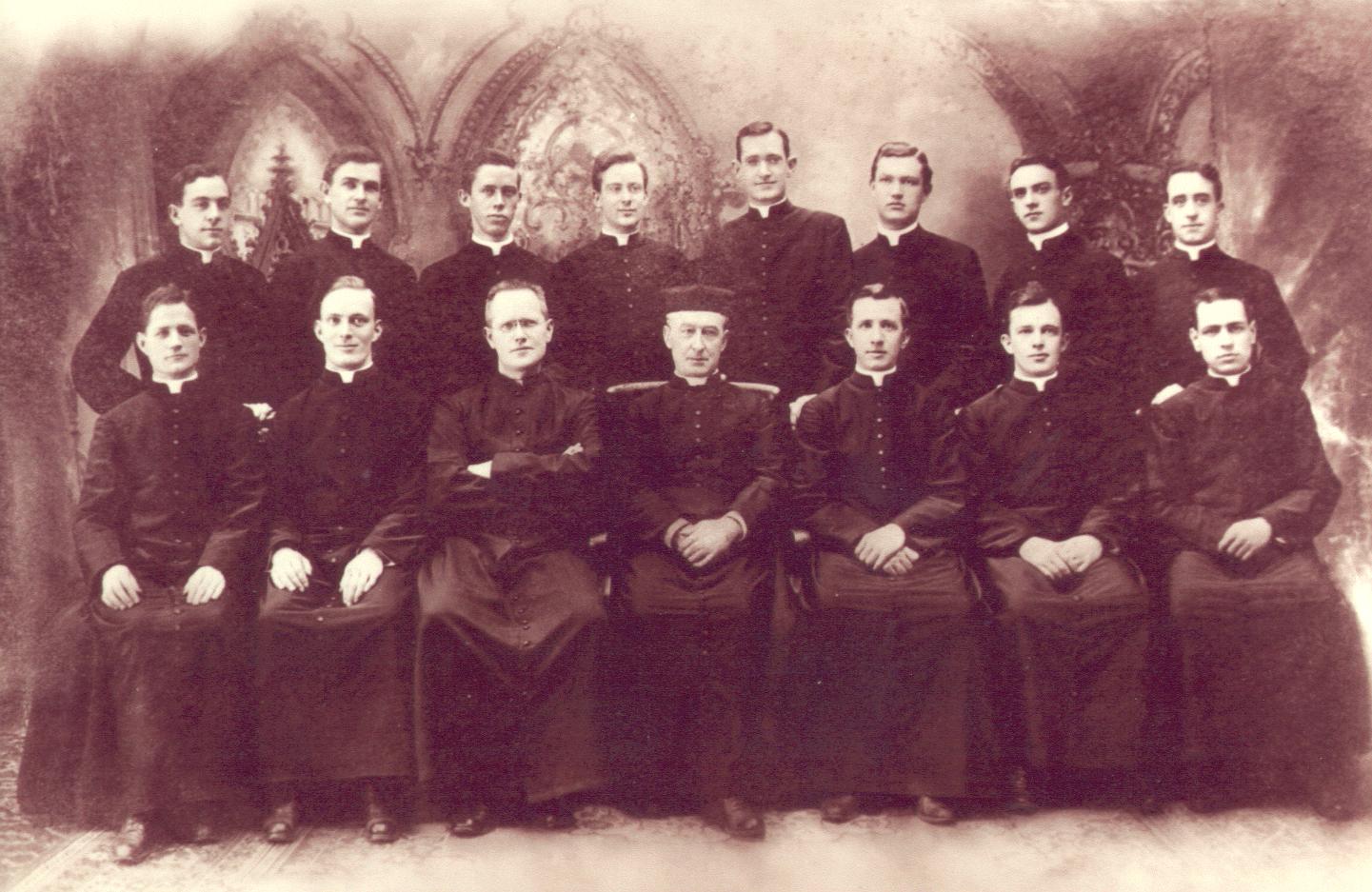
Father John Moore, C.M, was President of St. John’s University, Brooklyn, from 1906 to 1925. He is seated in the front row center wearing the biretta. With him is the ordination class of 1912 from St. John’s Seminary. Standing fifth from the left in the back row is Bernard J. Quinn (1888-1940), whose canonization cause is currently under consideration.
LIFE IN A SEMINARY.
How a Catholic Priest is Trained for His Duties.
The Long and Severe Course of Discipline and Study.
A Day’s Routine Hard Work.
Work and Small Pay.
The Brooklyn Eagle, October 19, 1890
The celebration of the jubilee of the sacerdotal ordination of Bishop Loughlin and the fact that the new diocesan seminary, at Lewis avenue and Hart street, forms the material of the general jubilee gift, makes something about the training of the Catholic priest of present interest.
Life in a seminary is divided between study and the cultivation of piety and devotion to the sacred calling to which the students aspire. The rules of discipline are strict and are carefully enforced. A student rises at 5 o’clock in summer and 5:30 in winter. Prayer, meditation and attendance at mass take up the time until 7:30, when breakfast comes. There is a short recreation then before the first class lecture at 8:15. This with study fills an hour and a half. Then fifteen minutes free time and from 11 to 11:45 the class room again. Fifteen minutes prayer and examination of conscience comes before the noon dinner hour and after it recreation until 2 o’clock. Sacred reading for half an hour follows with forty-five minutes’ preparation for the next lecture. A quarter of an hour is given to recreation before the third lecture, which lasts until 4:15. A brief rest and an hour and a half in study and fifteen minutes in prayer filled up the time to the supper hour, 7 o’clock, followed by another recreation. At 9 o’clock prayers are said, and at 9:30 all lights must be out and everybody in bed. This is the average daily routine.
Silence is required all day, except during the four hours of recreation. No one is allowed outside the seminary grounds, except by special permission. Smoking is not permitted; neither is visiting in each others’ rooms allowed. Any violation of the rules is punished by withholding ordination for six months longer and continued infractions of the regulations merits expulsion from the seminary. This severe regimen is considered necessary in order that strict compliance with the trivial details of perfect discipline may bring about the self control and equipoise required in those who have a true vocation to the priesthood. Every seminarian keeps his own room in order, making his bed and all the rest.
All the lectures, except those in sacred eloquence and physical sciences, are given in Latin. It is the language of the house. During the first two years of his course the seminarian reads an advanced course of mental philosophy and ethics. He also studies Jewish antiquities, the history of the different systems of philosophy, the physical sciences, especially their bearing on revelation, the exegesis of the Old Testament, ecclesiastical and natural theology and some modern language. In the next four years the course embraces moral and dogmatic theology, sacred scripture, exegesis, hermeneutics and history, liturgy, canon law, sacred eloquence, plain chant and Hebrew.
At the end of two years, if the student shows the necessary disposition and qualification, he receives tonsure. The head, however, is no longer shaved, except in some of the regular orders. For secular priests the bishop now merely clips the hair in five places: in the front, back and crown and over each year, according to the modified form. The other minor orders are usually conferred at intervals of six months after this and are considered as steps leading to the last grand result— sacerdotal ordination. A summer vacation of several weeks is given, during which the students generally return to their homes, where they are supposed to be under the immediate supervision of their parish priests.
When he has finished his course at the seminary the candidate is again examined on his theological acquirements, and if he passes satisfactorily he is ordained a priest by the bishop. He cannot be made a priest, however, until he has received the other orders in regular course, and two grades of sacred orders cannot be conferred on the same day. The church teaches that a priest receives supernatural power in his ordination, an indelible character, and, if rightly disposed, grace to support him in the exercise of his ministry. Having received ordination he returns to his bishop, to whom he makes a vow of obedience as his spiritual superior, and is then assigned to work in some parish.
NOTE: St. John the Baptist Seminary officially opened in 1891 in Brooklyn’s Bedford-Stuyvesant section and remained in existence until 1932. During these years over four hundred alumni were ordained priests for the Brooklyn diocese under Vincentian direction. As Vincentian historian Father Stafford Poole notes, over time it “eventually proved to be too small” to accommodate the growing number of vocations. By 1927, the diocese had 250 candidates for the priesthood, of which St. John’s could only house seventy. Its place was taken by the Seminary of the Immaculate Conception, which officially opened at Huntington, Long Island, in 1930.
Located adjacent to the seminary were St. John the Baptist Church, which The Brooklyn Eagle called “one of the finest specimens of Roman architecture in this country”; St. John the Baptist Parochial School; St. John’s Preparatory School, widely regarded in its day as one of the city’s finest high schools for boys; St. John’s University, and a Vincentian residence, which at its height housed nearly ninety priests and brothers.
Theoretically, a young man in the neighborhood could be baptized in the church, receive all his sacraments there, attend grammar school through college, study for the priesthood, and be ordained in the parish church, all without ever leaving the block. For many years priests of the Brooklyn diocese were ordained at St. John the Baptist rather than St. James Cathedral, which could only accommodate a certain number of people.
Next Post

January 27, 2011 Groundbreaking News!
Browse Our Archives
Select a Category African-American Catholics Alabama Catholics American Catholic History American Catholic women American History Anniversaries Anti-Catholicism Arkansas Catholics Benedictines Bishops Blessed John Henry Newman Book Reviews Books Boston College Brooklyn churches Brothers California Catholics Capuchins Cardinals Carlo Carretto Carmelites Catholic authors Catholic Cemeteries Catholic Historians Catholic History in Less Than 5 Minutes Catholic musicians Catholic Poetry Catholic Press Catholic School Textbook Catholic University of America Catholic Worker Catholics and Music Catholics and Race Catholics in Politics Catholics in the American Revolution Catholics in the Military Catholics in the Movies Catholics in the South Catholics in the West Catholics on Stage Catjolic Women Catolic Poetry Charles de Foucauld Children's Masses Christian Brothers Christmas Church Reform Civil Rights Movement Civil War Colleges and universities Converts D.C. Catholics Deaf Catholics Dominicans. Dorothy Day English Catholics Florida Catholics Fordham University Franciscans French Catholics Georgetown University German Americans Good Shepherd Sisters Hispanic Catholics Historians and Archivists Holy Cross Fathers Holy Name Society Idaho Catholics Illinois Catholics Indian Wars Indiana Catholics Irish Americans Irish Catholicism Italian Americans Italian Catholics Jesuits Josephite Sisters Kentucky Catholics Know-Nothings Laetare Medal Recipients laity Liturgical Movement Maine Catholics Manhattan College Maryland Catholicism Michigan Catholics Middle Ages Minnesota Catholics Missionaries Mississippi Catholics Missouri Catholics Monasteries Montana Catholics Native Americans New England Catholicism New Jersey Catholics New York Catholics North American College Ohio Catholics Oratorians Oregon Catholics Parish Mission Parishes Passionists Pat McNamara's Books Paulists Pennsylvania Catholics Popes Presidents Priests Quotations Religious Orders Rhode Island Catholics Saints Salesians Seminarians Seminaries Sermons Servants of God Siisters of Charity Sisters of Mercy South Carolina Catholics Spanish-American War Sports St. Francis of Assiai St. John Henry Newman Suplicians Tennessee Catholics Texas Catholics The year in review Thomas Merton Throwback Thursday Photograph Trappists Uncategorized University of Notre Dame Video Presentations Vincentians Virginia Catholics Visitation Nuns Washington West Point West Virginia Catholics West Viriginia Catholics Wisconsin Catholicism Women Religious World War II
Select a Month December 2020 June 2020 May 2020 April 2020 March 2020 March 2019 February 2019 January 2019 December 2018 November 2018 November 2014 October 2014 September 2014 August 2014 July 2014 June 2014 May 2014 December 2013 November 2013 October 2013 August 2013 July 2013 June 2013 May 2013 April 2013 March 2013 February 2013 January 2013 December 2012 November 2012 October 2012 September 2012 August 2012 July 2012 June 2012 April 2012 March 2012 December 2011 November 2011 October 2011 September 2011 August 2011 July 2011 June 2011 May 2011 April 2011 March 2011 February 2011 January 2011 December 2010 November 2010 October 2010 January 2010 December 2009 November 2009 October 2009 September 2009 August 2009 July 2009 June 2009 May 2009 April 2009 March 2009 February 2009 January 2009 December 2008
Follow Us!
TAKE THE
Religious Wisdom Quiz
What does the name "Jesus" mean?
Select your answer to see how you score.
The Lord Saves Prince of Peace Son of Man Chosen One
Related posts from McNamara's Blog

St. John Henry Newman and the “Special Charm...

American Catholics and Race in 2020: A Church...

“It’s About Time They Got Here”: Catholics and the...

The Struggle for an African American Priesthood
TRENDING AT PATHEOS Catholic

The Parable Of The Sower And The Word...
One of Christ’s most famous parables is that of the sower who...

Rejecting Doom: Christian Hope And Human Action
Christianity is a religion of hope. We are to have hope and...

Why I Choose the Eucharist Over the Sermon
Choose the Eucharist, Not the Sermon What are we supposed to get...

5 Design Elements Found in Spiritually Rooted Homes
Putting Spirituality Into Home Decor Our homes are more than our living...

Credo: A Story of God Told with the...
About 10 years ago, I began to imagine a personal "Credo" that...

The Anatomy of Divine Revelation in Catholic Thought
The claim that God has made Himself known to human beings is...
view all Catholic blogs
Ad-Free & Subscriber Log-In Subscription Support
- About Us
- 2026 Calendar
- Videos
- Podcasts
- Library of World Religions
- Faith In Media Tracker
- Advertise With Us
- Write for Us
- Privacy Policy
- Terms of Service
- Do Not Sell My Data
- Contact Us
- Radiant Digital
- Manage Newsletter Subscriptions
- Unsubscribe From Notifications
- Sitemap
Copyright 2008-2026, Patheos. All rights reserved.
Subscription Support Ad-Free & Subscriber Log-In
Follow Patheos