
BuddhistCatholicContemplativeEvangelicalGeneral ChristianHinduJewishLatter-day SaintMuslimNew VisionsProgressive Christian
Beliefs
- Buddhist
- Catholic
- Contemplative
- Evangelical
- General Christian
- Hindu
- Jewish
- Latter-day Saint
- More Voices
- Muslim
- New Visions
- Pagan
- Progressive Christian
Topics
- Religion News
- Food and Religion
- Sports and Religion
- Religious Art
- Religious Music and Entertainment
- Religious Events
- History and Religion
- Style and Religion
- Politics and Religion
- Women in Religion
- Recreation Outdoors and Religion
- Business Finance and Religion
- Careers Workplace and Religion
- Education and Religion
- Family Parenting and Religion
- Health Fitness and Religion
- Home and Religion
- Relationships and Religion
- Technology and Religion
- Travel and Religion
Columnists
- Buddhist Columnists
- Business Finance and Religion Columnists
- Careers Workplace and Religion Columnists
- Catholic Columnists
- Contemplative Columnists
- Education and Religion Columnists
- Evangelists Columnists
- Family Parenting and Religion Columnists
- General Christian Columnists
- Health Fitness and Religion Columnists
- Hindu Columnists
- History and Religion Columnists
- Home and Religion Columnists
- Jewish Columnists
- More Voices Columnists
- Latter Day Columnists
- Muslim Columnists
- New Visions Columnists
- Nonreligious Columnists
- Pagan Columnists
- Politics and Religion Columnists
- Progressive Columnists
- Recreation Outdoors and Religion Columnists
- Relationships and Religion Columnists
- Religion News Columnists
- Religious Art Columnists
- Religious Events Columnists
- Religious Music and Entertainment Columnists
- Sports and Religion Columnists
- Style and Religion Columnists
- Technology and Religion Columnists
- Travel and Religion Columnists
- Women in Religion Columnists
Resource Library
- 2026 Calendar
- Library of World Religions
- The 100 Most Holy Places on Earth
- Patheos Answers
- Podcasts
- Videos
- Faith Leaders Database
- Anglican Episcopalian
- Bahai
- Baptist
- Buddhism
- Christianity
- Confucianism
- Eastern Orthodoxy
- Hinduism
- Holiness and Pentecostal
- ISKCON
- Islam
- Judaism
- Lutheran
- Methodist
- The Church of Jesus Christ of Latter-day Saints
- New Age
- Paganism
- Presbytarian and Reformed
- Protestantism
- Religion Behind the Scenes
- Roman Catholic
- Scientology
- Shia Islam
- Sikhism
- Sufism
- Sunni Islam
- Taoism
- Zen
- See all religions
Research Tools
 Ad-Free & Subscriber Log-In Subscription Support
Ad-Free & Subscriber Log-In Subscription Support
Follow Patheos 

- Trending:
- Forgiveness
- |
- Marriage
- |
- Consciousness
- |
- Death Penalty
- |
- Election
- |
- Halloween
 For Puck's Sake
- Home
- Pagan
- Happy!: Grant Morrison, Tulpas, and Bronies
Happy!: Grant Morrison, Tulpas, and Bronies
Last updated on: August 2, 2019 at 4:39 pm by Mat Auryn
Happy!: Grant Morrison, Tulpas, and Bronies 2019-08-02T16:39:49+00:00 Mat Auryn
Patheos Explore the world's faith through different perspectives on religion and spirituality! Patheos has the views of the prevalent religions and spiritualities of the world.

Image Credit: Happy!
A night of looking for something to watch on Netflix took me down some weird rabbit holes on the internet that I couldn’t not share. Scrolling through my app looking for something to cast onto my television it recommended that I would like a show called “Happy!” The preview image grabbed me and the synopsis was bizarre enough to peak my interests – “A boozy ex-cop turned hit man thinks he’s losing his marbles when a cartoon unicorn only he can see urges him to rescue a girl kidnapped by Santa.” So I looked up a trailer and it said it was based on a graphic novel, so I looked that graphic novel up and two words sold me on it: “Grant Morrison.” Needless to say that I binged the show pretty quickly.
The Syfy/Netflix show ‘Happy!’ has a surreal bizarreness that you adapt to quickly. It’s sort of like if you took Sin City, Who Framed Roger Rabbit?, and My Little Pony and put them into a blender. It’s extremely graphically violent, hilarious at points, and surprisingly charmingly sweet. Plus, aside from what is discussed in this article it also has a Strega character and there are hints at themes of necromancy and spirit possession.
I’m going to try hard to not spoil the story too much for those who haven’t watched the show yet or read the graphic novel that it’s based upon. Essentially, Happy is the self-identified imaginary friend of a little girl named Hailey who seeks out Nick Sax to rescue her. Despite seeming like a hallucination of Nick’s mind, it soon becomes evident that this is something more than a hallucination. Happy can do things like check to see how many people are coming, reveal the cards others are holding during poker to Nick, and other surprising traits that rule out the idea that it’s a figment of Nick’s imagination – as Happy can know things that Nick doesn’t. Furthermore, children and a crack-smoking nutcase dressed as Santa can also perceive Happy. We see something else very interesting when Happy begins losing his hair, dulling in color, and slowly falling apart when Hailey begins losing hope that Happy is going to help save her.
“Tulpamancy”
While watching the show I quickly concluded that Happy was an artificial servitor spirit. An artificial servitor spirit (sometimes referred to classically as a ‘thought-form’) in occultism was first popularized in Theosophy and embraced in occultism, though it can vary from being sentient and having a form to sort of energy blobs that affect a person. Essentially, a thought-form in the sense of an “artificial servitor spirit”, is a form that is sculpted using mental, emotional, and astral energies of the occultist which then begin to take on an autonomous personality of its own. Artificial servitor spirits are often used to perform certain tasks, fetch things, or protect. They can usually be perceived by psychics outside of the creator. The idea is similar but different to concepts of egregores (or godforms), which are created and maintained by groups which become a sort of vessel into which a spirit or deity can enter into and empower.
I assumed that the similarities between this “imaginary friend” and the characteristics portrayed by Happy must be intentional since it’s Grant Morrison who wrote it. Grant Morrison is completely out of his mind in the best way possible. Grant Morrison is not only well-known in comic circles but also occult circles. As a practicing chaos magician, Grant Morrison often weaves in occult and metaphysical ideas into his works.
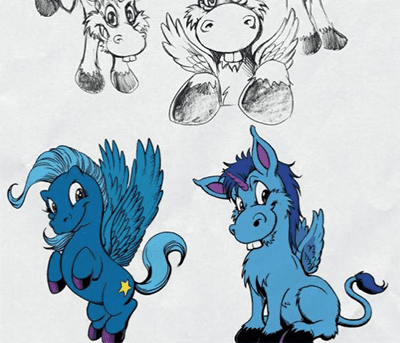
Image Source: Happy! Deluxe Edition
I decided to check out the graphic novel and was struck by what appears to be concept art for Happy, where he looks exactly like a pony from My Little Pony. I randomly searched the internet for My Little Pony and thought-forms and discovered that there’s a whole subculture marriage of people who are creating thought-forms based off of My Little Pony. The first group of people are called “tulpamancers” who perform “tulpamancy” and refer to their thoughtforms as “tulpas”, which is a misunderstanding of the term as we’ll see later on. As of today there are over 22 thousand members of the r/Tulpas subreddit forum.
Enter the Bronies
The second subculture are “bronies.” Bronies are adult male fans of My Little Pony. Somehow the two subcultures cross-pollinated and we now have a whole area of the internet where people are discussing their pony tulpas they’ve created. While not all brony tulpamancers are into it, a large portion seem to be creating their brony tulpas for sexual or romantic purposes. Whether Grant Morrison was conscious of this or not, it’s interesting to see that there’s also a sort of furry kink underground in ‘Happy!’ too, though they’re insects. Furries are people who dress up or identify as cartoon anthropomorphic animals and just like the brony tulpamancers, there’s a large portion that of the subculture that use it as a kink. We also see the parallel of a little girl’s imaginary friend and an adult male pairing up, just as My Little Pony was and is meant for little girls as their demographic yet has an unexpected adult male following.
“The My Little Pony fandom was one of the first online communities to really grab hold of the tulpa phenomenon,” a tulpamancer told Vice. “Bronies are very accepting of weirdness; they have that mindset of, ‘Wow, that’s not normal; that’s cool.’ The [My Little Pony] characters evoke a simple goodness… what fan wouldn’t want one for a friend?”
Shoddy Occultism & Metaphysics
While I’m not inherently against bronies, I am a little bit concerned about this. I mean, if they’re not harming anyone they can be fans of whatever they want – and I say more power to them. Different strokes for different folks. But as someone who teaches workshops on artificial servitors, I am a bit troubled by this tulpa phenomenon. The reason being is that the directions often provided in these groups to create the tulpa are not wise. That isn’t to say that they’re incorrect or that people shouldn’t or can’t make My Little Pony thoughtforms. But how they’re going about it is a bit unwise.
If an artificial servitor spirit is successfully created, it can be hard to control and even turn against the creator if made shoddily. Like any form of magick, one wants to ensure that they have every base covered. When making an artificial servitor spirit, one should have a fair amount of magickal will and training before attempting the task and more importantly clear and concise directions should be programmed into the servitor spirit – including a self-destruct or dismantling command. Most occultists who’ve worked with artificial servitor spirits have stories about their experiments getting out of hand before getting the hang on creation.
This is particularly true if the creator has not done self-introspective work. The artificial servitor being composed of one’s own thoughts and emotions and astral energy is exactly that – an extension of the magician. If the magician has not done the necessary shadow work and self-mastery it can and often will reflect that in the servitor spirit itself. If your head and emotions are a mess, that’s what you’re creating the servitor out of. They can also become parasitic in some cases and in others just run completely amok and out of control. Which is why, despite being a heavily mocked screenshot from 4chan, this post isn’t that far outside the realities of a servitor spirit gone wrong:
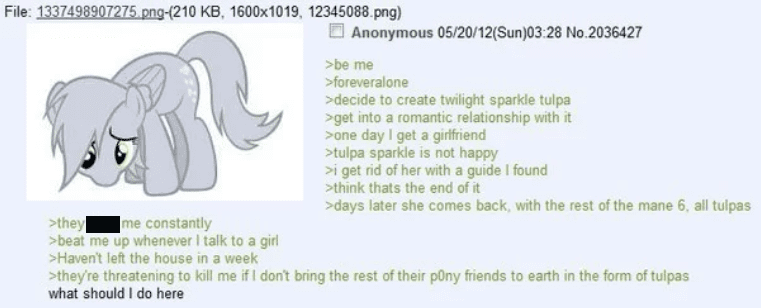
But That’s Not Quite What A Tulpa Actually Is
Despite the use of the word “tulpa” I know from other occultists who are more familiar with Tibetan Buddhism and Tibetan Sorcery that a tulpa isn’t equivalent to a thought-form. So I reached out to author and occultist Jason Miller, whom I know is trained in these areas and has spent time in Nepal to ask him what a tulpa actually was.
“”Mystiques et Magiciens du Tibet” was the name of the book that Alexandria David Neel wrote in 1928, published in 1931 as “With Mystics and Magicians in Tibet” in English. In that book Neel details her experiment making what we call today a servitor, and what she called a “Tulpa”. Because she did not want to be influenced by the “forms of the Lamaist Deities” which she saw around her in paintings and images she decided to create a short fat jolly monk. She shut herself up for several months and formed the phantom monk, which supposedly did the things normal travelers did and was occasionally seen by members of their traveling party.
Eventually, though the Monk became gaunt and mean. In her words, the experience turned into a “daynightmare”. She decided to dissolve the Tulpa before making her trip to Lhasa, but the creature fought back. According to her book, it took her six months of hard struggle to dissolve the Tulpa.
It is this story, now 85 years old, that gets referred to time and time again in any book that mentions Tulpas. When I started my study of Tibetan Buddhism, with an emphasis on sorcerous practices, of course, I found it quite odd that occultists keep going back to this story from the 1920s. At the time it was written Tibet was closed to outsiders and there was very little information available, but today it is 50 years after the Chinese invasion of Tibet and there are Lamas, monasteries, dharma centers, and teachers all over the western world. There are thousands of books by actual Tibetan detailing the once-secret practices of Tibetan magic and mysticism – so why then are we relying upon an 85-year-old account from a foreigner as the primary source for information on Tulpas?
There are Lamas everywhere, today, yet no western occultists thought to ask one about Tulpas before writing about them in their books on Thoughtforms, Servitors and Artificial Spirits. I made it my mission to ask every Lama that I could about the practice, and after asking dozens of Lamas, I arrived at the secret. Want to hear it? Here it is…
THE SECRET OF THE TULPA IS…
All of those books are wrong.
Now before you e-mail me the Wikipedia page showing that Tulpa is a real word, let me assure you that certainly, the word Tulpa is a real word. It even translates as “mind emanation” so the confusion is understandable. In Tibetan Buddhism this mind emanation is not a created spirit though, it gets used in other ways.
In some cases, the term is used for when a great Siddha emanates a body that his own consciousness would inhabit. In terms of western occultism, this is more like an astral body than a servitor. Such was the case when Garab Dorje’s mother thought he was a Nirmita (Tulpa) because his body was indestructible. This body, however, is visible to the naked eye, not an invisible astral projection, and certainly not a made up construction brought to consciousness through magic.
In the Dzogchen classic, Nang Jang, the author uses the example of a Tulpa for pointing out how reality arises from the base of being in the same way that a phantom appears from nothing but has no essential substance or reality of its own. This would be more like the casting of an illusion or mirage than the creation of a servitor.
In neither of these cases is the Tulpa anything like an artificial spirit that goes about on its own or is sent accomplish tasks for the magician. I am not denying that you can do this with magic – indeed I have done it – but that is not what a Tulpa is.”
– Jason Miller
Or the TL;DR version:
“In 1928 Alexandria David Neel misapplied a Tibetan term to her own thought form experiment – what we would now call a Tulpa. She was an amazing explorer and Tibetologist who made a mistake as all ground-breakers do.
Because so much of modern western occultism is rooted in the era of Crowley, Theosophy, and other early 20th century movements – Western Occultists naturally latched on to this term.
Unfortunately, even though Tibetan Lamas have been coming to the west for over 50 years now, offering secret teachings, translations, and empowerment – Occultists and Magicians have mostly ignored them.
The kind of “mental projection” indicated by the word Tulpa is more like a magicians astral body, or an illusion. If it cannot be seen by onlookers it is not a Tulpa.”
– Jason Miller
My Recommended Reading For Creating Artificial Servitors
Magical Use of Thought Forms: A Proven System of Mental & Spiritual Empowerment by Dolores Ashcroft-Nowicki and J. H. Brennan
Magickal Servitors: Create Your Own Spirits to Attract Pleasure, Power and Prosperity by Damon Brand
Creating Magickal Entities: A Complete Guide to Entity Creation by David Michael Cunningham
Thought Forms by Annie Besant and C. W. Leadbeater
Related Articles
Graphic Novels For Occultists
The Mysticism, Spirituality & Occultism of The Dark Crystal
The Real Witchcraft in The Chilling Adventures of Sabrina
A Witch Interprets ‘God Is A Woman’ by Ariana Grande
Westeros Deities, Astrology & Tarot
Hekate: Queen of Sorcery
Review: Elements of Spellcrafting
Review: The Sorcerer’s Secrets
Review: Protection & Reversal Magick
The Sorcery of Hekate
Connect With Me:
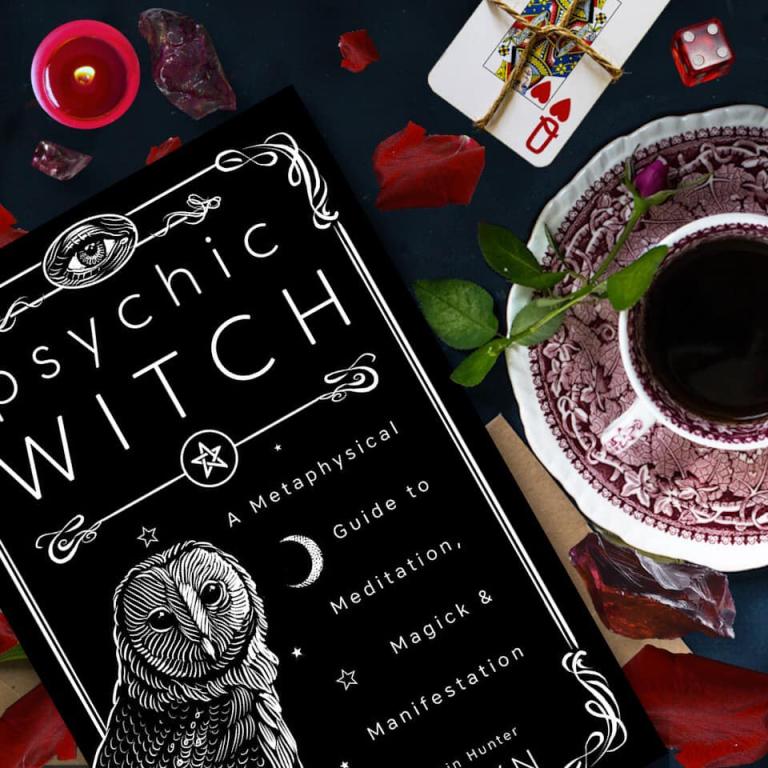
Click Below To Purchase My Book:
Previous Post
January 15, 2019
Review: The Robin Wood Tarot
Next Post

January 19, 2019 Best Books On Plant Magick
Browse Our Archives
Select a Category Book Reviews Deck Reviews Interviews Musings Uncategorized
Select a Month December 2021 November 2021 October 2021 August 2021 March 2021 December 2020 November 2020 October 2020 September 2020 August 2020 June 2020 May 2020 April 2020 February 2020 January 2020 December 2019 November 2019 October 2019 September 2019 August 2019 July 2019 June 2019 May 2019 April 2019 March 2019 February 2019 January 2019 December 2018 November 2018 October 2018 September 2018 August 2018 July 2018 June 2018 May 2018 April 2018 March 2018 February 2018 January 2018 December 2017 November 2017 October 2017 September 2017 August 2017 July 2017 June 2017 May 2017 April 2017
Follow Us!
TAKE THE
Religious Wisdom Quiz
True or False: 2 Peter warns that false teachers will secretly introduce destructive heresies.
Select your answer to see how you score.
FALSE TRUE
Related posts from For Puck's Sake
How to Spot a Spiritual Impersonator Scam on...

The Titanic Women of Llewellyn
Becoming A Part of Witch History At The...

Watch Llewellyn's Author Forum: Love Spells
TRENDING AT PATHEOS Pagan

I was recently chatting with someone on Instagram. She asked me what...

While there are many people who share their results, the end of...

On July 23, I saw Christopher Nolan's The Odyssey which is Homer’s...

As I write this two big events have just finished up. One...

Restoring the Watershed of Divine Love
Perhaps cooperation is not something we manufacture through legislation, ideology, or moral...

Many UUs don’t pray because of bad experiences in a previous religion,...
view all Pagan blogs
Ad-Free & Subscriber Log-In Subscription Support
- About Us
- 2026 Calendar
- Videos
- Podcasts
- Library of World Religions
- Faith In Media Tracker
- Advertise With Us
- Write for Us
- Privacy Policy
- Terms of Service
- Do Not Sell My Data
- Contact Us
- Radiant Digital
- Manage Newsletter Subscriptions
- Unsubscribe From Notifications
- Sitemap
Copyright 2008-2026, Patheos. All rights reserved.
Subscription Support Ad-Free & Subscriber Log-In
Follow Patheos