
BuddhistCatholicContemplativeEvangelicalGeneral ChristianHinduJewishLatter-day SaintMuslimNew VisionsProgressive Christian
Beliefs
- Buddhist
- Catholic
- Contemplative
- Evangelical
- General Christian
- Hindu
- Jewish
- Latter-day Saint
- More Voices
- Muslim
- New Visions
- Pagan
- Progressive Christian
Topics
- Religion News
- Food and Religion
- Sports and Religion
- Religious Art
- Religious Music and Entertainment
- Religious Events
- History and Religion
- Style and Religion
- Politics and Religion
- Women in Religion
- Recreation Outdoors and Religion
- Business Finance and Religion
- Careers Workplace and Religion
- Education and Religion
- Family Parenting and Religion
- Health Fitness and Religion
- Home and Religion
- Relationships and Religion
- Technology and Religion
- Travel and Religion
Columnists
- Buddhist Columnists
- Business Finance and Religion Columnists
- Careers Workplace and Religion Columnists
- Catholic Columnists
- Contemplative Columnists
- Education and Religion Columnists
- Evangelists Columnists
- Family Parenting and Religion Columnists
- General Christian Columnists
- Health Fitness and Religion Columnists
- Hindu Columnists
- History and Religion Columnists
- Home and Religion Columnists
- Jewish Columnists
- More Voices Columnists
- Latter Day Columnists
- Muslim Columnists
- New Visions Columnists
- Nonreligious Columnists
- Pagan Columnists
- Politics and Religion Columnists
- Progressive Columnists
- Recreation Outdoors and Religion Columnists
- Relationships and Religion Columnists
- Religion News Columnists
- Religious Art Columnists
- Religious Events Columnists
- Religious Music and Entertainment Columnists
- Sports and Religion Columnists
- Style and Religion Columnists
- Technology and Religion Columnists
- Travel and Religion Columnists
- Women in Religion Columnists
Resource Library
- 2026 Calendar
- Library of World Religions
- The 100 Most Holy Places on Earth
- Patheos Answers
- Podcasts
- Videos
- Faith Leaders Database
- Anglican Episcopalian
- Bahai
- Baptist
- Buddhism
- Christianity
- Confucianism
- Eastern Orthodoxy
- Hinduism
- Holiness and Pentecostal
- ISKCON
- Islam
- Judaism
- Lutheran
- Methodist
- The Church of Jesus Christ of Latter-day Saints
- New Age
- Paganism
- Presbytarian and Reformed
- Protestantism
- Religion Behind the Scenes
- Roman Catholic
- Scientology
- Shia Islam
- Sikhism
- Sufism
- Sunni Islam
- Taoism
- Zen
- See all religions
Research Tools
 Ad-Free & Subscriber Log-In Subscription Support
Ad-Free & Subscriber Log-In Subscription Support
Follow Patheos 

- Trending:
- Forgiveness
- |
- Marriage
- |
- Consciousness
- |
- Death Penalty
- |
- Election
- |
- Halloween
 For Puck's Sake
- Home
- Pagan
- A Brief History of The Krampus
A Brief History of The Krampus
Last updated on: December 6, 2019 at 4:17 pm by Mat Auryn
A Brief History of The Krampus 2019-12-06T16:17:50+00:00 Mat Auryn
Patheos Explore the world's faith through different perspectives on religion and spirituality! Patheos has the views of the prevalent religions and spiritualities of the world.
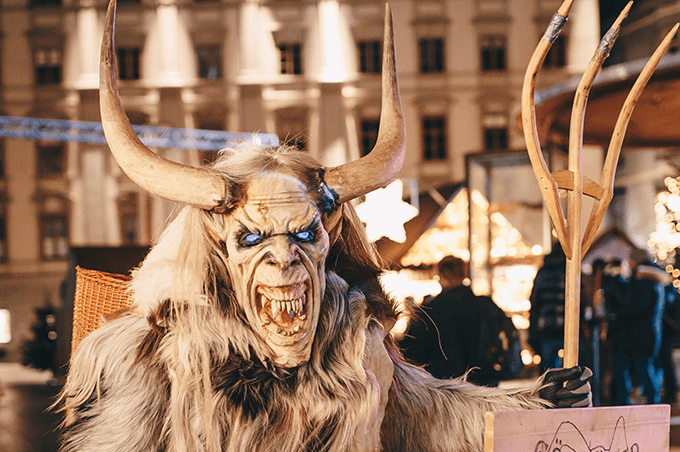
Image Credit: Calin-Andrei Stan | Standard License
Deriving his name from the word “krampen” meaning “claw,” the Krampus is described as half-goat, half-demon; a satyr-like spirit who travels with Saint Nicholas and divines whether children have been naughty or nice. If naughty, one would be lucky merely to receive a beating from the Krampus with his birch twigs or to have one’s pigtails ripped out. In worst-case scenarios, he would lead children off a cliff in Pied Piper fashion, throw them in frozen lakes, drown them in his own bathtub, stab and eat them with a pitchfork, or capture them in his sack to be carried off directly to the Underworld.
The Krampus is believed to be the remnant of pre-Christian Alpine traditions of heathenry and paganism, originating Austria, Germany, and the Czech Republic. However, there’s very little hard evidence left that we can trace to prove this notion. Despite this, Maurice Bruce wrote in The Journal of Folklore 1958 that “there seems to be little doubt as to his true identity for, in no other form is the full regalia of the Horned God of the Witches so well preserved. The birch – apart from its phallic significance – may have a connection with the initiation rites of certain witch-covens; rites which entailed binding and scourging as a form of mock-death. The chains could have been introduced in a Christian attempt to ‘bind the Devil’ but again they could be a remnant of pagan initiation rites.”1
Some believe that the Krampus was originally a spirit of purification and warding, as scourging is usually seen as a ritual act of purification. He is also related to other traditions associated with this time of year, such as the Perchten. The Perchten were the entourage spirits of Frau Perchta, a goddess sometimes associated with Holda and Frigga. Jacob Grimm, a collector of folktales and the editor of the famous Grimm’s Fairy Tales stated that Frau Perchta, as the guardian of beasts, was responsible for the Krampus. The Perchta were divided into two groups; the Schönperchten, who were the beautiful and kind spirits, and the Schiachperchten, the ugly and wild spirits in her retinue. The Schiachperchten are depicted as hairy and horned satyr-monsters, and much like the Krampus, they went door-to-door to drive away evil spirits, ghosts, and demons.
We see a similar tradition with the Krampus. On December 5th, known as Krampusnacht (or “Krampus night”), young men donned masks, goat horns, and animal fur costumes to represent the Krampus and travelled door-to-door, demanding libations of alcohol (customarily Schnapps liquor). As these men became drunker and drunker (perhaps possessed by the spirit of the Krampus they were emulating), they began accusing the people they met of their misdeeds and sins and threatening to beat them as punishment. Here we even see a hint of the archetype of Satan as the divine accuser, contrasted by Saint Nicholas as a holy benefactor.
This drunken procession called the Krampuslauf (meaning “Krampus run”), would soon turn into chaos and riots—and the men dressed as Krampus would turn from chasing children to chasing women as they grew increasingly more intoxicated. We see recurring themes here, which echo those of the Yule Goat, a similar spirit who was once the focus of fertility rites during the winter. The Yule Goat, believed to be of Proto-Indo-European origin, would have women sit upon his lap during his procession from house to house. (This may even be the origin of sitting on Santa’s lap.) The Krampus’ sexuality, like that of nearly every other horned pagan deity, hasn’t died either. The tradition of Krampuskarten (or “Krampus cards”) —comparable to the greeting cards exchanged for Christmas or Yule—evolved from illustrating the Krampus abducting or punishing children, to depicting very sadomasochistic, sexually themed cards where he’s pursuing and spanking women (or vice versa).
The Krampus is a persistent spirit who can’t seem to be erased by either religion or government. He was denounced by the Church and by fascist rule in Austria in 1934 and 1938. He’s been called a symbol of anti-Christianity, sinfulness, wickedness, and even social democracy. The Krampus has been repeatedly boycotted and denounced by child psychologists since 1953 for being psychologically scarring. Despite all the attempts to suppress this winter spirit, he remains more popular than ever right now, making appearances in pop culture through the media of movies, books, and television shows. Sometimes you just can’t keep a wild demon bound. Even when shown chained and restrained (a motif, it should be noted, that was added to his depiction by the Church), the Krampus continues to roam wild and free.
1. Bruce, Maurice (March 1958). “The Krampus in Styria”. Folklore. 69 (1): 44–47↩
View this post on Instagram
A post shared by Mat Auryn (@matauryn) on Sep 7, 2018 at 1:44pm PDT
This article of mine was originally published in the Winter Solstice 2017 issue of Horns Magazine and reproduced here with permission.
Related Articles:
Mat Auryn – This Fashionista Cat Devours People To Celebrate Yule
Mat Auryn – The Child-Eating Scarecrow Of Christmas
Mat Auryn -The Mischievous Tomte Spirits of Yule
Mat Auryn – A Brief History of The Krampus
Mat Auryn – What Is The Winter Solstice?
Mat Auryn – Seasonal Depression & The Winter Solstice
Connect With Me:
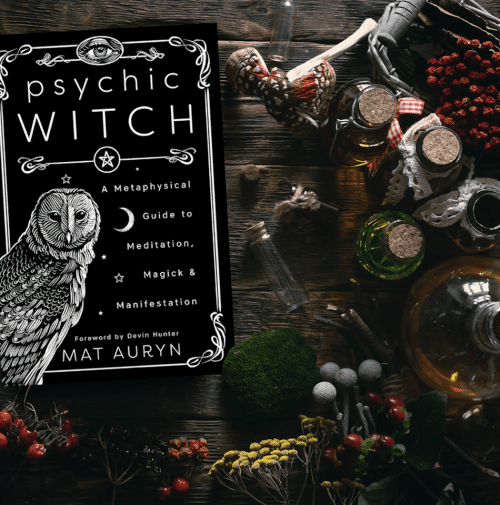
Click Below To Purchase My Book:
Previous Post

November 25, 2018
Review: The Holy Wild: A Heathen Bible for the Untamed Woman
Next Post

December 6, 2018 Chris Allaun on Shamanism, Witchcraft, and Ancestors
Browse Our Archives
Select a Category Book Reviews Deck Reviews Interviews Musings Uncategorized
Select a Month December 2021 November 2021 October 2021 August 2021 March 2021 December 2020 November 2020 October 2020 September 2020 August 2020 June 2020 May 2020 April 2020 February 2020 January 2020 December 2019 November 2019 October 2019 September 2019 August 2019 July 2019 June 2019 May 2019 April 2019 March 2019 February 2019 January 2019 December 2018 November 2018 October 2018 September 2018 August 2018 July 2018 June 2018 May 2018 April 2018 March 2018 February 2018 January 2018 December 2017 November 2017 October 2017 September 2017 August 2017 July 2017 June 2017 May 2017 April 2017
Follow Us!
TAKE THE
Religious Wisdom Quiz
Which disciple betrayed Jesus for 30 pieces of sliver?
Select your answer to see how you score.
Peter Andrew Judas Mary Magdalene
Related posts from For Puck's Sake

How to Spot a Spiritual Impersonator Scam on...

Review: The Eclectic Witch's Book of Shadows
TRENDING AT PATHEOS Pagan

I was recently chatting with someone on Instagram. She asked me what...

While there are many people who share their results, the end of...

On July 23, I saw Christopher Nolan's The Odyssey which is Homer’s...

As I write this two big events have just finished up. One...

Restoring the Watershed of Divine Love
Perhaps cooperation is not something we manufacture through legislation, ideology, or moral...

Many UUs don’t pray because of bad experiences in a previous religion,...
view all Pagan blogs
Ad-Free & Subscriber Log-In Subscription Support
- About Us
- 2026 Calendar
- Videos
- Podcasts
- Library of World Religions
- Faith In Media Tracker
- Advertise With Us
- Write for Us
- Privacy Policy
- Terms of Service
- Do Not Sell My Data
- Contact Us
- Radiant Digital
- Manage Newsletter Subscriptions
- Unsubscribe From Notifications
- Sitemap
Copyright 2008-2026, Patheos. All rights reserved.
Subscription Support Ad-Free & Subscriber Log-In
Follow Patheos