
BuddhistCatholicContemplativeEvangelicalGeneral ChristianHinduJewishLatter-day SaintMuslimNew VisionsProgressive Christian
Beliefs
- Buddhist
- Catholic
- Contemplative
- Evangelical
- General Christian
- Hindu
- Jewish
- Latter-day Saint
- More Voices
- Muslim
- New Visions
- Pagan
- Progressive Christian
Topics
- Religion News
- Food and Religion
- Sports and Religion
- Religious Art
- Religious Music and Entertainment
- Religious Events
- History and Religion
- Style and Religion
- Politics and Religion
- Women in Religion
- Recreation Outdoors and Religion
- Business Finance and Religion
- Careers Workplace and Religion
- Education and Religion
- Family Parenting and Religion
- Health Fitness and Religion
- Home and Religion
- Relationships and Religion
- Technology and Religion
- Travel and Religion
Columnists
- Buddhist Columnists
- Business Finance and Religion Columnists
- Careers Workplace and Religion Columnists
- Catholic Columnists
- Contemplative Columnists
- Education and Religion Columnists
- Evangelists Columnists
- Family Parenting and Religion Columnists
- General Christian Columnists
- Health Fitness and Religion Columnists
- Hindu Columnists
- History and Religion Columnists
- Home and Religion Columnists
- Jewish Columnists
- More Voices Columnists
- Latter Day Columnists
- Muslim Columnists
- New Visions Columnists
- Nonreligious Columnists
- Pagan Columnists
- Politics and Religion Columnists
- Progressive Columnists
- Recreation Outdoors and Religion Columnists
- Relationships and Religion Columnists
- Religion News Columnists
- Religious Art Columnists
- Religious Events Columnists
- Religious Music and Entertainment Columnists
- Sports and Religion Columnists
- Style and Religion Columnists
- Technology and Religion Columnists
- Travel and Religion Columnists
- Women in Religion Columnists
Resource Library
- 2026 Calendar
- Library of World Religions
- The 100 Most Holy Places on Earth
- Patheos Answers
- Podcasts
- Videos
- Faith Leaders Database
- Anglican Episcopalian
- Bahai
- Baptist
- Buddhism
- Christianity
- Confucianism
- Eastern Orthodoxy
- Hinduism
- Holiness and Pentecostal
- ISKCON
- Islam
- Judaism
- Lutheran
- Methodist
- The Church of Jesus Christ of Latter-day Saints
- New Age
- Paganism
- Presbytarian and Reformed
- Protestantism
- Religion Behind the Scenes
- Roman Catholic
- Scientology
- Shia Islam
- Sikhism
- Sufism
- Sunni Islam
- Taoism
- Zen
- See all religions
Research Tools
 Ad-Free & Subscriber Log-In Subscription Support
Ad-Free & Subscriber Log-In Subscription Support
Follow Patheos 

- Trending:
- Forgiveness
- |
- Marriage
- |
- Consciousness
- |
- Death Penalty
- |
- Election
- |
- Halloween
 For Puck's Sake
- Home
- Pagan
- The Etymology of Auras
The Etymology of Auras
Last updated on: March 31, 2019 at 2:01 am by Mat Auryn
The Etymology of Auras 2019-03-31T02:01:38+00:00 Mat Auryn
Patheos Explore the world's faith through different perspectives on religion and spirituality! Patheos has the views of the prevalent religions and spiritualities of the world.

Image Credit: Dmitry Bayer | CC0 License
The word aura comes from the Latin word aurae which means a breeze. In Greco-Roman mythology, four gods personified the four cardinal winds. These gods were called the Anemoi. The Anemoi had daughters who were the nymphs of the breezes. These nymphs were called the Aurae. There was also the principal goddess of breezes who was named Aura. Aura and the Aurae were depicted in classical art as having a velifactio, which was a piece of fabric that would billow in the breeze behind them.
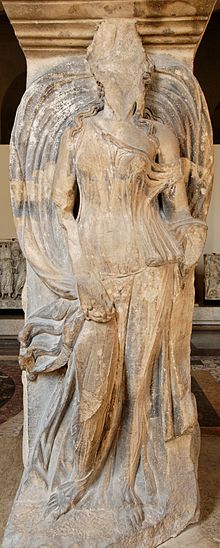
Aura velificans, caryatid from the agora of Thessalonica (late 2nd–early 3rd century)
This velifacatio would frame around them in an egg-shaped layer, which is reminiscent of how the aura looks to the eye. The velifacatio represented celestial energy, or what we might call astral energy in modern times, as the word astral is rooted in the latin astra/astro/astrum which means connected to the stars. Later, the velifacatio would be depicted in art behind deities, royalty, and people of a certain quality of spiritual power. This is similar to how halos are used in art to illustrate a holy person, which is also a reference to the aura of a person. I’m sure you’ve heard the expression that someone has an “air about them.” This expression points to the idea of an aura that a person has.
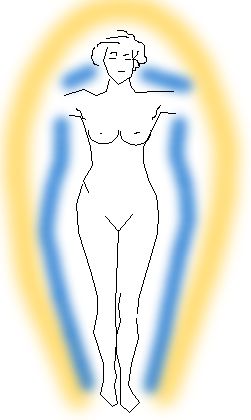
Representation of a human aura, after a diagram by Walter John Kilner (1847–1920).
The word Aura is very similar to the word Aurora. Aurora was the goddess of the dawn, and her name means “morning light” or “dawn.” Aurora and Aura were conflated by Roman writers such as Ovid in the Metamorphosis. I think this gives another layer of meaning of why we use the word aura for the energy field. So not only is a non-physical “air” about a person that appears in layers, but it’s also colored light just as the dawn sky is filled with various colored lights all blending into one another, just as the aura around a person appears.
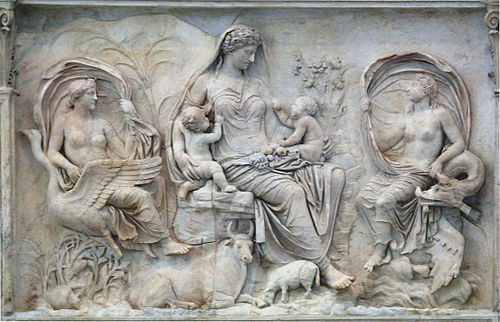
A pair of velificantes on the Augustan Altar of Peace (late 1st century BC)
Connect With Me
Previous Post
July 6, 2018
Review: The Enchanted Candle
Next Post

July 14, 2018 A Witch Interprets 'God Is A Woman' by Ariana Grande
Browse Our Archives
Select a Category Book Reviews Deck Reviews Interviews Musings Uncategorized
Select a Month December 2021 November 2021 October 2021 August 2021 March 2021 December 2020 November 2020 October 2020 September 2020 August 2020 June 2020 May 2020 April 2020 February 2020 January 2020 December 2019 November 2019 October 2019 September 2019 August 2019 July 2019 June 2019 May 2019 April 2019 March 2019 February 2019 January 2019 December 2018 November 2018 October 2018 September 2018 August 2018 July 2018 June 2018 May 2018 April 2018 March 2018 February 2018 January 2018 December 2017 November 2017 October 2017 September 2017 August 2017 July 2017 June 2017 May 2017 April 2017
Follow Us!
TAKE THE
Religious Wisdom Quiz
How many days did God take to create the world?
Select your answer to see how you score.
Seven Two Six Ten
Related posts from For Puck's Sake

How to Spot a Spiritual Impersonator Scam on...

Review: The Eclectic Witch's Book of Shadows


TRENDING AT PATHEOS Pagan

I was recently chatting with someone on Instagram. She asked me what...

While there are many people who share their results, the end of...

On July 23, I saw Christopher Nolan's The Odyssey which is Homer’s...

As I write this two big events have just finished up. One...

Restoring the Watershed of Divine Love
Perhaps cooperation is not something we manufacture through legislation, ideology, or moral...

Many UUs don’t pray because of bad experiences in a previous religion,...
view all Pagan blogs
Ad-Free & Subscriber Log-In Subscription Support
- About Us
- 2026 Calendar
- Videos
- Podcasts
- Library of World Religions
- Faith In Media Tracker
- Advertise With Us
- Write for Us
- Privacy Policy
- Terms of Service
- Do Not Sell My Data
- Contact Us
- Radiant Digital
- Manage Newsletter Subscriptions
- Unsubscribe From Notifications
- Sitemap
Copyright 2008-2026, Patheos. All rights reserved.
Subscription Support Ad-Free & Subscriber Log-In
Follow Patheos