
BuddhistCatholicContemplativeEvangelicalGeneral ChristianHinduJewishLatter-day SaintMuslimNew VisionsProgressive Christian
Beliefs
- Buddhist
- Catholic
- Contemplative
- Evangelical
- General Christian
- Hindu
- Jewish
- Latter-day Saint
- More Voices
- Muslim
- New Visions
- Pagan
- Progressive Christian
Topics
- Religion News
- Food and Religion
- Sports and Religion
- Religious Art
- Religious Music and Entertainment
- Religious Events
- History and Religion
- Style and Religion
- Politics and Religion
- Women in Religion
- Recreation Outdoors and Religion
- Business Finance and Religion
- Careers Workplace and Religion
- Education and Religion
- Family Parenting and Religion
- Health Fitness and Religion
- Home and Religion
- Relationships and Religion
- Technology and Religion
- Travel and Religion
Columnists
- Buddhist Columnists
- Business Finance and Religion Columnists
- Careers Workplace and Religion Columnists
- Catholic Columnists
- Contemplative Columnists
- Education and Religion Columnists
- Evangelists Columnists
- Family Parenting and Religion Columnists
- General Christian Columnists
- Health Fitness and Religion Columnists
- Hindu Columnists
- History and Religion Columnists
- Home and Religion Columnists
- Jewish Columnists
- More Voices Columnists
- Latter Day Columnists
- Muslim Columnists
- New Visions Columnists
- Nonreligious Columnists
- Pagan Columnists
- Politics and Religion Columnists
- Progressive Columnists
- Recreation Outdoors and Religion Columnists
- Relationships and Religion Columnists
- Religion News Columnists
- Religious Art Columnists
- Religious Events Columnists
- Religious Music and Entertainment Columnists
- Sports and Religion Columnists
- Style and Religion Columnists
- Technology and Religion Columnists
- Travel and Religion Columnists
- Women in Religion Columnists
Resource Library
- 2026 Calendar
- Library of World Religions
- The 100 Most Holy Places on Earth
- Patheos Answers
- Podcasts
- Videos
- Faith Leaders Database
- Anglican Episcopalian
- Bahai
- Baptist
- Buddhism
- Christianity
- Confucianism
- Eastern Orthodoxy
- Hinduism
- Holiness and Pentecostal
- ISKCON
- Islam
- Judaism
- Lutheran
- Methodist
- The Church of Jesus Christ of Latter-day Saints
- New Age
- Paganism
- Presbytarian and Reformed
- Protestantism
- Religion Behind the Scenes
- Roman Catholic
- Scientology
- Shia Islam
- Sikhism
- Sufism
- Sunni Islam
- Taoism
- Zen
- See all religions
Research Tools
 Ad-Free & Subscriber Log-In Subscription Support
Ad-Free & Subscriber Log-In Subscription Support
Follow Patheos 

- Trending:
- Forgiveness
- |
- Marriage
- |
- Consciousness
- |
- Death Penalty
- |
- Election
- |
- Halloween
 For Puck's Sake
- Home
- Pagan
- Review: Staubs and Ditchwater
Review: Staubs and Ditchwater
Last updated on: January 31, 2019 at 6:06 pm by Mat Auryn
Review: Staubs and Ditchwater 2019-01-31T18:06:44+00:00 Mat Auryn
Patheos Explore the world's faith through different perspectives on religion and spirituality! Patheos has the views of the prevalent religions and spiritualities of the world.
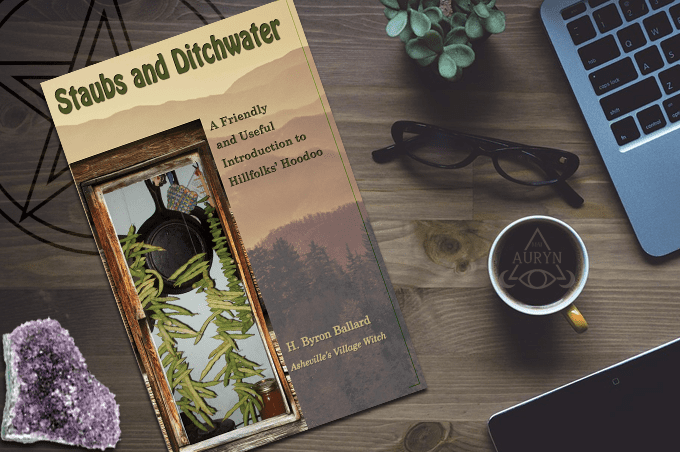
Staubs and Ditchwater: a Friendly and Useful Introduction to Hillfolks’ Hoodoo by H. Byron Ballard is a fascinating look into Appalachian folk magick practices. The word ‘hoodoo’ may be a bit incorrect, and Ballard admits that herself explaining the difficulty in labeling her nameless practice. “The thing that some of us do – it really doesn’t have a name. I call it “hillfolks’ hoodoo” as a branding technique, because it is alliterative and because the general public has some notion of what “hoodoo” is – though they are often incorrect in the notioning of it. It is a technique for highlighting this set of skills in a way that begins to feel at least somewhat familiar to a modern audience.” She then proceeds to clarify the difference between hoodoo and what she practices, defining hoodoo as originating from African diasporas usually with a strong Catholic flavor. Her practices instead come from interaction between the Native Americans and European immigrants, mostly Scottish, Irish, and German. These practices were preserved and passed on by what some may call hillbillies, but which Ballard prefers to call ‘hillfolk’, seeing the term hillbilly as derogatory.
What’s great about Staubs and Ditchwater is not only does it provide some almost universal folk magick beliefs and practices, but there’s some really unique perspectives and ideas in this book I haven’t read in any other book regarding folk magick. Ballard has a no-fluff and down-to-earth approach to her writing and teaching, getting straight to the point and having no time for any nonsense. However, it’s not purely instructional or purely theoretical – it’s sprinkled with anecdotal stories that feel almost biographical at times, often talking about how she was passed on this information and practices – but all of it serves a purpose within the book.
Another thing that’s interesting is that the book is pretty unreligious in nature. Despite coming from a family that practice such folk beliefs, Ballard comes from an ancestral line of Methodists and Baptists (as most folk magick tends to be monotheistic based) and is an ordained High Priestess of Wicca. She sees her practice as a sort of marriage between all of these practices along with some things she’s borrowed from her interactions with other types of folk magick practitioners over the years. As such, the book becomes a resource for anyone of any practice that wants to incorporate the wisdom Ballard shares in her book into their own unique path, regardless of what it is.
Connect With Me
Website | Tarot Readings | Facebook | Twitter | Instagram | Tumblr | Mailing List
Previous Post

December 29, 2017
In Nomine Hekate
Next Post

January 1, 2018 The Magick of Affirmations
Browse Our Archives
Select a Category Book Reviews Deck Reviews Interviews Musings Uncategorized
Select a Month December 2021 November 2021 October 2021 August 2021 March 2021 December 2020 November 2020 October 2020 September 2020 August 2020 June 2020 May 2020 April 2020 February 2020 January 2020 December 2019 November 2019 October 2019 September 2019 August 2019 July 2019 June 2019 May 2019 April 2019 March 2019 February 2019 January 2019 December 2018 November 2018 October 2018 September 2018 August 2018 July 2018 June 2018 May 2018 April 2018 March 2018 February 2018 January 2018 December 2017 November 2017 October 2017 September 2017 August 2017 July 2017 June 2017 May 2017 April 2017
Follow Us!
TAKE THE
Religious Wisdom Quiz
Who did Jesus raise from the dead after four days?
Select your answer to see how you score.
Widow's son Jairus’ daughter Lazarus Himself
Related posts from For Puck's Sake

Review: The Eclectic Witch's Book of Shadows

TRENDING AT PATHEOS Pagan

I was recently chatting with someone on Instagram. She asked me what...

While there are many people who share their results, the end of...

On July 23, I saw Christopher Nolan's The Odyssey which is Homer’s...

As I write this two big events have just finished up. One...

Restoring the Watershed of Divine Love
Perhaps cooperation is not something we manufacture through legislation, ideology, or moral...

Many UUs don’t pray because of bad experiences in a previous religion,...
view all Pagan blogs
Ad-Free & Subscriber Log-In Subscription Support
- About Us
- 2026 Calendar
- Videos
- Podcasts
- Library of World Religions
- Faith In Media Tracker
- Advertise With Us
- Write for Us
- Privacy Policy
- Terms of Service
- Do Not Sell My Data
- Contact Us
- Radiant Digital
- Manage Newsletter Subscriptions
- Unsubscribe From Notifications
- Sitemap
Copyright 2008-2026, Patheos. All rights reserved.
Subscription Support Ad-Free & Subscriber Log-In
Follow Patheos