
BuddhistCatholicContemplativeEvangelicalGeneral ChristianHinduJewishLatter-day SaintMuslimNew VisionsProgressive Christian
Beliefs
- Buddhist
- Catholic
- Contemplative
- Evangelical
- General Christian
- Hindu
- Jewish
- Latter-day Saint
- More Voices
- Muslim
- New Visions
- Pagan
- Progressive Christian
Topics
- Religion News
- Food and Religion
- Sports and Religion
- Religious Art
- Religious Music and Entertainment
- Religious Events
- History and Religion
- Style and Religion
- Politics and Religion
- Women in Religion
- Recreation Outdoors and Religion
- Business Finance and Religion
- Careers Workplace and Religion
- Education and Religion
- Family Parenting and Religion
- Health Fitness and Religion
- Home and Religion
- Relationships and Religion
- Technology and Religion
- Travel and Religion
Columnists
- Buddhist Columnists
- Business Finance and Religion Columnists
- Careers Workplace and Religion Columnists
- Catholic Columnists
- Contemplative Columnists
- Education and Religion Columnists
- Evangelists Columnists
- Family Parenting and Religion Columnists
- General Christian Columnists
- Health Fitness and Religion Columnists
- Hindu Columnists
- History and Religion Columnists
- Home and Religion Columnists
- Jewish Columnists
- More Voices Columnists
- Latter Day Columnists
- Muslim Columnists
- New Visions Columnists
- Nonreligious Columnists
- Pagan Columnists
- Politics and Religion Columnists
- Progressive Columnists
- Recreation Outdoors and Religion Columnists
- Relationships and Religion Columnists
- Religion News Columnists
- Religious Art Columnists
- Religious Events Columnists
- Religious Music and Entertainment Columnists
- Sports and Religion Columnists
- Style and Religion Columnists
- Technology and Religion Columnists
- Travel and Religion Columnists
- Women in Religion Columnists
Resource Library
- 2026 Calendar
- Library of World Religions
- The 100 Most Holy Places on Earth
- Patheos Answers
- Podcasts
- Videos
- Faith Leaders Database
- Anglican Episcopalian
- Bahai
- Baptist
- Buddhism
- Christianity
- Confucianism
- Eastern Orthodoxy
- Hinduism
- Holiness and Pentecostal
- ISKCON
- Islam
- Judaism
- Lutheran
- Methodist
- The Church of Jesus Christ of Latter-day Saints
- New Age
- Paganism
- Presbytarian and Reformed
- Protestantism
- Religion Behind the Scenes
- Roman Catholic
- Scientology
- Shia Islam
- Sikhism
- Sufism
- Sunni Islam
- Taoism
- Zen
- See all religions
Research Tools
 Ad-Free & Subscriber Log-In Subscription Support
Ad-Free & Subscriber Log-In Subscription Support
Follow Patheos 

- Trending:
- Forgiveness
- |
- Marriage
- |
- Consciousness
- |
- Death Penalty
- |
- Election
- |
- Halloween
 For Puck's Sake
- Home
- Pagan
- Aradia of the White Flame
Aradia of the White Flame
Last updated on: December 2, 2017 at 12:29 am by Mat Auryn
Aradia of the White Flame 2017-12-02T00:29:00+00:00 Mat Auryn
Patheos Explore the world's faith through different perspectives on religion and spirituality! Patheos has the views of the prevalent religions and spiritualities of the world.
In the Sacred Fires Tradition of Witchcraft, we have a concept which we call Sacred Flames. Simply put, the Sacred Flames are primordial forces that we align ourselves with. Each flame provides the tools, techniques, and powers to forge our own soul’s path towards transformation and eventually apotheosis and divine union. As we go through each flame we work with a different frequency of our gods and goddesses, who provide us with challenges, attunements, and gnostic insights. Each flame is an expression of the Holy Fire. The concept of Holy Fire or Witch Fire is central to the Sacred Fires tradition of Witchcraft. As we touch and work with the different flames of the Holy Fire, it touches and changes our own energy and identity.

Image Credit: Engin Akyurt | Edited by Mat Auryn | CC0 License
It is Aradia within our tradition that acts as guide through our transformation. Aradia is the avatar of the White Flame within Sacred Fires. The White Flame is the home frequency of the witch and the witch power within you. During the White Flame training we are taught to harness the witch power, meet our familiar spirit, as well as to align and purify ourselves. During this portion of the training, all basic knowledge of popular witchcraft including an introduction to Sabbatic and ecstatic craft styles is taught. The White Flame is available to everyone who wishes to seek it out as an outer-court training system, as these empowerments are meant to assist every witch who desires it. The White Flame is the basic “Witch Fire” or “Witch Power” and all the material in Devin Hunter’s The Witches Book of Power is considered White Flame material. The other flames are reserved for the inner-court tradition, though The Witches Book of Spirits touches upon some of our outer-court material for the Indigo Flame. The other flames emerge and are all accessed from the white flame first, just as all color on the light spectrum can be refracted from white.
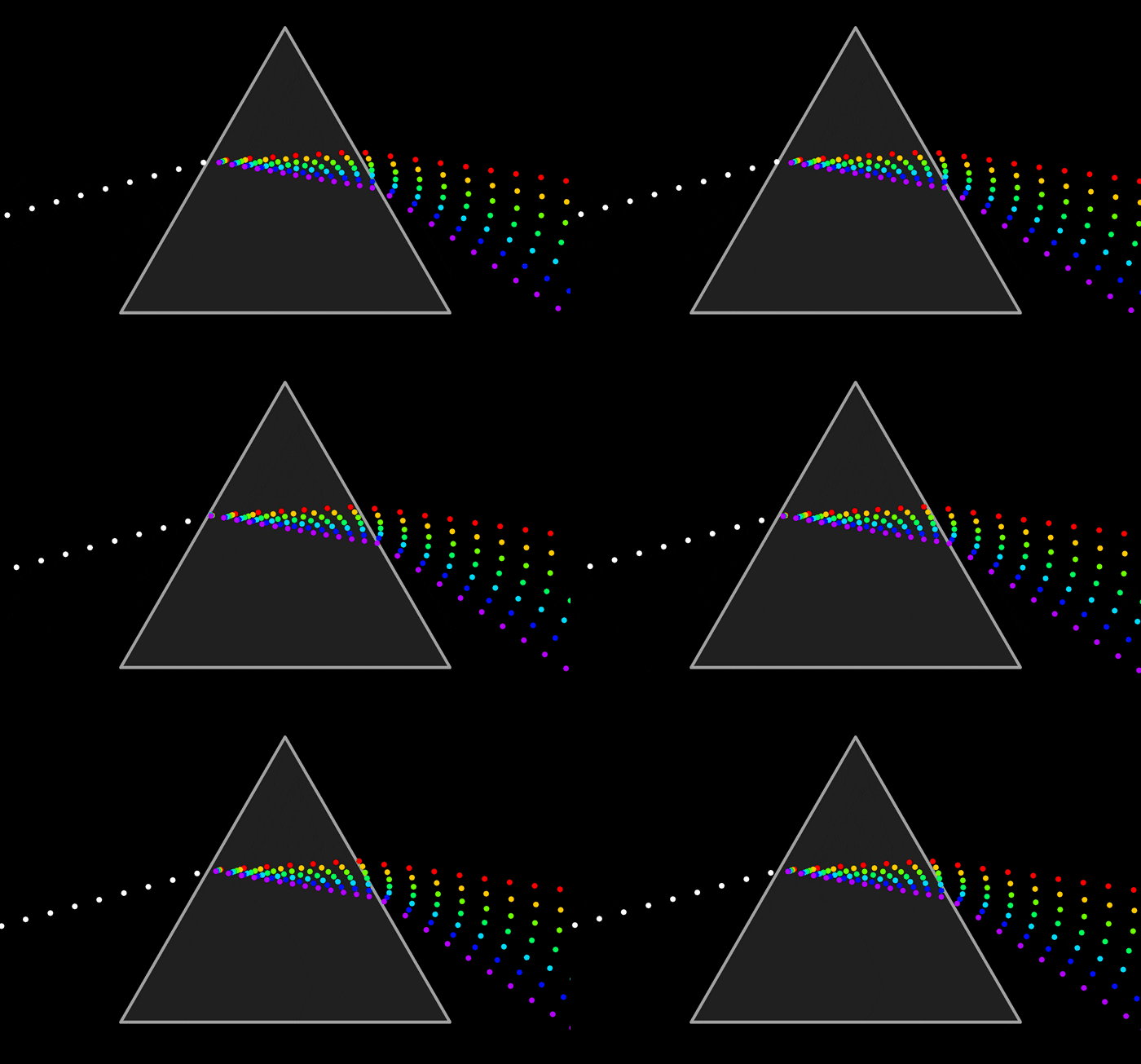
Image Credit: Wikimedia
Aradia, of course is the “first witch” in myth sent from Diana and Dianus (or Lucifer). The debated historical Aradia is not the aspect of Aradia that I’m talking about. For us, Aradia is much more complex and much more simple than a just historical Christ-like figure of the witches or a goddess of witchcraft. For that I would recommend checking out Weiser’s version of Aradia or Gospel of the Witches which has some great entries on the topic at the end of the book by some very well-known authors and Aradia: Gospel of the Witches, Expanded Edition which provides a totally new translation and some interesting academic discussion on the historical authenticity of Aradia. Raven Grimassi’s The Book of The Holy Strega and Italian Witchcraft also provide information that he was passed on from his family’s Strega tradition in regards to the lore of Aradia as a real individual.
To Understand Aradia in Sacred Fires we have to take a look at our cosmology. Our main gods are that of Diana, whom we work with as Queen of the Witches and Dianus, whom we work with as King of the Witches. They are the Divine Twins that emerge from the Star Goddess, or Source. If we think of this all in the idea of frequency, we have the Star Goddess who splits into two different frequencies as God and Goddess (though gender isn’t really a thing for us when it comes to how we view our gods). For anyone who has used binaural beats you know that a solid unwavering tone in the left ear (lets say it’s 200 Hz for example), and another unwavering tone in the right ear (let’s say 205 Hz), the brain will hear this as wavering sound and will process it as a totally new frequency (which would be 5 Hz in our example), as if the two frequencies have given birth to a new one. While not a perfect example, it’s one of the best I can use as a metaphor. In this metaphor Aradia is a new frequency that occurs from the union of these two different frequencies, just like the myth about Diana and Dianus/Lucifer’s union creating Aradia.

Image Credit: Stock Snap | CC0 License
However, the gods are not just frequencies. They are individual entities with their own distinct personalities, gods and goddesses in every sense of the word and Aradia is no different. For us Aradia is the teacher of Witchcraft as well as the spirit of the Witch themselves. It’s very hard for me not to see a similarity and parallels with Shakti in Hinduism and Yoga traditions. Shakti is considered to be a primordial cosmic power that moves through all things, very similar to the idea of “The Star Goddess” in the Feri Traditions of Witchcraft and within Sacred Fires. She’s a goddess in her own right, but she is also a force that lays dormant within each person in the form of kundalini. When that kundalini is activated it leads to cosmic awareness and mystical powers, much like the ideas of the Witch Fire in Witchcraft Traditions.
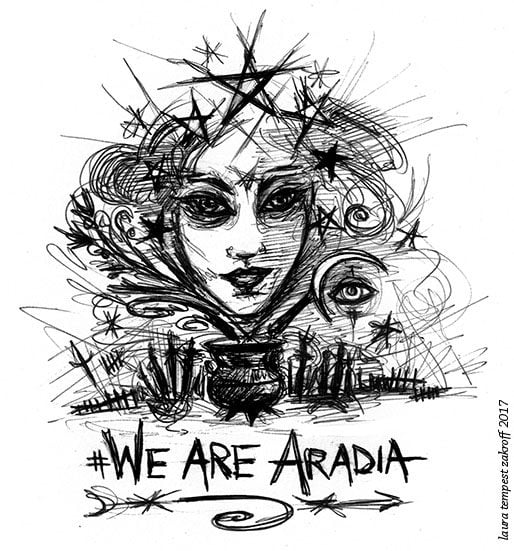
Image Credit: Laura Tempest Zakroff | Used With Permission
While there’s various etymological theories regarding Aradia’s name, the one I resonate with the best is that it is a compound of the Latin & Italian word ara meaning altar and dia being a shortened version of Diana. Thus she is the “Altar of Diana”, that sacred place inside us from which we do our magick and witchcraft. Just as the Charge of the Goddess states, “If that which you seek, you find not within yourself, you will never find without.” Aradia is that divinity within us that we need to tune into to genuinely understand divinity outside of us. Aradia is what were refer to as that place within you that certain Craft traditions refer to when they say “Thou Art God/dess”. Aradia is a reminder that our power comes from the gods and that we are the children of the gods ourselves and as such are meant to be free in our own self-sovereignty, because We Are Aradia.
There’s a somewhat rhetorical question often posed in witchcraft when the topic of initiations comes up for the purpose of meditation. The question is “Well, who initiated the first witch?” After meditation on this for a couple of years, I’ve come to my own answer. Aradia, as the spirit and force of the witch power was the first initiator. The answer lies hidden in plain sight for me within Aradia or Gospel of the Witches by Charles Leland in which the goddess Diana speaks to Aradia:
“Tis true indeed that thou a spirit art,
But thou wert born but to become again
A mortal; thou must go to earth below
To be a teacher unto women and men
Who fain would study witchcraft in thy school.”
Previous Post

November 13, 2017
Traditional Witchcraft Historicity & Perpetuity
Next Post

November 16, 2017 Rivers of the Underworld
Browse Our Archives
Select a Category Book Reviews Deck Reviews Interviews Musings Uncategorized
Select a Month December 2021 November 2021 October 2021 August 2021 March 2021 December 2020 November 2020 October 2020 September 2020 August 2020 June 2020 May 2020 April 2020 February 2020 January 2020 December 2019 November 2019 October 2019 September 2019 August 2019 July 2019 June 2019 May 2019 April 2019 March 2019 February 2019 January 2019 December 2018 November 2018 October 2018 September 2018 August 2018 July 2018 June 2018 May 2018 April 2018 March 2018 February 2018 January 2018 December 2017 November 2017 October 2017 September 2017 August 2017 July 2017 June 2017 May 2017 April 2017
Follow Us!
TAKE THE
Religious Wisdom Quiz
Who wrote Lamentations, mourning Jerusalem's destruction?
Select your answer to see how you score.
Jeremiah Ezra Obadiah Isaiah
Related posts from For Puck's Sake

How to Spot a Spiritual Impersonator Scam on...

Review: The Eclectic Witch's Book of Shadows

TRENDING AT PATHEOS Pagan

I was recently chatting with someone on Instagram. She asked me what...

While there are many people who share their results, the end of...

On July 23, I saw Christopher Nolan's The Odyssey which is Homer’s...

As I write this two big events have just finished up. One...

Restoring the Watershed of Divine Love
Perhaps cooperation is not something we manufacture through legislation, ideology, or moral...

Many UUs don’t pray because of bad experiences in a previous religion,...
view all Pagan blogs
Ad-Free & Subscriber Log-In Subscription Support
- About Us
- 2026 Calendar
- Videos
- Podcasts
- Library of World Religions
- Faith In Media Tracker
- Advertise With Us
- Write for Us
- Privacy Policy
- Terms of Service
- Do Not Sell My Data
- Contact Us
- Radiant Digital
- Manage Newsletter Subscriptions
- Unsubscribe From Notifications
- Sitemap
Copyright 2008-2026, Patheos. All rights reserved.
Subscription Support Ad-Free & Subscriber Log-In
Follow Patheos