
BuddhistCatholicContemplativeEvangelicalGeneral ChristianHinduJewishLatter-day SaintMuslimNew VisionsProgressive Christian
Beliefs
- Buddhist
- Catholic
- Contemplative
- Evangelical
- General Christian
- Hindu
- Jewish
- Latter-day Saint
- More Voices
- Muslim
- New Visions
- Pagan
- Progressive Christian
Topics
- Religion News
- Food and Religion
- Sports and Religion
- Religious Art
- Religious Music and Entertainment
- Religious Events
- History and Religion
- Style and Religion
- Politics and Religion
- Women in Religion
- Recreation Outdoors and Religion
- Business Finance and Religion
- Careers Workplace and Religion
- Education and Religion
- Family Parenting and Religion
- Health Fitness and Religion
- Home and Religion
- Relationships and Religion
- Technology and Religion
- Travel and Religion
Columnists
- Buddhist Columnists
- Business Finance and Religion Columnists
- Careers Workplace and Religion Columnists
- Catholic Columnists
- Contemplative Columnists
- Education and Religion Columnists
- Evangelists Columnists
- Family Parenting and Religion Columnists
- General Christian Columnists
- Health Fitness and Religion Columnists
- Hindu Columnists
- History and Religion Columnists
- Home and Religion Columnists
- Jewish Columnists
- More Voices Columnists
- Latter Day Columnists
- Muslim Columnists
- New Visions Columnists
- Nonreligious Columnists
- Pagan Columnists
- Politics and Religion Columnists
- Progressive Columnists
- Recreation Outdoors and Religion Columnists
- Relationships and Religion Columnists
- Religion News Columnists
- Religious Art Columnists
- Religious Events Columnists
- Religious Music and Entertainment Columnists
- Sports and Religion Columnists
- Style and Religion Columnists
- Technology and Religion Columnists
- Travel and Religion Columnists
- Women in Religion Columnists
Resource Library
- 2026 Calendar
- Library of World Religions
- The 100 Most Holy Places on Earth
- Patheos Answers
- Podcasts
- Videos
- Faith Leaders Database
- Anglican Episcopalian
- Bahai
- Baptist
- Buddhism
- Christianity
- Confucianism
- Eastern Orthodoxy
- Hinduism
- Holiness and Pentecostal
- ISKCON
- Islam
- Judaism
- Lutheran
- Methodist
- The Church of Jesus Christ of Latter-day Saints
- New Age
- Paganism
- Presbytarian and Reformed
- Protestantism
- Religion Behind the Scenes
- Roman Catholic
- Scientology
- Shia Islam
- Sikhism
- Sufism
- Sunni Islam
- Taoism
- Zen
- See all religions
Research Tools
 Ad-Free & Subscriber Log-In Subscription Support
Ad-Free & Subscriber Log-In Subscription Support
Follow Patheos 

- Trending:
- Forgiveness
- |
- Marriage
- |
- Consciousness
- |
- Death Penalty
- |
- Election
- |
- Halloween
 For Puck's Sake
- Home
- Pagan
- Ivo Dominguez Jr. & the Tough Astrology Questions
Ivo Dominguez Jr. & the Tough Astrology Questions
Last updated on: February 10, 2018 at 7:25 pm by Mat Auryn
Ivo Dominguez Jr. & the Tough Astrology Questions 2018-02-10T19:25:23+00:00 Mat Auryn
Patheos Explore the world's faith through different perspectives on religion and spirituality! Patheos has the views of the prevalent religions and spiritualities of the world.
There are so many misconceptions when it comes to astrology. It seems there’s always some “expert” astronomer or scientist “debunking” astrology without understanding the very basic premise of astrology. While astronomy and science are important, I tend to find that their “debunking” tends to be either based on a totally wrong misconception of the foundational beliefs of astrology and is expressed condescendingly. There are constant statements that are made over and over online and on television in these attempts to discredit astrology that have those who take the study serious rolling their eyes. I decided to reach out to the person I consider the foremost expert in the field of astrology that I know, Mr. Ivo Dominguez Jr., and ask him about some of these misconceptions as well as some of the more challenging questions pertaining to astrology.
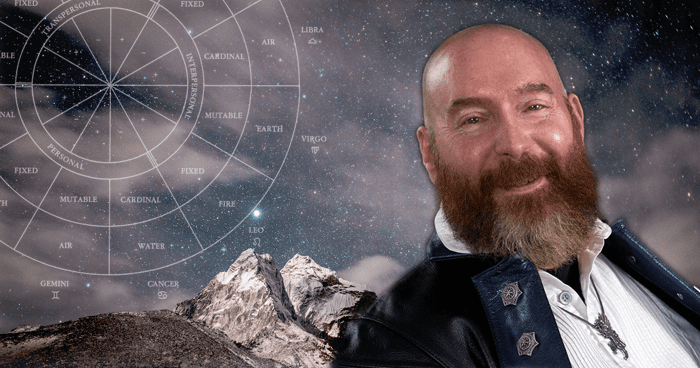
Image Credit: Ivo Dominguez | Edit by Mat Auryn
Ivo Domínguez, Jr. has been active in Wicca and the Pagan community since 1978, has been teaching since 1982. Ivo was a founding member, and a past High Priest, of Keepers of the Holly Chalice, the first coven of the Assembly of the Sacred Wheel a Wiccan Tradition. He currently serves as one of the Elders of the Assembly of the Sacred Wheel, a Wiccan syncretic tradition that draws inspiration from Astrology, Qabala, the Western Magickal Tradition and the folk religions of Europe. Ivo is also one of the key organizers for the New Alexandrian Library Project. He is the author of Practical Astrology for Witches and Pagans: Using the Planets and the Stars for Effective Spellwork, Rituals, and Magickal Work; Casting Sacred Space: The Core Of All Magickal Work; Spirit Speak: Knowing and Understanding Spirit Guides, Ancestors, Ghosts, Angels, and the Divine; Beneath the Skins. His newest book is Keys to Perception: A Practical Guide To Psychic Development.
First of all, I’m curious as to how you got interested in astrology and how it’s changed your life. I don’t view you as a man who believes things blindly. How did you come to believe astrology?
I value intuition as much as I do reason, and I am always looking for systems and patterns. My early studies of magick often referenced astrology so I knew that many of the teachers and authors that I valued saw utility in this sacred science so I was prompted to learn more. I also have great respect for the Hermetic axiom of “as above, so below” and apply it to everything that I can observe. In December of 1974 I purchased the “Sun Wheel Astrological Calendar 1975” by Armando Busick published by Houghton Mifflin. Then over the course of 1975, I tracked the relationship between the information in the calendar with occurrences in my life and the broader world. By the middle of the year, I was convinced that astrology did indeed work. I still test all new astrological techniques and methods before including them in my practice or teachings.
People tend to view astrology as horoscopes and place the main emphasis on their sun signs, emphasizing that astrology believes that there’s only twelve different types of people. Do you feel this leads to a misunderstanding of astrology?
Each of the planets is an indicator for a portion of a person’s nature and they can be distributed in a wide range of combinations throughout the Zodiac. As such, each person is a unique mixture of many Signs. The Sun is the source of your being and as such is very important as an indicator, but by itself the information that it provides is simplistic. The Moon and the Sign that it is in has a great deal of information about a person’s psyche. If all we looked at were the possible combinations of the Sun and Moon, then we’d be up to 144 basic types. When we consider the Rising Sign, the Ascendant, then we are up to 1728 basic types. As you add in the rest of the Planets, let alone the Asteroids, the number of possibilities becomes astronomically high, pun intended. Additionally, there are 30 degrees in each Sign and each degree contains different nuances of expression. Many people are only exposed to superficial sort of predictions and personality analysis based on the Sun Sign alone. Understandably, this limited representation can lead them to discredit astrology.
Why do you think it is that sometimes twins born at the same time have completely different personalities and lives? Shouldn’t their astrological information be pretty much identical?
Depending upon when and where twins are born, a few minutes can actually produce some pretty dramatic differences in their birth charts. For the sake of answering your question more fully, let’s assume that the twins in question are identical twins and that the major features of their charts are the same. In this case their genetics would be as close to the same as possible. The birth chart can be thought of as a map of their energetic, their spiritual genome. If we examine their lives and personalities, we may find some striking similarities but also distinct differences. Their bodies and their birth charts are vehicles of incarnation and are inhabited by two distinct and separate souls each with their own free will and life purposes related to their incarnations. In some ways this question is really about going beyond the question of nature/nurture or brain/mind and adding the spiritual dimension of the uniqueness of souls.
I think the thing that bugs me the most that I often hear is that “astrologers believe that retrograde planets actually move backwards”. We know that they don’t actually move backwards but appear to do so in the sky. Why would a planet’s appearance affect us differently than what it’s actually doing?
Imagine that the planets are like athletes running in an oval stadium with lanes marked for each runner. The runner in the third lane is the Earth. Let’s say that the runner named Earth is glancing inwards at runner Mercury. Mercury is in the innermost lane, the smallest circuit, and as Earth is looking Mercury passes the Earth. A bit later the Earth looks again and it appears that Mercury is going in the wrong direction, because it has looped around. A similar thing happens with the runners that are further out than the Earth except that the Earth pulls ahead of them. This explains the apparent backwards motion of a retrograde planet. It also gives a clue as to why retrogrades have an impact on our lives. A retrograde indicates a time period in which the relationship in the motion between two planets is different. The relationship between planets whether it be in the forming of specific geometries (aspects), positions within the Zodiac, or relative motion are indicators of subtle energy exchange and of the shape of space-time in the physical realm as well as in other planes of reality. Retrogrades are much more than a matter of viewpoint and perspective.
Speaking of retrogrades, they tend to have become a modern scapegoat. People make statements such as “everything is going wrong because Mercury is in retrograde!” Do you believe that retrogrades have more of a purpose than creating havoc in our lives?
One of the risks associated with a passing knowledge of astrology is that it becomes a resource for rationalization rather than insight. The best advice during a Mercury retrograde is the same advice given to an apprentice carpenter, “measure twice and cut once.” Mercury is associated with many things including travel and communications which require more care and focus during a retrograde. However, Mercury is not responsible for your lapses of attention, poor planning, or sloppy work. Retrograde periods can be quite productive if you work with them rather than against them. The pattern that a retrograde planet makes in the sky is a loop, and your thoughts and actions should also loop back before moving forward. I find that Mercury retrograde is a good time for me to review or rework my writings, workshops, and other projects. It is also a time when people may have breakthroughs in therapy, past life work, or in reframing the meaning of past experiences. Mercury is not the only planet that retrogrades. With the exception of the Sun and the Moon, all the planets go retrograde periodically. To use those retrogrades well, spend some time learning the areas of life that are correlated to each planet.
Every now and again there’s statements about “new signs” or “signs we didn’t know about” such as Ophiuchus, because it is in the Sun’s path and therefore debunks all of astrology. Are these really zodiacal signs? Why or why not?
There have been and will be many types of sky lore, celestial omen reading, folk astronomy, systems of sky divination from many cultures, etc., but astrology whether it is Western or Vedic can only have 12 Signs. You can look at the many stars that are in the Sun’s path in the sky and there are many more constellations named by ancient cultures or use your imagination and connect the dots to name new ones. Constellations are not one and the same as Signs, and I’ll explain that more fully in your next question. Aside from that, the reason you can’t shoehorn in an additional Sign is that violates the fundamental conceptual frameworks in astrology.
The 12 Signs alternate in polarity, each is one of the Three Modalities in their natural order, and are three cycles of the Four Elements. The meanings of the Signs are encoded in these patterns and reinforced by the relationship between the Signs based on their Modality and Element. There is a great deal of sacred geometry in the aspects, houses, and other structures in astrology that would be broken with the addition of a 13th Sign. There have been new planets added to astrology but they are mobile components in the system of astrology. Determining the meaning of a new planet is a lengthy process. If you want to add a Sign, you’d need to create an entirely new system. The one we currently use has taken a bit over 4000 years to reach its current level of refinement and stability. Good luck with that. If you came up with a 36 Sign system, that could work because it is already recognized that the decans, each 10 degrees of a Sign have observable differences. More importantly, this reimagining of the Zodiac is still in harmony with the underlying structures.
Embed from Getty ImagesSometimes astronomers will point out that the earth’s axis wobbles and that our zodiac is now off, almost by a full sign and that astrologers don’t recognize this. Do the zodiac signs correlate to specific constellations themselves?
The Signs are 30° divisions that mark the journey of the Sun through the changes of the seasons. The two solstices and the two equinoxes are the anchors that set the order and the placement of the Signs and create a quartered circle in astrological charts. Then, if you divide each quarter into three pieces, you have the twelve-fold structure that is the Signs. Sailors in open waters far from the land use the stars as surrogate landmarks. Relative to the short spans of human lives, the stars seem to be fixed points. When the sacred science of astrology was being formulated, the collections of stars that we name as constellations were used as navigational points in the deep of the sky. In fact, because of the slow wobble in the Earth’s rotation the stars do move about 1° every 72 years. As such the constellations that we see in the night sky do not match up with the Signs of the zodiac. The Signs are not about those distant stars, the Signs depict the journey of the Sun through its 12 stations.
Astrologers are quite aware of the wobble, the small circle slowly traced by the Earth’s poles, as that is what determines the change of the Astrological Ages. The wobble in the axis also changes which star is the North Star. Incidentally, there is no South Star. Over the millennia, this small circle changes which constellation is rising in the East at the Spring Equinox which indicates the Sign of the Age that we are in. Aries will always be the Sign of the northern Spring Equinox in the Solar Year. The Sign of the northern Spring Equinox does change with the change of the Ages in the Great Year.
While Western astrology is tropical, other systems such as Vedic astrology are sidereal. What is the difference and shouldn’t there be a “right” or “wrong” system since they are so different.
There are many differences between Western and Vedic astrology that arise from differences of approach, culture, and religion, but there are also some shared principles. Both systems are looking at the same planets, and both have accumulated layers of systems of analysis over centuries of usage.The oldest strictly astrological manuscript in Sanskrit is called the “Sayings of the Greeks” as Hellenistic astrology came to India through the impact of Alexander the Great’s legacy. There are older documents that are a part of the Vedas and Hindu religion that speak to the science of light, of understanding the heavens within a religious context. These borrowings of astrological ideas from Babylon, Egypt, and Greece were folded into India’s system of astrology. This resulted in some names and terms being used in both systems that have diverged in meaning which confuses people when they discover their Signs and charts look very different when cast by Western vs Vedic astrologers.
Either system works well because they are coherent, logical, rules based systems, that have been polished by many minds working for many years. In either case, it is still a matter of looking at the great above to see who it is reflected in the smaller below. Asking which is better is similar to asking which religion is better or whether the iPhone is better than an Android phone. It is a matter of opinion and not fact. How well either system of astrology works is more about the skill and the intuition of the practitioner offering a reading or guidance.
Most people view astrology as purely predictive, like fortunetelling. What other implications does astrology have within our lives?
The study of your birth chart can be used to understand your psychology, vocational aptitudes, recurring patterns of experiences, karma, and more. It can be a guide to spiritual development and an indicator for strengths and weaknesses. Astrology can be used as an adjunct to applying your knowledge of finances, politics, sociology, and so on in understanding the roots and outcomes of changes in populations of people. Often people think of using predictive astrology for personal and short term purposes. It is also applicable to clusters of people in relationships whether these clusters are romantic, families, organizations, businesses, or nations. These predictions can also be longterm and thematic guidance as well as information about specific details. On a cultural level, looking at the placement of the slow moving outer planets can yield insights into encouraging understanding between different generations. Almost any mundane endeavor or field can be augmented by the use of astrology.
As occultists, how can a greater understanding of astrology improve our magickal practices?
It has often been said, that the West lacks a sacred language with the subtle and specific spiritual vocabulary of a language or alphabet such as Sanskrit or Hebrew. We actually do have such a language, it is nuanced, versatile, and it is astrology. If you are fluent in astrology you have words, descriptions, symbols, glyphs, and more that can be used to describe magickal energies and patterns. Astrology also contains within it another story for the changes of the seasons of the year in 12 chapters.
It also contains an expanded set of meanings and relationships between the Elements. Too often references to astrological concepts in tables of correlations and correspondences, in the choice of symbols or colors for an altar, in the recipes for incense, etc. are nothing more than rote transmissions without any understanding of the underlying principles. If you become versed in astrology you will be able to look at your reference books that provides correspondences for herbs, oils, crystals, etc. and understand how and why there is a Planet, a Sign, or an Element associated with them.
Additionally, you should be able to look at recipes or magical formulae, and begin to understand them as a combination of energetic ingredients as described by their astrological correlations. Using astrology as a tool you will be able to create new recipes, rituals, spells, etc. based on the knowledge that the physical ingredients are representations and anchors for particular types of energy. I regularly use astrology to assist in planning, modifying, or inspiring workings and rituals. I could go on a bit more, but I’m going to suggest read my book Practical Astrology For Witches And Pagans.
Connect With Me
Website | Tarot Readings | Facebook | Twitter | Instagram | Tumblr | Mailing List
Previous Post

September 25, 2017
True Black: Creating A Timeless Tarot
Next Post
September 28, 2017 Review: Call of the Horned Piper
Browse Our Archives
Select a Category Book Reviews Deck Reviews Interviews Musings Uncategorized
Select a Month December 2021 November 2021 October 2021 August 2021 March 2021 December 2020 November 2020 October 2020 September 2020 August 2020 June 2020 May 2020 April 2020 February 2020 January 2020 December 2019 November 2019 October 2019 September 2019 August 2019 July 2019 June 2019 May 2019 April 2019 March 2019 February 2019 January 2019 December 2018 November 2018 October 2018 September 2018 August 2018 July 2018 June 2018 May 2018 April 2018 March 2018 February 2018 January 2018 December 2017 November 2017 October 2017 September 2017 August 2017 July 2017 June 2017 May 2017 April 2017
Follow Us!
TAKE THE
Religious Wisdom Quiz
I saw the Lord seated on a throne, high and exalted, while six-winged beings called out 'Holy, holy, holy.' What were these creatures?
Select your answer to see how you score.
Leviathan Angels Seraphim Cherubim
Related posts from For Puck's Sake
Review: The Four Elements of the Wise

Mat Auryn Chats With Rachel True

The 20 Best Books On The Dead For...

The New Book That 36 Witch Elders &...
TRENDING AT PATHEOS Pagan

I was recently chatting with someone on Instagram. She asked me what...

While there are many people who share their results, the end of...

On July 23, I saw Christopher Nolan's The Odyssey which is Homer’s...

As I write this two big events have just finished up. One...

Restoring the Watershed of Divine Love
Perhaps cooperation is not something we manufacture through legislation, ideology, or moral...

Many UUs don’t pray because of bad experiences in a previous religion,...
view all Pagan blogs
Ad-Free & Subscriber Log-In Subscription Support
- About Us
- 2026 Calendar
- Videos
- Podcasts
- Library of World Religions
- Faith In Media Tracker
- Advertise With Us
- Write for Us
- Privacy Policy
- Terms of Service
- Do Not Sell My Data
- Contact Us
- Radiant Digital
- Manage Newsletter Subscriptions
- Unsubscribe From Notifications
- Sitemap
Copyright 2008-2026, Patheos. All rights reserved.
Subscription Support Ad-Free & Subscriber Log-In
Follow Patheos