
BuddhistCatholicContemplativeEvangelicalGeneral ChristianHinduJewishLatter-day SaintMuslimNew VisionsProgressive Christian
Beliefs
- Buddhist
- Catholic
- Contemplative
- Evangelical
- General Christian
- Hindu
- Jewish
- Latter-day Saint
- More Voices
- Muslim
- New Visions
- Pagan
- Progressive Christian
Topics
- Religion News
- Food and Religion
- Sports and Religion
- Religious Art
- Religious Music and Entertainment
- Religious Events
- History and Religion
- Style and Religion
- Politics and Religion
- Women in Religion
- Recreation Outdoors and Religion
- Business Finance and Religion
- Careers Workplace and Religion
- Education and Religion
- Family Parenting and Religion
- Health Fitness and Religion
- Home and Religion
- Relationships and Religion
- Technology and Religion
- Travel and Religion
Columnists
- Buddhist Columnists
- Business Finance and Religion Columnists
- Careers Workplace and Religion Columnists
- Catholic Columnists
- Contemplative Columnists
- Education and Religion Columnists
- Evangelists Columnists
- Family Parenting and Religion Columnists
- General Christian Columnists
- Health Fitness and Religion Columnists
- Hindu Columnists
- History and Religion Columnists
- Home and Religion Columnists
- Jewish Columnists
- More Voices Columnists
- Latter Day Columnists
- Muslim Columnists
- New Visions Columnists
- Nonreligious Columnists
- Pagan Columnists
- Politics and Religion Columnists
- Progressive Columnists
- Recreation Outdoors and Religion Columnists
- Relationships and Religion Columnists
- Religion News Columnists
- Religious Art Columnists
- Religious Events Columnists
- Religious Music and Entertainment Columnists
- Sports and Religion Columnists
- Style and Religion Columnists
- Technology and Religion Columnists
- Travel and Religion Columnists
- Women in Religion Columnists
Resource Library
- 2026 Calendar
- Library of World Religions
- The 100 Most Holy Places on Earth
- Patheos Answers
- Podcasts
- Videos
- Faith Leaders Database
- Anglican Episcopalian
- Bahai
- Baptist
- Buddhism
- Christianity
- Confucianism
- Eastern Orthodoxy
- Hinduism
- Holiness and Pentecostal
- ISKCON
- Islam
- Judaism
- Lutheran
- Methodist
- The Church of Jesus Christ of Latter-day Saints
- New Age
- Paganism
- Presbytarian and Reformed
- Protestantism
- Religion Behind the Scenes
- Roman Catholic
- Scientology
- Shia Islam
- Sikhism
- Sufism
- Sunni Islam
- Taoism
- Zen
- See all religions
Research Tools
 Ad-Free & Subscriber Log-In Subscription Support
Ad-Free & Subscriber Log-In Subscription Support
Follow Patheos 

- Trending:
- Forgiveness
- |
- Marriage
- |
- Consciousness
- |
- Death Penalty
- |
- Election
- |
- Halloween
 For Puck's Sake
- Home
- Pagan
- Deity As A River
Deity As A River
Last updated on: April 17, 2020 at 8:51 pm by Mat Auryn
Deity As A River 2020-04-17T20:51:38+00:00 Mat Auryn
Patheos Explore the world's faith through different perspectives on religion and spirituality! Patheos has the views of the prevalent religions and spiritualities of the world.
Deity tends to be one of the most mysterious things in my experience. My relationship and views on deity constantly change. Sometimes people ask me if I’m a monist, a dualist, a soft polytheist (seeing all godforms as the same divinity) or a hard polytheist (seeing all the godforms as individual and distinct). Sometimes I ask myself this as well. The answer always turns out to be “Yes, and…”. The gods themselves are a paradox. One of the things that has always intrigued me is the evolution of a god. We see throughout ancient history that gods often evolve, are conflated or synthesized with others and absorb attributes of others.

Image Credit: Unsplash | CC0 License
Does this mean all gods are the same? “Yes, and…” Does this mean all the gods are individual and distinct? “Yes, and…” There are three popular occult models that I like to use, the diamond, comparison of human consciousness, and my current favorite, the river.
The most commonly used and understood model of deity amongst pagans is that of the mutli-faceted diamond which is embraced by softer polytheists. The idea is basically that deity is a diamond and each god-form is a different facet on the same diamond, with each side of the diamond containing the facet having a basic archetypal aspect. While this is a great model for beginning to understand deity, I have found that in my experience it can fall a bit short as a metaphor when experiencing deity directly.
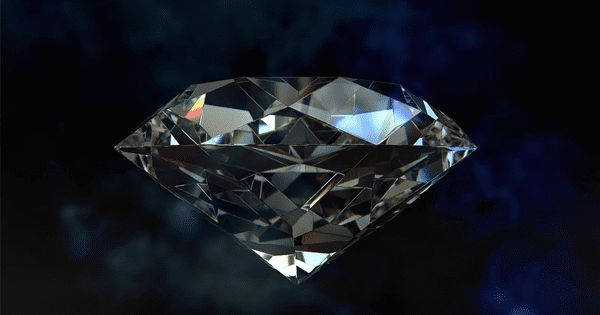
Image Credit: Dimitris Christou | CC0 License
The second model that I like is the comparison of human consciousness. You the reader are surely a very different human being than I. We look different, have different emotions, desires, backgrounds, histories, etc. We may even be completely unaware of one another. Yet on a higher level we are all part of the same collective consciousness of humanity, which is a part of the higher divinity. On one level we’re all individuals, on another level we’re connected to our ancestors through the same river of blood. You and I have different bloodlines of ancestry, but if you trace it far enough back we’ll find a place of common ancestry, regardless of who you are. For me, this model works a bit better.
My current favorite model is one that Christopher Penczak proposed in response to a question I had. The idea is viewing deity as a river, and this is how I’ve come to understand it. If we think of Source as an ocean and gods as rivers coming from the ocean, things make a bit more sense for me. Just as the rivers are composed mostly of water, so are we. There are different points where the river shifts, splits, comes back together, etc. Which we see throughout history.

Image Credit: Dan Roizer | CC0 License
Let’s take Hekate as an example with some of her historical conflations and synthesizations. We have the Thracian deity Bendis as a river. She then forks into two different rivers of their own, that of Artemis and Hekate. Artemis then merges with another river which we’ll call Diana. Hekate the Greek goddess takes a turn and becomes Hecate, the Roman goddess with some slight differences. At some point Hekate then merges with Diana as Diana-Hekate. We find that Ereshkigal merges at one point of the river as Hekate-Ereshkigal of the Greek Magical Papyri. We also find that a completely different and distinct river named Isis merges with Hekate at some point and creates Isis-Hekate.
Now looking at the river of Hekate as a whole, there’s a point where Hekate splits off into different streams of power, or perhaps different epithets – also different egregoric connections with different groups and civilizations. We also find Hekate’s river broadening at some point as Hekate Soitera, the World-Soul itself of the Chaldean Oracles. But we must also remember that the water all came from the same source ocean as well.
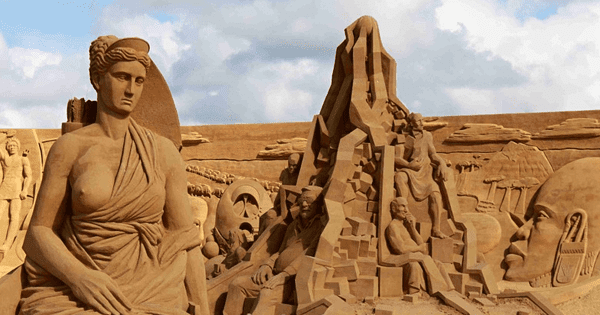
Image Credit: Violetta | CC0 License
When we call upon and work with deity, we are experiencing different and distinct parts of the river and where it merges and splits throughout history. We have points of specific power and personality. The gods however, transcending time and space, contain all of these past points and future points simultaneously outside of our linear perception of reality.
That being said, not all rivers touch so to speak. I’m not so sure that calling upon Quetzalcoatl-Eros would work or even make sense. Discussing this with Jason Miller recently, he shared a great insight which I agree with. He told me that he feels that “20th Century Paganism has had a terrible tendency to oversimplify and ask only about the correspondences – not the differences. As such we get a bland stew. If we focus on differences and what makes a being unique, we have an avenue for depth and lifelong commitment. I would much rather see someone face a quarter and invoke a deity by reciting a long list of their attributes and deeds, than someone standing up shouting dozens of names that have the thinnest connection and say ‘you who are known by….’”
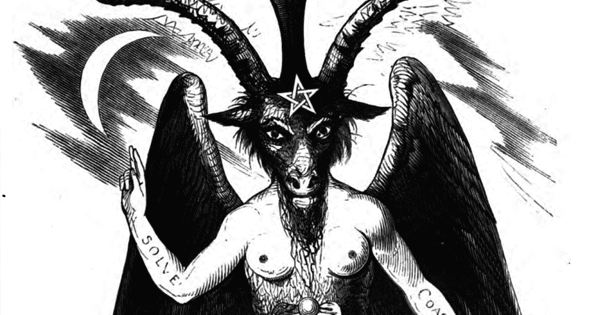
Image Credit: Eliphas Levi | Public Domain

As a witch, my relationship with the divine is one of paradox. I allow the gods to be what they are without trying to tell them or force them to be something that fits my ideals. This is also why I think Baphomet is such a great depiction of the divine. Baphomet is paradoxical and composed of disparate aspects. Baphomet’s the five elements, male and female, sun and moon, man and beast, angel and demon, god and devil, everything and nothing, creation and destruction, union and separation, physical and spiritual, symbolic and literal.
Baphomet is a genius example of “Yes, and…” which is why I feel Baphomet is such a great symbol of meditating on the divine and as such “The Great Initiator” of the mysteries. Baphomet exists as a mental construct but also existed before humanity existed and will long after humanity does not.
In conclusion, I would say that the gods are and probably always will be the biggest mystery whom our understanding of shifts and changes as our relationship and experience with the divine does. When we think we fully understand deity, it’s a sign that we’re completely lost when it comes to understanding deity. While models are helpful, none are absolute or perfect. They help us gain an approximate understanding, but not an exact one, which may be impossible while living life as a human.
Ways To Support My Work:





Previous Post

May 30, 2017
Review: Hekate: A Devotional
Next Post

June 1, 2017 Review: Sacred Medicine Cupboard
Browse Our Archives
Select a Category Book Reviews Deck Reviews Interviews Musings Uncategorized
Select a Month December 2021 November 2021 October 2021 August 2021 March 2021 December 2020 November 2020 October 2020 September 2020 August 2020 June 2020 May 2020 April 2020 February 2020 January 2020 December 2019 November 2019 October 2019 September 2019 August 2019 July 2019 June 2019 May 2019 April 2019 March 2019 February 2019 January 2019 December 2018 November 2018 October 2018 September 2018 August 2018 July 2018 June 2018 May 2018 April 2018 March 2018 February 2018 January 2018 December 2017 November 2017 October 2017 September 2017 August 2017 July 2017 June 2017 May 2017 April 2017
Follow Us!
TAKE THE
Religious Wisdom Quiz
Cast your bread upon the waters and after many days you will find it again. What does this encourage?
Select your answer to see how you score.
Fishing Generosity Patience Sharing
Related posts from For Puck's Sake

How to Spot a Spiritual Impersonator Scam on...

Review: The Eclectic Witch's Book of Shadows
TRENDING AT PATHEOS Pagan

I was recently chatting with someone on Instagram. She asked me what...

While there are many people who share their results, the end of...

On July 23, I saw Christopher Nolan's The Odyssey which is Homer’s...

As I write this two big events have just finished up. One...

Restoring the Watershed of Divine Love
Perhaps cooperation is not something we manufacture through legislation, ideology, or moral...

Many UUs don’t pray because of bad experiences in a previous religion,...
view all Pagan blogs
Ad-Free & Subscriber Log-In Subscription Support
- About Us
- 2026 Calendar
- Videos
- Podcasts
- Library of World Religions
- Faith In Media Tracker
- Advertise With Us
- Write for Us
- Privacy Policy
- Terms of Service
- Do Not Sell My Data
- Contact Us
- Radiant Digital
- Manage Newsletter Subscriptions
- Unsubscribe From Notifications
- Sitemap
Copyright 2008-2026, Patheos. All rights reserved.
Subscription Support Ad-Free & Subscriber Log-In
Follow Patheos