
BuddhistCatholicContemplativeEvangelicalGeneral ChristianHinduJewishLatter-day SaintMuslimNew VisionsProgressive Christian
Beliefs
- Buddhist
- Catholic
- Contemplative
- Evangelical
- General Christian
- Hindu
- Jewish
- Latter-day Saint
- More Voices
- Muslim
- New Visions
- Pagan
- Progressive Christian
Topics
- Religion News
- Food and Religion
- Sports and Religion
- Religious Art
- Religious Music and Entertainment
- Religious Events
- History and Religion
- Style and Religion
- Politics and Religion
- Women in Religion
- Recreation Outdoors and Religion
- Business Finance and Religion
- Careers Workplace and Religion
- Education and Religion
- Family Parenting and Religion
- Health Fitness and Religion
- Home and Religion
- Relationships and Religion
- Technology and Religion
- Travel and Religion
Columnists
- Buddhist Columnists
- Business Finance and Religion Columnists
- Careers Workplace and Religion Columnists
- Catholic Columnists
- Contemplative Columnists
- Education and Religion Columnists
- Evangelists Columnists
- Family Parenting and Religion Columnists
- General Christian Columnists
- Health Fitness and Religion Columnists
- Hindu Columnists
- History and Religion Columnists
- Home and Religion Columnists
- Jewish Columnists
- More Voices Columnists
- Latter Day Columnists
- Muslim Columnists
- New Visions Columnists
- Nonreligious Columnists
- Pagan Columnists
- Politics and Religion Columnists
- Progressive Columnists
- Recreation Outdoors and Religion Columnists
- Relationships and Religion Columnists
- Religion News Columnists
- Religious Art Columnists
- Religious Events Columnists
- Religious Music and Entertainment Columnists
- Sports and Religion Columnists
- Style and Religion Columnists
- Technology and Religion Columnists
- Travel and Religion Columnists
- Women in Religion Columnists
Resource Library
- 2026 Calendar
- Library of World Religions
- The 100 Most Holy Places on Earth
- Patheos Answers
- Podcasts
- Videos
- Faith Leaders Database
- Anglican Episcopalian
- Bahai
- Baptist
- Buddhism
- Christianity
- Confucianism
- Eastern Orthodoxy
- Hinduism
- Holiness and Pentecostal
- ISKCON
- Islam
- Judaism
- Lutheran
- Methodist
- The Church of Jesus Christ of Latter-day Saints
- New Age
- Paganism
- Presbytarian and Reformed
- Protestantism
- Religion Behind the Scenes
- Roman Catholic
- Scientology
- Shia Islam
- Sikhism
- Sufism
- Sunni Islam
- Taoism
- Zen
- See all religions
Research Tools
 Ad-Free & Subscriber Log-In Subscription Support
Ad-Free & Subscriber Log-In Subscription Support
Follow Patheos 

- Trending:
- Forgiveness
- |
- Marriage
- |
- Consciousness
- |
- Death Penalty
- |
- Election
- |
- Halloween
 Catholic and Enjoying It!
- Home
- Catholic
- Good Friday
Good Friday
Last updated on: April 19, 2019 at 12:28 am by Mark Shea
Good Friday 2019-03-20T12:46:35-07:00 Mark Shea
Patheos Explore the world's faith through different perspectives on religion and spirituality! Patheos has the views of the prevalent religions and spiritualities of the world.

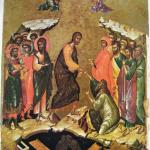
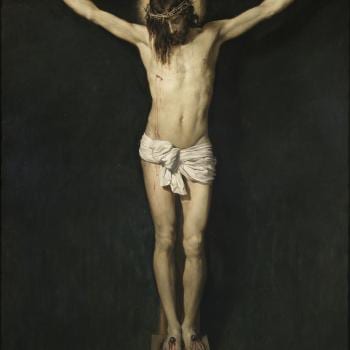
We are meant to feel that his life was in that sense a sort of love affair with death, a romance of the pursuit of the ultimate sacrifice. From the moment when the star goes up like a birthday rocket, to the moment when the sun is extinguished like a funeral torch, the whole story moves on wings with the speed and direction of a drama, ending in an act beyond words. Therefore the story of Christ is the story of a journey, almost in the manner of a military march; certainly in the manner of the quest of a hero moving to his achievement or his doom. It is a story that begins in the paradise of Galilee, a pastoral and peaceful land having really some hint of Eden, and gradually climbs the rising country into the mountains that are nearer to the storm-clouds and the stars, as to a Mountain of Purgatory. He may be met as if straying in strange places, or stopped on the way for discussion or dispute; but his face is set towards the mountain city. That is the meaning of that great culmination when he crested the ridge and stood at the turning of the road and suddenly cried aloud, lamenting over Jerusalem. Some light touch of that lament is in every patriotic poem or if it is absent, the patriotism stinks with vulgarity. That is the meaning of the stirring and startling incident at the gates of the Temple, when the tables were hurled like lumber down the steps, and the rich merchants driven forth with bodily blows; the incident that must be at least as much of a puzzle to the pacifists as any paradox about non-resistance can be to any of the militarists. I have compared the quest to the journey of Jason, but we must never forget that in a deeper sense it is rather to be compared to the journey of Ulysses. It was not only a romance of travel but a romance of return; and of the end of a usurpation. No healthy boy reading the story regards the rout of the Ithacan suitors as anything but a happy ending. But there are doubtless some who regard the rout of the Jewish merchants and money-changers with that refined repugnance which never fails to move them in the presence of violence, and especially of violence against the well-to-do. The point here, however, is that all these incidents have in them a character of mounting crisis. In other words, these incidents are not incidental. When Apollonius the ideal philosopher is brought before the judgment seat of Domitian and vanishes by magic, the miracle is entirely incidental. It might have occurred at any time in the wandering life of the Tyanean; indeed, I believe it is doubtful in date as well as in substance. The ideal philosopher merely vanished, and resumed his ideal existence somewhere else for an indefinite period. It is characteristic of the contrast perhaps that Apollonius was supposed to have lived to an almost miraculous old age. Jesus of Nazareth was less prudent in his miracles. When Jesus was brought before the judgment-seat of Pontius Pilate, he did not vanish. It was the crisis and the goal; it was the hour and the power of darkness. It was the supremely supernatural act of all his miraculous life, that he did not vanish.
Every attempt to amplify that story has diminished it. The task has been attempted by many men of real genius and eloquence as well as by only too many vulgar sentimentalists and self-conscious rhetoricians. The tale has been retold with patronizing pathos by elegant skeptics and with fluent enthusiasm by boisterous best-sellers. It will not be retold here. The grinding power of the plain words of the Gospel story is like the power of millstones; and those who can read them simply enough will feel as if rocks had been rolled upon them. Criticism is only words about words; and of what use are words about such words as these? What is the use of wordpainting about the dark garden filled suddenly with torchlight and furious faces? ‘Are you come out with swords and staves as against a robber? All day I sat in your temple teaching, and you took me not.’ Can anything be added to the massive and gathered restraint of that irony; like a great wave lifted to the sky and refusing to fall? ‘Daughters of Jerusalem, weep not for me but weep for yourselves and for your children!
As the High Priest asked what further need he had of witnesses, we might well ask what further need we have of words. Peter in a panic repudiated him: ‘and immediately the cock crew; and Jesus looked upon Peter, and Peter went out and wept bitterly.’ Has anyone any further remarks to offer? Just before the murder he prayed for all the murderous race of men saying ‘They know not what they do’; is there anything to say to that, except that we know as little what we say? Is there any need to repeat and spin out the story of how the tragedy trailed up the Via Dolorosa and how they threw him in haphazard with two thieves in one of the ordinary batches of execution; and how in all that horror and howling wilderness of desertion one voice spoke in homage, a startling voice from the very last place where it was looked for, the gibbet of the criminal; and he said to that nameless ruffian, ‘This night shalt thou be with me in Paradise’? Is there anything to put after that but a full-stop? Or is anyone prepared to answer adequately that farewell gesture to all flesh which created for his Mother a new Son?
It is more within my powers, and here more immediately to my purpose, to point out that in that scene were symbolically gathered all the human forces that have been vaguely sketched in this story. As kings and philosophers and the popular element had been symbolically present at his birth, so they were more practically concerned in his death; and with that we come face to face with the essential fact to be realized. All the great groups that stood about the Cross represent in one way or another the great historical truth of the time; that the world could not save itself. Man could do no more. Rome and Jerusalem and Athens and everything else were going down like a sea turned into a slow cataract. Externally indeed the ancient world was still at its strongest, it is always at that moment that the inmost weakness begins. But in order to understand that weakness we must repeat what has been said more than once; that it was not the weakness of a thing originally weak. It was emphatically the strength of the world that was turned to weakness and the wisdom of the world that was turned to folly.
***
And as it was with these powers that were good, or at least had once been good, so it was with the element which was perhaps the best, or which Christ himself seems certainly to have felt as the best. The poor to whom he preached the good news, the common people who heard him gladly, the populace that had made so many popular heroes and demigods in the old pagan world showed also the weaknesses that were dissolving the world. They suffered the evils often seen in the mob of the city, and especially the mob of the capital, during the decline of a society. The same thing that makes the rural population live on tradition makes the urban population live on rumor. just as its myths at the best had been irrational, so its likes and dislikes are easily changed by baseless assertion that is arbitrary without being authoritative. Some brigand or other was artificially turned into a picturesque and popular figure and run as a kind of candidate against Christ. In all this we recognize the urban population that we know, with its newspaper scares and scoops. But there was present in this ancient population an evil more peculiar to the ancient world. We have noted it already as the neglect of the individual, even of the individual voting the condemnation and still more of the individual condemned. It was the soul of the hive; a heathen thing. The cry of this spirit also was heard in that hour, ‘It is well that one man die for the people! Yet this spirit in antiquity of devotion to the city and to the state had so been in itself and in its time a noble spirit. It had its poets and its martyrs; men still to be honored forever. It was failing through its weakness in not seeing the separate soul of a man, the shrine of all mysticism; but it was only failing as everything else was failing. The mob went along with the Sadducees and the Pharisees, the philosophers and the moralists. It went along with the imperial magistrates and the sacred priests, the scribes and the soldiers, that the one universal human spirit might suffer a universal condemnation; that there might be one deep, unanimous chorus of approval and harmony when Man was rejected of men.
There were solitudes beyond where none shall follow. There were secrets in the inmost and invisible part of that drama that have no symbol in speech; orin any severance of a man from men. Nor is it easy for any words less stark and single-minded than those of the naked narrative even to hint at the horror of exaltation that lifted itself above the hill. Endless expositions have not come to the end of it, or even to the beginning. And if there be any sound that can produce a silence, we may surely be silent about the end and the extremity; when a cry was driven out of that darkness in words dreadfully distinct and dreadfully unintelligible, which man shall never understand in all the eternity they have purchased for him; and for one annihilating instant an abyss that is not for our thoughts had opened even in the unity of the absolute; and God bad been forsaken of God. – G.K. Chesterton, The Everlasting Man
Previous Post

April 18, 2019
Holy Thursday
Next Post
April 20, 2019 Holy Saturday
Browse Our Archives
Select a Category Uncategorized
Select a Month May 2020 April 2020 March 2020 February 2020 January 2020 December 2019 November 2019 October 2019 September 2019 August 2019 July 2019 June 2019 May 2019 April 2019 March 2019 February 2019 January 2019 December 2018 November 2018 October 2018 September 2018 August 2018 July 2018 June 2018 May 2018 April 2018 March 2018 February 2018 January 2018 December 2017 November 2017 October 2017 September 2017 August 2017 July 2017 June 2017 May 2017 April 2017 March 2017 February 2017 January 2017 December 2016 November 2016 October 2016 September 2016 August 2016 July 2016 June 2016 May 2016 December 2015 November 2015 October 2015 September 2015 August 2015 July 2015 June 2015 May 2015 April 2015 March 2015 February 2015 January 2015 December 2014 November 2014 October 2014 September 2014 August 2014 July 2014 June 2014 May 2014 April 2014 March 2014 February 2014 January 2014 December 2013 November 2013 October 2013 September 2013 August 2013 July 2013 June 2013 May 2013 April 2013 March 2013 February 2013 January 2013 December 2012 November 2012 October 2012 September 2012 August 2012 July 2012 June 2012 May 2012 April 2012 March 2012 February 2012 January 2012 December 2011 November 2011 October 2011 September 2011 August 2011 July 2011 June 2011 May 2011 April 2011 March 2011 February 2011 January 2011 December 2010 November 2010 October 2010 September 2010 August 2010 July 2010 June 2010 May 2010 April 2010 March 2010 February 2010 January 2010 December 2009 November 2009 October 2009 September 2009 August 2009 July 2009 June 2009 May 2009 April 2009 March 2009 February 2009 January 2009 September 2006 June 2006 July 2005 April 2005 May 2002 April 2002 0000
Follow Us!
TAKE THE
Religious Wisdom Quiz
According to 1 Peter, Jesus bore our sins in his body where?
Select your answer to see how you score.
On the mountain In the tomb In the garden On the tree (cross)
Related posts from Catholic and Enjoying It!
Good Friday, 1613. Riding Westward by John Donne

"Good Friday" by Christina Rossetti


TRENDING AT PATHEOS Catholic

Rejecting Doom: Christian Hope And Human Action
Christianity is a religion of hope. We are to have hope and...

It’s What Comes From Within Which Matters
One of the most difficult things for us to understand is why...

Why I Choose the Eucharist Over the Sermon
Choose the Eucharist, Not the Sermon What are we supposed to get...

5 Design Elements Found in Spiritually Rooted Homes
Putting Spirituality Into Home Decor Our homes are more than our living...

Credo: A Story of God Told with the...
About 10 years ago, I began to imagine a personal "Credo" that...

The Anatomy of Divine Revelation in Catholic Thought
The claim that God has made Himself known to human beings is...
view all Catholic blogs
Ad-Free & Subscriber Log-In Subscription Support
- About Us
- 2026 Calendar
- Videos
- Podcasts
- Library of World Religions
- Faith In Media Tracker
- Advertise With Us
- Write for Us
- Privacy Policy
- Terms of Service
- Do Not Sell My Data
- Contact Us
- Radiant Digital
- Manage Newsletter Subscriptions
- Unsubscribe From Notifications
- Sitemap
Copyright 2008-2026, Patheos. All rights reserved.
Subscription Support Ad-Free & Subscriber Log-In
Follow Patheos