
BuddhistCatholicContemplativeEvangelicalGeneral ChristianHinduJewishLatter-day SaintMuslimNew VisionsProgressive Christian
Beliefs
- Buddhist
- Catholic
- Contemplative
- Evangelical
- General Christian
- Hindu
- Jewish
- Latter-day Saint
- More Voices
- Muslim
- New Visions
- Pagan
- Progressive Christian
Topics
- Religion News
- Food and Religion
- Sports and Religion
- Religious Art
- Religious Music and Entertainment
- Religious Events
- History and Religion
- Style and Religion
- Politics and Religion
- Women in Religion
- Recreation Outdoors and Religion
- Business Finance and Religion
- Careers Workplace and Religion
- Education and Religion
- Family Parenting and Religion
- Health Fitness and Religion
- Home and Religion
- Relationships and Religion
- Technology and Religion
- Travel and Religion
Columnists
- Buddhist Columnists
- Business Finance and Religion Columnists
- Careers Workplace and Religion Columnists
- Catholic Columnists
- Contemplative Columnists
- Education and Religion Columnists
- Evangelists Columnists
- Family Parenting and Religion Columnists
- General Christian Columnists
- Health Fitness and Religion Columnists
- Hindu Columnists
- History and Religion Columnists
- Home and Religion Columnists
- Jewish Columnists
- More Voices Columnists
- Latter Day Columnists
- Muslim Columnists
- New Visions Columnists
- Nonreligious Columnists
- Pagan Columnists
- Politics and Religion Columnists
- Progressive Columnists
- Recreation Outdoors and Religion Columnists
- Relationships and Religion Columnists
- Religion News Columnists
- Religious Art Columnists
- Religious Events Columnists
- Religious Music and Entertainment Columnists
- Sports and Religion Columnists
- Style and Religion Columnists
- Technology and Religion Columnists
- Travel and Religion Columnists
- Women in Religion Columnists
Resource Library
- 2026 Calendar
- Library of World Religions
- The 100 Most Holy Places on Earth
- Patheos Answers
- Podcasts
- Videos
- Faith Leaders Database
- Anglican Episcopalian
- Bahai
- Baptist
- Buddhism
- Christianity
- Confucianism
- Eastern Orthodoxy
- Hinduism
- Holiness and Pentecostal
- ISKCON
- Islam
- Judaism
- Lutheran
- Methodist
- The Church of Jesus Christ of Latter-day Saints
- New Age
- Paganism
- Presbytarian and Reformed
- Protestantism
- Religion Behind the Scenes
- Roman Catholic
- Scientology
- Shia Islam
- Sikhism
- Sufism
- Sunni Islam
- Taoism
- Zen
- See all religions
Research Tools
 Ad-Free & Subscriber Log-In Subscription Support
Ad-Free & Subscriber Log-In Subscription Support
Follow Patheos 

- Trending:
- Forgiveness
- |
- Marriage
- |
- Consciousness
- |
- Death Penalty
- |
- Election
- |
- Halloween
 Catholic and Enjoying It!
- Home
- Catholic
- Yesterday’s Gospel and the Blessed Virgin Mary
Yesterday’s Gospel and the Blessed Virgin Mary
Last updated on: June 11, 2018 at 11:15 am by Mark Shea
Yesterday’s Gospel and the Blessed Virgin Mary 2018-06-11T11:15:52-07:00 Mark Shea
Patheos Explore the world's faith through different perspectives on religion and spirituality! Patheos has the views of the prevalent religions and spiritualities of the world.
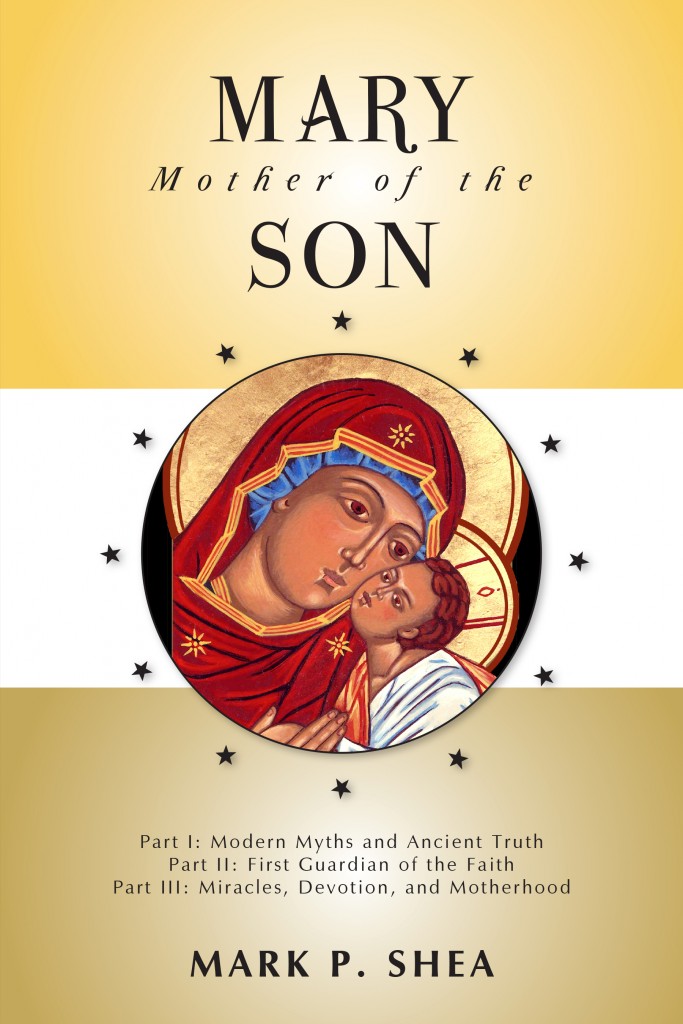
Yesterday’s gospel is often a favorite with the Jesus Constantly Rebuked Mary Crowd. As a former member of that crowd, I discussed it in my book, Mary, Mother of the Son in connection with her supposedly “sinful unbelief” in Jesus:
The Witness of the Gospels
Once I moved away from the not-as-airtight-as-I-thought passages in Romans and the false notion that Catholics think Mary did not need a Savior, my mind turned to the Gospels, most prominently Mark 3:13–35:
And he went up on the mountain, and called to him those whom he desired; and they came to him. And he appointed twelve, to be with him, and to be sent out to preach and have authority to cast out demons: Simon whom he surnamed Peter; James the son of Zebedee and John the brother of James, whom he surnamed Bo-anerges, that is, sons of thunder; Andrew, and Philip, and Bartholomew, and Matthew, and Thomas, and James the son of Alphaeus, and Thaddaeus, and Simon the Cananaean, and Judas Iscariot, who betrayed him.
Then he went home; and the crowd came together again, so that they could not even eat. And when his family heard it, they went out to seize him, for people were saying, “He is beside himself.” And the scribes who came down from Jerusalem said, “He is possessed by Be-elzebul, and by the prince of demons he casts out the demons.” And he called them to him, and said to them in parables, “How can Satan cast out Satan? If a kingdom is divided against itself, that kingdom cannot stand. And if a house is divided against itself, that house will not be able to stand. And if Satan has risen up against himself and is divided, he cannot stand, but is coming to an end. But no one can enter a strongman’s house and plunder his goods, unless he first binds the strong man; then indeed he may plunder his house.
“Truly, I say to you, all sins will be forgiven the sons of men, and whatever blasphemies they utter; but whoever blasphemes against the Holy Spirit never has forgiveness, but is guilty of an eternal sin”—for they had said, “He has an unclean spirit.”
And his mother and his brethren came; and standing outside they sent to him and called him. And a crowd was sitting about him; and they said to him, “Your mother and your brethren are outside, asking for you.” And he replied, “Who are my mother and my brethren?” And looking around on those who sat about him, he said, “Here are my mother and my brethren! Whoever does the will of God is my brother, and sister, and mother.”
Some readers may suppose I made a mistake by including that chunk of Scripture at the beginning about Jesus calling his disciples. But part of Mark’s purpose in arranging these stories together is to get us to understand that Jesus is creating a new covenant family that’s greater than the biological family because it’s rooted in his divine power, not in mere biological kinship. (Luke and Matthew make exactly the same point in Luke 11:27–28 and Matthew 12:46–50.) So Mark shows Jesus calling his disciples and concludes with Jesus declaring that they are his family.
But it’s easy for a modern reader to perceive a different dynamic in this narrative than the one Mark intends. That’s partly because Jesus couches some of his affirmations in statements that sound to our ears like denials. To see what I mean, note this peculiar exchange:
And as he was setting out on his journey, a man ran up and knelt before him, and asked him, “Good Teacher, what must I do to inherit eternal life?” And Jesus said to him, “Why do you call me good? No one is good but God alone” (Mark 10:17–18).
This passage, taken in isolation, is a favorite among those who like to argue that Jesus denied he is God. The problem is, the same author who records this saying also records numerous sayings of Jesus that make it extremely clear Jesus did claim to be God. From Jesus’ forgiveness of sins (Mark 2:1–12) to his frank and open application of the divine name “I AM” to himself (Mark 14:61–62), Mark records Jesus’ claim to deity. So why does Mark also record Jesus’ apparently problematic response to the young man’s question? Precisely because Jesus means for us to recognize that he is called good because he really is Good, and therefore really is God. What appears to be a denial is, when we think about it, actually another claim to deity.
Jesus’ seeming rebuke of Mary has the same character. It’s an apparent denial that turns out to be an affirmation. For neither Jesus nor Mark is saying that biological families are evil and should be repudiated, while only spiritual families are good. Rather, Jesus is saying that biological families are good, that spiritual families are even better and, in a larger context, calling us to unite these two aspects of family altogether. Jesus declares, “Whoever does the will of God is my brother, and sister, and mother.” The only way we can take that as a rebuke of Mary would be to show that she refused to do God’s will. But Luke has already made clear that she eagerly obeyed God. Indeed, Mary’s words are those of the quintessential disciple, “Behold, I am the handmaid of the Lord; let it be to me according to your word” (Luke 1:38). So she is Jesus’ mother in both the biological and the spiritual sense and he means us to understand this, just as he means us to understand that he really is good, and therefore really is God.
“Not so fast!” says the Evangelical reader, “Aren’t you forgetting that little incident in the middle of the passage: the one where his family thought he was nuts? How is that evidence of Mary’s faith?”
This is perhaps the favorite moment in the Gospels for critics of the Immaculate Conception. However, as I discovered upon a close reading, it’s plagued with difficulties when used for that purpose.
In the first place, this claim of Mary’s “faithlessness” is rather hard to square with the complaints lodged against her by Evangelical readers of the story of the wedding at Cana. If Mary believed in Jesus’ messianic powers so much that she was sinfully pushing him to do theatrical wonders in John 2, then what is the sense in saying she had no faith in him as Messiah in Mark 3? The complaints cannot both be true. Indeed, there is no reason to think either are true. For it is not Mary who says Jesus is beside himself (i.e., crazy or demon possessed). It is “people.” Second, Mark tells us precisely who was spreading this notion among “people.” It was not his family but Jesus’ worst enemies, the Jerusalem scribes. Indeed, Jesus himself makes clear the scribes’ enmity was so bitter that, in charging him with acting by demonic power, they were actually committing the unforgivable sin of blaspheming the Holy Spirit. They hated Jesus so much that they didn’t mind damning themselves if they could just score a good solid lie against him.
So what’s the reaction of his family? They come to seize him. Why? Because they think he’s nuts? The text doesn’t say that. And that’s the point. They could just as easily have come to rescue Jesus from a feared attack by his enemies as to try to put him in the Home for Messianic Crazies. In fact, something rather similar takes place in Acts 19. Paul, like Jesus, has powerful enemies. A group of Ephesian silversmiths, whose trade in silver idols of the goddess Artemis was endangered by the spread of the faith, leads a crowd of Paul’s bitterest enemies to the theater and they begin shouting “Great is Artemis of the Ephesians!” Note the interaction between Paul and his friends:
Paul wished to go in among the crowd, but the disciples would not let him; some of the Asiarchs also, who were friends of his, sent to him and begged him not to venture into the theater (Acts 19:30–31).
In short, Paul’s friends were primarily motivated by a desire to keep their friend from being lynched by his enemies, not by an urge to lock him in the goofy booth. Nobody charges them with lack of faith. Rather, we naturally commend them for faithfully sticking with their friend in a very difficult spot. Yet Mary frequently incurs the charge, not merely of faithlessness, but even of agreeing with his worst enemies that her Son was demon-possessed! Once again, I began to realize that this tells us more about Evangelical attitudes to Mary than about anything in the text of Scripture. After all, we have already been told that Mary was the handmaid of the Lord. We have seen the scriptural testimony to her as a living sign of God’s perpetual fruitfulness in Jesus Christ, a woman whom all generations would call blessed, a woman who loved Jesus deeply and totally with the love of an adorer for her God and the love of a mother for her Son.
Yet, at the first opportunity to do so, we Evangelicals applied an astonishing double standard to her and concluded that, while the friends of St. Paul obviously had his best interests at heart, Jesus’ own mother “simply must” have thought he was a demonically-possessed nutcase. And we said all this despite the fact that virtually the only thing sustaining this view of Mary is John’s remark that “even his brethren did not believe in him” (John 7:5). But John never tells us, “Even his mother did not believe in him.” On the contrary, neither John nor Mark gives us anything to go on about Mary besides the fact that she was there and that Jesus told us a good disciple was basically like his mother.
Previous Post

June 11, 2018
Blaming abortion supporters for the death penalty
Next Post
June 12, 2018 For the Embryology Textbook Tells Me So
Browse Our Archives
Select a Category Uncategorized
Select a Month May 2020 April 2020 March 2020 February 2020 January 2020 December 2019 November 2019 October 2019 September 2019 August 2019 July 2019 June 2019 May 2019 April 2019 March 2019 February 2019 January 2019 December 2018 November 2018 October 2018 September 2018 August 2018 July 2018 June 2018 May 2018 April 2018 March 2018 February 2018 January 2018 December 2017 November 2017 October 2017 September 2017 August 2017 July 2017 June 2017 May 2017 April 2017 March 2017 February 2017 January 2017 December 2016 November 2016 October 2016 September 2016 August 2016 July 2016 June 2016 May 2016 December 2015 November 2015 October 2015 September 2015 August 2015 July 2015 June 2015 May 2015 April 2015 March 2015 February 2015 January 2015 December 2014 November 2014 October 2014 September 2014 August 2014 July 2014 June 2014 May 2014 April 2014 March 2014 February 2014 January 2014 December 2013 November 2013 October 2013 September 2013 August 2013 July 2013 June 2013 May 2013 April 2013 March 2013 February 2013 January 2013 December 2012 November 2012 October 2012 September 2012 August 2012 July 2012 June 2012 May 2012 April 2012 March 2012 February 2012 January 2012 December 2011 November 2011 October 2011 September 2011 August 2011 July 2011 June 2011 May 2011 April 2011 March 2011 February 2011 January 2011 December 2010 November 2010 October 2010 September 2010 August 2010 July 2010 June 2010 May 2010 April 2010 March 2010 February 2010 January 2010 December 2009 November 2009 October 2009 September 2009 August 2009 July 2009 June 2009 May 2009 April 2009 March 2009 February 2009 January 2009 September 2006 June 2006 July 2005 April 2005 May 2002 April 2002 0000
Follow Us!
TAKE THE
Religious Wisdom Quiz
Which Christian movement is called "Holiness" and focuses on personal sanctification?
Select your answer to see how you score.
Eastern Orthodox Pentecostal Wesleyan/Methodist Anglican
Related posts from Catholic and Enjoying It!

Since it's that time of year again...

Hey Portland, Oregon! I'm coming your way October...

TRENDING AT PATHEOS Catholic

Rejecting Doom: Christian Hope And Human Action
Christianity is a religion of hope. We are to have hope and...

It’s What Comes From Within Which Matters
One of the most difficult things for us to understand is why...

Why I Choose the Eucharist Over the Sermon
Choose the Eucharist, Not the Sermon What are we supposed to get...

5 Design Elements Found in Spiritually Rooted Homes
Putting Spirituality Into Home Decor Our homes are more than our living...

Credo: A Story of God Told with the...
About 10 years ago, I began to imagine a personal "Credo" that...

The Anatomy of Divine Revelation in Catholic Thought
The claim that God has made Himself known to human beings is...
view all Catholic blogs
Ad-Free & Subscriber Log-In Subscription Support
- About Us
- 2026 Calendar
- Videos
- Podcasts
- Library of World Religions
- Faith In Media Tracker
- Advertise With Us
- Write for Us
- Privacy Policy
- Terms of Service
- Do Not Sell My Data
- Contact Us
- Radiant Digital
- Manage Newsletter Subscriptions
- Unsubscribe From Notifications
- Sitemap
Copyright 2008-2026, Patheos. All rights reserved.
Subscription Support Ad-Free & Subscriber Log-In
Follow Patheos