
BuddhistCatholicContemplativeEvangelicalGeneral ChristianHinduJewishLatter-day SaintMuslimNew VisionsProgressive Christian
Beliefs
- Buddhist
- Catholic
- Contemplative
- Evangelical
- General Christian
- Hindu
- Jewish
- Latter-day Saint
- More Voices
- Muslim
- New Visions
- Pagan
- Progressive Christian
Topics
- Religion News
- Food and Religion
- Sports and Religion
- Religious Art
- Religious Music and Entertainment
- Religious Events
- History and Religion
- Style and Religion
- Politics and Religion
- Women in Religion
- Recreation Outdoors and Religion
- Business Finance and Religion
- Careers Workplace and Religion
- Education and Religion
- Family Parenting and Religion
- Health Fitness and Religion
- Home and Religion
- Relationships and Religion
- Technology and Religion
- Travel and Religion
Columnists
- Buddhist Columnists
- Business Finance and Religion Columnists
- Careers Workplace and Religion Columnists
- Catholic Columnists
- Contemplative Columnists
- Education and Religion Columnists
- Evangelists Columnists
- Family Parenting and Religion Columnists
- General Christian Columnists
- Health Fitness and Religion Columnists
- Hindu Columnists
- History and Religion Columnists
- Home and Religion Columnists
- Jewish Columnists
- More Voices Columnists
- Latter Day Columnists
- Muslim Columnists
- New Visions Columnists
- Nonreligious Columnists
- Pagan Columnists
- Politics and Religion Columnists
- Progressive Columnists
- Recreation Outdoors and Religion Columnists
- Relationships and Religion Columnists
- Religion News Columnists
- Religious Art Columnists
- Religious Events Columnists
- Religious Music and Entertainment Columnists
- Sports and Religion Columnists
- Style and Religion Columnists
- Technology and Religion Columnists
- Travel and Religion Columnists
- Women in Religion Columnists
Resource Library
- 2026 Calendar
- Library of World Religions
- The 100 Most Holy Places on Earth
- Patheos Answers
- Podcasts
- Videos
- Faith Leaders Database
- Anglican Episcopalian
- Bahai
- Baptist
- Buddhism
- Christianity
- Confucianism
- Eastern Orthodoxy
- Hinduism
- Holiness and Pentecostal
- ISKCON
- Islam
- Judaism
- Lutheran
- Methodist
- The Church of Jesus Christ of Latter-day Saints
- New Age
- Paganism
- Presbytarian and Reformed
- Protestantism
- Religion Behind the Scenes
- Roman Catholic
- Scientology
- Shia Islam
- Sikhism
- Sufism
- Sunni Islam
- Taoism
- Zen
- See all religions
Research Tools
 Ad-Free & Subscriber Log-In Subscription Support
Ad-Free & Subscriber Log-In Subscription Support
Follow Patheos 

- Trending:
- Forgiveness
- |
- Marriage
- |
- Consciousness
- |
- Death Penalty
- |
- Election
- |
- Halloween
 Catholic and Enjoying It!
- Home
- Catholic
- Blood, Tribe, Jonah and the Good Samaritan
Blood, Tribe, Jonah and the Good Samaritan
Last updated on: October 9, 2017 at 11:30 am by Mark Shea
Blood, Tribe, Jonah and the Good Samaritan 2017-10-09T11:30:07-07:00 Mark Shea
Patheos Explore the world's faith through different perspectives on religion and spirituality! Patheos has the views of the prevalent religions and spiritualities of the world.
Today’s readings put together an Old and New Testament text that, at first glance, may seem unrelated.
The OT text is the beginning of the story of Jonah and the gospel reading is the Parable of the Good Samaritan.
It took a minute for my slow brain to figure out why the Church combines those readings. But then it hit me: both are direct challenges to tribalism.
Lots of people miss that the story of Jonah is a challenge to the notion that the Chosen People are chosen because of their superiority to the Gentiles. Most people assume Jonah runs away from God because he is afraid the Assyrians to whom he is sent will not listen to him.
On the contrary, Jonah runs because he is afraid they will. Jonah wants the Assyrian bastard to get it in the neck. He wants God to destroy Nineveh. He hates the Ninevites guts and does not want to afford them a chance to repent. So he takes is on the lam and, in the significant language of the sacred writer, runs “away from the presence of the LORD”. What is signficant about that? Because in the OT the “presence of the LORD” is typically associated with Jerusalem, where the temple is located. But Jonah is running away from Nineveh, not Jerusalem, which is the ancient near Eastern equivalent of 1942 Berlin.
The Assyrians were not nice people. They saw themselves as Manly Men Doing Manly Things in a Manly Way. For sport, they were really into killing lions:
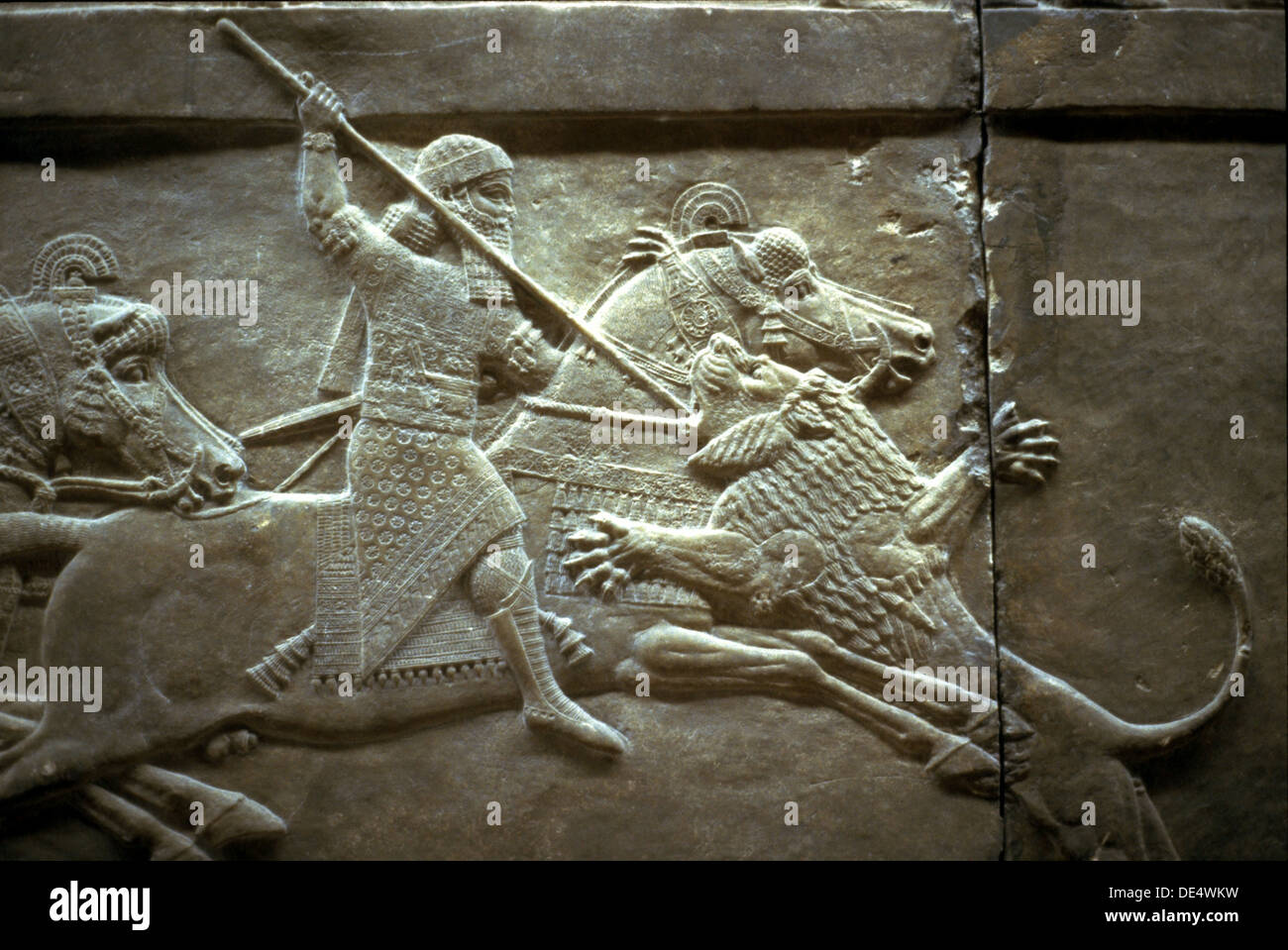
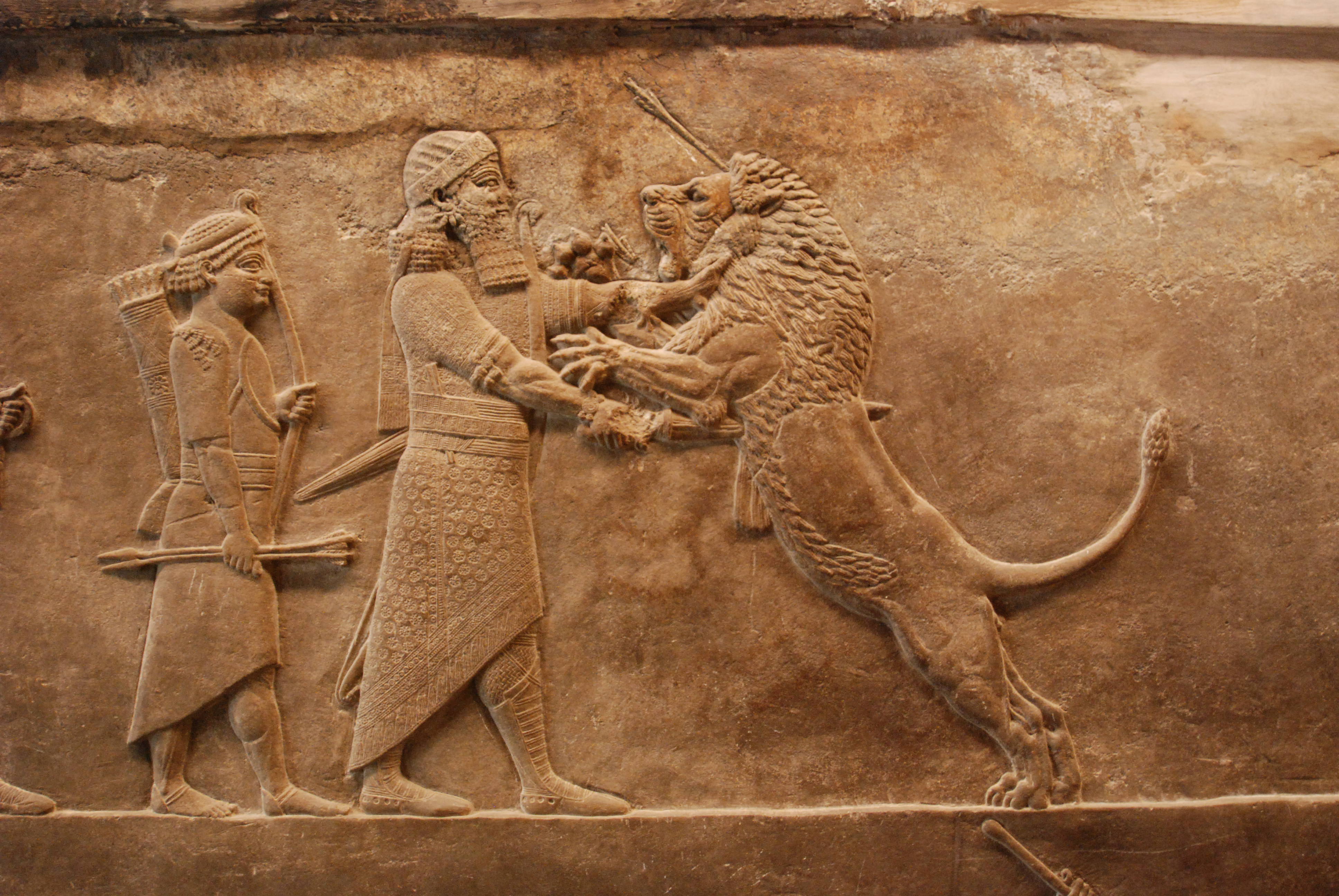

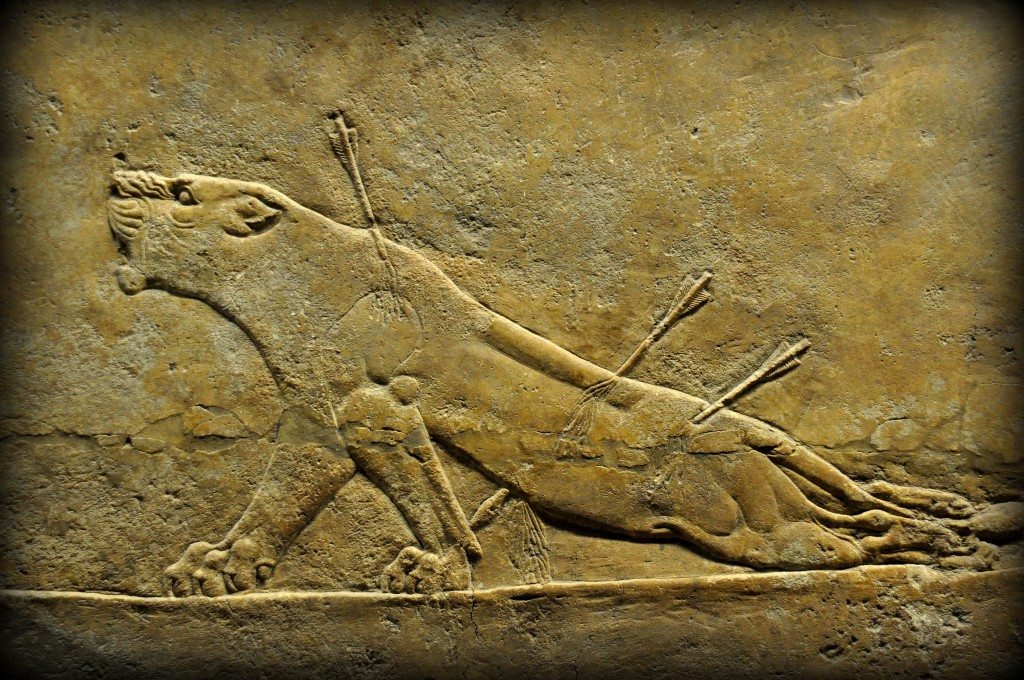
And they transferred this approach to life to their human victims as well. Indeed, virtually the only image we have of an Israelite comes to us from the Assyrians (since Israelites did not make graven images). It an emissary of the Israelite king Jehu (himself perhaps the most brutal monarch in Israelite history) bowing and scraping before Shalmaneser:

Eventually, the bowing and scraping ceased to have the desired effect and the Assyrians rolled over Israel with devastating force. They were brutal conquerors who practiced ethnic cleansing with cruel skill and they were the ones responsible for permanently wiping the northern kingdom of Israel off the map and exiling the Ten Lost Tribes of Israel into everlasting historical oblivion. When their empire in turn fell the prophet Nahum summarized the Assyrian contribution to world civilization by describing Nineveh thus:
Woe to the bloody city,
all full of lies and booty—
no end to the plunder!
The crack of whip, and rumble of wheel,
galloping horse and bounding chariot!
Horsemen charging,
flashing sword and glittering spear,
hosts of slain,
heaps of corpses,
dead bodies without end—
they stumble over the bodies!
And all for the countless harlotries of the harlot,
graceful and of deadly charms,
who betrays nations with her harlotries,
and peoples with her charms. (Na 3:1–4).
and concluding with this gloat:
Your shepherds are asleep,
O king of Assyria;
your nobles slumber.
Your people are scattered on the mountains
with none to gather them.
There is no assuaging your hurt,
your wound is grievous.
All who hear the news of you
clap their hands over you.
For upon whom has not come
your unceasing evil? (Na 3:18–19).
In short, the Assyrians were people we could do without, who never will be missed. And Jonah feels the full force of that. He would love it if God destroyed Nineveh. What possible reason–apart from the command of God Almighty–could he have to go warn these Nazis of the ancient world to repent and find the mercy of God? To hell with ’em.
That situation more or less obtains with the audience that Jesus addresses in the story of the Good Samaritan too. We sometimes hear that Jesus was apolitical. Rubbish. This parable is as political as it gets. If you want to get the hang of how it sounded to its original audience, all you have to do is replace their despised outgroups and cherished ingroups with our own and you will feel the offense Jesus went out of his way to give.
To conservative American Catholics it would be the Parable of the Good ISIS Member and the people passing the wounded man by would be a Latin Mass Traditionalist and a member of the Trump Campaign staff.
Were he telling it to a member of Black Lives Matter, it would be the Parable of the Good Klansman.
Were he telling it to a Bernie Bro, it would be the Parable of the Good Trump Donor.
The point is that Samaritans were despised by Jesus’ Jewish audience, and not without reason, just as our outgroups have done things to earn our loathing. And yet Jesus demands that we look beyond tribal membership labels and see the person and hope for their personal redemption.
Previous Post

October 9, 2017
The Trump Administration Had $250,000 to Blow
Next Post
October 10, 2017 Yup
Browse Our Archives
Select a Category Uncategorized
Select a Month May 2020 April 2020 March 2020 February 2020 January 2020 December 2019 November 2019 October 2019 September 2019 August 2019 July 2019 June 2019 May 2019 April 2019 March 2019 February 2019 January 2019 December 2018 November 2018 October 2018 September 2018 August 2018 July 2018 June 2018 May 2018 April 2018 March 2018 February 2018 January 2018 December 2017 November 2017 October 2017 September 2017 August 2017 July 2017 June 2017 May 2017 April 2017 March 2017 February 2017 January 2017 December 2016 November 2016 October 2016 September 2016 August 2016 July 2016 June 2016 May 2016 December 2015 November 2015 October 2015 September 2015 August 2015 July 2015 June 2015 May 2015 April 2015 March 2015 February 2015 January 2015 December 2014 November 2014 October 2014 September 2014 August 2014 July 2014 June 2014 May 2014 April 2014 March 2014 February 2014 January 2014 December 2013 November 2013 October 2013 September 2013 August 2013 July 2013 June 2013 May 2013 April 2013 March 2013 February 2013 January 2013 December 2012 November 2012 October 2012 September 2012 August 2012 July 2012 June 2012 May 2012 April 2012 March 2012 February 2012 January 2012 December 2011 November 2011 October 2011 September 2011 August 2011 July 2011 June 2011 May 2011 April 2011 March 2011 February 2011 January 2011 December 2010 November 2010 October 2010 September 2010 August 2010 July 2010 June 2010 May 2010 April 2010 March 2010 February 2010 January 2010 December 2009 November 2009 October 2009 September 2009 August 2009 July 2009 June 2009 May 2009 April 2009 March 2009 February 2009 January 2009 September 2006 June 2006 July 2005 April 2005 May 2002 April 2002 0000
Follow Us!
TAKE THE
Religious Wisdom Quiz
What is the "Great Commission" Jesus gave his followers?
Select your answer to see how you score.
Build a temple Go and make disciples Stay hidden Gather riches
Related posts from Catholic and Enjoying It!



Thinking about the Sunday Readings
TRENDING AT PATHEOS Catholic

Rejecting Doom: Christian Hope And Human Action
Christianity is a religion of hope. We are to have hope and...

It’s What Comes From Within Which Matters
One of the most difficult things for us to understand is why...

Why I Choose the Eucharist Over the Sermon
Choose the Eucharist, Not the Sermon What are we supposed to get...

5 Design Elements Found in Spiritually Rooted Homes
Putting Spirituality Into Home Decor Our homes are more than our living...

Credo: A Story of God Told with the...
About 10 years ago, I began to imagine a personal "Credo" that...

The Anatomy of Divine Revelation in Catholic Thought
The claim that God has made Himself known to human beings is...
view all Catholic blogs
Ad-Free & Subscriber Log-In Subscription Support
- About Us
- 2026 Calendar
- Videos
- Podcasts
- Library of World Religions
- Faith In Media Tracker
- Advertise With Us
- Write for Us
- Privacy Policy
- Terms of Service
- Do Not Sell My Data
- Contact Us
- Radiant Digital
- Manage Newsletter Subscriptions
- Unsubscribe From Notifications
- Sitemap
Copyright 2008-2026, Patheos. All rights reserved.
Subscription Support Ad-Free & Subscriber Log-In
Follow Patheos