
BuddhistCatholicContemplativeEvangelicalGeneral ChristianHinduJewishLatter-day SaintMuslimNew VisionsProgressive Christian
Beliefs
- Buddhist
- Catholic
- Contemplative
- Evangelical
- General Christian
- Hindu
- Jewish
- Latter-day Saint
- More Voices
- Muslim
- New Visions
- Pagan
- Progressive Christian
Topics
- Religion News
- Food and Religion
- Sports and Religion
- Religious Art
- Religious Music and Entertainment
- Religious Events
- History and Religion
- Style and Religion
- Politics and Religion
- Women in Religion
- Recreation Outdoors and Religion
- Business Finance and Religion
- Careers Workplace and Religion
- Education and Religion
- Family Parenting and Religion
- Health Fitness and Religion
- Home and Religion
- Relationships and Religion
- Technology and Religion
- Travel and Religion
Columnists
- Buddhist Columnists
- Business Finance and Religion Columnists
- Careers Workplace and Religion Columnists
- Catholic Columnists
- Contemplative Columnists
- Education and Religion Columnists
- Evangelists Columnists
- Family Parenting and Religion Columnists
- General Christian Columnists
- Health Fitness and Religion Columnists
- Hindu Columnists
- History and Religion Columnists
- Home and Religion Columnists
- Jewish Columnists
- More Voices Columnists
- Latter Day Columnists
- Muslim Columnists
- New Visions Columnists
- Nonreligious Columnists
- Pagan Columnists
- Politics and Religion Columnists
- Progressive Columnists
- Recreation Outdoors and Religion Columnists
- Relationships and Religion Columnists
- Religion News Columnists
- Religious Art Columnists
- Religious Events Columnists
- Religious Music and Entertainment Columnists
- Sports and Religion Columnists
- Style and Religion Columnists
- Technology and Religion Columnists
- Travel and Religion Columnists
- Women in Religion Columnists
Resource Library
- 2026 Calendar
- Library of World Religions
- The 100 Most Holy Places on Earth
- Patheos Answers
- Podcasts
- Videos
- Faith Leaders Database
- Anglican Episcopalian
- Bahai
- Baptist
- Buddhism
- Christianity
- Confucianism
- Eastern Orthodoxy
- Hinduism
- Holiness and Pentecostal
- ISKCON
- Islam
- Judaism
- Lutheran
- Methodist
- The Church of Jesus Christ of Latter-day Saints
- New Age
- Paganism
- Presbytarian and Reformed
- Protestantism
- Religion Behind the Scenes
- Roman Catholic
- Scientology
- Shia Islam
- Sikhism
- Sufism
- Sunni Islam
- Taoism
- Zen
- See all religions
Research Tools
 Ad-Free & Subscriber Log-In Subscription Support
Ad-Free & Subscriber Log-In Subscription Support
Follow Patheos 

- Trending:
- Forgiveness
- |
- Marriage
- |
- Consciousness
- |
- Death Penalty
- |
- Election
- |
- Halloween
 Catholic and Enjoying It!
- Home
- Catholic
- The 20th Century was about atomic power
The 20th Century was about atomic power
Last updated on: June 2, 2015 at 12:40 am by Mark Shea
The 20th Century was about atomic power 2015-05-08T18:33:34-07:00 Mark Shea
Patheos Explore the world's faith through different perspectives on religion and spirituality! Patheos has the views of the prevalent religions and spiritualities of the world.
The 21st Century will be about editing the genome:
CRISPR, a new genome editing tool, could transform the field of biology—and a recent study on genetically-engineered human embryos has converted this promise into media hype. But scientists have been tinkering with genomes for decades. Why is CRISPR suddenly such a big deal?
The short answer is that CRISPR allows scientists to edit genomes with unprecedented precision, efficiency, and flexibility. The past few years have seen a flurry of “firsts” with CRISPR, from creating monkeys with targeted mutations to preventing HIV infection in human cells. Earlier this month, Chinese scientists announced they applied the technique to nonviable human embryos, hinting at CRISPR’s potential to cure any genetic disease. And yes, it might even lead to designer babies. (Though, as the results of that study show, it’s still far from ready for the doctor’s office.)
In short, CRISPR is far better than older techniques for gene splicing and editing. And you know what? Scientists didn’t invent it.
CRISPR/Cas9 comes from strep bacteria…
CRISPR is actually a naturally-occurring, ancient defense mechanism found in a wide range of bacteria. As far as back the 1980s, scientists observed a strange pattern in some bacterial genomes. One DNA sequence would be repeated over and over again, with unique sequences in between the repeats. They called this odd configuration “clustered regularly interspaced short palindromic repeats,” or CRISPR.
As with the atom (or, for that matter, every technological discovery since we figured out how to use chipped stones to kill prey and slay Abel), this holds enormous promise and immense danger. It might be possible to simply edit cystic fibrosis or Down syndrome or a hundred other genetic afflictions out of our children’s gene instead of (as we barbarically do today) simply killing children in the womb. I can see no reason why the Catholic tradition would oppose healing these affliction–assuming of course that they cure does not interfere with the natural processes of begetting and does not involve the taking of innocent human life.
But on the other hand, it is also quite possible–and even likely given our culture that reduces human life to salable commodities–that such technology will usher in Designer Humans[TM] and a whole raft of evil attempts to manufacture Alphas, Betas, Gammas, Deltas and Epsilons.
Now, more than ever, it is vital that we learn and learn well the prophetic warning of C.S. Lewis’ The Abolition of Man:
Man’s conquest of Nature, if the dreams of some scientific planners are realized, means the rule of a few hundreds of men over billions upon billions of men. There neither is nor can be any simple increase of power on Man’s side. Each new power won by man is a power over man as well. Each advance leaves him weaker as well as stronger. In every victory, besides being the general who triumphs, he is also the prisoner who follows the triumphal car.
I am not yet considering whether the total result of such ambivalent victories is a good thing or a bad. I am only making clear what Man’s conquest of Nature really means and especially that final stage in the conquest, which, perhaps, is not far off. The final stage is come when Man by eugenics, by pre-natal conditioning, and by an education and propaganda based on a perfect applied psychology, has obtained full control over himself. Human nature will be the last part of Nature to surrender to Man. The battle will then be won. We shall have taken the thread of life out of the hand of Clotho and be henceforth free to make our species whatever we wish it to be. The battle will indeed be won. But who, precisely, will have won it?
For the power of Man to make himself what he pleases means, as we have seen, the power of some men to make other men what they please. In all ages, no doubt, nurture and instruction have, in some sense, attempted to exercise this power. But the situation to which we must look forward will be novel in two respects. In the first place, the power will be enormously increased. Hitherto the plans of educationalists have achieved very little of what they attempted and indeed, when we read them — how Plato would have every infant “a bastard nursed in a bureau”, and Elyot would have the boy see no men before the age of seven and, after that, no women,’ and how Locke wants children to have leaky shoes and no turn for poetry — we may well thank the beneficent obstinacy of real mothers, real nurses, and (above all) real children for preserving the human race in such sanity as it still possesses. But the man-moulders of the new age will be armed with the powers of an omnicompetent state and an irresistible scientific technique: we shall get at last a race of conditioners who really can cut out all posterity in what shape they please.
The second difference is even more important. In the older systems both the kind of man the teachers wished to produce and their motives for producing him were prescribed by the Tao — a norm to which the teachers themselves were subject and from which they claimed no liberty to depart. They did not cut men to some pattern they had chosen. They handed on what they had received: they initiated the young neophyte into the mystery of humanity which over-arched him and them alike. It was but old birds teaching young birds to fly. This will be changed. Values are now mere natural phenomena. Judgements of value are to be produced in the pupil as part of the conditioning. Whatever Tao there is will be the product, not the motive, of education. The conditioners have been emancipated from all that. It is one more part of Nature which they have conquered. The ultimate springs of human action are no longer, for them, something given. They have surrendered — like electricity: it is the function of the Conditioners to control, not to obey them. They know how to produce conscience and decide what kind of conscience they will produce. They themselves are outside, above. For we are assuming the last stage of Man’s struggle with Nature. The final victory has been won. Human nature has been conquered — and, of course, has conquered, in whatever sense those words may now bear.
The Conditioners, then, are to choose what kind of artificial Tao they will, for their own good reasons, produce in the Human race. They are the motivators, the creators of motives. But how are they going to be motivated themselves?
For a time, perhaps, by survivals, within their own minds, of the old ‘natural’ Tao. Thus at first they may look upon themselves as servants and guardians of humanity and conceive that they have a duty’ to do it good’. But it is only by confusion that they can remain in this state. They recognize the concept of duty as the result of certain processes which they can now control. Their victory has consisted precisely in emerging from the state in which they were acted upon by those processes to the state in which they use them as tools. One of the things they now have to decide is whether they will, or will not, so condition the rest of us that we can go on having the old idea of duty and the old reactions to it. How can duty help them to decide that? Duty itself is up for trial: it cannot also be the judge. And good fares no better. They know quite well how to produce a dozen different conceptions of good in us. The question is which, if any, they should produce. No conception of good can help them to decide. It is absurd to fix on one of the things they are comparing and make it the standard of comparison.
To some it will appear that I am inventing a factitious difficulty for my Conditioners. Other, more simple-minded, critics may ask. Why should you suppose they will be such bad men?’ But I am not supposing them to be bad men. They are, rather, not men (in the old sense) at all. They are, if you like, men who have sacrificed their own share in traditional humanity in order to devote themselves to the task of deciding what ‘Humanity’ shall henceforth mean. ‘Good’ and bad’, applied to them, are words without content: for it is from them that the content of these words is henceforward to be derived. Nor is their difficulty factitious, “We might suppose that it was possible to say ‘After all, most of us want more or less the same things — food and drink and sexual intercourse, amusement,
art, science, and the longest possible life for individuals and for the species. Let them simply say. This is what we happen to like, and go on to condition men in the way most likely to produce it. Where’s the trouble?’ But this will not answer. In the first place, it is false that we all really like the same things. But even if we did, what motive is to impel the Conditioners to scorn delights and live laborious days in order that we, and posterity, may have what we like? Their duty? But that is only the Tao, which they may decide to impose on us, but which cannot be valid for them. If they accept it, then they are no longer the makers of conscience but still its subjects, and their final conquest over Nature has not really happened. The preservation of the species? But why should the species be preserved? One of the questions before them is whether this feeling for posterity (they know well how it is produced) shall be continued or not. However far they go back, or down, they can find no ground to stand on. Every motive they try to act on becomes at once petitio. It is not that they are bad men. They are not men at all. Stepping outside the Tao, they have stepped into the void. Nor are their subjects necessarily unhappy men. They are not men at all: they are artefacts. Man’s final conquest has proved to be the abolition of Man.
Previous Post

June 2, 2015
Three Stooges Returning in Action-Comedy
Next Post
June 2, 2015 Stephen Colbert Cuts up with Fr. James Martin
Browse Our Archives
Select a Category Uncategorized
Select a Month May 2020 April 2020 March 2020 February 2020 January 2020 December 2019 November 2019 October 2019 September 2019 August 2019 July 2019 June 2019 May 2019 April 2019 March 2019 February 2019 January 2019 December 2018 November 2018 October 2018 September 2018 August 2018 July 2018 June 2018 May 2018 April 2018 March 2018 February 2018 January 2018 December 2017 November 2017 October 2017 September 2017 August 2017 July 2017 June 2017 May 2017 April 2017 March 2017 February 2017 January 2017 December 2016 November 2016 October 2016 September 2016 August 2016 July 2016 June 2016 May 2016 December 2015 November 2015 October 2015 September 2015 August 2015 July 2015 June 2015 May 2015 April 2015 March 2015 February 2015 January 2015 December 2014 November 2014 October 2014 September 2014 August 2014 July 2014 June 2014 May 2014 April 2014 March 2014 February 2014 January 2014 December 2013 November 2013 October 2013 September 2013 August 2013 July 2013 June 2013 May 2013 April 2013 March 2013 February 2013 January 2013 December 2012 November 2012 October 2012 September 2012 August 2012 July 2012 June 2012 May 2012 April 2012 March 2012 February 2012 January 2012 December 2011 November 2011 October 2011 September 2011 August 2011 July 2011 June 2011 May 2011 April 2011 March 2011 February 2011 January 2011 December 2010 November 2010 October 2010 September 2010 August 2010 July 2010 June 2010 May 2010 April 2010 March 2010 February 2010 January 2010 December 2009 November 2009 October 2009 September 2009 August 2009 July 2009 June 2009 May 2009 April 2009 March 2009 February 2009 January 2009 September 2006 June 2006 July 2005 April 2005 May 2002 April 2002 0000
Follow Us!
TAKE THE
Religious Wisdom Quiz
True or False: Romans teaches that we are justified by works of the law.
Select your answer to see how you score.
FALSE TRUE
Related posts from Catholic and Enjoying It!


C.S. Lewis reads The Four Loves

C.S. Lewis and the Recent Massacres in Israel
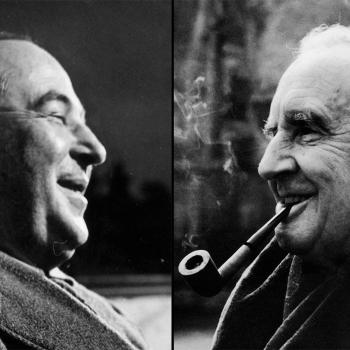
Very promising documentary on Lewis and Tolkien in...
TRENDING AT PATHEOS Catholic

Rejecting Doom: Christian Hope And Human Action
Christianity is a religion of hope. We are to have hope and...

It’s What Comes From Within Which Matters
One of the most difficult things for us to understand is why...

Why I Choose the Eucharist Over the Sermon
Choose the Eucharist, Not the Sermon What are we supposed to get...

5 Design Elements Found in Spiritually Rooted Homes
Putting Spirituality Into Home Decor Our homes are more than our living...

Credo: A Story of God Told with the...
About 10 years ago, I began to imagine a personal "Credo" that...

The Anatomy of Divine Revelation in Catholic Thought
The claim that God has made Himself known to human beings is...
view all Catholic blogs
Ad-Free & Subscriber Log-In Subscription Support
- About Us
- 2026 Calendar
- Videos
- Podcasts
- Library of World Religions
- Faith In Media Tracker
- Advertise With Us
- Write for Us
- Privacy Policy
- Terms of Service
- Do Not Sell My Data
- Contact Us
- Radiant Digital
- Manage Newsletter Subscriptions
- Unsubscribe From Notifications
- Sitemap
Copyright 2008-2026, Patheos. All rights reserved.
Subscription Support Ad-Free & Subscriber Log-In
Follow Patheos