
BuddhistCatholicContemplativeEvangelicalGeneral ChristianHinduJewishLatter-day SaintMuslimNew VisionsProgressive Christian
Beliefs
- Buddhist
- Catholic
- Contemplative
- Evangelical
- General Christian
- Hindu
- Jewish
- Latter-day Saint
- More Voices
- Muslim
- New Visions
- Pagan
- Progressive Christian
Topics
- Religion News
- Food and Religion
- Sports and Religion
- Religious Art
- Religious Music and Entertainment
- Religious Events
- History and Religion
- Style and Religion
- Politics and Religion
- Women in Religion
- Recreation Outdoors and Religion
- Business Finance and Religion
- Careers Workplace and Religion
- Education and Religion
- Family Parenting and Religion
- Health Fitness and Religion
- Home and Religion
- Relationships and Religion
- Technology and Religion
- Travel and Religion
Columnists
- Buddhist Columnists
- Business Finance and Religion Columnists
- Careers Workplace and Religion Columnists
- Catholic Columnists
- Contemplative Columnists
- Education and Religion Columnists
- Evangelists Columnists
- Family Parenting and Religion Columnists
- General Christian Columnists
- Health Fitness and Religion Columnists
- Hindu Columnists
- History and Religion Columnists
- Home and Religion Columnists
- Jewish Columnists
- More Voices Columnists
- Latter Day Columnists
- Muslim Columnists
- New Visions Columnists
- Nonreligious Columnists
- Pagan Columnists
- Politics and Religion Columnists
- Progressive Columnists
- Recreation Outdoors and Religion Columnists
- Relationships and Religion Columnists
- Religion News Columnists
- Religious Art Columnists
- Religious Events Columnists
- Religious Music and Entertainment Columnists
- Sports and Religion Columnists
- Style and Religion Columnists
- Technology and Religion Columnists
- Travel and Religion Columnists
- Women in Religion Columnists
Resource Library
- 2026 Calendar
- Library of World Religions
- The 100 Most Holy Places on Earth
- Patheos Answers
- Podcasts
- Videos
- Faith Leaders Database
- Anglican Episcopalian
- Bahai
- Baptist
- Buddhism
- Christianity
- Confucianism
- Eastern Orthodoxy
- Hinduism
- Holiness and Pentecostal
- ISKCON
- Islam
- Judaism
- Lutheran
- Methodist
- The Church of Jesus Christ of Latter-day Saints
- New Age
- Paganism
- Presbytarian and Reformed
- Protestantism
- Religion Behind the Scenes
- Roman Catholic
- Scientology
- Shia Islam
- Sikhism
- Sufism
- Sunni Islam
- Taoism
- Zen
- See all religions
Research Tools
 Ad-Free & Subscriber Log-In Subscription Support
Ad-Free & Subscriber Log-In Subscription Support
Follow Patheos 

- Trending:
- Forgiveness
- |
- Marriage
- |
- Consciousness
- |
- Death Penalty
- |
- Election
- |
- Halloween
 Catholic and Enjoying It!
- Home
- Catholic
- C.S. Lewis’ Episcopal Ghost Walks the Earth
C.S. Lewis’ Episcopal Ghost Walks the Earth
Last updated on: December 29, 2014 at 11:45 pm by Mark Shea
C.S. Lewis’ Episcopal Ghost Walks the Earth 2014-12-29T23:45:59-07:00 Mark Shea
Patheos Explore the world's faith through different perspectives on religion and spirituality! Patheos has the views of the prevalent religions and spiritualities of the world.
Its latest incarnation is Marian Budde the PiskieBish of DC, who writes:
To say that resurrection is essential doesn’t mean that if someone were to discover a tomb with Jesus’ remains in it that the entire enterprise would come crashing down.
Uh, yeah. It does. “If Christ is not raised, your faith is in vain,” says St. Paul. No resurrection, no good news. In fact, no news. The gospels are nothing other than passion and resurrection narratives with long introductions.
Lewis saw it all coming in The Great Divorce:
FOR A moment there was silence under the cedar trees and then-pad, pad, pad-it was broken. Two velvet-footed lions came bouncing into the open space, their eyes fixed upon each other, and started playing some solemn romp. Their manes looked as if they had been just dipped in the river whose noise I could hear close at hand, though the trees hid it. Not greatly liking my company, I moved away to find that river, and after passing some thick flowering bushes, I succeeded. The bushes came almost down to the brink. It was as smooth as Thames but flowed swiftly like a mountain stream: pale green where trees overhung it but so clear that I could count the pebbles at the bottom. Close beside me I saw another of the Bright People in conversation with a ghost. It was that fat ghost with the cultured voice who had addressed me in the bus, and it seemed to be wearing gaiters.
“My dear boy, I’m delighted to see you,” it was saying to the Spirit, who was naked and almost blindingly white. “I was talking to your poor father the other day and wondering where you were.”
“You didn’t bring him?” said the other.
“Well, no. He lives a long way from the bus, and, to be quite frank, he’s been getting a little eccentric lately. A little difficult. Losing his grip. He never was prepared to make any great efforts, you know. If you remember, he used to go to sleep when you and I got talking seriously! Ah, Dick, I shall never forget some of our talks. I expect you’ve changed your views a bit since then. You became rather narrow-minded towards the end of your life: but no doubt you’ve broadened out again.”
“How do you mean?”
“Well, it’s obvious by now, isn’t it, that you weren’t quite right. Why, my dear boy, you were coming to believe in a literal Heaven and Hell!”
“But wasn’t I right?”
“Oh, in a spiritual sense, to be sure. I still believe in them in that way. I am still, my dear boy, looking for the Kingdom. But nothing superstitious or mythological. . . .”
“Excuse me. Where do you imagine you’ve been?”
“Ah, I see. You mean that the grey town with its continual hope of morning (we must all live by hope, must we not?), with its field for indefinite progress, is, in a sense, Heaven, if only we have eyes to see it? That is a beautiful idea.”
“I didn’t mean that at all. Is it possible you don’t know where you’ve been?”
“Now that you mention it, I don’t think we ever do give it a name. What do you call it?”
“We call it Hell.”
“There is no need to be profane, my dear boy. I may not be very orthodox, in your sense of that word, but I do feel that these matters ought to be discussed simply, and seriously, and reverently.”
“Discuss Hell reverently? I meant what I said. You have been in Hell: though if you don’t go back you may call it Purgatory.”
“Go on, my dear boy, go on. That is so like you. No doubt you’ll tell me why, on your view, I was sent there. I’m not angry.”
“But don’t you know? You went there because you are an apostate.”
“Are you serious, Dick?”
“Perfectly.”
“This is worse than I expected. Do you really think people are penalized for their honest opinions? Even assuming, for the sake of argument, that those opinions were mistaken.”
“Do you really think there are no sins of intellect?”
“There are indeed, Dick. There is hidebound prejudice, and intellectual dishonesty, and timidity, and stagnation. But honest opinions fearlessly followed-they are not sins.”
“I know we used to talk that way. I did it too until the end of my life when I became what you call narrow. It all turns on what are honest opinions.”
“Mine certainly were. They were not only honest but heroic. I asserted them fearlessly. When the doctrine of the Resurrection ceased to commend itself to the critical faculties which God had given me, I openly rejected it. I preached my famous sermon. I defied the whole chapter. I took every risk.”
“What risk? What was at all likely to come of it except what actually came-popularity, sales for your books, invitations, and finally a bishopric?”
“Dick, this is unworthy of you. What are you suggesting?”
“Friend, I am not suggesting at all. You see, I know now. Let us be frank. Our opinions were not honestly come by. We simply found ourselves in contact with a certain current of ideas and plunged into it because it seemed modern and successful. At College, you know, we just started automatically writing the kind of essays that got good marks and saying the kind of things that won applause. When, in our whole lives, did we honestly face, in solitude, the one question on which all turned: whether after all the Supernatural might not in fact occur? When did we put up one moment’s real resistance to the loss of our faith?”
“If this is meant to be a sketch of the genesis of liberal theology in general, I reply that it is a mere libel. Do you suggest that men like …”
“I have nothing to do with any generality. Nor with any man but me and you. Oh, as you love your own soul, remember. You know that you and I were playing with loaded dice. We didn’t want the other to be true. We were afraid of crude salvationism, afraid of a breach with the spirit of the age, afraid of ridicule, afraid (above all) of real spiritual fears and hopes.”
“I’m far from denying that young men may make mistakes. They may well be influenced by current fashions of thought. But it’s not a question of how the opinions are formed. The point is that they were my honest opinions, sincerely expressed.”
“Of course. Having allowed oneself to drift, unresisting, unpraying, accepting every half-conscious solicitation from our desires, we reached a point where we no longer believed the Faith. Just in the same way, a jealous man, drifting and unresisting, reaches a point at which he believes lies about his best friend: a drunkard reaches a point at which (for the moment) he actually believes that another glass will do him no harm. The beliefs are sincere in the sense that they do occur as psychological events in the man’s mind. If that’s what you mean by sincerity they are sincere, and so were ours. But errors which are sincere in that sense are not innocent.”
“You’ll be justifying the Inquisition in a moment!”
“Why? Because the Middle Ages erred in one direction, does it follow that there is no error in the opposite direction?”
“Well, this is extremely interesting,” said the Episcopal Ghost. “It’s a point of view. Certainly, it’s a point of view. In the meantime . . .”
“There is no meantime,” replied the other. “AH that is over. We are not playing now. I have been talking of the past (your past and mine) only in order that you may turn from it forever. One wrench and the tooth will be out. You can begin as if nothing had ever gone wrong. White as snow. It’s all true, you know. He is in me, for you, with that power. And- I have come a long journey to meet you. You have seen Hell: you are in sight of Heaven. Will you, even now, repent and believe?”
“I’m not sure that I’ve got the exact point you are trying to make,” said the Ghost.
“I am not trying to make any point,” said the Spirit. “I am telling you to repent and believe.”
“But my dear boy, I believe already. We may not be perfectly agreed, but you have completely misjudged me if you do not realize that my religion is a very real and a very precious thing to me.”
“Very well,” said the other, as if changing his plan. “Will you believe in me?”
“In what sense?”
“Will you come with me to the mountains? It will hurt at first, until your feet are hardened. Reality is harsh to the feet of shadows. But will you come?”
“Well, that is a plan. I am perfectly ready to consider it. Of course I should require some assurances … I should want a guarantee that you are taking me to a place where I shall find a wider sphere of usefulness-and scope for the talents that God has given me-and an atmosphere of free inquiry-in short, all that one means by civilization and-er-the spiritual life.”
“No,” said the other. “I can promise you none of these things. No sphere of usefulness: you are not needed there at all. No scope for your talents: only forgiveness for having perverted them. No atmosphere of inquiry, for I will bring you to the land not of questions but of answers, and you shall see the face of God.”
“Ah, but we must all interpret those beautiful words in our own way! For me there is no such thing as a final answer. The free wind of inquiry must always continue to blow through the mind, must it not? Trove all things’ . . . to travel hopefully is better than to arrive.”
“If that were true, and known to be true, how could anyone travel hopefully? There would be nothing to hope for.”
“But you must feel yourself that there is something stifling about the idea of finality? Stagnation, my dear boy, what is more soul-destroying than stagnation?”
“You think that, because hitherto you have experienced truth only with the abstract intellect. I will bring you where you can taste it like honey and be embraced by it as by a bridegroom. Your thirst shall be quenched.”
“Well, really, you know, I am not aware of a thirst for some ready-made truth which puts an end to intellectual activity in the way you seem to be describing. Will it leave me the free play of Mind, Dick? I must insist on that, you know.”
“Free, as a man is free to drink while he is drinking. He is not free still to be dry.” The Ghost seemed to think for a moment. “I can make nothing of that idea,” it said.
“Listen!” said the White Spirit. “Once you were a child. Once you knew what inquiry was for. There was a time when you asked questions because you wanted answers, and were glad when you had found them. Become that child again: even now.”
“Ah, but when I became a man I put away childish things.”
“You have gone far wrong. Thirst was made for water; inquiry for truth. What you now call the free play of inquiry has neither more nor less to do with the ends for which intelligence was given you than masturbation has to do with marriage.”
“If we cannot be reverent, there is at least no need to be obscene. The suggestion that I should return at my age to the mere factual in-quisitiveness of boyhood strikes me as preposterous. In any case, that question-and-answer conception of thought only applies to matters of fact. Religious and speculative questions are surely on a different level.”
“We know nothing of religion here: we think only of Christ. We know nothing of speculation. Come and see. I will bring you to Eternal Fact, the Father of all other facthood.”
“I should object very strongly to describing God as a ‘fact.’ The Supreme Value would surely be a less inadequate description. It is hardly . . .”
“Do you not even believe that He exists?”
“Exists? What does Existence mean? You will keep on implying some sort of static, ready-made reality which is, so to speak, ‘there,’ and to which our minds have simply to conform. These great mysteries cannot be approached in that way. If there were such a thing (there is no need to interrupt, my dear boy) quite frankly, I should not be interested in it. It would be of no religions significance. God, for me, is something purely spiritual. The spirit of sweetness and light and tolerance-and, er, service, Dick, service. We mustn’t forget that, you know.”
“If the thirst of the Reason is really dead . . . ,” said the Spirit, and then stopped as though pondering. Then suddenly he said, “Can you, at least, still desire happiness?”
“Happiness, my dear Dick,” said the Ghost placidly, “happiness, as you will come to see when you are older, lies in the path of duty. Which reminds me. . . . Bless my soul, I’d nearly forgotten. Of course I can’t come with you. I have to be back next Friday to read a paper. We have a little Theological Society down there. Oh yes! there is plenty of intellectual life. Not of a very high quality, perhaps. One notices a certain lack of grip-a certain confusion of mind. That is where I can be of some use to them. There are even regrettable jealousies. … I don’t know why, but tempers seem less controlled than they used to be. Still, one mustn’t expect too much of human nature. I feel I can do a great work among them. But you’ve never asked me what my paper is about! I’m taking the text about growing up to the measure of the stature of Christ and working out an idea which I feel sure you’ll be interested in. I’m going to point out how people always forget that Jesus (here the Ghost bowed) was a comparatively young man when he died. He would have outgrown some of his earlier views, you know, if he’d lived. As he might have done, with a little more tact and patience. I am going to ask my audience to consider what his mature views would have been. A profoundly interesting question. What a different Christianity we might have had if only the Founder had reached his full stature! I shall end up by pointing out how this deepens the significance of the Crucifixion. One feels for the first time what a disaster it was: what a tragic waste … so much promise cut short. Oh, must you be going? Well, so must I. Goodbye, my dear boy. It has been a great pleasure. Most stimulating and provocative. Goodbye, goodbye, goodbye.”
The Ghost nodded its head and beamed on the Spirit with a bright clerical smile-or with the best approach to it which such unsubstantial lips could manage-and then turned away humming? softly to itself “City of God, how broad and far.”
Previous Post

April 5, 2013
Atheism!
Next Post
April 5, 2013 The Latest Issue of Christian Democracy is on the Air!
Browse Our Archives
Select a Category Uncategorized
Select a Month May 2020 April 2020 March 2020 February 2020 January 2020 December 2019 November 2019 October 2019 September 2019 August 2019 July 2019 June 2019 May 2019 April 2019 March 2019 February 2019 January 2019 December 2018 November 2018 October 2018 September 2018 August 2018 July 2018 June 2018 May 2018 April 2018 March 2018 February 2018 January 2018 December 2017 November 2017 October 2017 September 2017 August 2017 July 2017 June 2017 May 2017 April 2017 March 2017 February 2017 January 2017 December 2016 November 2016 October 2016 September 2016 August 2016 July 2016 June 2016 May 2016 December 2015 November 2015 October 2015 September 2015 August 2015 July 2015 June 2015 May 2015 April 2015 March 2015 February 2015 January 2015 December 2014 November 2014 October 2014 September 2014 August 2014 July 2014 June 2014 May 2014 April 2014 March 2014 February 2014 January 2014 December 2013 November 2013 October 2013 September 2013 August 2013 July 2013 June 2013 May 2013 April 2013 March 2013 February 2013 January 2013 December 2012 November 2012 October 2012 September 2012 August 2012 July 2012 June 2012 May 2012 April 2012 March 2012 February 2012 January 2012 December 2011 November 2011 October 2011 September 2011 August 2011 July 2011 June 2011 May 2011 April 2011 March 2011 February 2011 January 2011 December 2010 November 2010 October 2010 September 2010 August 2010 July 2010 June 2010 May 2010 April 2010 March 2010 February 2010 January 2010 December 2009 November 2009 October 2009 September 2009 August 2009 July 2009 June 2009 May 2009 April 2009 March 2009 February 2009 January 2009 September 2006 June 2006 July 2005 April 2005 May 2002 April 2002 0000
Follow Us!
TAKE THE
Religious Wisdom Quiz
Three friends came to comfort but ended up accusing. A fourth spoke with more wisdom. What were their names in order of arrival?
Select your answer to see how you score.
Bildad, Eliphaz, Elihu, and Zophar Zophar, Elihu, Eliphaz, and Bildad Elihu, Zophar, Bildad, and Eliphaz Eliphaz, Bildad, Zophar, and Elihu
Related posts from Catholic and Enjoying It!


C.S. Lewis reads The Four Loves

C.S. Lewis and the Recent Massacres in Israel
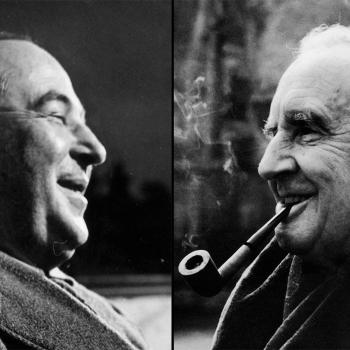
Very promising documentary on Lewis and Tolkien in...
TRENDING AT PATHEOS Catholic

Rejecting Doom: Christian Hope And Human Action
Christianity is a religion of hope. We are to have hope and...

It’s What Comes From Within Which Matters
One of the most difficult things for us to understand is why...

Why I Choose the Eucharist Over the Sermon
Choose the Eucharist, Not the Sermon What are we supposed to get...

5 Design Elements Found in Spiritually Rooted Homes
Putting Spirituality Into Home Decor Our homes are more than our living...

Credo: A Story of God Told with the...
About 10 years ago, I began to imagine a personal "Credo" that...

The Anatomy of Divine Revelation in Catholic Thought
The claim that God has made Himself known to human beings is...
view all Catholic blogs
Ad-Free & Subscriber Log-In Subscription Support
- About Us
- 2026 Calendar
- Videos
- Podcasts
- Library of World Religions
- Faith In Media Tracker
- Advertise With Us
- Write for Us
- Privacy Policy
- Terms of Service
- Do Not Sell My Data
- Contact Us
- Radiant Digital
- Manage Newsletter Subscriptions
- Unsubscribe From Notifications
- Sitemap
Copyright 2008-2026, Patheos. All rights reserved.
Subscription Support Ad-Free & Subscriber Log-In
Follow Patheos