
BuddhistCatholicContemplativeEvangelicalGeneral ChristianHinduJewishLatter-day SaintMuslimNew VisionsProgressive Christian
Beliefs
- Buddhist
- Catholic
- Contemplative
- Evangelical
- General Christian
- Hindu
- Jewish
- Latter-day Saint
- More Voices
- Muslim
- New Visions
- Pagan
- Progressive Christian
Topics
- Religion News
- Food and Religion
- Sports and Religion
- Religious Art
- Religious Music and Entertainment
- Religious Events
- History and Religion
- Style and Religion
- Politics and Religion
- Women in Religion
- Recreation Outdoors and Religion
- Business Finance and Religion
- Careers Workplace and Religion
- Education and Religion
- Family Parenting and Religion
- Health Fitness and Religion
- Home and Religion
- Relationships and Religion
- Technology and Religion
- Travel and Religion
Columnists
- Buddhist Columnists
- Business Finance and Religion Columnists
- Careers Workplace and Religion Columnists
- Catholic Columnists
- Contemplative Columnists
- Education and Religion Columnists
- Evangelists Columnists
- Family Parenting and Religion Columnists
- General Christian Columnists
- Health Fitness and Religion Columnists
- Hindu Columnists
- History and Religion Columnists
- Home and Religion Columnists
- Jewish Columnists
- More Voices Columnists
- Latter Day Columnists
- Muslim Columnists
- New Visions Columnists
- Nonreligious Columnists
- Pagan Columnists
- Politics and Religion Columnists
- Progressive Columnists
- Recreation Outdoors and Religion Columnists
- Relationships and Religion Columnists
- Religion News Columnists
- Religious Art Columnists
- Religious Events Columnists
- Religious Music and Entertainment Columnists
- Sports and Religion Columnists
- Style and Religion Columnists
- Technology and Religion Columnists
- Travel and Religion Columnists
- Women in Religion Columnists
Resource Library
- 2026 Calendar
- Library of World Religions
- The 100 Most Holy Places on Earth
- Patheos Answers
- Podcasts
- Videos
- Faith Leaders Database
- Anglican Episcopalian
- Bahai
- Baptist
- Buddhism
- Christianity
- Confucianism
- Eastern Orthodoxy
- Hinduism
- Holiness and Pentecostal
- ISKCON
- Islam
- Judaism
- Lutheran
- Methodist
- The Church of Jesus Christ of Latter-day Saints
- New Age
- Paganism
- Presbytarian and Reformed
- Protestantism
- Religion Behind the Scenes
- Roman Catholic
- Scientology
- Shia Islam
- Sikhism
- Sufism
- Sunni Islam
- Taoism
- Zen
- See all religions
Research Tools
 Ad-Free & Subscriber Log-In Subscription Support
Ad-Free & Subscriber Log-In Subscription Support
Follow Patheos 

- Trending:
- Forgiveness
- |
- Marriage
- |
- Consciousness
- |
- Death Penalty
- |
- Election
- |
- Halloween
 Mark D. Roberts
-
Publications
-
Series
- Advent Devotional Guide: Preparing for the Coming of Christ
- Ancient Ephesus and the New Testament
- Ash Wednesday: What Is Ash Wednesday? How Do We Observe It? Why Should We?
- Christmas According to Dickens
- Christmas Pictures
- Christopher Hitchens: My Response to god is not Great
- Christopher Hitchens: Our Three-Hour Debate
- Do Demons Exist?
- God at Work: A Review of the Book by David Miller
- God's Guidance for Christians in Conflict
- Handel's Messiah: An Unexpected Easter Masterpiece
- Harvard Ironies
- How Does God Guide Us?
- How Lent Can Make a Difference in Your Relationship with God
- Illegal Immigration: Seeking a Christian Perspective
- Introduction to Eastertide: The Season of Easter
- Introduction to the Christian Year
- Liturgical Year Chart
- Photos of Jerusalem
- Praying in the Name of Jesus
- Privacy and God
- Redeemer Presbyterian Church: Why Is It Thriving?
- Seeking the Peace of Christ: Christianity and Peacemaking
- Thanksgiving: Not Just a Day, But a Season
- The Birth of Jesus: Hype or History?
- The Colors of the Christian Year – Part of Series: Introduction to the Christian Year
- The End of the Presbyterian Church (U.S.A.)?
- The End of the Presbyterian Church (U.S.A.)? Revisited
- The Mission of God and the Missional Church
- The Piazza del Popolo in Rome and Its Augustan Obelisk
- The Seven Last Words of Christ: Reflections for Holy Week
- The Stations of the Cross: A Devotional Guide for Lent and Holy Week
- Thin Places
- Unmasking the Jesus Seminar
- VBS Fun: Vacation Bible School Skits
- Was Jesus Divine?
- Was Jesus Married? A Careful Look at the Real Evidence
- What is a Church?
- What is a Successful Worship Leader?
- What is Advent? An Introduction to Advent
- What is Pentecost? Why Does It Matter?
- What Language Did Jesus Speak? Why Does It Matter?
- What To Do If Someone Sins Against You: The Teaching of Jesus
- What Was the Message of Jesus?
- Why Did Jesus Have to Die?
- Why Don't We Pray for Business?
- Why Not Just Leave the PC(USA)?
- Home
- Evangelical
Praying in the Name of Jesus
Praying in the Name of Jesus:
What Is It? How Should We Do It?
Should We Do It When We Pray in Public, Civic Gatherings?
by Rev. Dr. Mark D. Roberts
Copyright © 2011 by Mark D. Roberts and Patheos.com
Note: You may download this resource at no cost, for personal use or for use in a Christian ministry, as long as you are not publishing it for sale. All I ask is that you acknowledge the source of this material: http://www.patheos.com/blogs/markdroberts/. For all other uses, please contact me at [email protected]. Thank you.
Praying “In Jesus’ Name” in Civic Gatherings: Introduction
Recently I was talking with a friend about praying in civic gatherings such as city council meetings or community luncheons. “When you pray in meetings like these,” he asked, “do you pray in the name of Jesus?”
“Yes,” I answered, “always. But not in the way you might be thinking.” I went on to explain how I pray in the name of Jesus when I’m asked to pray in public, non-religious contexts. So I thought it might be interesting to share my practice here.
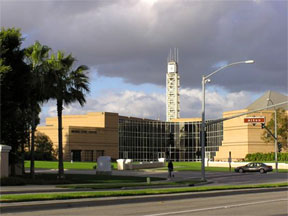 When I was Senior Pastor of Irvine Presbyterian Church, I was called upon occasionally to pray in civic contexts. Sometimes I prayed before Irvine City Council meetings. Sometimes I prayed at community luncheons sponsored by secular organizations. When it was my turn to pray, I always made a point of actually praying, that is, of speaking to God and not using prayer as a way of addressing those gathered. I also made an effort to be relatively short. You may be surprised (then again, you may not be surprised) to learn that many pastors did just the opposite. They used their “prayer” as an occasion to preach. And they often went on way too long. One organizer of a community event thanked me profusely for being prayerful and brief. I expect this might account for why I got invited to be the prayer giver at many civic events. (Photo: Irvine City Hall, where the City Council meets)
When I prayed in civic gatherings, I did not end my prayers with the words, “in Jesus’ name” or something similar. This really bugged a pastor friend of mine, who insisted adamantly that all civic prayer should mention Jesus, and that I was failing to honor Christ by my practice.
I, on the contrary, believe that saying the words “in Jesus’ name” in civic prayer gatherings is something about which Christians may rightly disagree. I don’t think there’s one right answer to this question. Some of us believe that we should say “in Jesus’ name” at the end of public prayers. We should do this, they argue, both to in obedience to Jesus and to help draw people to him. Other Christians prefer not to say “in Jesus’ name” at the end of their civic prayers, because they don’t want to offend people or because they want to be more inclusive of those gathered, many of whom may not be Christians.
I fall in the second camp, in that I don’t say “in Jesus’ name” when I pray in civic gatherings. Yet I still claim to pray in Jesus’ name. This requires some explanation. So, let me address two questions:
What does it mean to pray in the name of Jesus?
Why don’t I say “in Jesus’ name” at the end of a civic prayer?
I’ll take on the first question tomorrow.
What Does It Mean to Pray in the Name of Jesus?
In several passages from the Gospel of John, Jesus instructs us to pray in his name. For example:
“I will do whatever you ask in my name, so that the Father may be glorified in the Son. If in my name you ask me for anything, I will do it.” (John 14:13-14; see also 15:16; 16:23-24, 26)
This command has led many Christians to end their prayers with something like “in Jesus’ name” or “through Christ our Lord” before they say “Amen.”
I often end my prayers with “in Jesus’ name.” But when Jesus told us to pray in his name, he wasn’t talking about the words with which we end our prayers. Perhaps the clearest proof of this comes in the prayer we call The Lord’s Prayer, found in different versions in Matthew 6:9-13 and Luke 11:2-4. In neither of these exemplary prayers does Jesus end with “in my name” or something like that. In Luke 11, Jesus continues to teach about prayer, urging us to be persistent (vv. 5-8) and confident (vv. 9-13) when we pray. But nowhere does he say we should speak his name in order to get our prayers heard.
If praying in Jesus’s name is not saying “in Jesus’ name” at the end of the prayer, what is it? We get help in answering this question from other passages in which Jesus uses the phrase “in my name.” For example:
“Whoever welcomes one such child in my name welcomes me.” (Matt 18:5)
“Again, truly I tell you, if two of you agree on earth about anything you ask, it will be done for you by my Father in heaven. For where two or three are gathered in my name, I am there among them.” (Matt 18:19-20)
Neither of these passages has to do with saying the words “in Jesus’ name.” Rather, they’re about doing something under his authority, or as his representative. So, in Matthew 18:5, “in my name” means something like “Whoever welcomes one such child under my authority and representing me, welcomes me.” Matthew 18:19-20 is especially telling because verse 19 speaks of prayer, and verse 20 speaks of gathering in Jesus’ name, but not using his name as some sort of ending to a prayer.
 All Christians pray in Jesus’s name, and only in Jesus’ name, in that we approach God under the authority of Jesus and, if you will, by his permission and because of his effort on our behalf. We come before God’s throne of grace, not in our own merit, but in the merit of Jesus. I’m reminded of a time when I visited the U.S. Capitol in Washington as a guest of Congressman John Campbell. With him as my guide, I walked freely around the Capitol, entering many areas that were reserved only for members of Congress and their guests. I was welcome in that place, not because of who I was or because of anything I had done, but because I was there “in the name” of Congressman Campbell. So it is when we come before God in the name of Jesus. (Photo: The U.S Capitol in the spring.)
If we are to pray in Jesus’ name, then this means our prayers should reflect Jesus’ own values and purposes. Our prayers should be imbued with the kingdom agenda of Jesus. In order to pray “in Jesus’ name” in this particular sense, our minds and hearts must be shaped by Scripture. We must set aside times of quiet to attend to the still, small voice of the Spirit of Jesus. Ideally, when we pray in Jesus’ name, not only are we approaching God in the authority of Jesus, but also we are coming with Jesus’ own desires.
So, when I say that I always pray “in Jesus’ name,” I am saying, first of all, that I approach the Father only through Jesus, only through what he has done for me on the cross. I hope that my prayers are also consistent with his will, though I recognize that my own agenda can intrude into my prayers fairly easily. Yet my desire is to bring my prayers more and more in line with what Jesus desires.
Should Christians end their prayers with “in Jesus’ name”? It depends. If saying “in Jesus’ name” at the end of our prayers reminds us of whose invitation has allowed us to pray, then this is a fine practice. And if saying “in Jesus’ name” helps us seek Jesus’ own will when we pray, then we ought to say it often. But, if we think that saying “in Jesus’ name” is what it means to pray in his name, then we are missing the point. Moreover, if we believe, as I did when I was young, that “in Jesus’ name” is some sort of magic formula that ensures God will hear my prayers, then we might need to pray without these words, at least until our theology gets a tune up.
In conclusion, we can obey Jesus’ instruction about praying in his name without saying “in Jesus’ name” or some such phrase at the end of our prayers. This gives us the freedom, in our civic prayers, to say “in Jesus’ name” or not. Neither practice is more or less consistent with Jesus’ teaching on prayer.
Tomorrow I’ll explain why I don’t say “in Jesus’ name” when I’m praying in Jesus’s name in civic gatherings.
Why I Don’t Say “In Jesus’ Name” at the End of a Civic Prayer
When I have prayed in civic gatherings, such as city council meetings or community luncheons, I have ended my prayers by saying, simply, “Amen,” rather than saying what I’d say when leading prayer in church: “in Jesus’ name, Amen.” I realize that others have a different practice, and I respect their convictions even if I don’t share them. In this post I want to explain why I don’t say “in Jesus’ name” at the end of my civic prayers.
If you’ve read my last post, you have seen that Christians are not required to say “in Jesus’ name” at the end of our prayers. When Jesus teaches us to pray in his name, this is not about the words we say. Rather, it’s a call to pray in his authority and under his sovereignty. This means we are free to say “in Jesus’s name” or not.
When I have prayed in public, secular gatherings, I have not said “in Jesus’s name” because I knew that many of the people whom I was leading in prayer were not Christians. My goal was to include through my words as many people in the prayer as possible. I wanted all who had gathered to be able to pray with me, to join me in the “Amen” without hesitation. I didn’t want to leave some people out if I could help it.
Some Christians are reticent to mention the name of Jesus because they’re embarrassed about their faith. I can honestly say I don’t fall into this group, though there have been times in my life when I did. God help us not to be afraid of identifying with Jesus! After all, it was Jesus himself who said:
“Everyone therefore who acknowledges me before others, I also will acknowledge before my Father in heaven; but whoever denies me before others, I also will deny before my Father in heaven.” (Matthew 10:32-33)
Of course this passage was not addressing the issue at hand. Jesus wasn’t concerned here with whether or not his followers should say “in Jesus’ name” when they pray in public. But the sense of this passage does suggest that if one is motivated by embarrassment to omit the name of Jesus, in prayer or in any other communication, that person is skating on thin spiritual ice.
Ironically, it is my commitment to following Jesus that leads me to pray without saying “in Jesus’ name.” Jesus, after all, welcomed to himself those who hadn’t the faintest idea who he really was. They were drawn to his truth, his kindness, and his love. People did not flock to Jesus because he hammered them with religious language, but because he welcomed them with God’s own love. In this context he was able to speak of the truth of God’s kingdom and its implications for people, which included calling them to repentance.
I’m more than happy to talk with non-Christian folk about Jesus. In my experience, this sort of conversation happens best when I have welcomed people and have shown consideration for their convictions, feelings, and concerns. So, strangely enough, I don’t pray “in Jesus’s name” in civic gatherings precisely because I want to welcome people in Jesus’s name. I want to show the kind of consideration for people that Jesus demonstrated in his ministry.
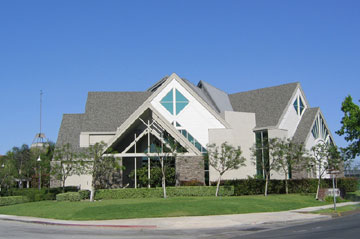 There are some public (or semi-public) settings in which I would mention the name of Jesus in prayer. I think of interfaith funerals, for example, where representatives of different faith traditions pray ways that are consistent with their own religious convictions. I have often performed weddings or funerals in settings where many of those in the congregation are not Christian. Yet those who asked me to officiate (the couple getting married or the family of the deceased) sought me out to do an explicitly Christian service. The people in the congregation expected me, as a Christian pastor, to speak and pray as a Christian. (Photo: The sanctuary of Irvine Presbyterian Church, where I performed dozens of weddings and funerals.)
Now you know why I don’t say “in Jesus’ name” when I pray in civic gatherings, and why I believe that, nevertheless, I am praying in Jesus’ name. I am not saying, however, that all Christians should do as I do. I believe that we have freedom in Christ to end our prayers in different ways, according to our sense of what it means for us to honor God.
Ad-Free & Subscriber Log-In Subscription Support
- About Us
- 2026 Calendar
- Videos
- Podcasts
- Library of World Religions
- Faith In Media Tracker
- Advertise With Us
- Write for Us
- Privacy Policy
- Terms of Service
- Do Not Sell My Data
- Contact Us
- Radiant Digital
- Manage Newsletter Subscriptions
- Unsubscribe From Notifications
- Sitemap
Copyright 2008-2026, Patheos. All rights reserved.
Subscription Support Ad-Free & Subscriber Log-In
Follow Patheos